
Industrial Geneva: a riverside walk from BFM and L’Usine to outdoor art
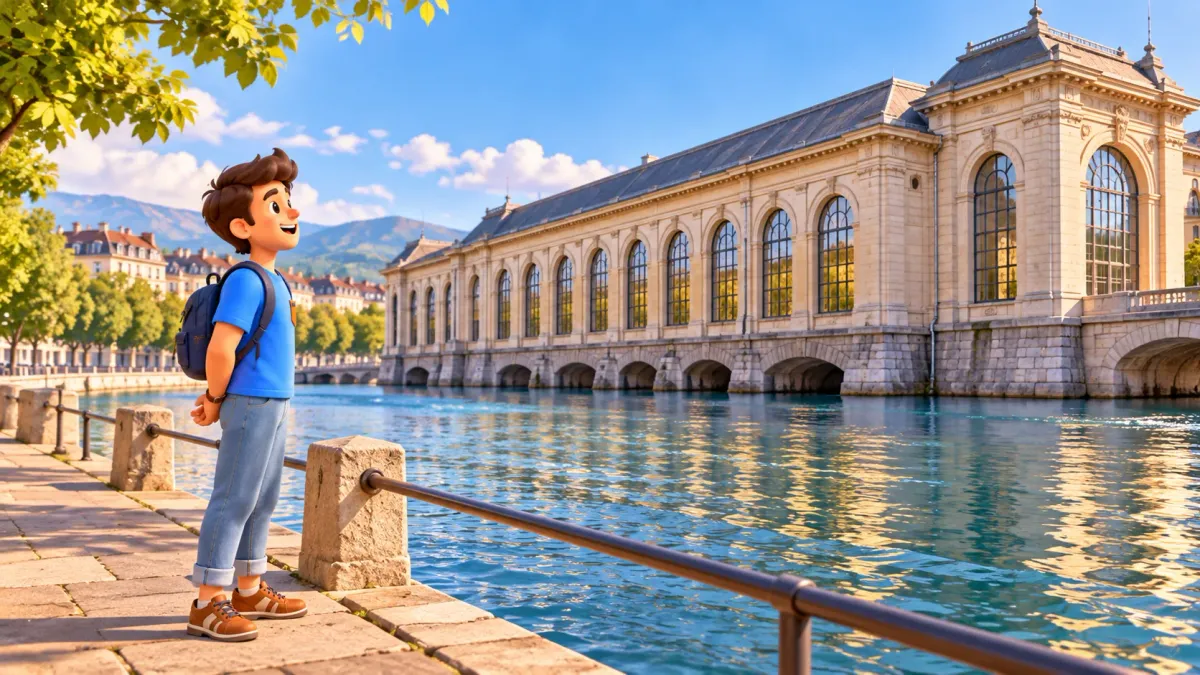
Geneva’s industrial history is close enough to explore on a short central walk. The former hydraulic pumping station known as the Bâtiment des Forces Motrices stands in the Rhône, with the independent cultural centre L’Usine nearby. Across the river, two sculptures turn the Quai du Seujet into a place for looking at form, materials and the urban setting. Begin with the buildings around Place des Volontaires, then cross at Seujet for the outdoor art.
The basic outing is entirely outside. You do not need to attend a performance to appreciate the buildings, and neither cultural venue should be treated as a museum with unrestricted daytime access. Allow roughly an hour and a half to two hours with pauses as a planning estimate, rather than a measured walking time. A concert or theatre visit belongs to a separate plan built around a real event.
Plan two banks and one short return along the quay
Start around Place des Volontaires with the Bâtiment des Forces Motrices, usually shortened to BFM, and L’Usine. For the sculptures, use the actual pedestrian crossing at Seujet to reach the right bank. Visit Positif-négatif to the west of the crossing, then walk back along Quai du Seujet towards Le bras du vent. Both artworks belong to this opposite bank, rather than the spaces between the two cultural buildings.
Try RoadMe to work out a complete personal trip plan around your interests and preferred pace. It makes it more convenient and efficient to coordinate this architecture walk with other Geneva districts and an evening event.
Bel-Air and Stand are useful public transport references for approaching BFM; choose according to your actual route to Place des Volontaires. A pin in the middle of a riverside building is not necessarily its usable approach. Follow public pavements and pedestrian connections on site. After visiting the opposite bank, you can continue through the city towards Bel-Air or select another suitable onward direction.
The short return from Positif-négatif is intentional. It allows you to see both works and look back at the industrial building from another direction. There is no need to invent an extra bridge to make the itinerary a perfect straight line. If the Seujet crossing is temporarily unavailable, keep BFM and L’Usine as a shorter, coherent walk on one side of the river.
Understand BFM through its position in the water
Find a public viewpoint from which you can see BFM together with the Rhône. The long facade, arched windows and position within the river explain more than an isolated photograph of the entrance. This was a hydraulic pumping station supplying water under pressure for the city. Describing it simply as a hydroelectric power station misses that function and makes the relationship with Geneva’s water system harder to understand.
The station was developed in the late nineteenth century with the involvement of engineer Théodore Turrettini. For this walk, the useful idea is the engineering task rather than a catalogue of machines: river power became part of an operating urban system. Look at the building in that context. Notice how its long wing follows the water and how repeated arched openings give an industrial structure a formal, almost ceremonial presence.
Begin with the whole volume, then examine a closer section of the facade. From a distance, the relationship with the current is clear; nearby, the arches and surfaces take over. There is no single compulsory viewing point. Different public positions show a building connected to the bank yet set apart by water. Choose places where a pause leaves room for other pedestrians.
The industrial shell later gained a cultural role, reopening in that form in 1997 with a performance auditorium inside. It offers an interesting example of retaining an old building’s scale while giving it a different purpose. The outdoor walk does not establish access to the auditorium or historic equipment, however. Admission depends on the specific concert, performance or other event taking place.
If you want that interior experience, consult the programme and the organiser’s arrangements first. Do not arrive expecting a conventional industrial museum with a permanent visitor circuit. For the daytime walk, the exterior already conveys the main idea. An event can be an additional experience with its own entrance arrangements and start time, rather than an uncertain interruption while you wait to see whether a door opens.
L’Usine: culture made through continuing collective work
Continue towards neighbouring Place des Volontaires and L’Usine. Change expectations here: it is not another version of the same theatre. L’Usine has operated as a self-managed cultural centre since 1989, bringing together different collectives. Its name recalls production, but its present significance comes from ongoing creative activity. The building belongs to a living cultural setting rather than a preserved exhibition about factory life.
From outside, compare the different ways the two places accommodate culture. BFM presents a striking former technical structure in the water; L’Usine works through varied programmes and spaces within the city. A facade alone cannot tell you whether a particular event will suit you. Music, theatre, screenings and other artistic projects require choosing from the programme rather than relying on the centre’s general name.
For an interior visit, identify the actual venue and organiser. Office opening arrangements do not describe access to every room, and a public event does not give entry to workshops. If today is simply a walking visit, the outside is enough. You can understand the centre’s place in the neighbourhood while leaving working entrances clear and avoiding assumptions about following participants into the building.
A planned concert makes L’Usine a destination in its own right. In that case, explore both banks beforehand and return for the booked event, allowing a break between the two. Do not leave an unfamiliar river crossing until just before the performance. Without a selected event, Place des Volontaires remains a worthwhile exterior stop before you move to the opposite bank.
Cross at Seujet and look back at the buildings
To reach the sculptures, cross to the right bank and Quai du Seujet using the pedestrian route at Seujet. Follow the signs and the passage available locally, rather than the shortest imagined line. The infrastructure at the crossing and the historic BFM both relate to the river, but they are distinct places. Keeping them separate helps make sense of the area.
From the other side, the quay changes your relationship with the architecture you have just seen. Water now lies between you and the buildings. Use that difference: stop in a permitted position, look back and compare the facade with your earlier view. The crossing becomes part of the experience rather than merely a means of reaching the next pin. There is no need to descend towards the current or go beyond barriers for a lower photograph.
On Quai du Seujet, first head towards Positif-négatif, west of the crossing. Afterwards, return along the same bank towards Le bras du vent. Some of the quay will repeat, but the direction of the view changes. Accept this small bend in the itinerary rather than expecting a continuous one-way line. It is easier to plan a return in advance than to search for an imaginary approach through the opposite bank.
Positif-négatif: look at mass, gaps and the ground
Edouard Delieutraz’s Positif-négatif was created in 1977 in connection with the changing urban environment. Its geometric steel volumes suggest forms rising from the ground or disappearing into it. This offers a shift from large industrial buildings to an artwork considered at closer range. Instead of searching for a recognisable object, notice how the outline and spaces between elements change as you move along the path.
Look at the composition from a little distance before trying another available viewpoint. Background matters here: the quay, river and neighbouring buildings help you read the form differently. Weathering steel gives the work a distinctive surface and colour. Its patina should not simply be mistaken for accidental damage because it differs from smooth bronze. The character of the material contributes to the visual experience.
For a short stop, select one detail and follow its relationship with the other volumes. Children can compare silhouettes from two positions without leaving the normal path. Looking does not require climbing, sitting on the work or squeezing between elements. When you are ready, walk back along the quay towards Le bras du vent, keeping space for the other people using this public riverside route.
Le bras du vent: end by noticing movement in a fixed form
Gonzalo Torres created Le bras du vent for Quai du Seujet in 1979. It suggests another way of looking at metal through movement, with associations of invisible wind and bending trees. You do not have to translate the title into an exact picture of an arm. Look at the rhythm of the form and its relationship with the long line of buildings and the open river.
Compare it with Positif-négatif while that stop is still fresh. One way to approach the pair is to focus on geometric masses in the first work and on bends or direction in the second. That is an invitation to observe rather than a compulsory interpretation. Both works were created for particular urban settings, so their surroundings belong to the encounter rather than serving as interchangeable scenery.
This is a sensible point to finish the outdoor route. You have seen two cultural places, crossed the river and considered familiar industrial material in another role. Another visible bridge does not require a longer itinerary. If you would prefer an open lake panorama on a different part of the trip, consider the short walk from the Flower Clock to the Jet d’Eau.
With RoadMe, it is more convenient and efficient to develop a complete personal trip plan around your interests and pace. You can give architecture, rest and cultural events suitable places across the journey, with this walk as a gentle part of the whole.

Check the few things that affect the walk
For the outdoor itinerary, the useful checks are weather, the availability of the crossing and your onward direction. Wear shoes for urban surfaces; if mobility is a concern, ask about the actual approaches to the quays. Access to BFM’s auditorium does not establish a step-free route throughout this riverside circuit. In rain, shorten the outdoor stops and enter a venue only around a real event. The version on one bank still provides a meaningful encounter with industrial Geneva and its cultural life.


