
Between Gare du Nord and Gare de l’Est: What to See in Two Hours

The streets between Gare du Nord and Gare de l’Est offer more than a quick station transfer. With two hours available for sightseeing, you can look at Saint-Vincent-de-Paul, step into the covered Saint-Quentin market, take a proper break and pass Saint-Laurent before finishing outside the next station. Railway architecture frames a short glimpse of everyday Paris.
The important distinction is between two hours for this walk and a two-hour train connection. The programme begins and ends on public forecourts. Getting off a train, reaching the street, arranging luggage and preparing for the next departure all need separate time. Choose the full walk only after those requirements leave a genuine two-hour window.
Choose a two-hour outing or a shorter station walk
Use RoadMe to build a complete personal trip plan around your dates, interests, pace and budget. Planning in the app makes it much more convenient to fit a neighbourhood walk and useful breaks into the wider journey.
The main direction is Gare du Nord → Saint-Vincent-de-Paul → Saint-Quentin market → Saint-Laurent → Gare de l’Est. Start on the southern Gare du Nord forecourt, by Esplanade Napoléon III and rue de Dunkerque. Finish on the southern Gare de l’Est forecourt at Place du 11 Novembre 1918. These outdoor reference points are separate from platforms, underground exits and departure terminals.
The selected street connections total about 1.53 kilometres. Allow roughly 1.5–2 kilometres with movement around the stops, and about thirty-five minutes for walking, crossings and orientation. These are map-based estimates for a manageable pace with light baggage, rather than measured walking times or a guarantee of a completely step-free route.
| Part of the outing | Full walk | Short walk |
|---|---|---|
| Gare du Nord exterior | 10 minutes | 5 minutes |
| All street connections and orientation | 35 minutes | 25 minutes |
| Saint-Vincent-de-Paul exterior | 15 minutes | Omitted |
| Saint-Quentin covered market | 20 minutes | 10 minutes |
| Pause | 20 minutes | 10 minutes |
| Saint-Laurent exterior | 10 minutes | 5 minutes |
| Gare de l’Est exterior | 10 minutes | 5 minutes |
| Total between forecourts | 120 minutes | 60 minutes |
Walking time is distributed between the stops, not a separate activity to complete after them. The short version leaves out Saint-Vincent and reaches the market more directly; its street connections cover about 1.14 kilometres. Neither version includes a full meal, prolonged shopping, baggage queues or boarding preparations.
Begin outside Gare du Nord, with the station behind you
Once you have reached the southern public forecourt, take ten minutes to look back at the building. The present station designed by Jacques-Ignace Hittorff opened in 1864. Its monumental stone architecture gives an ordinary departure point the presence of a civic building: compare the scale of its openings with the people moving below them.
This is an exterior introduction, not a tour through every station hall. Use a position that keeps entrances and passenger routes clear. A station photograph or address does not establish that every doorway is currently available, so follow the signs for the actual public exit and approach.
For the full walk, take boulevard de Denain towards rue La Fayette and continue to the lower part of Place Franz Liszt. This brings you to a street-level view of Saint-Vincent-de-Paul. The short walk heads towards Saint-Quentin without this western church detour, using rue de Saint-Quentin towards boulevard de Magenta.
Saint-Vincent-de-Paul: notice the church above the square
The building’s raised position is part of its effect. From the lower square, look at the two front towers and the monumental stairway leading towards the church. The composition has a different relationship with the street from the station you have just left: it draws the eye upwards rather than inviting a continuous flow of passengers.
Inaugurated in 1844, Saint-Vincent-de-Paul was designed by Jean-Baptiste Lepère and then Hittorff. That shared architect provides a small connection with Gare du Nord without requiring an extensive architectural lecture. Fifteen minutes are enough to appreciate the frontage and its setting from outside.
The exterior is the basis of this itinerary. The parish currently reports that the principal door is closed to protect the organ and that four lateral entrances are used. If you want a quiet look inside, follow the current visitor instructions to an available side entrance rather than expecting to enter through the main front door.
Published parish opening schedules differ, so confirm access for your date instead of relying on a single precise timetable. Services and ceremonies take priority. An interior visit, the stairway or a side-door detour can require extra time; the parish’s occasional hour-long guided visits belong to a separate programme.
Saint-Quentin market: a metal hall for everyday trade
Continue along rue des Petits Hôtels to boulevard de Magenta. The covered market’s useful address is 85 bis boulevard de Magenta. Enter through an open public doorway and keep the aisles clear. Looking around does not require a purchase, and twenty minutes allow a short discovery rather than a complete food tour.
The hall belongs to the 1860s and the nineteenth-century tradition of metal-framed markets. Look at the structure overhead, then at the way traders arrange their displays below it. The interesting contrast is between a durable public building and the changing products and daily activity it accommodates.
Choose two or three details: a connection in the frame, the rhythm of the supports and a view along an aisle. Let the architecture and working market carry the visit. You do not need a catalogue of stalls or menus, and a particular trader’s opening or meal service should not be assumed from the hall’s general hours.
As checked in October 2026, the municipal schedule is Tuesday–Saturday 8am–8pm; Sunday 8am–1.30pm; closed Monday. Tuesday–Saturday daytime gives the simplest market option. On Sunday, place this stop comfortably before 1.30pm. A late arrival or a closed hall calls for an exterior look and a different pause, or another day if the market is your main interest.
The city lists no public toilets at the market. Arrange that practical stop elsewhere rather than counting on the hall to provide every service. Carry any bags with you, leave room for customers and avoid stopping in the middle of a busy passage.
Make the pause part of the programme
Keep twenty minutes for rest in the full version. The market has a shared seating area intended for food and drinks bought from its traders. If that suits you, choose something modest and allow time for ordering; a vacant seat or immediate service is not guaranteed. A full lunch would lengthen the outing.
You can also choose another suitable available stopping place. Buying refreshments is optional, so the route does not depend on a named café being open. With a large case or tired children, the break may be more useful than another interior visit. Adjust the observations around it while preserving your train preparation time.
Plan the whole day in RoadMe according to the places you enjoy and the pace that suits you. A complete personal itinerary in the app makes it easier to organise walks, main visits and rest efficiently across the trip.
Saint-Laurent: read the layers from the public street
From the market, follow boulevard de Magenta southeast, then rue Saint-Laurent, boulevard de Strasbourg and rue Sibour. This public-street connection avoids depending on gates through Square Alban-Satragne. Use the marked crossings and look at Saint-Laurent from the public approach near rue Sibour.
The church has layers of different periods. It was rebuilt in the fifteenth century, while the present neo-Gothic front was installed between 1862 and 1865 by Constant-Dufeux, extending the nave in front of the earlier façade. The pointed forms you see at the front therefore also belong to nineteenth-century changes in the city.
Ten minutes outside are sufficient for this contrast with the railway buildings and market. The parish welcomes visitors, but its published opening information contains differences, particularly at the start of the day. This walk does not rely on a guaranteed early indoor stop or a round-the-clock opening.
Enter only if current conditions permit a quiet visit, and respect worship and instructions on site. The parish address, 119 bis rue du Faubourg Saint-Martin, helps identify the place; it does not guarantee access through a particular door. If entry is inconvenient, remain outside and keep the final connection straightforward.
Finish at Gare de l’Est before starting train preparations
Continue towards rue du 8 Mai 1945 and the southern forecourt on Place du 11 Novembre 1918. From the public space, notice the pale stone frontage, the broad semicircular glazed opening and its surrounding architectural frame. The station originated in 1849, from a project by architect François-Alexandre Duquesney and engineer Pierre Cabanel de Sermet.
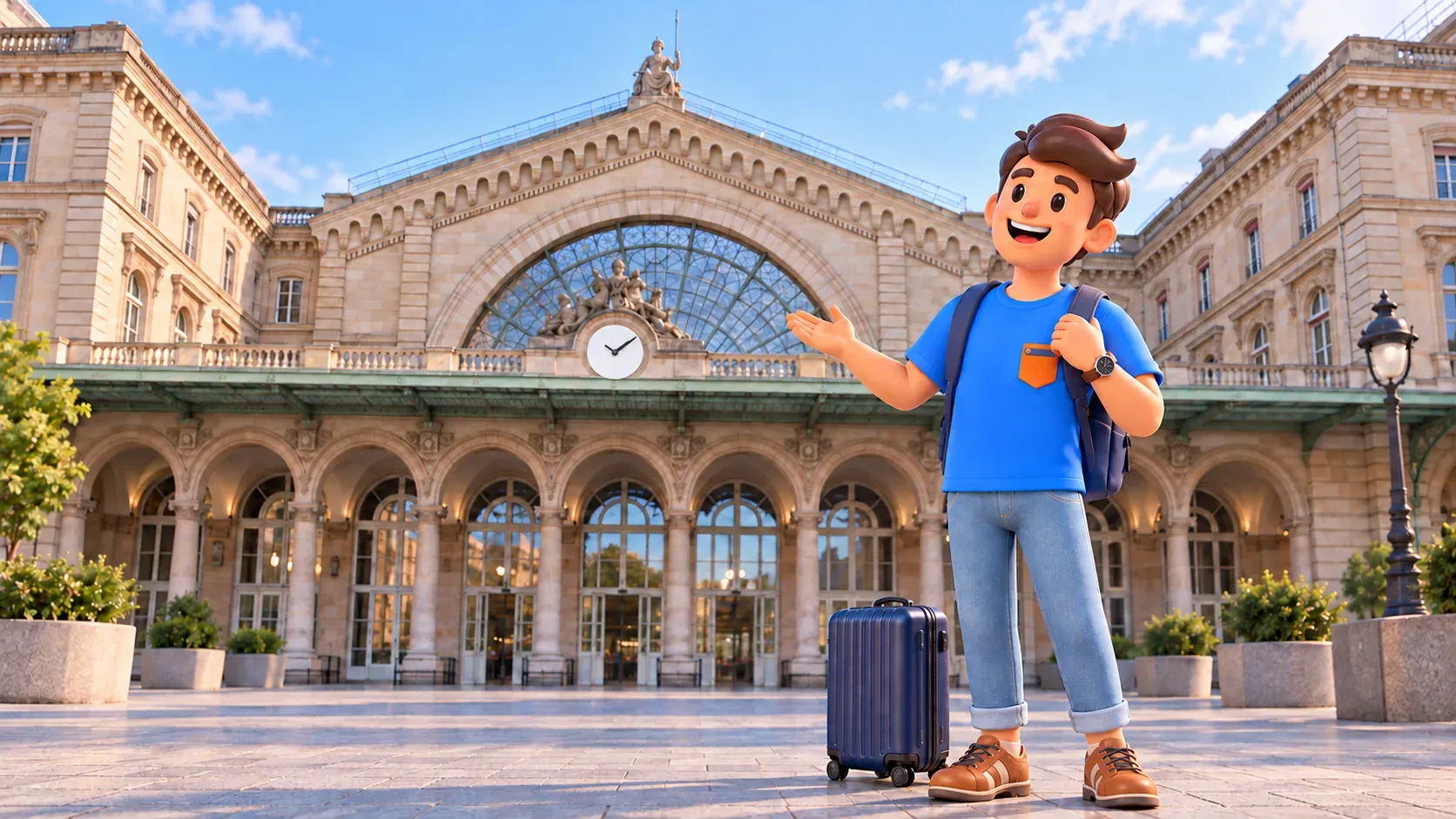
The ten-minute stop is a brief exterior finish. Choose the view available without blocking passengers, then turn to the actual departure hall if you have a train. The walk ends at the forecourt, so finding a platform or terminal is an additional task. Station buildings, luggage services and controlled boarding areas have different conditions.
Work backwards from the train and keep luggage in the right place
Begin with your departure time and the advance-arrival instructions on your current ticket. Subtract the required margin, baggage collection and navigation to the correct hall or terminal. That gives the latest time to finish outside the station. Subtract another 120 or 60 minutes to choose the walk’s latest start, after leaving the arrival platform and dealing with any bag deposit.
Use your actual arrival when deciding whether this window remains. Eurostar services to London involve different procedures from continental journeys, and other operators have their own boarding arrangements. A short boarding cutoff is not a sensible arrival target. There is no universal spare-time calculation that makes every two-hour connection suitable for sightseeing.
Gare du Nord has a staffed left-luggage service, while Gare de l’Est has lockers. Both require their own opening and availability checks; neither guarantees space. Allow for deposit, collection and possible queues. With a small bag that you can comfortably carry, storage may be unnecessary, but bulky luggage can make narrow aisles and church entry impractical.
If you leave bags at Nord and depart from Est, you must return to Nord to collect them. That return and collection are outside the walk’s allowance. Alternatively, depositing at Est before starting at Nord requires an initial transfer and deposit. Choose the direction and storage together so the itinerary finishes at your real departure station.
For a Nord departure, reverse the programme and check when the market stop now falls. With a tight connection, choose the direct transfer instead of either sightseeing version: the map estimate is roughly 625 metres between the selected forecourt points. The familiar rue d’Alsace option includes stairs or an escalator; check current equipment and assistance if needed.
On a separate day, our two-hour Canal Saint-Martin walk begins near Saint-Laurent and follows gardens and water towards République. Give it its own outing: it does not finish back at Gare de l’Est within those two hours.


