
Canal Saint-Martin in two hours: a relaxed waterside walk
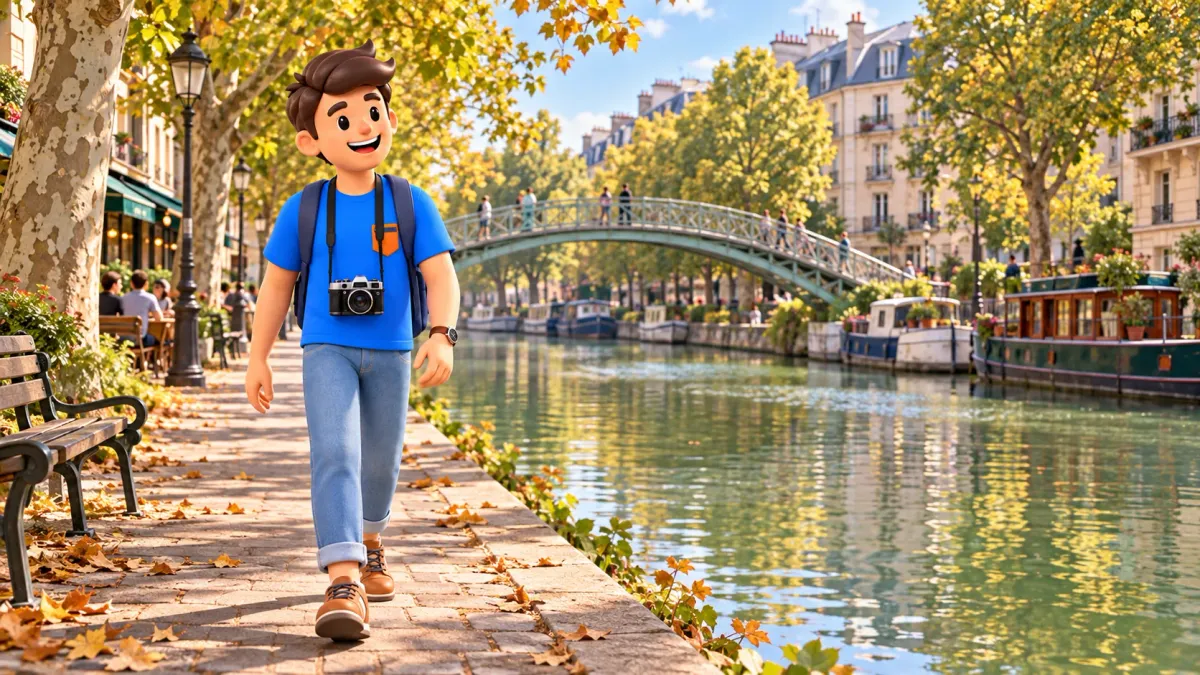
A Canal Saint-Martin walk works best when you leave room to stop. This two-hour route begins by Saint-Laurent church near Gare de l’Est, passes through Jardin Villemin, and follows the open canal south towards République. You get a church façade, a neighbourhood garden and time beside the water without turning the afternoon into a sequence of museum visits.
The basic walk needs no admission tickets. Church entry is optional, cafés are your choice, and watching a boat use a lock depends on traffic. The timings below are planning estimates, including pauses, rather than measured walking times. Allow roughly 1.5–2 kilometres, depending on your garden loop and final approach to République.
Choose a short canal walk with time to linger
Start outside Saint-Laurent on Rue du Faubourg Saint-Martin. Head east along Rue des Récollets towards Jardin Villemin, then reach the canal and follow Quai de Valmy south. Stay on this bank for the simplest version. At Rue du Faubourg du Temple, leave the water and turn west towards Place de la République.
This direction suits an arrival near Gare de l’Est and a finish closer to central Paris. If you start at République, you can reverse the route, but check the garden’s closing time first. Neither direction requires you to walk the whole canal. La Villette is a different, longer outing to the north; adding it would use up the time reserved here for sitting and looking.
For a walk shaped around your own interests and pace, try RoadMe: the app creates a personal two-hour route from your current location. It makes planning more convenient by bringing your choices into one itinerary, so you can spend more attention on the city around you.
Use the following schedule as a flexible outline. If you spend longer in the church or stop for a meal, shorten the final waterside section. A full restaurant lunch belongs outside the two-hour allowance.
| Elapsed time | Stage | What to do |
|---|---|---|
| 0–15 minutes | Saint-Laurent | Look at the façade; enter only if appropriate |
| 15–35 minutes | Rue des Récollets and Jardin Villemin | Walk into the garden and make a short loop |
| 35–45 minutes | Approach to the canal | Reach Quai de Valmy and turn south |
| 45–70 minutes | Canal and locks | Walk slowly and choose a viewing stop |
| 70–95 minutes | Waterside pause | Sit, have a drink or take photographs |
| 95–110 minutes | Lower open section | Continue towards Rue du Faubourg du Temple |
| 110–120 minutes | République | Leave the canal and finish by the square |
Begin at Saint-Laurent: a small lesson in changing Paris
Saint-Laurent provides a useful first stop because it makes the neighbourhood’s different ages visible. The church has a much older history, but the façade you see today is nineteenth-century neo-Gothic. Between 1862 and 1865, architect Simon-Claude Constant-Dufeux replaced the earlier façade and extended the nave as the surrounding streets were reshaped.
Look at the pointed openings and vertical lines, then at the broader urban space around them. The building’s front was adjusted to the new street alignment: its medieval-looking appearance is partly a response to modernising Paris. That contrast gives you something concrete to notice without needing a long architectural lecture.
For this itinerary, looking from outside is enough. The parish welcomes visitors, but the church is an active place of worship, and a service takes priority over sightseeing. If the door is open and a quiet visit is possible, allow a few minutes inside. Keep your voice low and avoid walking around taking pictures during worship.
Do not treat the church as a round-the-clock indoor stop. Published parish information contains differing morning opening times, so this walk does not rely on a precise early entry. A daytime start is easier to organise. If you want a detailed interior visit, check directly with the parish and give it its own time allowance.
Walk through Jardin Villemin before reaching the water
Continue along Rue des Récollets to the garden entrance at 14 Rue des Récollets. Its full municipal name is Jardin Villemin–Mahsa Jîna Amini; the shorter Jardin Villemin remains useful when recognising the place. This is a neighbourhood pause with lawns, winding paths, trees and a bandstand, rather than a formal garden that needs a prescribed tour.
Take one short loop, then choose whether to sit here or save the longer break for the canal. The garden occupies ground associated with the former military hospital, itself linked to the Récollets complex. Its name recalls Jean-Antoine Villemin, the military doctor who demonstrated that tuberculosis could be transmitted. A few lines of history are enough to change how you see this pocket of greenery.
For families, the play area may be the most useful stop. For someone carrying a camera, the paths and bandstand offer a change from street façades. If a child settles into playing, let the garden become the main pause and reduce the canal section. There is no need to make two long stops simply because both appear in the outline.
Garden hours are seasonal. As checked on 13 October 2026, the published schedule for 1–24 October is 8am–7.30pm on weekdays and 9am–7.30pm at weekends. From 25 October 2026 to 28 February 2027, closing moves to 5.45pm, with the same listed morning opening times. These dates matter if you reverse the route or walk late in the day.
If the gates are closed, continue along Rue des Récollets to the canal instead of looking for an unofficial entrance. The waterfront remains the core of the outing. Exceptional garden closures can occur during bad weather or works, so check the notice at the entrance.
Follow Quai de Valmy and read the working canal
Once you reach the water, turn south along Quai de Valmy. The canal is an engineered route, with locks and bridges controlling movement through a dense city. Completed in 1825, it belonged to the network developed to improve water supply and navigation. Its practical origins explain why the waterside scene feels different from a broad Seine panorama.
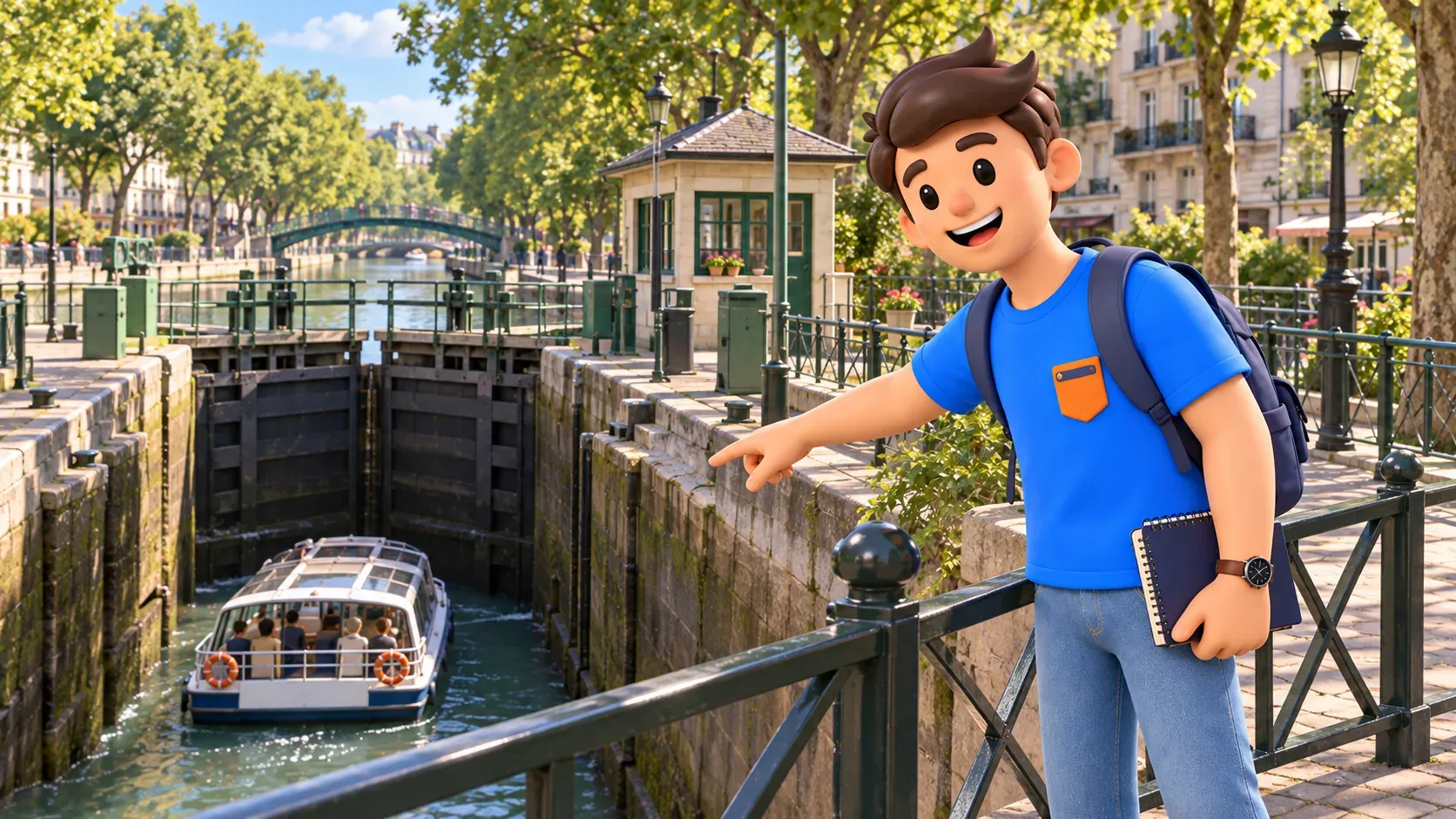
Choose one place to watch the water, rather than trying to inspect every bridge. At a lock, notice the enclosed chamber and the difference in water levels. When a boat passes, the gates and changing level make the system easier to understand. If nothing is moving, the shape of the lock still tells the story; you do not need to wait for a demonstration.
A boat passage is a possible extra, not a scheduled attraction included in this walk. Avoid building the whole afternoon around seeing one. The pedestrian bridges provide another point of interest: their raised profiles let people cross above the navigation channel, while the quay offers views from water level.
The basic route stays on the western bank. You may cross an available bridge for a different perspective, but steps and temporary restrictions can make this inconvenient. If you prefer to avoid stairways, remain on the quay and use street-level crossings only when necessary. This is a planning suggestion, not a guarantee that the complete route is step-free.
Make the pause part of the itinerary
Reserve around twenty to twenty-five minutes for doing very little. Find an available bench or suitable public seating, put the camera away for a moment and watch how the canal changes the pace of the streets. The water provides a clear direction for the walk, so you can stop without having to decide on the next attraction immediately.
A takeaway drink or a small snack is optional. Bring water and choose a café only when you want one; the route does not depend on a named business being open. If you sit at a table, account for ordering and payment as well as the drink itself. On a busy afternoon, the pause may take longer than the outline allows.
For photographs, try three different views: a bridge seen from the quay, a lock framed with surrounding buildings, and a quieter detail such as a reflection or tree shadow. Move to a position that leaves space for people passing. You can make an interesting set without crossing every bridge or walking right up to the edge.
Keep children close beside the water and use ordinary public seating rather than treating the canal edge as a bench. Take packaging with you if a bin is full. Swimming is not part of this itinerary: temporary supervised summer arrangements do not make the canal a place for unrestricted swimming.
Finish towards République instead of following the canal all day
Continue south towards Rue du Faubourg du Temple. This gives the walk a clear stopping point before the water’s covered continuation. The Saint-Martin Canal includes an underground section of about two kilometres; a pedestrian walk along the open banks does not provide access to that tunnel. Boat cruises are a separate activity with their own departures and duration.
At Rue du Faubourg du Temple, turn west for Place de la République. The final stretch changes the atmosphere from narrow water views to a broad public square. Finish here, or use the square as a meeting point before your next activity. Avoid adding Bastille merely because it lies farther along the canal’s overall route.
To fit a slower afternoon like this into a larger trip, you can use RoadMe to build a personal day-by-day plan around your dates, interests, pace and budget. Organising the trip in the app makes it easier to see how walks and main visits belong together, rather than arranging each stop separately.
If you have a booking after the walk, leave the canal earlier and allow a separate transfer margin. The two-hour estimate ends at the square; it does not include reaching another venue, entering a station or travelling across Paris.
Adjust the walk to weather, energy and available time
In warm weather, a morning start gives you more flexibility for choosing a shaded pause. Trees do not provide continuous shade along every section. In winter, favour daylight and take the garden’s earlier closing seriously. A cold or wet day is a good reason to shorten the open-air route and have a seated indoor break.
With only an hour, choose the garden approach and one section of Quai de Valmy, then turn back or leave by a nearby street. With more time, extend the pause or make a modest detour; a longer northern walk towards La Villette deserves a fresh plan. The most useful extra time here is often time spent staying still.
Canal-side redevelopment is ongoing in 2026, and the current municipal programme extends beyond that year. Follow signed diversions and keep crossings optional. Before setting out, confirm the garden hours for your date, choose which stop gets the longest pause and check where your next journey begins. Those three decisions are enough to make this a manageable two-hour walk.
For another short outing on a different day, try the two-hour Marais walk through squares, historic mansions and gardens.


