
Medieval towers of Florence: a walk through the city before the Renaissance
Florence before the Renaissance is still present in the central streets, but it rarely stands apart as an untouched medieval scene. Towerhouses survive inside later buildings, their stone bases and narrow vertical forms carrying traces of family status, defence, government and adaptation. Looking for those traces can change a familiar walk. Instead of waiting for another grand facade or museum entrance, you begin to notice a seam in a wall, a projecting stone support or an unexpectedly rounded building. The city’s earlier life becomes visible through details that ordinary movement often passes by.
Allow roughly ninety minutes to two hours after reaching Piazza Santa Elisabetta for a focused outdoor sequence: Pagliazza and the neighbouring Donati-Ricci tower, the Castagna and Cerchi area, then Buondelmonti towards Via delle Terme, with a modest pause. This is an editorial planning allowance, not a measured circuit or a promise that every upper estimate fits. The plan includes no tower climb or automatic interior access. Arrival from accommodation and the onward journey are separate. Choose a manageable number of observations and let the connections remain part of a living city rather than a race between isolated monuments.
Begin with what a towerhouse meant
A medieval tower could combine dwelling, refuge and a public sign of a family’s position. Height and strength mattered in a city shaped by rivalry, while the building remained connected to daily life and neighbouring properties. The familiar image of isolated defensive towers captures only part of that world. Wooden structures could extend from walls, houses could be linked, and later owners enlarged windows or merged volumes. A surviving tower is therefore not necessarily a complete, unaltered object. Its relationship with the adjoining street and building can be the most useful evidence of how it was used.
RoadMe makes the whole trip much more convenient to prepare: the app develops a personalised itinerary around your interests, dates and comfortable pace. Medieval streets, architecture, one museum on another part of the day and proper breaks can fit into a coherent plan, so less effort goes into arranging the sequence and more attention stays with Florence itself.
For this walk, look at three things: the overall shape, changes in material or openings, and the connection to neighbouring walls. You do not need specialist vocabulary to use those questions. They also stop the route becoming a catalogue of family names. A name locates the historical association, while the visible building tells a longer story of change. Stay with appropriate public positions and keep doors and circulation clear. Most of the value comes from looking carefully, not from expecting the tower itself to function as a museum or a viewing platform.
Pagliazza gives the route an unexpected beginning
At Piazza Santa Elisabetta, the Pagliazza tower stands out for its rounded form. That is a useful first contrast with the rectangular towerhouses more often associated with Florence. Archaeological investigation found an earlier curved Roman structure below, but the dating of the above-ground building has been discussed in different ways. A written record from 1268 already relates to its use as a women’s prison. The historical name recalls straw bedding. These layers make the site more interesting than assigning the whole visible form a single precise origin and leaving the story there.
Give the small square and the neighbouring Donati-Ricci observation around twenty to twenty-five minutes together as an initial allowance. Look at how the rounded masonry joins later walls rather than trying to see the tower as a freestanding object. Its later life included use as a church bell tower, further incorporation into surrounding buildings and twentieth-century restoration that made it visible again. Today it is part of a hotel complex. Public exterior observation is the basis of this walk; archaeological remains or hospitality spaces should not be assumed to be independently open simply because a tower appears on the route.
This first stop also sets a useful rule for interpretation. A Roman layer beneath a medieval use does not make every stone Roman, just as a present hotel does not erase the earlier prison. Several histories can occupy the same footprint. You can notice enough from outside to understand that principle without needing a complete excavation report. The rounded plan is your visual starting point. From here, the neighbouring rectangular forms will offer a different way to read height, consolidation and the later transformation of older property into a more comfortable city building.
Donati-Ricci shows how two towers became a changing house
The Donati-Ricci building brings together older neighbouring tower properties, one facing Via del Corso and the other related to the small square. The family names connect it with influential urban groups and the political world of late medieval Florence. The architectural question is how a severe vertical dwelling changed over time. Wider, more regular windows belong to later adaptation. Holes and projecting stone supports recall external wooden structures. Rather than reconstructing an entire lost gallery in your imagination with absolute certainty, notice the material clues that make such a different street arrangement conceivable.
Where the actual public approach permits, compare the faces towards the street and the square. A small change of position can explain more than a long list of dates. The building’s present mass was not simply designed as one uniform monument. It absorbed properties and needs. This is why a tower walk should look at adjoining fabric as well as the top. The earlier urban silhouette was changed by rebuilding, lowering and adaptation; what survives is valuable partly because it reveals those processes. You are reading a city that continued to live, not an abandoned medieval set.
At Castagna, connect the tower to city government
Move by a suitable current public route towards the San Martino area, counting the real connection rather than treating proximity as no walking time. Torre della Castagna adds a different role. In 1282 it was made available to the city’s priors, before the permanent government palace existed. The compact stone building therefore helps you think beyond family residence. Early civic authority also needed protected space and a degree of independence from powerful households. The nearby religious and residential fabric reminds you how closely different urban functions could sit together in a dense centre.
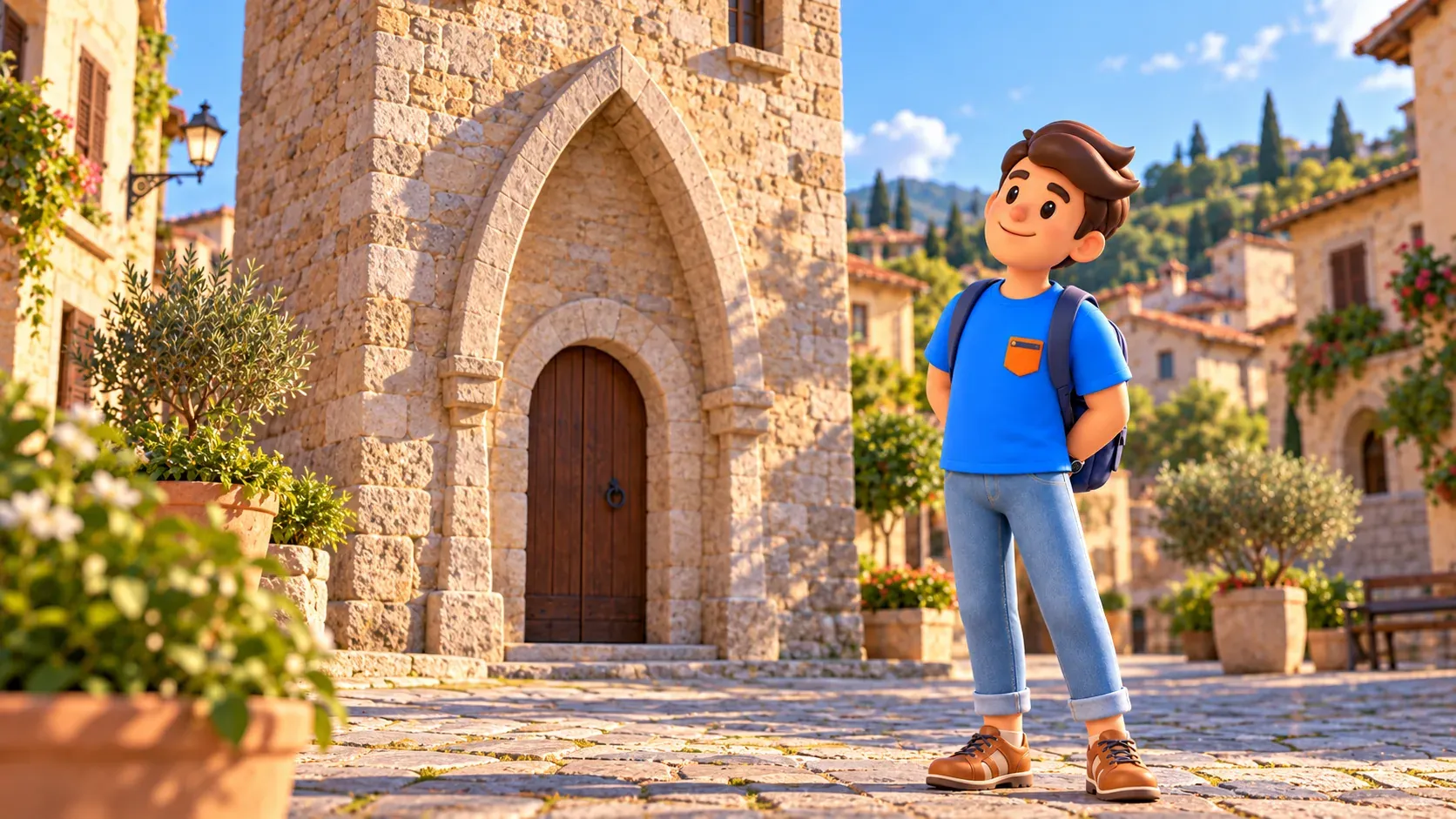
Allow roughly fifteen minutes for a selected exterior observation. Look at the doorway’s relationship between a higher pointed arch and a smaller opening within. A useful architectural detail can give the stop a clear focus without an interior. The tradition associating the name with chestnuts used as voting counters is a memorable part of the story, but it should not become the entire explanation of how government worked. The more substantial point is the movement from a small earlier seat towards the later monumental Palazzo Vecchio. A modest tower can reveal a stage of civic history that a famous palace alone does not show.
Cerchi makes the surrounding wall part of the subject
A short selected connection towards the Cerchi tower can add around ten minutes of observation with its immediate approach when practical. Follow actual public streets and identify the building from a current map. Here, the medieval core is absorbed into later development, with its vertical identity still readable. The lower stonework differs from upper portions shaped by later change. Look for the boundary between tower and neighbouring wall. This is a different kind of survival from an isolated tower rising on its own, and it is worth noticing precisely because it is less theatrically obvious.
The Cerchi family belongs to the political and social geography of medieval Florence, but the visible facade should not be expected to explain every alliance and conflict. Architecture gives the subject a material scale. You can imagine family position and close neighbourhood without reducing complex politics to a single rivalry. If you have already explored the Dante district, the streets may feel familiar; the purpose here is a different way of looking. The building is not only a biographical backdrop. Its physical adaptation shows how older structures survived by becoming useful inside later urban arrangements.
Finish with Buondelmonti’s stone and projecting supports
Continue towards the Buondelmonti tower on Via delle Terme using the actual public connection that suits the day. Reserve roughly fifteen to twenty minutes for a selected observation, in addition to the walking time between the areas. Its substantial stone fabric and vertical form make a good final comparison. Lower rustication, openings and projecting supports offer details to look for. Such supports and holes relate to an urban world with timber extensions and connections, rather than the entirely bare stone silhouettes often imagined when thinking about medieval streets today.
The family’s place in Florence’s history includes the traditional story of a broken marriage arrangement and conflict with the Amidei. It belongs to the familiar narrative about Guelph and Ghibelline division, but it is not an exhaustive explanation of complicated urban conflict. Keep the story in proportion to what the building can show. The tower itself has six levels and later connections to adjoining property. Its survival is not simply the preservation of an untouched family fortress. Like the other stops, it lets you recognise how a medieval form could continue inside a changing city.
From here, the most useful final comparison is among shapes and functions. Pagliazza’s curve, Donati-Ricci’s merged fabric, Castagna’s civic use and the more rectangular family towers do not all tell the same story. That diversity is why the walk works without climbing anything. You have looked at several ways height and masonry could serve the city, then seen how later generations altered them. A few clear relationships remain more memorable than a complete list of dates attached to every level of stone. Let the final stop give the sequence a conclusion before adding another district.
RoadMe is especially useful when you want a complete personalised trip rather than a checklist of tower addresses: your interests and pace determine how medieval history, art, neighbourhood walks and comfortable pauses fit across the days available. Prepare the itinerary beforehand and download the useful content for offline access, making it more convenient and effective to follow while exploring.
Choose a short version and keep the finish practical
For a shorter outing, stay with the Santa Elisabetta pair and the Castagna-Cerchi area, then pause and finish through a practical real connection. Roughly sixty to seventy-five minutes can be an initial framework for a modest selection, not a measured promise. The fuller ninety-minute-to-two-hour version adds Buondelmonti and more looking. Allow around fifteen to twenty-five minutes across the actual selected connections and about twenty minutes for rest; the upper ends of all observations and links can extend the outing. A full meal, museum or tower ascent requires separate time.

Do not automatically add the towers across the river, the city gates or a climb up Arnolfo’s tower. They answer different questions and can be worthwhile plans of their own. Urban surfaces and narrow streets also need an approach suited to your mobility and the weather. For a different architectural language in the same city, the Brunelleschi Renaissance walk offers another subject. Here, leave with a new habit: look at the joins, the openings and the changing stone. Medieval Florence becomes easier to recognise when you allow its later transformations to remain part of the story.


