
Across the IJ: Eye and A’DAM in three hours
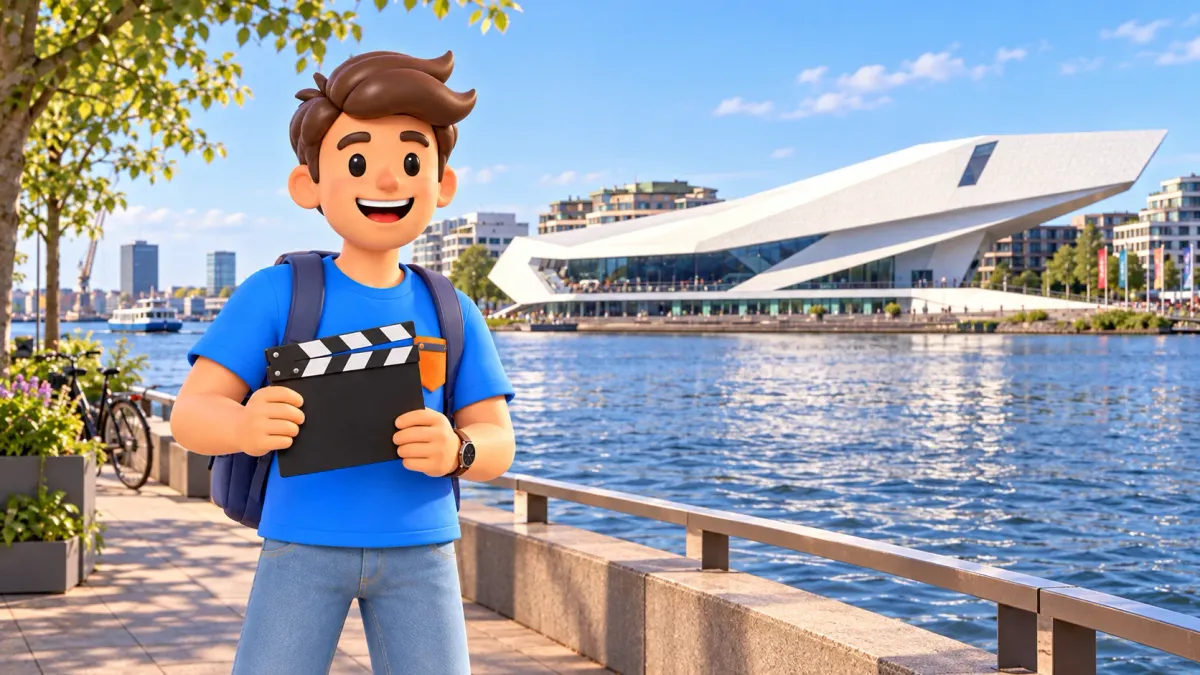
Crossing the IJ behind Amsterdam Centraal is a simple way to change the scale of a city visit. The close turns of the canals give way to wide water, a longer horizon and two neighbouring buildings with very different silhouettes: the white Eye Filmmuseum and the tall A’DAM Tower. Give this area its own part of the day if you want contemporary architecture and one substantial view from above.
This plan allows roughly three hours for the free F3 ferry, Eye’s exterior and a paid visit to A’DAM Lookout. An exhibition or a film screening is a different programme, with its own time and ticket arrangements. Below, you can also choose a shorter shore-only outing. Decide first whether the panorama or cinema is your main interest, rather than trying to collect everything simply because the buildings stand close together.
Choose what the three hours are for
The main version suits architecture and skyline interests. Start around 11am at the F3 departure point on the IJ side of Amsterdam Centraal and return to the station around 2pm. The programme includes crossing, waterfront, one viewing-platform visit and return. Add the journey from your accommodation separately: the suggested clock begins at the ferry departure area, not at your hotel or the station’s southern entrance.
RoadMe makes it much more convenient to get a personal walking or whole-trip plan around your interests, dates and pace. Tell the app whether cinema, contemporary architecture, skyline views or longer breaks matter most, then use a complete route it has worked out for your stay.
Allow about twenty minutes for waiting, crossing and approaching the waterfront; thirty for Eye outside and the promenade; ten to find the Lookout entrance; eighty for admission, ascent, views and descent; and forty for the shore and return ferry. These are planning estimates, not a measured track. Queues, temporary diversions or a longer stop may extend the outing. Change the next part of your day instead of treating the finish as a guaranteed appointment.
Lookout requires a ticket. Check the chosen product and entry arrangements before you travel, without assuming that every offer includes the swing, other attractions or a substantial meal. The panorama is the main paid experience in this version. If that does not interest you, remain by the water and make a shorter trip, rather than buying an activity merely to fill the interval between two ferry rides.
This is a compact part of Amsterdam-Noord, not a complete borough itinerary. NDSM is a separate destination rather than an extra stop just beyond these buildings. Our three-day Amsterdam itinerary gives it its own place in a longer visit. You can enjoy both northern areas during one stay, while respecting the different routes and time each deserves instead of joining them through the vague idea of being across the water.
Take the right ferry, not a canal cruise
At Centraal, follow signs towards IJzijde and the ferries. You need F3 to Buiksloterweg. Read the destination rather than boarding any vessel that happens to be departing. GVB lists this crossing as free and operating day and night. It is public transport across the IJ, not a sightseeing cruise around the canals, so it neither requires a cruise ticket nor supplies a guided explanation of the city’s landmarks.
The crossing itself takes only a few minutes, but the whole transfer is longer. Finding the departure point, waiting to board and walking on arrival also need time. That is what the first block allows for. Check current services for your date, especially if you have a train or timed event later. A short ride does not mean that every part of the journey can safely be compressed into five minutes.
After arrival, follow public paths along the waterfront towards Eye. The landmarks are close, but use available approaches. Eye warns that building works may affect access and advises following temporary yellow diversion signs. Allow for that before your ticketed visit. A small change of direction is more useful than an attempted shortcut through a closed area, and the walking estimates should remain flexible if local arrangements differ on the day.
Eye outside: find a changing frame
Eye Filmmuseum’s waterfront address is IJpromenade 1. Its white building opened here in 2012, designed by the Viennese practice Delugan Meissl Associated Architects. A short exterior stop needs no complete architectural lecture. Start with one observation: this long, low shape changes as you move. Roof, dark glazing and water take on different relationships, so the first broad view need not be the only one worth considering during the walk.
Look at the silhouette from an available public part of the promenade, then approach as the route allows. Choose a contrast: pale surface and dark glass, an angled line and the water’s horizon, or the large structure and people nearby. You do not need an inventory of components. A single comparison gives contemporary architecture something concrete to offer even if you have never studied a project description or planned to learn professional design terminology.
Cinema suggests a playful way of looking: choose a wide shot, then a middle view and a small fragment, without necessarily photographing all three. This is an activity for the walk, not an explanation of every intention behind the design. With children, different people can select a roof line, a reflection or an unusual shape. Compare the choices briefly, then decide whether the next part should be the skyline or a longer museum visit.
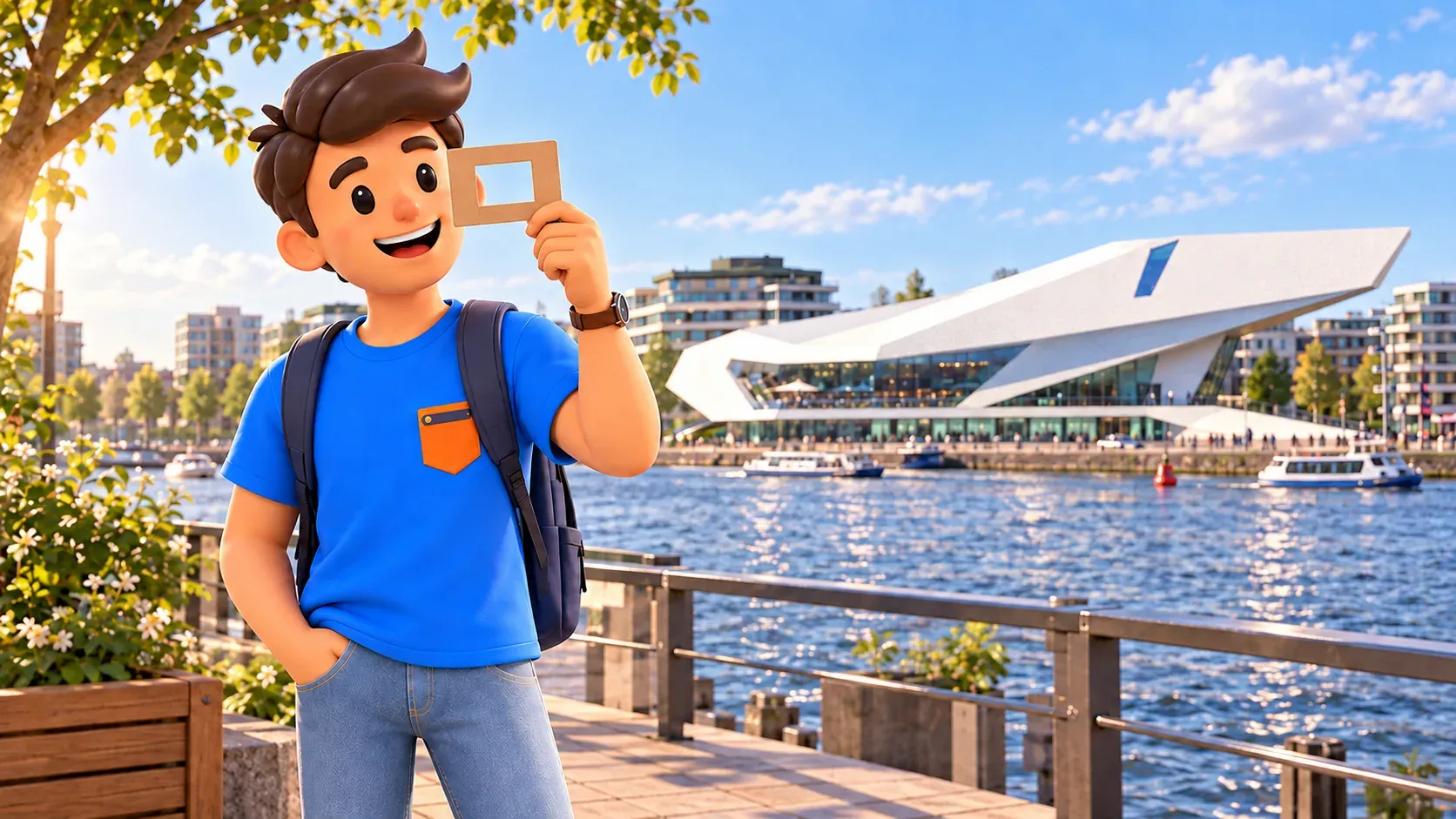
Eye has exhibitions and film screenings, but seeing the exterior is not a visit to its collections. Do not confuse the waterfront museum with the Collection Centre at Asterweg 26. That is a different location with different functions and access arrangements. This plan uses the white building by the IJ. The distinction matters when searching a map, where related museum names can suggest that every part belongs to one visitor building near the ferry landing.
A’DAM Lookout: make the panorama meaningful
After Eye outside, find A’DAM Lookout’s entrance on the waterfront opposite the museum. The operator’s current visitor information gives IJpromenade 4. Use local Lookout signs too, rather than treating every entrance to the tower as interchangeable. Different venues and spaces occupy the building and have their own arrangements. The ten-minute transition includes calm orientation as well as the short walk, so you can arrive at the intended entrance without rushing.
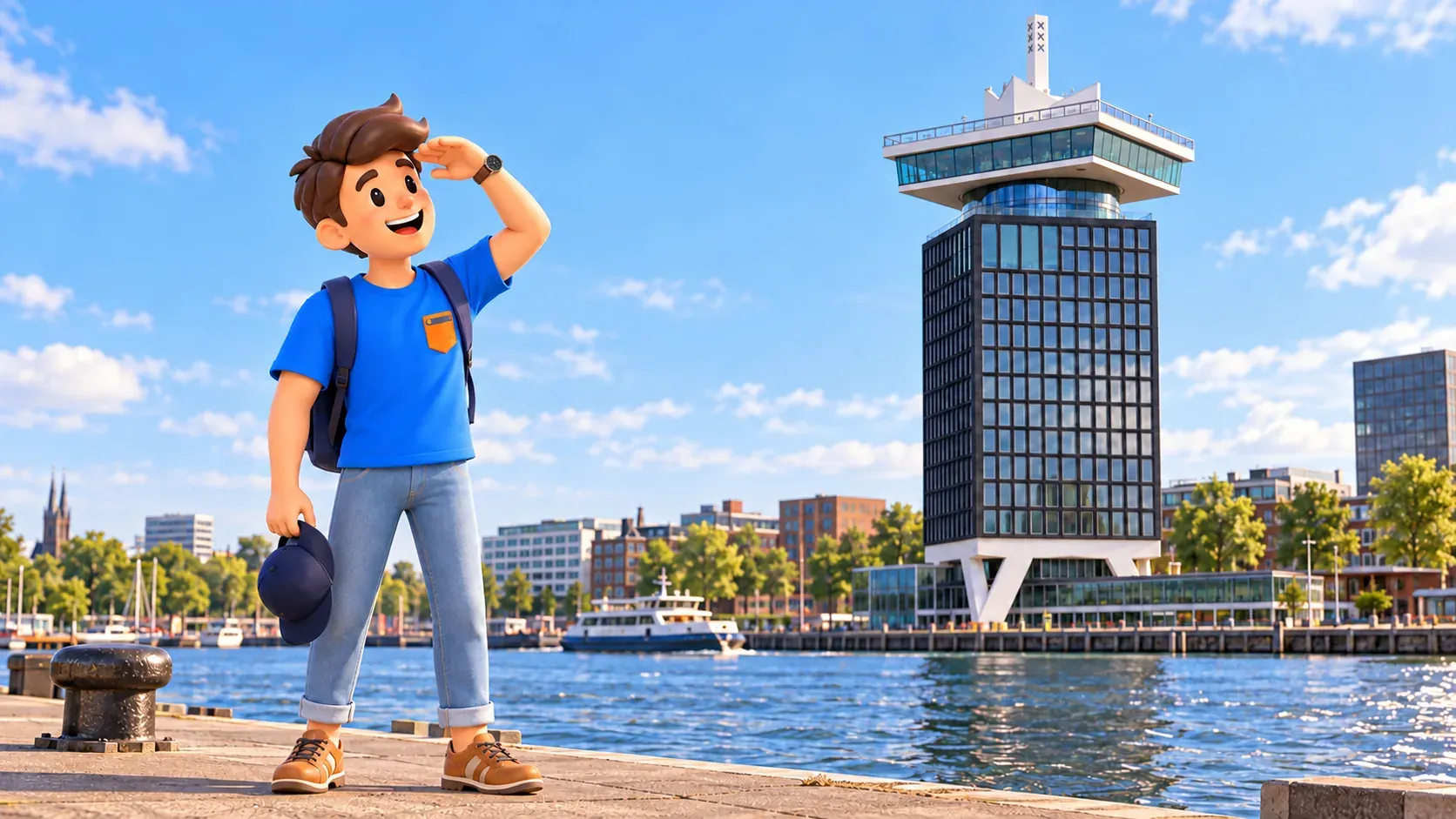
Before ascending, compare the neighbouring buildings from ground level. Eye stretches along the shore while the dark tower directs your gaze upwards. Its window grid and projecting upper section make the contrast easy to see without technical terms. This prepares the next experience: first you look at the structure from the city, then at the city from the structure. Those two views belong together, even if a skyline photograph originally prompted the visit.
Lookout has an indoor observation area and an open-air deck with an all-round panorama. Ordinary published hours are daily 10am–10pm, with last admission at 9pm. Check date-specific changes rather than relying on this pattern for every holiday or event. The hours also do not automatically describe the restaurants or other floors in the tower. For the suggested daytime outing, the main question is whether your chosen admission fits the time you have allowed.
The eighty-minute block includes admission, ascent, looking around and descent. It is a suggested time budget, not a fixed ticket duration or a guarantee of immediate entry. Begin by finding the broad IJ and Centraal on the opposite bank. Then look at the denser city beyond. The panorama can answer a simple question: where did you just cross to, and how does this shore relate to the centre you already experienced at street level?
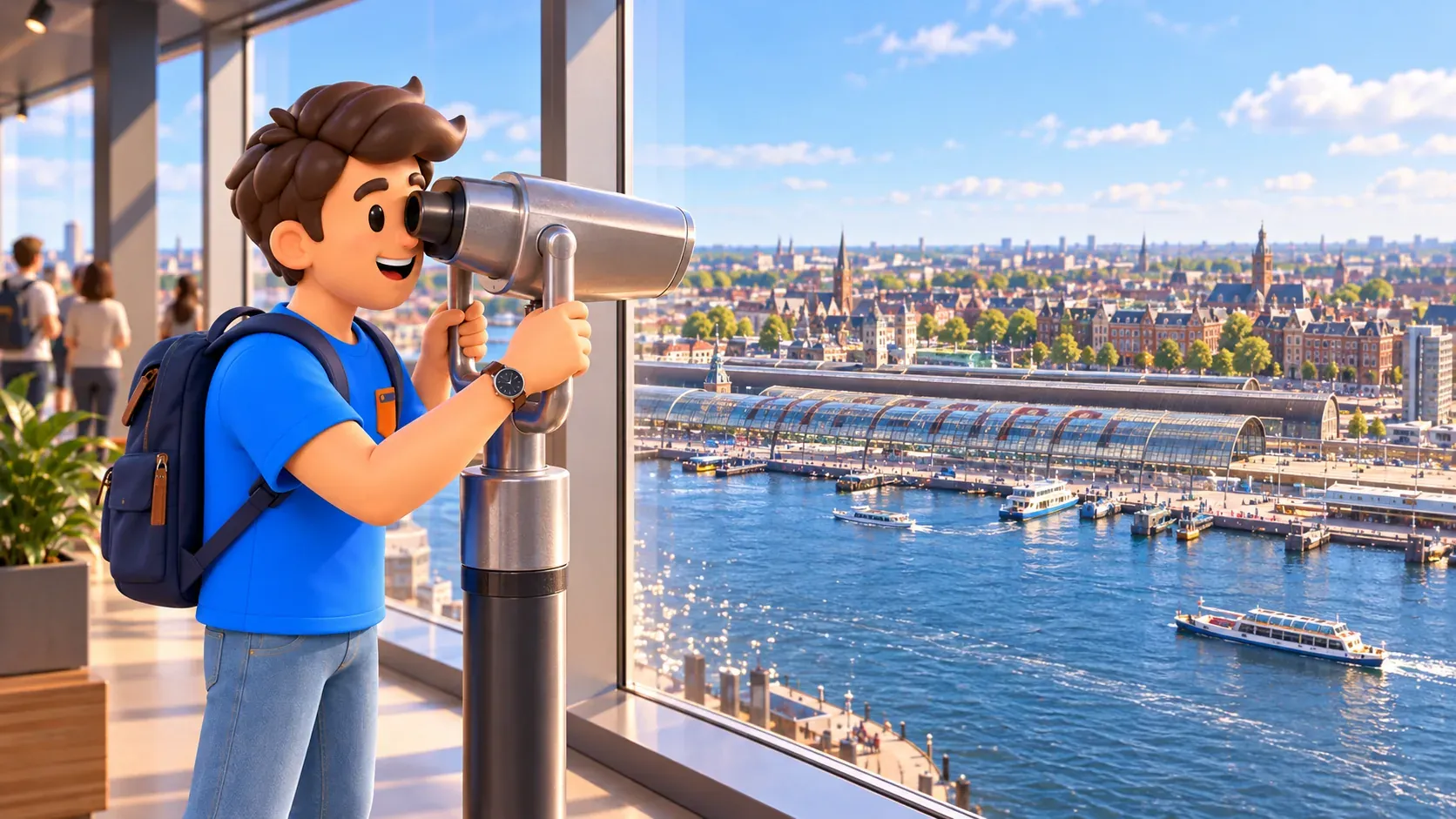
Do not try to name every tower or roof. Pick two or three reference points and compare larger forms: water, railway, older streets and more open spaces. That overall pattern gives the height a purpose. Cloud and rain change the experience, and distant visibility can be limited. An indoor deck provides shelter but does not make the horizon automatically clear. Decide whether the view you are likely to have suits your reasons for paying to go up.
The Over the Edge swing is an additional activity, not a requirement for a successful visit. If it interests you, check inclusion in your chosen ticket and the current conditions beforehand. This route works without it. If some people want another attraction while others only want the view, agree on the arrangement first. That prevents a shared walk from becoming an unexpected wait without a clear meeting time after the main panorama.
If you want to combine the lookout, film museum and other city areas, RoadMe can prepare a personal trip plan around your interests and available time. Using a fully worked-out route in the app is much easier than repeatedly connecting ferries, ticketed visits and breaks from separate recommendations.
When cinema deserves the main visit
If film is your priority, make Eye the principal visit and leave the tower as an exterior landmark or move its ascent to another time. Exhibition, screening and building architecture are different experiences. Choose a substantial activity from the museum’s programme and give it its own block, adding the crossing and shore around it. A full film and exhibition alongside Lookout will make a longer half-day programme, dependent on the screening’s actual start.
Eye’s ordinary published exhibition hours are Tuesday–Sunday, 10am–7pm. Outside official Dutch school holidays, the exhibition is closed on Mondays and the box office and restaurant open at 6pm. During those school holidays, the museum opens at 10am including the exhibition. Exhibition areas may also close between shows for installation. A spontaneous Monday daytime museum visit therefore needs a date and programme check, rather than an assumption that a daily exterior walk implies daily gallery access.
Check the film’s language and subtitles for the particular screening. An international title on a programme does not guarantee that everyone in your party will follow it comfortably. If interests differ, share the waterfront and organise the cinema separately with a clear meeting place afterwards. That can be more enjoyable than persuading everyone to spend a long time in a screening solely because the building stands conveniently near the ferry you already chose.
Return with a little room left
After Lookout, the plan leaves about forty minutes for a brief shore pause, the walk to Buiksloterweg, waiting and the F3 return. Do not automatically use all of that allowance for shopping or a café if something in the centre has a fixed start. Assess the current approach and ferry service first. Returning to the same station is convenient, but the onward walk to a tram, platform or restaurant still needs a separate allowance.
If you decide against the ascent, keep the two exterior silhouettes and the water, returning earlier. In rain or strong wind, shorten exposed stops; for a proper indoor alternative, check admission and access before changing the programme. Assess surfaces, steps and lifts against your needs: the complete route has not been checked as step-free. Let the northern shore add a new view of Amsterdam while leaving energy for the rest of the day.


