
Domènech i Montaner’s Barcelona: music, medicine and Modernisme
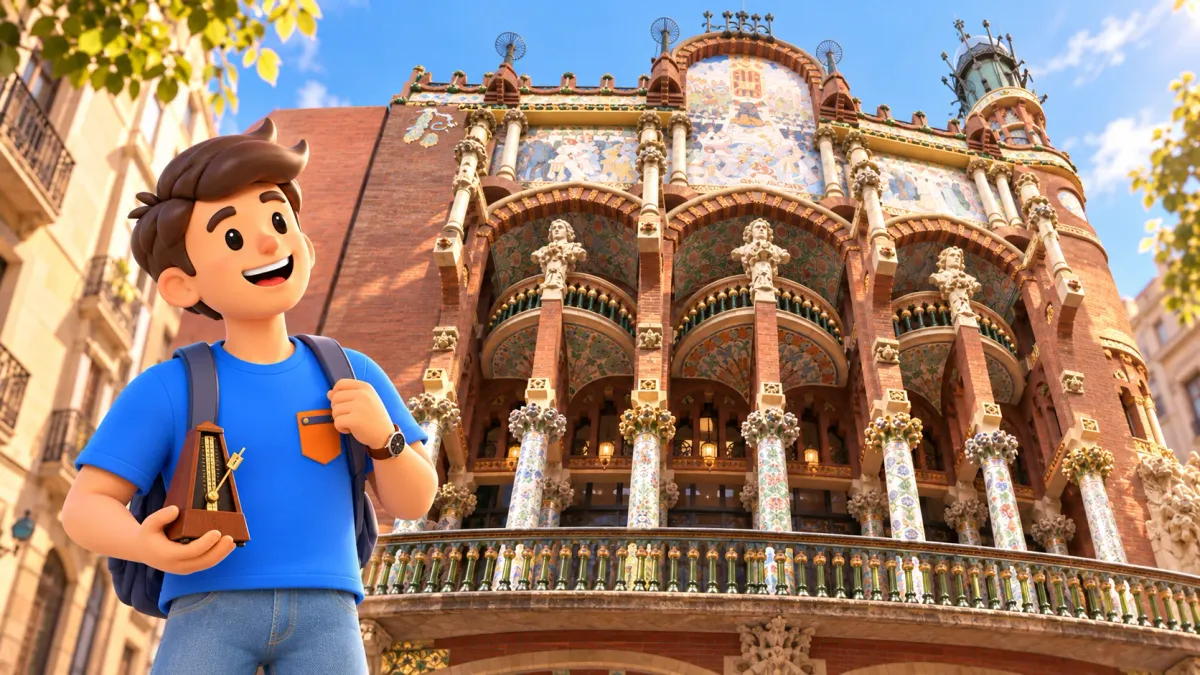
A glass sun draws your eyes upwards at the Palau de la Música Catalana. At Sant Pau, the same instinct to look around takes you out between separate pavilions and gardens. Visiting both gives you a rewarding introduction to Lluís Domènech i Montaner through two public purposes: making music and caring for people. Flowers, coloured surfaces and daylight connect the buildings, while their organisation tells very different stories.
Allow about five hours and fifteen minutes, from 09:30 to 14:45. Start at the Palau, Carrer del Palau de la Música, 4–6, and finish outside the historic Sant Pau entrance at Sant Antoni Maria Claret, 167. This plan includes two paid self-guided visits, a transfer and lunch. Your journey back to your accommodation and any evening performance are additional.
Two interiors, with space between them
Build the morning around an actually available 10:00 self-guided Palau slot. Arrive at 09:30 for the exterior, the entrance instructions on your ticket and admission formalities. Allow until 11:00 inside and on departure. The operator describes the self-guided visit as roughly fifty to fifty-five minutes; our one-hour allowance includes a small exit buffer.
Use 11:00–12:00 to reach the historic Sant Pau area, then 12:00–13:00 for lunch nearby. Spend 13:00–14:30 on a selective, unhurried visit, followed by fifteen minutes to pause and leave. Sant Pau lists its standard self-guided visit at forty-five to sixty minutes. The ninety minutes here are our planning estimate for a slower look, rather than an advertised tour duration.
To fit this architectural day into a trip shaped around your interests, try RoadMe: the app develops a personal day-by-day plan using your dates, pace and budget. It makes the complete itinerary more convenient to use, bringing substantial visits and time to rest into one programme.
These are estimates, not timings measured on location. Check actual admissions and your transfer before buying. If the available Palau slot starts later, move the whole programme rather than squeezing lunch or the space between buildings. The five-hour-and-fifteen-minute outline covers these two places; inserting another museum changes the day.
At the Palau, choose a visit rather than a concert
The format used here is a self-guided visit with a digital information brochure. That is not an audio guide or a live guided tour. At the check on 17 October 2026, the brochure was advertised in seventeen languages, including English, French, German, Spanish and Russian. Read the particular product before paying, since other formats may have different languages and inclusions.
The Palau remains a working concert venue. An architectural visit does not include a performance, and a concert ticket does not grant a free tour of all the rooms. Do not expect an organ recital or permission to walk onto the stage during this self-guided visit. If hearing music matters to you, choose a separate performance and leave time to return comfortably.
Normal tourist visiting hours are 09:00–15:30, subject to available sessions. Longer box-office or café hours do not extend access to the concert hall. The venue's programme can affect which spaces are open, and visitors arriving after their visit has started are not admitted. Saving an electronic ticket does not remove the reason to arrive early.
A home for collective music
Domènech i Montaner built the Palau in 1905–1908 for the Orfeó Català choral society, with construction financed through public subscription. That background gives the elaborate decoration a social setting. This was a place where people gathered to sing and listen, rather than a private drawing room enlarged for visitors. Start with the activity the building supported before examining every ornament.
From the street, brickwork, sculpture and mosaic-covered columns make a richly layered surface. Choose one recurring element, perhaps a flower or a shift from stone to coloured tile. Follow it indoors instead of trying to identify every figure immediately. A small question carried from the façade into the building makes the visit more coherent than a long checklist of details.
In the concert hall, look at the central stained-glass skylight, with its warm centre and downward-projecting form suggesting a sun. Then move your attention towards the side glazing and the organ above the stage. Daylight is part of the room's overall design, not merely a spotlight on one famous feature. The steel frame helped open up the interior and give glass an important architectural role.
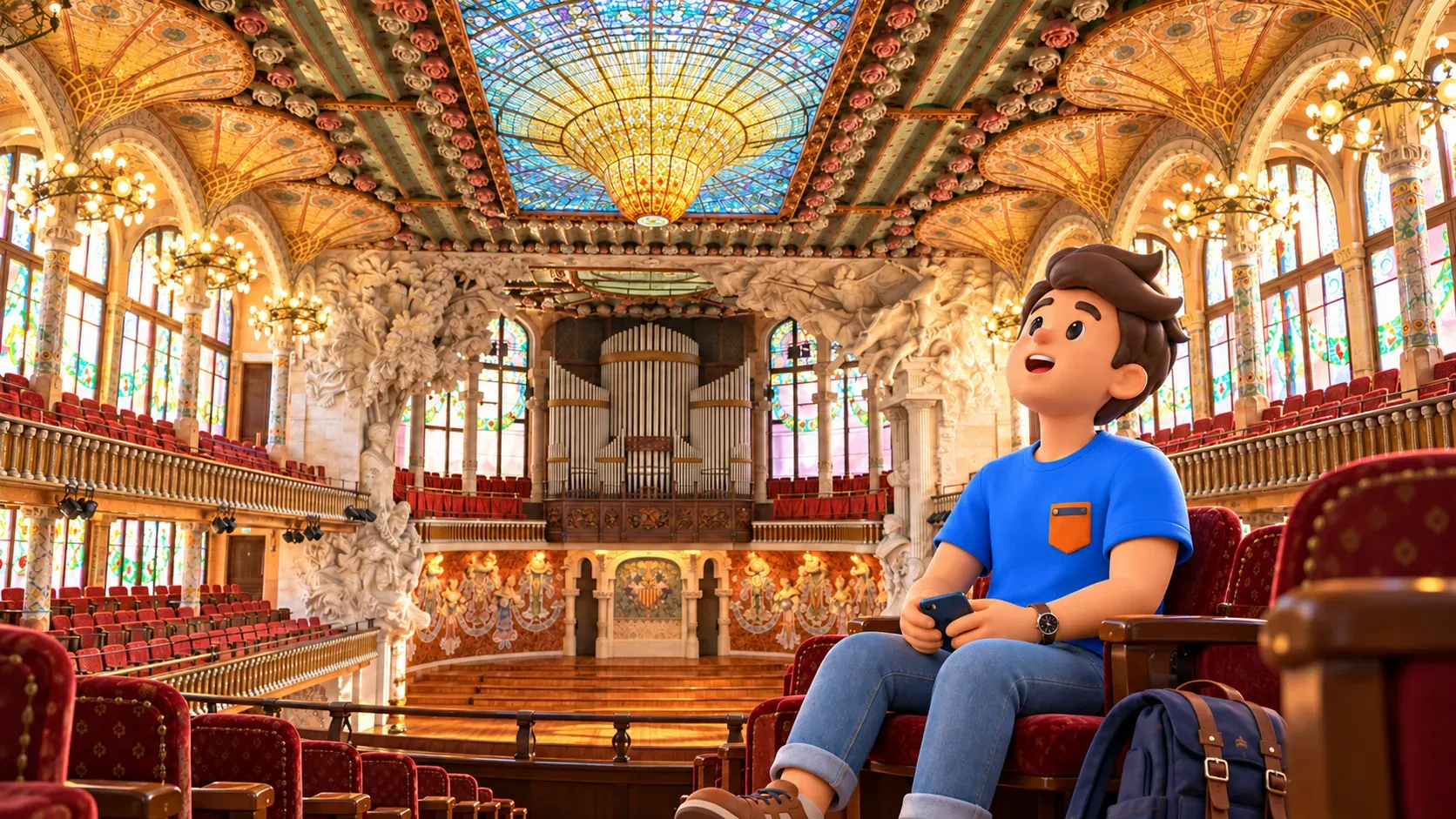
The skylight is associated with the work of Antoni Rigalt i Blanch, while Lluís Bru contributed mosaics; other artists and craftspeople also shaped the building. The architect's name gathers those contributions together without replacing them. Notice how a flat coloured surface meets a sculpture, or how glass and ceramic produce different kinds of brightness. That interaction makes Modernisme tangible.
If the day's accessible route includes the Lluís Millet Hall and its mosaic columns, allow a few quiet minutes there. After the larger concert room, the scale of circulation and conversation changes. Follow the staff's instructions and the spaces actually open. You do not need access to a closed room to understand the relationship between the building's public purpose and its decorative richness.
Keep an hour for the transfer and an hour for lunch
The Palau stands in the historic centre; Sant Pau lies substantially further north. They are not neighbouring buildings linked by a short doorway-to-doorway stroll. The 11:00–12:00 allowance covers leaving, walking to transport, waiting and reaching the correct entrance area. Choose public transport using the operator's current journey information, or assess a taxi journey. An hour is a planning margin, not a guaranteed travel time.
Set your destination as the Recinte Modernista de Sant Pau at Sant Antoni Maria Claret, 167. The present-day hospital operates north of the historic buildings; its entrance is not the tourist entrance. Choose somewhere to eat near the historic frontage and check its opening hours in advance. A restaurant discovered on the way should not become a fixed promise of quick service.
Lunch also provides a useful change of attention after the concert hall. Sit down, put away your screen and let the morning settle. Choose a meal that fits your appetite and available time rather than adding a separate food expedition. If the transfer takes longer than expected, reassess admission arrangements and optional stops instead of turning the hospital visit into a race.
Sant Pau: a hospital conceived as a system
The institution's history reaches back to the medieval Hospital de la Santa Creu in the Raval, but these Modernista buildings are not medieval. A bequest from the Paris-based banker Pau Gil helped make the new project possible. Construction began in 1902. Domènech i Montaner planned separate pavilions, gardens and underground connections in response to contemporary ideas about hygiene and the organisation of care.
The work extended beyond a single building campaign. The architect's son, Pere Domènech i Roura, completed the project, and the complex was inaugurated in 1930. In 2009, healthcare activity moved into new buildings to the north, allowing restoration and new uses for the historic site. Cultural visits now coexist with organisations and knowledge-related activity. The entire collection of pavilions is not a continuously open museum.
The Palau and Sant Pau were jointly inscribed on the UNESCO World Heritage List in 1997. Comparing their functions gives that pairing substance: one gathers listeners into a shared room, while the other distributes activities among buildings. Their common authorship becomes clearer through that difference than through a simple resemblance between colourful façades.
Three observations instead of every room
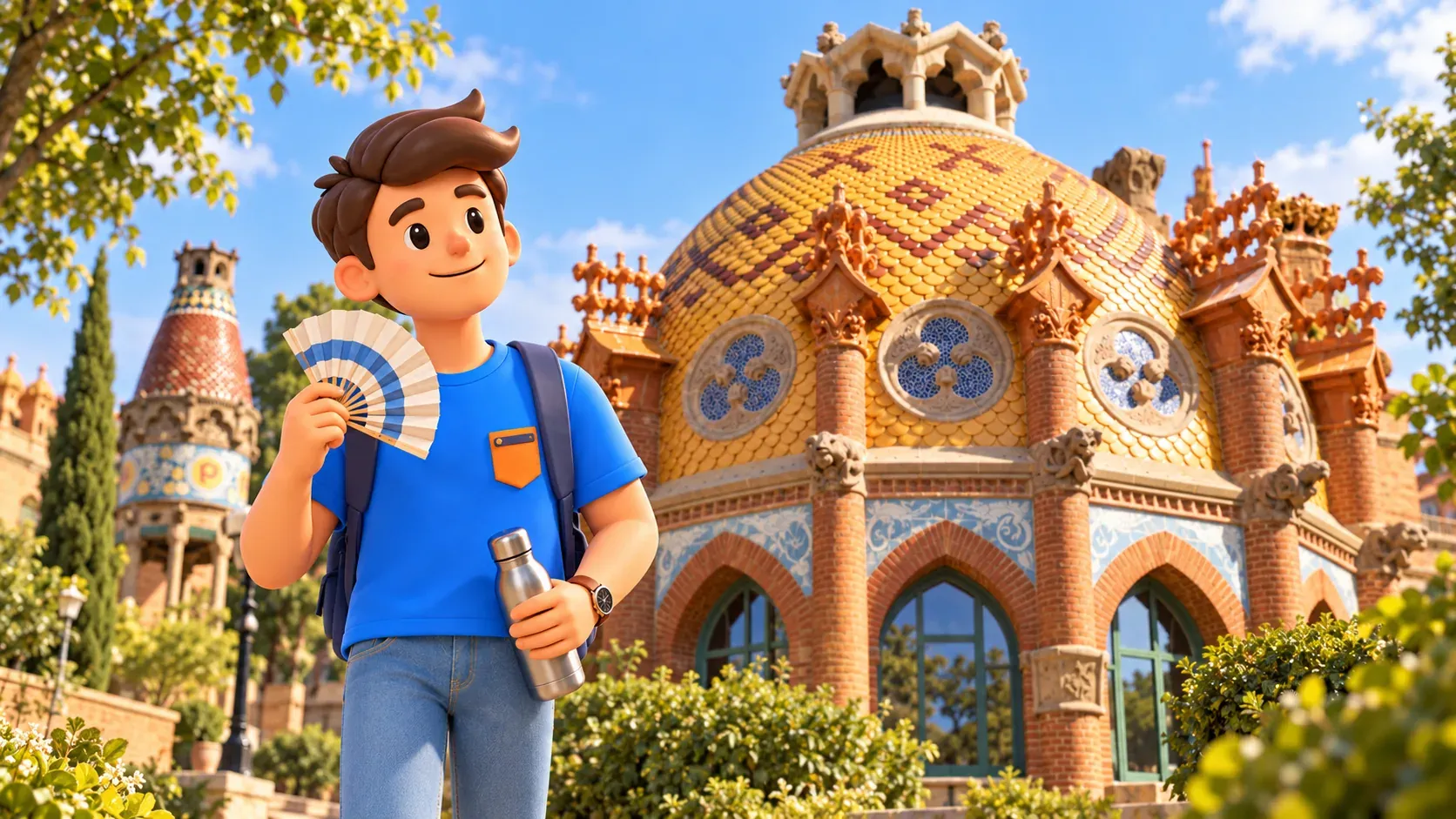
First, notice the space between pavilions. Gardens belonged to the original architectural concept, alongside daylight, ventilation and a more humane environment for patients. This describes the project's historical intentions, not evidence that attractive architecture cures disease. Observe how an individual building gains breathing space and how paths reconnect it to the wider complex.
Next, look at an underground connection if it is included in the route open that day. Compare it with movement through the garden: separate buildings above, linking infrastructure below. You do not need to explore every tunnel. One clear relationship between the two levels already explains why this was a planned hospital system rather than a collection of decorative fronts.
Finally, spend time in one available pavilion. Sant Salvador introduces the institution's history; Sant Rafael recreates a hospital environment of the 1920s. These are examples to consider where access permits, rather than guaranteed entries to both. Restored architecture and a reconstructed display do not imply that every object has remained untouched in its original position since opening.
If medical history, decorative craft or architecture is your particular interest, give that priority to RoadMe. The app prepares a personal trip plan around your interests, making it easier to give a favourite subject its place alongside other neighbourhoods and days.
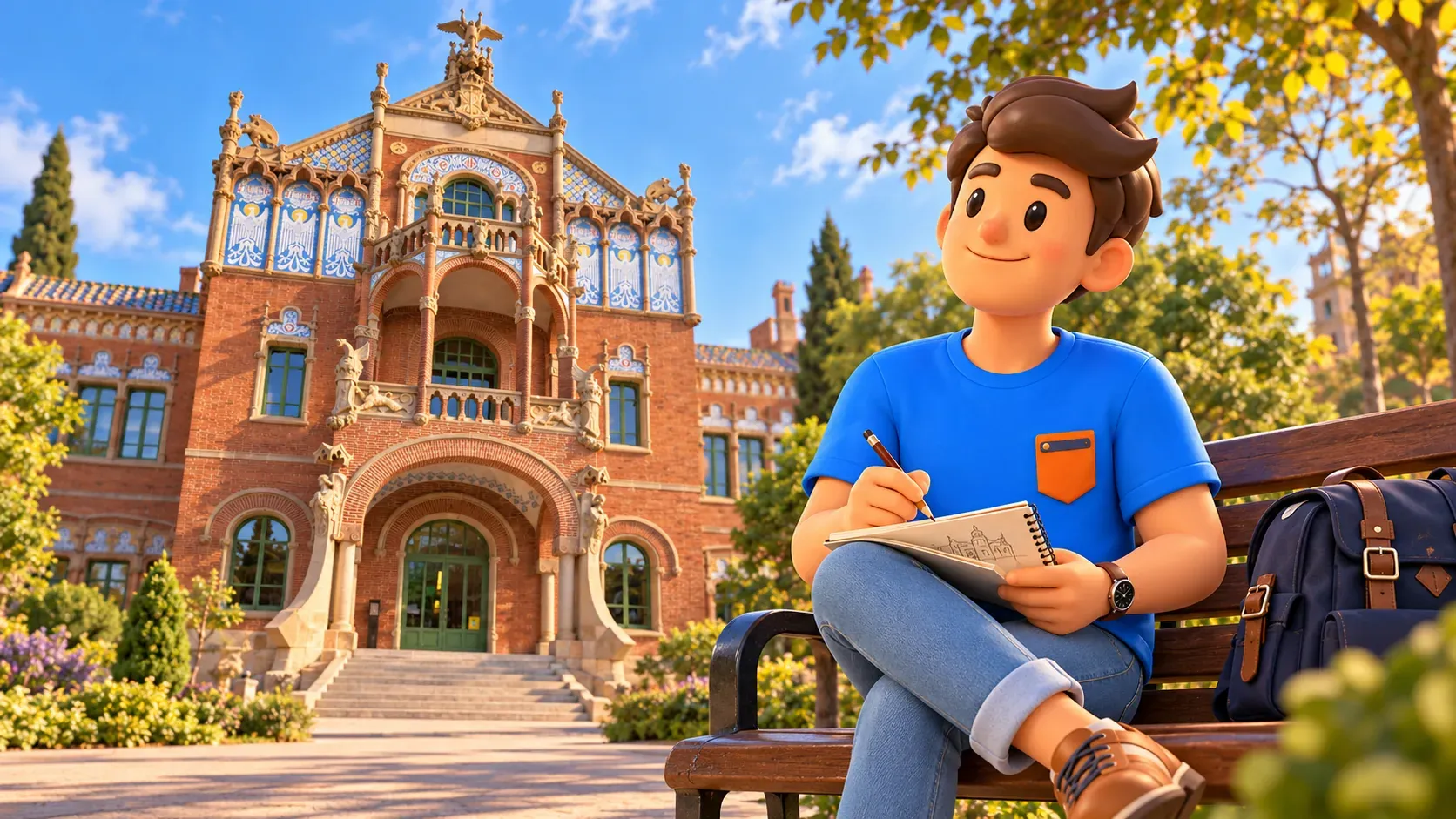
Compare exposed brick with glazed ceramic, then a roofline with the shape of a window. After the Palau, the materials are familiar but the rhythm has changed. For photographs, alternate a wider view with one detail that interests you. A few considered observations create a stronger memory than ninety minutes spent trying to collect every possible angle.
Practical checks and a calm finish
Sant Pau normally opens daily at 09:30, closing at 18:30 from April to October and 17:00 from November to March; last admission is thirty minutes before closing. It is closed on 25 December. A 13:00 visit fits the ordinary schedule in both seasons, but check your date and the spaces available rather than assuming an unchanged route.
Budget for paid admission at both sites. Compare separate self-guided tickets with a compatible combined offer if useful, reading its conditions carefully. Do not interpret it as including a concert, a guide or every pavilion. Bring a small bag and arrange large luggage elsewhere. At the Palau, food and drink are not permitted during the visit, and flash photography and tripods are prohibited.
Both sites provide accessibility arrangements, but the journey between them needs its own assessment. Ask about the appropriate entrance, lifts and assistance for your requirements; a general map label cannot settle every detail. Use the final fifteen minutes to pause and leave towards the historic frontage. For another day with a shorter exterior walk, consider our Sagrada Família to Sant Pau route, which serves a different purpose without repeating today's two interiors.


