
Dante in Verona: a Short Walk Around Piazza dei Signori
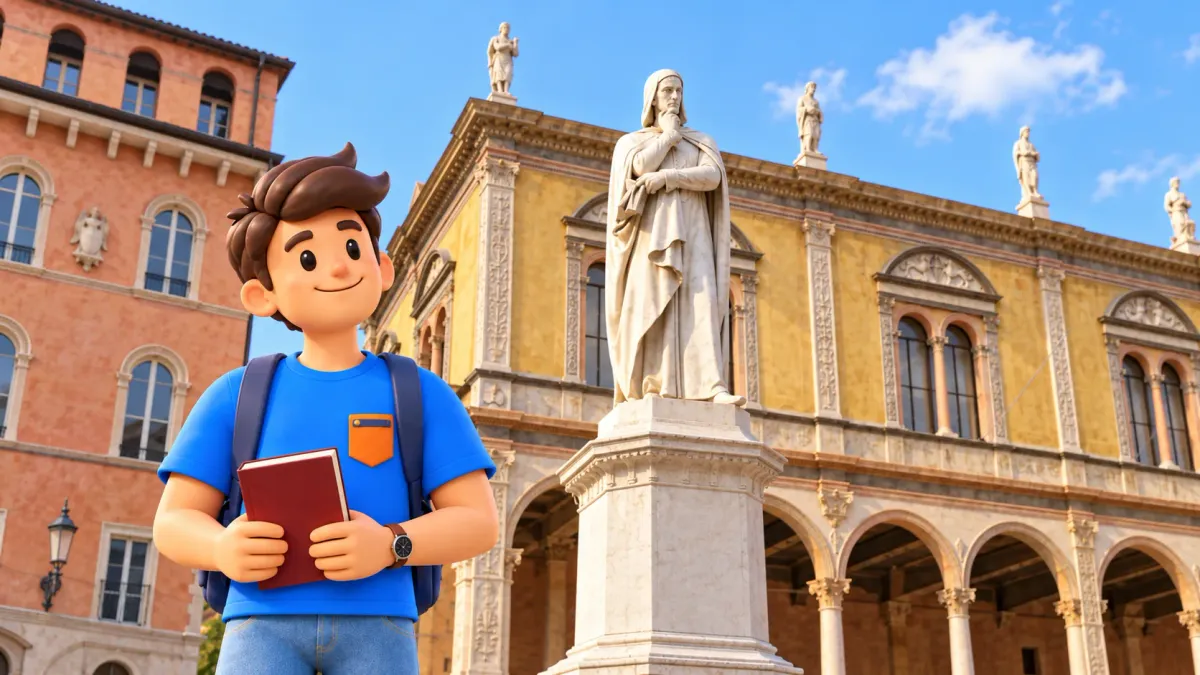
On Piazza dei Signori, Dante appears lost in thought while the city moves around him. For many visitors, the statue is simply a convenient landmark in central Verona. It can also begin a small walk about another side of the city: refuge, patronage and the place literature occupies in everyday public space.
You do not need to read the Divine Comedy before arriving. This route suits anyone who knows little beyond the author's name, as well as readers looking for one coherent subject among the usual squares. Allow roughly an hour and a half to two hours. Distances are short; most of the time belongs to looking, making a few historical connections and taking a quiet pause.
A compact route with one clear subject
Begin beside Dante's statue in Piazza dei Signori, also known as Piazza Dante. Follow the edge of the square to look at the palace façades, continue to the nearby Arche Scaligere beside Santa Maria Antica, and return to the square for a little reading or rest. The basic route uses exterior views from public urban space.
RoadMe makes it easier to turn an interest in literature, history and architecture into a personal trip plan shaped around your preferences and pace. Try building your Verona visit in the app so the Dante walk finds a comfortable place among your other interests.
Our allowance is 10–15 minutes of walking, 20–25 minutes at the statue, another 20–25 minutes for façades, 15–20 minutes at the tombs and 25–35 minutes for a pause and reflection. These are our slow-looking estimates, not the duration of an organised tour. You can move faster, but short distances are useful here because they let you linger.
The programme does not include a tower climb, museum galleries or a library visit. Each brings separate arrangements and needs additional time. For a first encounter, it is enough to connect the poet, the setting of civic power and the monuments to rulers associated with his Veronese life.
Start with the statue's pose
Choose a position where you can see the whole figure without blocking other people. Pale marble, long robes, a concentrated face and the hand at the chin make the image recognisable. Before reading the inscription, try describing its mood: thoughtfulness, distance, severity or calm. There is no test to pass before you can begin looking.
The sculptor Ugo Zannoni created the monument, erected in 1865 for the six-hundredth anniversary of Dante's birth. This matters: it is a nineteenth-century view of a medieval writer. The figure has not stood here since Dante's lifetime, and it is not a contemporary record of a moment when he occupied this exact spot.
That gives the walk its first question: why did the city place this writer in the middle of a setting associated with power? The answer involves more than the fame of his poem. For Verona, Dante also represents someone who found refuge here after exile from Florence. Behind the solemn monument lies a less ceremonial human situation.
Move a little to one side and compare the silhouette against different façades. It can seem isolated, then part of a larger architectural conversation. This simple exercise requires no specialist knowledge, only time to look without immediately trying to fit every building into a single photograph.
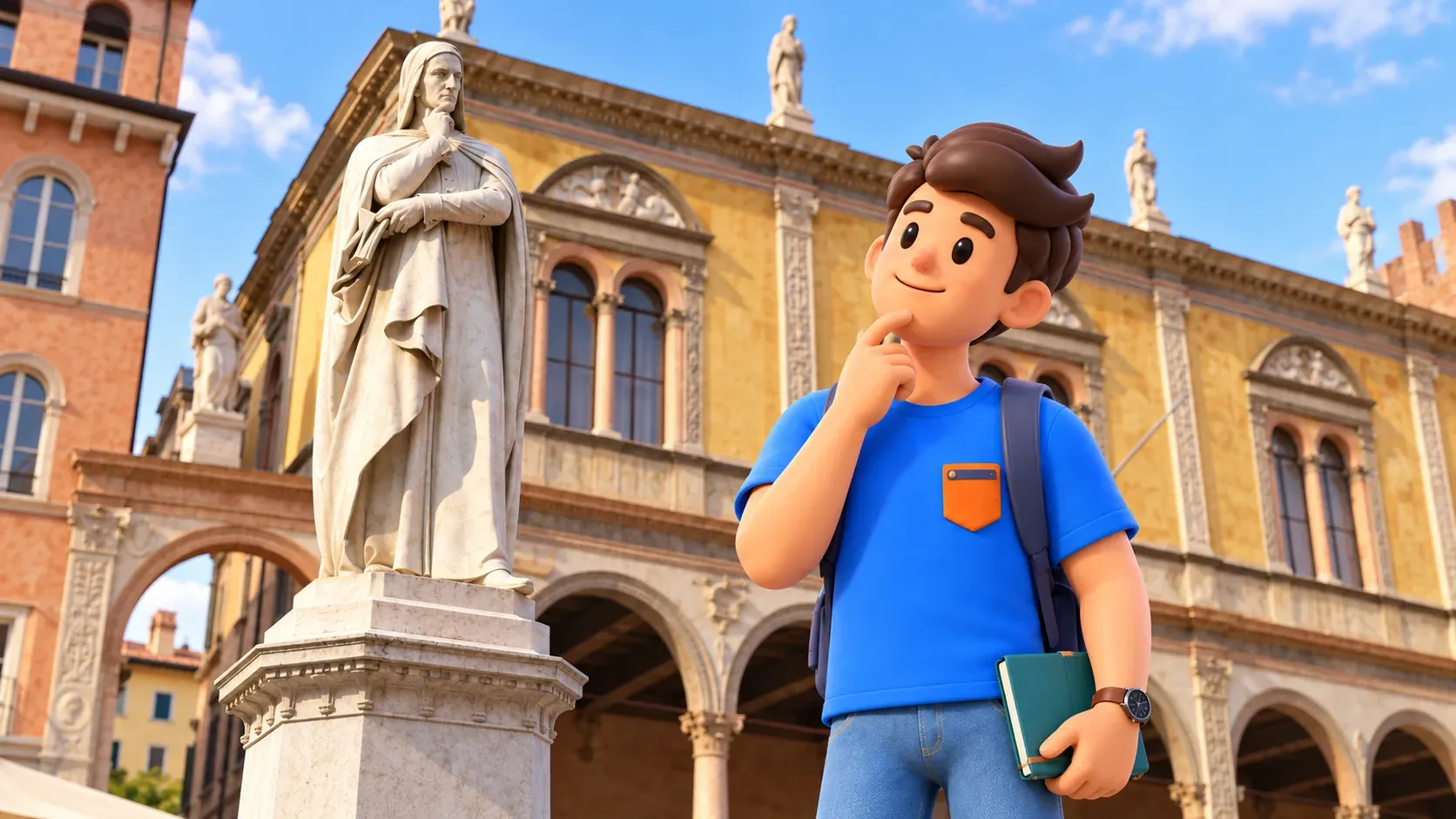
A memorial, rather than the poet's grave
The Verona statue is a memorial, not Dante's burial place. His tomb is in Ravenna. The nearby Scaliger tombs can accidentally merge separate stories in a visitor's mind; keeping them distinct makes this walk clearer. You move from the poet's public image to the memory of his Veronese patrons.
Think of the route as an encounter with how a city remembers a person. The statue shows whom Verona chose to honour, while palaces and tombs suggest the environment connected with his life. None needs to be treated as an exact illustration of a particular line of poetry.
Why Dante's story belongs in Verona
Dante was Florentine, and Verona became an important place during his exile. His stays were connected with the della Scala family, rulers of the city. Bartolomeo della Scala belongs to the earlier part of the story; Cangrande I later became a particularly important patron. Avoid reducing every visit to a single host and one continuous residence.
For this walk, the complete chronology of his movements is less useful than understanding a writer's need to live, work and be heard outside his home city. Patronage involved more than grand receptions. It also concerned the circumstances of intellectual work, giving the palace meaning beyond an attractive façade.
The connection with Cangrande appears in Paradiso, the third part of the Divine Comedy. To prepare, read a short section of Canto XVII with notes in a translation you find accessible. On the square, the themes of refuge and support are enough. There is no need to turn the outing into a compulsory retelling of the whole poem.
A literary text and a biographical map are different things. A person's appearance in the poem does not identify the room where a particular line was written. Keeping that distinction preserves the historical substance of the experience without filling every unknown detail with an appealing invention.
Palace façades: power and hospitality
Walk around the edge of Piazza dei Signori. Connected buildings and passages create an almost enclosed room within the busy historic centre. The atmosphere differs from neighbouring Piazza delle Erbe, but it need not be empty or silent at any guaranteed hour. Look at the square as a whole before examining details.
The palace complex associated with Cangrande, known as Palazzo del Podestà, keeps the theme of patronage in view. Observe it from outside. Its present administrative functions do not make it a museum with permanently open rooms. This route does not require finding an interior entrance or following office staff through a door.
Notice the different periods around you. Scaliger history, later alterations, the Renaissance Loggia del Consiglio and the nineteenth-century monument share one square. Dante could not have seen everything visible today. That is part of the interest: Verona continued to use and change its civic setting rather than freezing it as the scenery of a single century.
Choose a detail that suggests a building's purpose: a formal portal, a coat of arms, a connection between blocks or an orderly arrangement of windows. You do not have to identify every owner immediately. Ask what the architecture might communicate to someone approaching: welcome, organisation, authority or a boundary between public and private.
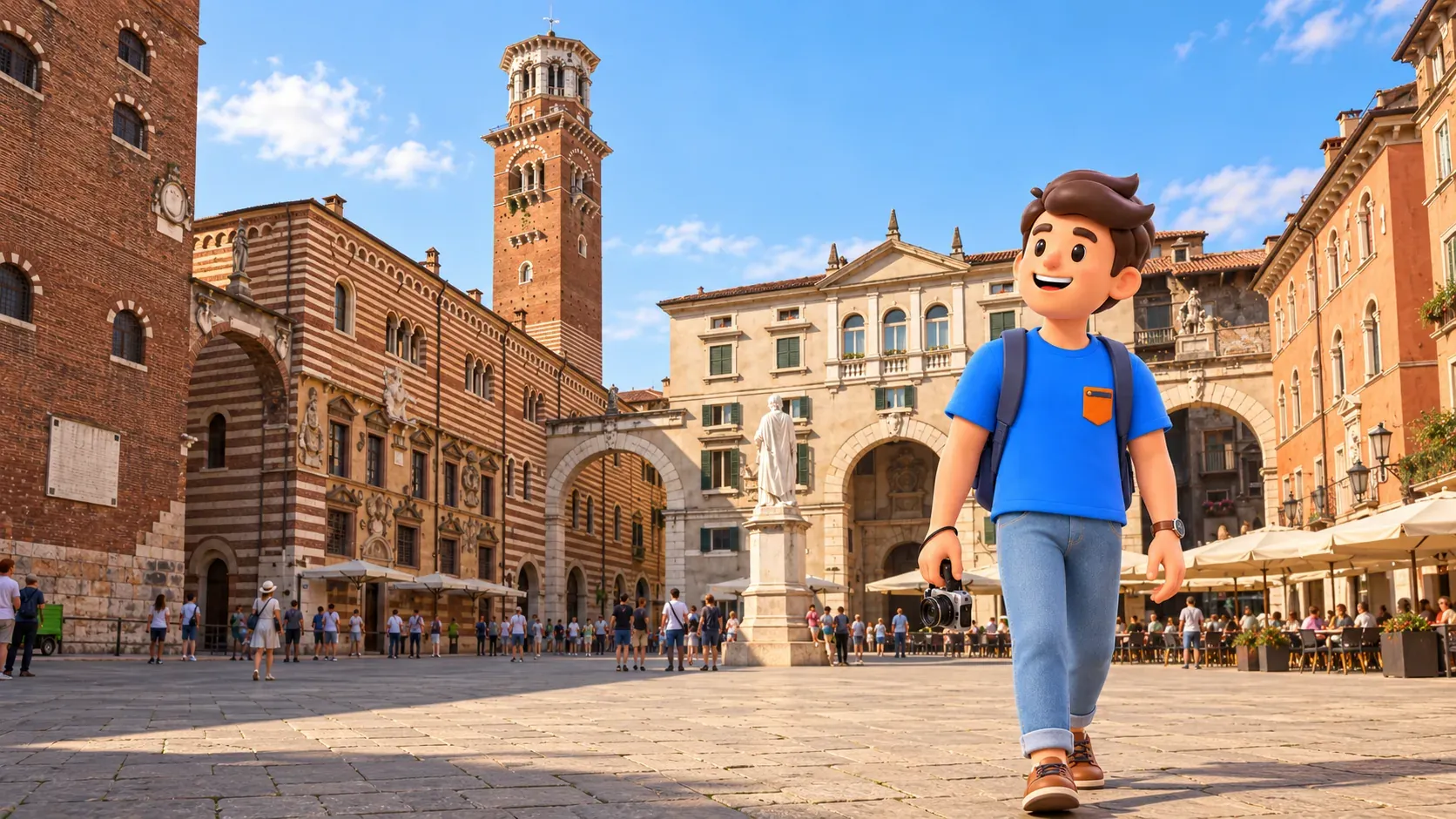
For a photograph, try keeping the statue and part of its surroundings together. The image may express the walk's subject better than a separate portrait of the marble head. There is no need to climb the plinth or occupy steps and passages for the composition.
The Scaliger tombs: meet the patron's public image
Beside Santa Maria Antica, very close to the square, the Arche Scaligere form the Gothic burial complex of della Scala rulers. Here the literary story meets the language of dynastic memory. Raised canopies, sculpture and the iron enclosure work differently from the thoughtful figure in the centre of the square.
Do not set yourself the task of analysing every tomb. For this subject, concentrate on Cangrande I, one of Dante's important Veronese patrons. His tomb is associated with the church portal. The famous equestrian figure above it should be distinguished from the original sculpture, now held at the Castelvecchio museum: the figure at the tomb is a copy.
Do not confuse Cangrande I with Cangrande II, under whom Castelvecchio was built. Repeated names can create a misleading shortcut between poet, ruler and castle, as though they all refer to one person. The castle is not a necessary continuation of this walk; its museum deserves different time and attention.
Look from the street through the enclosure rather than treating admission inside as essential. Entry to the enclosed area depends on the current calendar and ticket arrangements; the short route does not rely on it. An open church door also does not mean there is no service or unrestricted permission for photography.
Compare two ways of being remembered. Dante's statue emphasises thought, while the dynastic monuments convey the rulers' status and public standing. This is a visual observation, not a complete explanation of the sculptors' intentions. It is enough to start a conversation between neighbouring objects.
Return to the square and read a little
Go back to Piazza dei Signori along the familiar short connection. The statue now has a little more context: a city that received an exile and a ruling family connected with his stay. The route returns to its original question instead of requiring another distant attraction to keep going.
If literature is one part of your ideal trip alongside art, gardens and riverside exploring, let RoadMe develop a personal plan around those interests. The app makes it more convenient to distribute the themes across your days and choose a pace that leaves room for thoughtful stops.
You might now read a short passage in translation, consult a note or write down one thought. A café seat available at the time can provide a proper break. The edge of a passage beside the statue should not become a compulsory reading spot: ordinary city movement continues around you.
With companions, ask each person for one remembered image: the poet's face, a coat of arms, a horse and rider or the enclosed feel of the square. This brings observations together without a literature quiz. People with different backgrounds can participate because the conversation begins with what they saw, rather than what they know by heart.

Continue without losing the subject
For a separate continuation, try our bookish walk between the Capitolare and Civic Library. Give it its own block of time and check the opening arrangements. It shifts attention from a writer's memory to the preservation and everyday reading of texts.
If time is short, finish here. The exterior route does not require a museum ticket, but this is not a promise of unrestricted access at every hour: events and barriers may change a passage. There are no compulsory hills or stairs in the basic walk. If access matters, consider surfaces and the current pedestrian arrangements.
The useful discovery is a human story behind a literary name. Dante becomes someone who needed a place to live and work, as well as the author of a famous difficult book. Verona gives that story a setting; a few attentive stops can make the statue more than a point in a square.


