
Cultural Jumeirah in Half a Day: Mosque, Etihad Museum and Union House
Jumeirah offers a cultural visit with two different kinds of encounter. At the mosque, architecture connects with religious life and the possibility of a conversation through the appropriate visitor programme. At the Etihad ensemble, documents and a historic meeting place help explain the formation of the United Arab Emirates. The value of the pairing is in that difference, not in treating three names as interchangeable photo stops.
Set aside a flexible half-day, roughly four to five hours depending on the mosque programme, museum visit, transfer and pause. This is an editorial estimate, not a measured schedule. Start with the current visitor arrangements, then connect the places realistically. Union House belongs to the historic setting of the Etihad ensemble; it is not a separate free-entry promise added automatically to the museum name.
Use the real visitor programme as the starting point
RoadMe can create a personal route or whole Dubai trip around your interests, dates and pace. Prepare this cultural half-day in the app: connecting the mosque visit, museum and time to reflect is much more convenient than coordinating several separate lists.
Check Jumeirah Mosque's current cultural visitor programme and choose a suitable session if you want more than an exterior view. A working religious site and an ordinary attraction have different uses. Read the present entry, clothing and visitor requirements for the programme you select. Let those actual arrangements determine the beginning rather than assuming interior access at any hour.
Then check the museum visit and the current way its historic grounds and Union House are included or approached. A name in an itinerary does not explain every room or part of the site. Make the half-day around what is actually available, leaving enough time to consider the museum rather than fitting it into a leftover gap.
The mosque and museum are separate places within Jumeirah, not neighbouring rooms of one complex. Choose a real public walking route or a suitable transfer according to conditions and the group. Give that movement its own time. A comfortable connection is more useful than forcing the whole outing to look like one uninterrupted footpath.
Keep the endpoint flexible enough for a pause and onward travel. If the mosque session and museum do not fit the same half-day, choose the most important visit and put the other on a different date. The cultural pairing remains a useful idea without requiring a rushed combination at the expense of the actual experience.
Jumeirah Mosque: historical forms in a modern city
Jumeirah Mosque opened in 1979. Its two minarets and central dome create a clear symmetrical composition, while pale stone makes the smaller carved details legible in changing light. The historical architectural references belong to a building of modern Dubai. It is not a surviving medieval monument transplanted unchanged into the growing city.
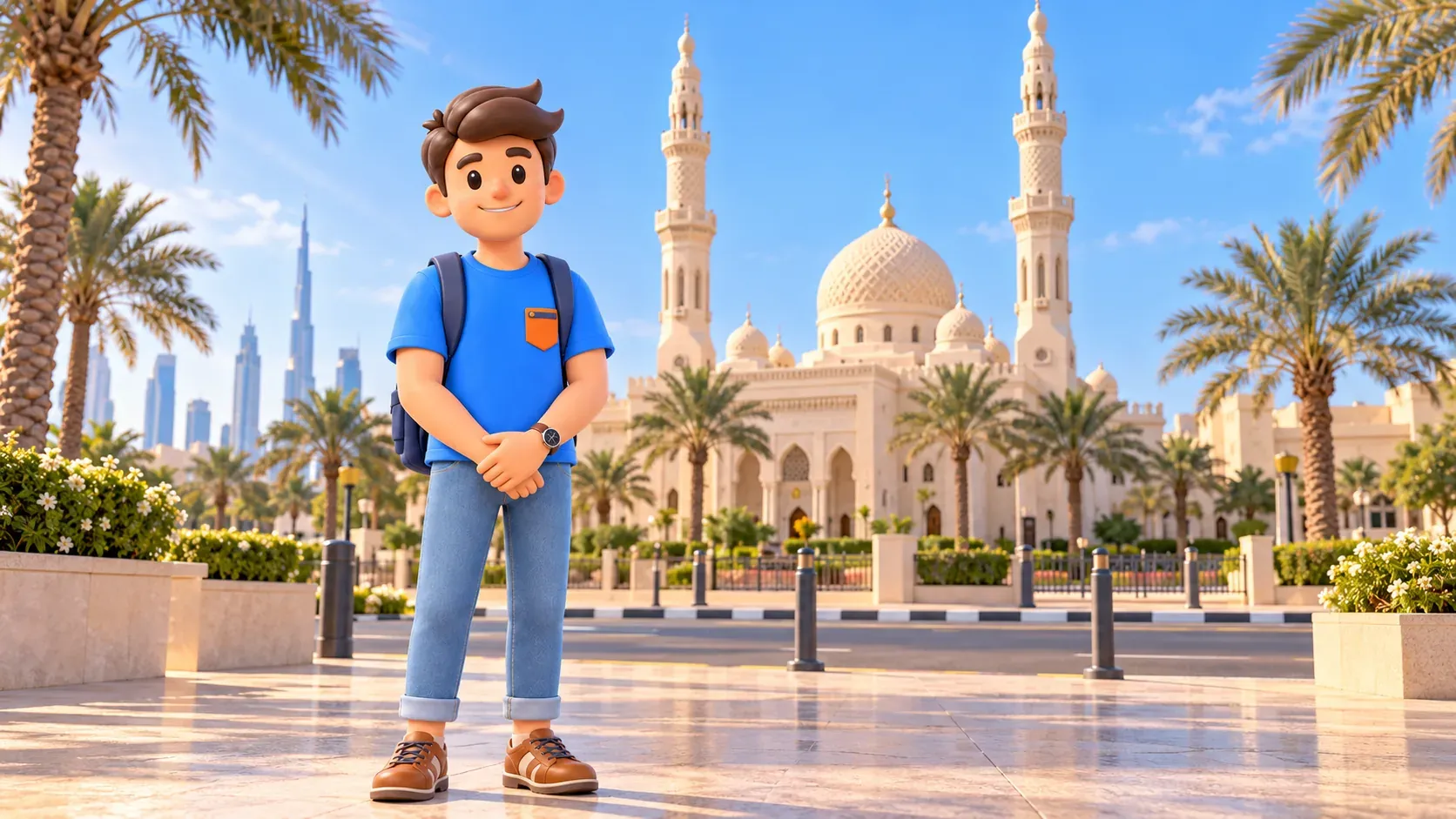
The design draws on traditions associated with Egypt and Syria. For a first visit, the visible relationships matter more than memorising several style labels: the dome holds the main body together, the two minarets frame it and repeated arches connect the larger and smaller parts. Look at the whole before allowing ornament to take over your attention.
At a closer appropriate exterior viewpoint, compare smooth areas with carved relief. Light creates fine differences between a projecting edge and a recess. The large symmetry remains, but detail gives the building a different scale. A wide image and a quiet moment studying one area can provide two useful ways to remember the architecture.
Keep the building's purpose present in the visit. It is a religious place used by a community, not only an architectural object. Follow the actual visitor organisation and the guidance offered for your session. An attentive exterior view can be worthwhile in its own right, while a cultural programme adds another kind of encounter rather than merely opening another photo room.
Make conversation part of the cultural visit
The mosque's public cultural role is associated with the Sheikh Mohammed Centre for Cultural Understanding and its approach of opening conversation about traditions. The useful idea is direct explanation: questions can connect a building with practices and everyday meaning. The exact opportunity depends on the visitor programme you have chosen.
Prepare one or two sincere questions. You might be interested in the use of space, the role of a particular architectural element or how visitors should understand a practice explained during the session. A focused question gives room for an answer. You do not need to arrive with a long list or assume the visit will settle every question about a whole religion or society.
Listen to the distinction between the specific place, an individual explanation and a wider tradition. A cultural visit is more useful when it leaves those scales clear. You can learn something concrete without turning one conversation into a general rule about everyone living in Dubai. Let the actual explanation guide what you take away.
Afterwards, keep a brief note of a point that changed your understanding. It might be a practical detail or a question you had never considered. That note can link to the second half of the outing, where the focus shifts from conversation and religious space to historical evidence and the foundation of the federation.
Etihad Museum: read the story through evidence
Etihad Museum stands beside the historic place connected with the UAE's formation. Its ceremonial opening was in December 2016, with public visiting beginning in January 2017. The project by Moriyama & Teshima Architects places much of the museum below ground, allowing the historic structures at the surface to retain their own scale.
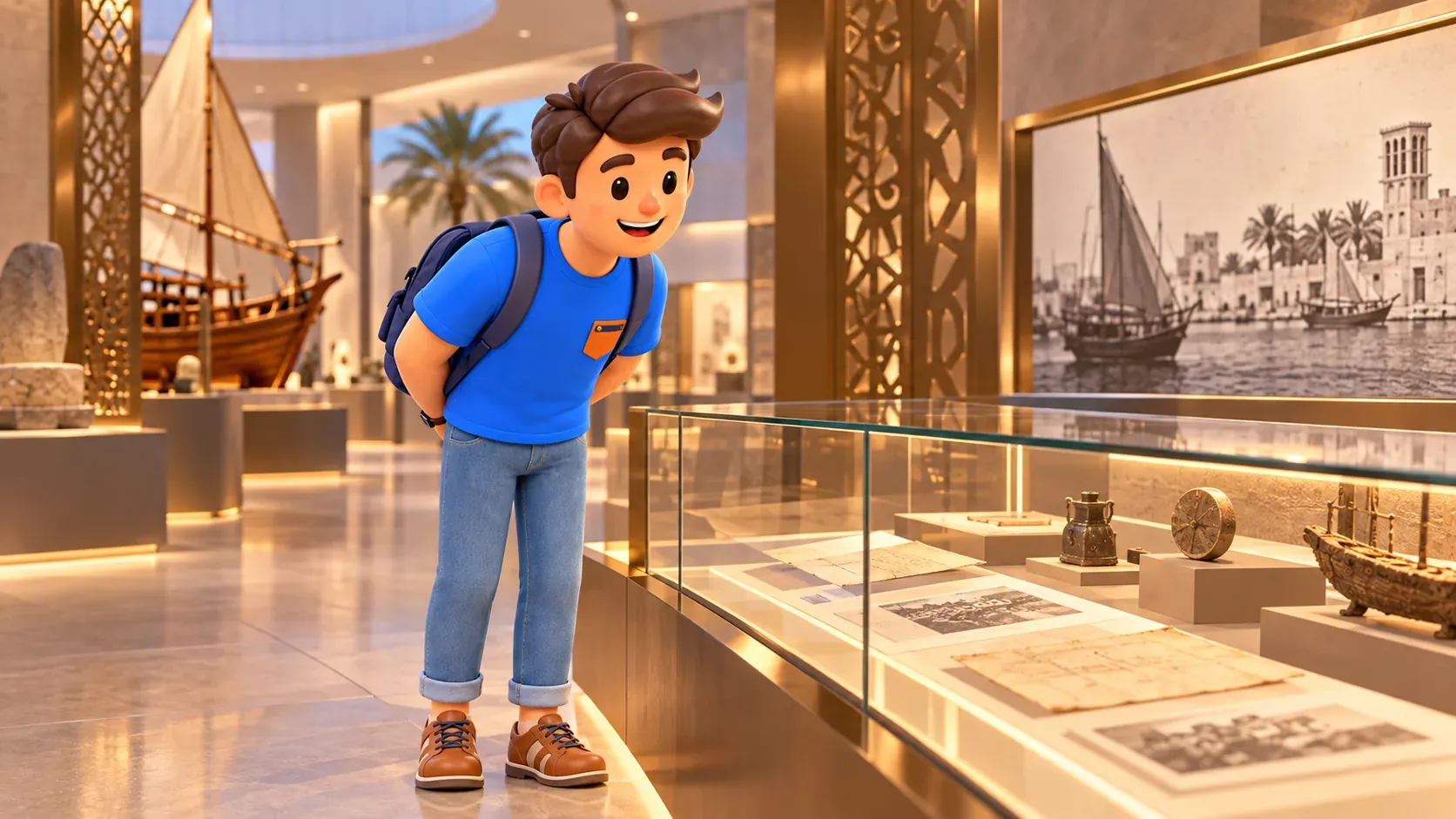
The museum's subject includes the period leading to the federation and its first years. Photographs, documents, personal belongings and other historical materials offer different kinds of evidence. Choose a few examples and ask what each can explain. A photograph records one view, an object connects to a person and a written agreement formalises decisions.
Look for a sequence rather than treating every display as an isolated fact. How did discussions become agreements, and how were those agreements represented in documents? This way of reading gives a visit a thread without requiring you to retain every name or date. The formation of a state becomes a historical process rather than one abstract announcement.
The key chronology is worth keeping clear. Six emirates came together when the federation was proclaimed on 2 December 1971. Ras Al Khaimah joined in February 1972. The present seven-emirate union therefore does not mean that all seven joined on the same day. That distinction helps make the symbolism of the modern complex more precise.
Give one document or object enough time to look closely. What information is visible, and what context is needed to understand it? You can enjoy the broader presentation while recognising that evidence and interpretation work together. There is no need to rush every case simply to claim that the whole museum has been covered.
The museum pavilion turns a document into architecture
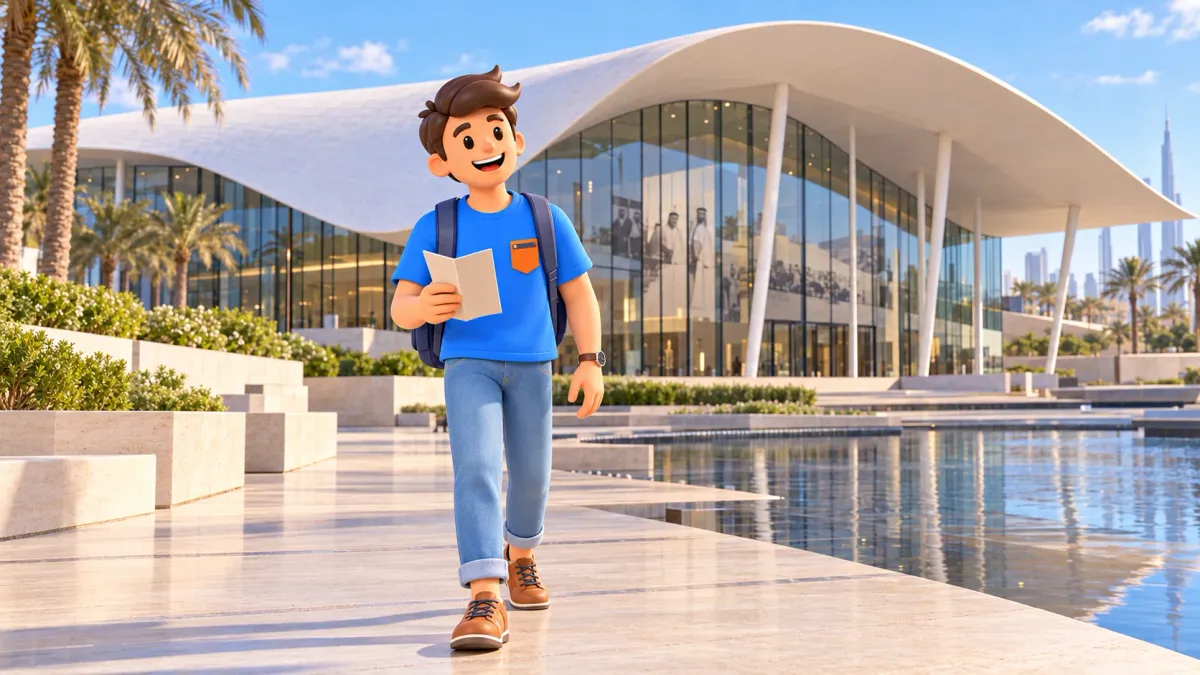
The entrance pavilion has a curved roof recalling a sheet of manuscript. Its tapered supports evoke writing instruments, linking the architectural image to agreements recorded in text. The design does not reproduce a historic meeting room. It offers a contemporary way of introducing the documents and decisions discussed inside.
Compare the broad roof with the more intimate scale of looking at material in a case. One makes a large public symbol; the other asks for close attention. The move below ground allows substantial exhibition space without making every part of the site into one monumental object. This relationship between scale and subject is a useful architectural theme.
Notice how light reaches the museum through the design rather than assuming below ground means entirely separated from daylight. Materials and smaller details can connect large rooms to the human scale of reading. The building's role is to support an encounter with history, not only provide a striking exterior shape for the beginning of the visit.
Union House: the historic place and the later account
Union House is a small circular building constructed in 1965 as part of Sheikh Rashid bin Saeed Al Maktoum's guest residence. On 2 December 1971, rulers of six emirates signed the declaration forming the UAE here. Its importance lies in that specific event and place, not in the scale of the building.
Read it in contrast with the newer museum. The pavilion symbolises a document; Union House is connected with the actual meeting. A modest room and a much larger historical consequence can belong together. This comparison helps explain why a site can matter intensely even when its architecture is smaller than the institutions later built to interpret it.
Follow the current visitor arrangements for viewing the historic building and grounds. The setting also includes later conservation and memorial work. It is useful to distinguish the place of an event from the subsequent ways it has been preserved and presented. Both have a history, but they are not the same moment.
There is no need to turn this part into a separate long excursion. Its value is the connection between the material account in the museum and a real location associated with the decisions. Give that relationship attention within whatever access is actually provided, rather than assuming an additional unrestricted interior visit.
A pause connects conversation and history
Choose an available place to rest or have a drink after the main visits. Ask for one idea from the mosque programme and one piece of evidence from the museum. The answers need not be the same across the group. Connecting different kinds of learning is more useful than comparing how many facts each person has memorised.

With children, keep a simple distinction: one place helps explain living practices, another tells a story through objects and documents. They do not need to absorb every political detail. A remembered question and one clearly understood historical sequence can already form a meaningful cultural outing.
Let the pause determine the right ending. If attention is full, finish rather than add another museum automatically. If everyone wants a longer meal, give it space and adjust the onward plan. The ordinary return to transport also needs time; a half-day does not end at the last photogenic roof.
RoadMe can fit this cultural Jumeirah visit into a personal multi-day Dubai plan, balancing your interests, pace and time to rest. Use the app to organise the whole trip more efficiently, so museums, neighbourhoods and lighter days work together without rebuilding the programme every evening.
For an older urban setting on another day, the Al Fahidi walk follows wind towers, coffee and galleries. The Al Shindagha museum plan helps choose a different heritage focus. Keep those as separate opportunities, leaving this half-day its own connection between conversation, documents and the place of union.


