
From quarry and steel sites to parks: how Chicago reshapes its landscape

A green park does not necessarily begin with a green history. In Chicago, a pond can sit beside an old quarry wall, a walking path can pass a remnant of steel production, and a wetland can carry the consequences of industrial dumping. Knowing that past changes the view: the landscape becomes a record of decisions, rather than a simple escape from the city.
Palmisano Park, Steelworkers Park and Big Marsh offer three distinct examples. They do not occupy one former factory site and are not neighbouring stops on a short walk. Their common subject is transformation: how to make land available for new uses while dealing with what earlier activity left behind. Design, historical memory and ecological work enter the story in different proportions.
A park is a new chapter, not proof that the past vanished
Start by separating three questions. What happened here before, what did the new landscape change, and what remains visible or requires continuing care? Those questions prevent two tempting simplifications: calling every green space untouched nature, or seeing a reused industrial site only as a ruin. A functioning park can be both a contemporary public place and a landscape shaped by older work.
Build your personal Chicago trip with RoadMe around your dates, interests and preferred pace. Give these landscape stories a place within the whole journey, with time for the park you choose and the travel it requires.
The three examples also involve people. Industrial land supported work and neighbourhood life, not just machines. Turning it into a park creates another set of uses without making the earlier social world irrelevant. Looking at the material traces is a way to begin that conversation, rather than a complete account of everyone whose life was connected with the site.
This article compares histories and ways of observing them. It does not provide a timed circuit, a route between all three parks or permission to explore neighbouring industrial property. Choose one example that fits your interests and day. You can understand the comparison through reading without needing to turn the whole subject into a single excursion.
Palmisano: a quarry becomes a designed landscape
Palmisano Park in Bridgeport occupies the former Stearns Quarry site. Quarrying was followed by use for construction debris before the land became a park. Those are different stages, not one continuous activity. The present pond and exposed rock connect the visitor with the quarry history, while the shaped ground and planting belong to later decisions about how the site could function.
A crucial distinction is between the earlier depth of the quarry and the pond you see today. Do not carry an old mining measurement into a description of the current water as if nothing had changed. The intervening filling and landscape work matter. The park is not an open quarry simply decorated with paths; it has a new physical arrangement and purpose.
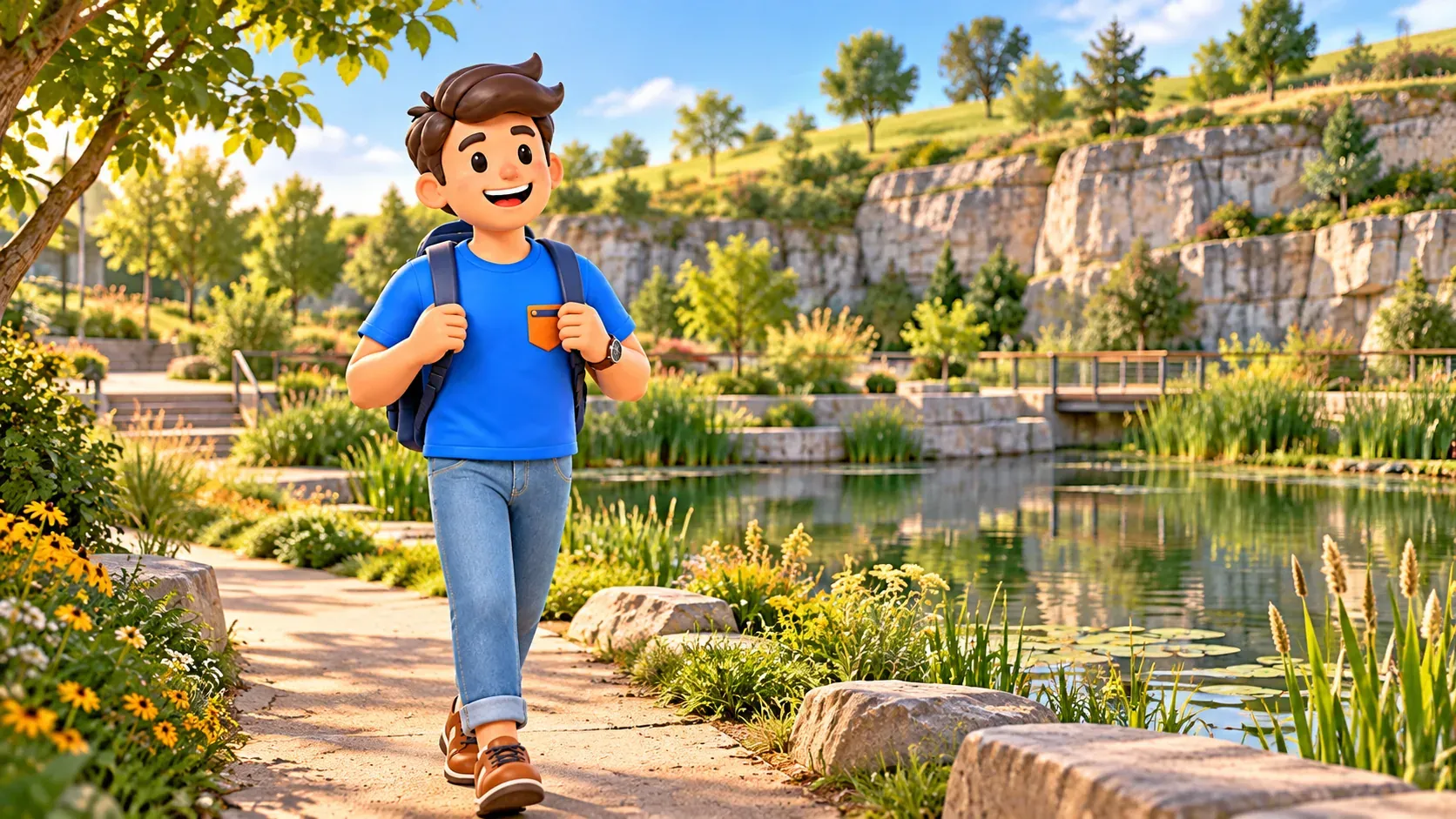
From an established path, notice the relationship between water, the exposed wall and the planted slopes. Ask which parts reveal a previous land use and which organise the present experience. You do not need to classify every stone. The point is to recognise that a seemingly natural scene can be composed from both inherited material and deliberate contemporary design.
The park’s wetlands, paths and landform make different ways of using the site possible. Treat them as features of a designed public landscape rather than evidence that the ground returned spontaneously to an earlier condition. Reuse can involve substantial work that remains partly invisible once vegetation becomes established. A pleasant view does not explain its own engineering history.
A useful observation is to compare a small detail with the whole scene. A rock face suggests extraction; the broader arrangement suggests a park. Neither view cancels the other. That difference helps explain why such a place can offer recreation and an encounter with industrial history at the same time, without becoming a preserved workplace or a technical demonstration.
Steelworkers Park: keeping industrial memory in view
Steelworkers Park in South Chicago occupies part of the former South Works steel complex. It is important to keep the scale precise: the park is not the entire former industrial property. The great concrete ore walls are its most conspicuous inherited elements. They relate to material handling in the steel industry, rather than being ordinary decorative walls added for a park effect.
Calling them concrete matters. Their connection with steel production does not mean that the walls themselves are steel plates. Material and former use are different pieces of information. From a public path, the contrast between an enormous industrial remnant and present vegetation gives a clear starting point for understanding how the same land can support very different activities.

The name also directs attention to workers, rather than presenting the site as anonymous empty land discovered by a park project. A factory’s history includes livelihoods, relationships and neighbourhood change. You cannot recover all of that from a wall, but remembering it makes the visit more thoughtful than treating the structure solely as a dramatic background for a photograph.
Some designated facilities give parts of the industrial structure a recreational role, including a climbing wall. That does not mean every surviving wall is open for climbing. If a particular activity interests you, consult its current arrangements. For a historical visit, observation from the established public areas already provides the relationship between remnant, landscape and present use.
Do not assume that park creation has resolved every question about the much larger surrounding industrial area. A park can be one transformation within a broader changing landscape. Its presence is real and useful without serving as proof that all nearby land shares the same access, condition or future. Keep the actual park boundary separate from the wider industrial story.
Big Marsh: recreation and habitat work share a complicated site
Big Marsh in South Deering belongs to the Calumet landscape. Industrial waste and slag dumping affected the site before its development as a park. Its present identity combines designated recreation areas with spaces for quieter nature observation and habitat work. It should not be described as a piece of untouched wilderness simply hidden within the city.
The distinction between creating public access and restoring ecological conditions is useful here. Opening a park and caring for a habitat are related actions, but not identical achievements. Water, soil and vegetation can require different kinds of attention. A new visitor experience does not justify a blanket statement that all effects of earlier industrial activity have disappeared.

Likewise, an older study of a specific environmental problem should not automatically be presented as the current condition of every part of the park. Historical evidence needs its date and scope. For an ordinary visit, use current park guidance and remain in designated areas. The landscape’s story can be explained without turning the article into an unsupported claim about present health conditions.
Big Marsh includes cycling facilities as well as areas intended for quieter recreation and wildlife observation. These uses are not interchangeable on every path. Choose an activity, then consult the current information for the relevant part of the park. A general description of cycling opportunities does not mean every habitat trail becomes a bike route, or that every facility operates whenever the grounds are open.
For a calm observation, look at the relationship between water, reeds and open land from a permitted path. Wildlife sightings depend on actual conditions, not on the presence of an attractive photograph online. You may leave with a better sense of landscape even without seeing a particular species. The value of the visit does not depend on reproducing someone else’s encounter.
Three transformations do not mean one recipe
Palmisano makes the sequence of extraction, filling and landscape design visible. Steelworkers keeps substantial industrial traces within a new public setting. Big Marsh brings ecological work and designated recreation into a landscape affected by earlier industry. These are selected readings, not exclusive categories. Each park also involves design, care and historical choices beyond the single feature used to introduce it.
Use RoadMe to shape the whole personal trip around the history, green spaces and activities you enjoy. Choose the park that fits your days and pace, leaving room for travel and pauses.
A useful comparison concerns what each place asks you to notice. One may draw attention to a rock face and shaped ground, another to a large wall, another to the relation between recreation and habitat. All three encourage a more precise use of the word “natural.” Vegetation and water can be real parts of a landscape that has also been extensively altered by people.
There is no need to decide which park represents the most complete transformation. Such a ranking would require criteria the view alone cannot supply. Instead, ask what became possible and what remains part of the place’s story. That approach makes room for the benefits of new public use without making an unsupported claim that every earlier problem has been solved.
Visit the present landscape with its history in mind
Before setting out, check the chosen park’s current access, relevant facility arrangements and directions. Park grounds and an environmental centre can have different opening conditions. Path works and activity schedules also belong to the date of the visit. This account does not guarantee uninterrupted access, climbing availability or a particular event merely because those things appear in a general description.
Stay on established routes for your chosen activity and let a simple observation lead the visit. Compare an inherited feature with a current use, then consider what lies beyond the visible surface. You do not need to enter water, climb rock or explore restricted ground to understand the contrast. A public park offers its own setting for the question.
The role of community institutions in preserving experience appears in Chicago’s museums of different cultures. These parks preserve and transform another kind of evidence. They show how a city can create new landscapes while remaining connected to the work, material and decisions that shaped the land before.


