
Chicago’s Theatrical Loop: A Short Walk Before Your Show
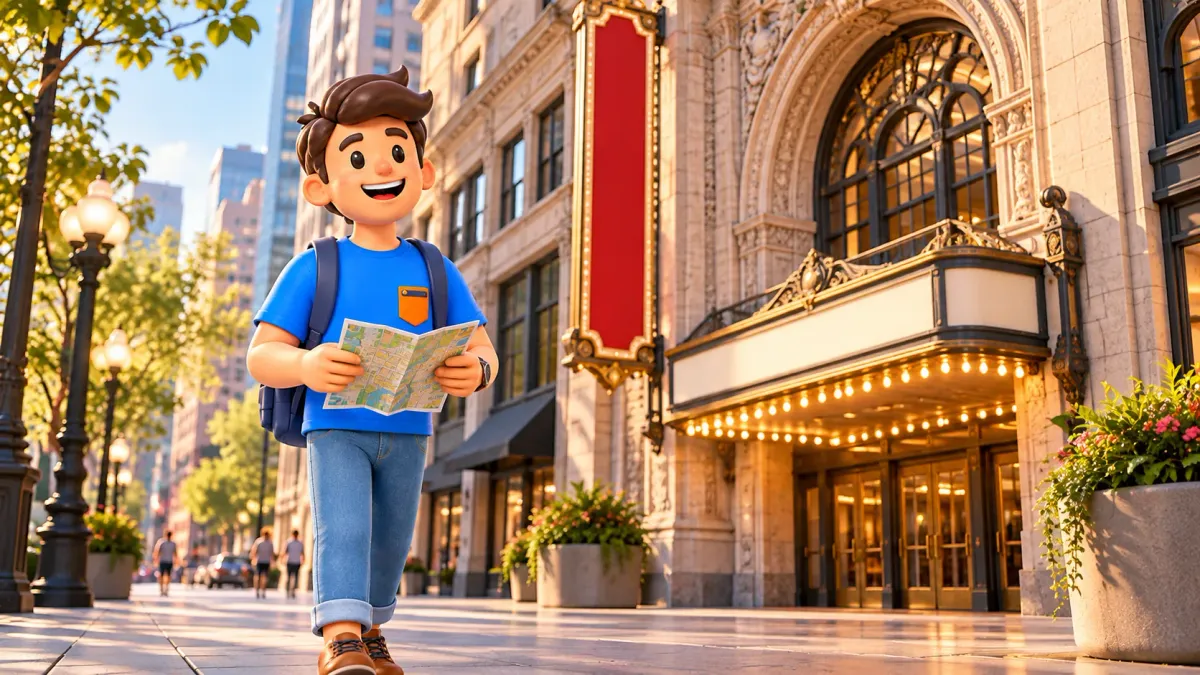
A short walk through Chicago’s theatrical Loop should end at the theatre on your own ticket. Choose two or three nearby facades, leave space for a pause and protect the final arrival time. The Chicago Theatre, Goodman, James M. Nederlander, Cadillac Palace and CIBC form a useful set of possibilities, not five compulsory admissions before a performance.
This outing is about organising an evening you have already chosen. It does not select a production for an imaginary travel date or promise that every theatre has a show tonight. Exterior observations can give the walk atmosphere without adding tours, backstage access or an architectural history lecture to a tightly timed afternoon.
Make your actual performance the fixed finish
Open the booking and confirm the city, date, start time, theatre, full address and any specific auditorium. A familiar production name is not enough: touring shows move, and some producers present work at more than one location. The title of the musical Chicago should not be confused with a ticket to The Chicago Theatre.
RoadMe helps build a complete personal trip around your dates, interests and preferred pace. Try fixing this performance as the evening’s destination, then arranging Chicago’s museums, neighbourhoods, meals and travel across the whole stay with enough room to enjoy each part.
A two-hour outline before the performance allows forty-five minutes for movement, twenty-five for facade observations, twenty for a short pause and thirty for final arrival. These are planning estimates, not measured durations or an operator’s universal admission rule. A full restaurant meal, the show itself and your journey from the accommodation are additional.
If the actual curtain is at 7.30pm, this example starts at 5.30pm and reaches the chosen theatre around 7pm. It is an illustration, not a standard Loop timetable. Follow an earlier arrival instruction when your event requires it, and extend the plan if collecting tickets, accessibility arrangements or individual needs require more time.
Choose a finish before choosing the walking order
The Chicago Theatre is at 175 North State Street. Goodman identifies its main building at 170 North Dearborn Street. The James M. Nederlander Theatre is at 24 West Randolph Street, and Cadillac Palace is at 151 West Randolph Street. CIBC Theatre sits further south at 18 West Monroe Street.
These addresses make a compact central group with a southern extension. They are not interchangeable names for one building, and they do not all share the same operator. Keep the exact venue in your phone or notes and make the last part of the route lead naturally to it rather than following a fixed order regardless of tonight’s booking.
For a Randolph or Dearborn finish, concentrate on the northern cluster and omit Monroe if it creates unnecessary return walking. For a CIBC finish, allow the southbound connection along Dearborn and the short move towards Monroe. For The Chicago Theatre, reverse the relevant northern sequence so State Street becomes the finish rather than a place you must hurry back to.
Do not add Navy Pier, Second City or another distant stage to this short Loop round. Those venues can make separate evenings with their own routes. A common citywide theatre category does not erase transport time or make a faraway facade a convenient pre-show detour.
Use The Chicago Theatre as a street encounter
On State Street, choose a public position that lets the facade and marquee read together without blocking the entrance. The vertical sign gives the building a strong street identity, but an exterior photograph is different from admission. Keep room for ordinary pedestrians, staff activity and any audience forming for a separate event.
The venue hosts a range of events, including concerts, comedy and theatrical performances. Do not infer tonight’s programme from the building’s name. If you have no ticket here, a short facade observation can still belong to the walk; it does not include the lobby, staircase or auditorium.
The operator offers a separate tour experience on its own arrangements. That should not be squeezed into this short pre-show sequence or presented as a free look inside before any event. If an interior tour is your main interest, book and time it as a distinct activity with enough room for the rest of the day.
Make Randolph Street a short comparison
From the State Street area, use the actual crossings towards Randolph. The Nederlander at 24 West Randolph provides one exterior stop, while the Goodman area on Dearborn is nearby. Follow public sidewalks rather than assuming a lobby can connect streets or that a theatre entrance is a convenient indoor shortcut between observations.
At the Nederlander, look at the relationship between the frontage, canopy and the sidewalk below. Notice how a performance building addresses a busy commercial street. A short comparison of entrance scale and exterior detail gives the stop a purpose without making an unsupported claim about the view from a particular seat inside.
Cadillac Palace lies further west at 151 West Randolph. Include it when it suits your finish and available time. Going there is not mandatory merely because the address appears in a theatre list. If your performance is elsewhere and the clock is tightening, keep the nearer facade and leave the western extension for another walk.
At Goodman, check the actual performance space
Goodman’s building on Dearborn provides a contrasting exterior presence within the central cluster. Keep the observation on the public sidewalk, leaving arrival areas clear. If your booking is at Goodman, check whether it names the Albert, the Owen or another specific performance location rather than assuming that the organisation’s main address answers every ticket question.
Some programmes associated with a theatre organisation may take place elsewhere. The booking’s full location has priority over a logo or an organisation name on a general season page. Resolve that before starting the facade round, because discovering an off-site address at the final door can consume the whole arrival margin.
If Goodman is not your destination, a short exterior contrast is enough. Do not make a free foyer visit essential to the walk or assume that a working box office means public access to every performance room. Box-office hours, building access and curtain time describe different activities.
When it is your destination, follow current guest-service instructions. Goodman’s published late-arrival policy leaves seating to the house manager and may mean waiting for an appropriate break or using another seat initially. That is a reason to protect arrival time, not a promise that lateness can always be repaired without missing anything.

Use CIBC as the southern finish when appropriate
CIBC Theatre at 18 West Monroe Street belongs to the southern option in this compact plan. From the Randolph and Dearborn area, follow a suitable public route south along Dearborn and connect towards Monroe. Check legal crossings and current street conditions. It is a real walking segment, not a transfer to omit from the timetable.
If CIBC is your selected theatre, let it become the final stop rather than walking past it early and returning after another loop. If your booking is in the northern cluster, you can simply omit the southern extension. The aim is a coherent approach to your own event, not collecting every venue in one evening.
A closed box office on a particular date is not evidence that the theatre has permanently closed, and an open box office does not establish a performance that night. Use the actual show calendar and ticket. This distinction is especially useful when several venues have different gaps between productions or changing weekly office arrangements.
Keep ticket instructions specific to the operator
Download or prepare the actual ticket format before the walk, with enough battery and account access for the evening. Broadway In Chicago states that screenshots are not accepted for entry. Follow its booking instructions rather than assuming that any image of a barcode is an adequate replacement for the mobile ticket required.
The Chicago Theatre has its own digital-ticket arrangements and an exception for events specifically designated device-free. Do not transfer that exception to a different operator or event. Check the details attached to your booking and solve any unclear access requirement before arriving in a crowd.
Check age suitability, identification, seating category, accessibility support and the actual performance duration where available. A matinee, evening performance or special event can differ from a neighbouring venue’s schedule. Do not assume every production has an interval, the same runtime or an identical policy for children.
If companions hold tickets on one phone, agree how you will arrive together under the booking’s arrangements. A practical meeting point before the final entrance is more useful than trying to find one another in a queue. Keep the check brief and leave attention for the street rather than repeatedly reading accounts while walking.
Eat and settle belongings before final arrival
The twenty-minute pause in this outline is not a guarantee of a full sit-down meal. For a leisurely pre-theatre dinner, add a separate block and begin earlier. Choose an actually open place able to serve within your time, with your dietary needs and the distance to your final theatre in mind.
Bag and coat arrangements differ. Broadway In Chicago says coat or bag-check facilities are unavailable and asks visitors to bring only what fits comfortably under the seat. The Chicago Theatre publishes a different checking arrangement. Do not turn one operator’s service into a promise for all five buildings on this walk.
Resolve large belongings at your accommodation or a genuinely confirmed storage option before the final approach. Do not invent a nearby deposit business or assume staff can hold luggage as a favour. Check current restrictions on cameras, food and drinks as well, keeping the rule attached to the actual venue rather than the theatre district generally.
Use the seated pause to finish these checks and rest your feet. If a meal runs late, remove another facade rather than reducing the protected arrival block. The performance is the reason for the outing, and a missed exterior observation is easier to recover on another day than the opening of a booked show.

Arrive with the walk finished
At the chosen venue, follow the entrance and staff directions for your event. A thirty-minute cushion is a planning choice, not a queue-length guarantee. Security, ticket collection and individual needs may take longer. If your operator asks for an earlier arrival, that instruction replaces the example in this outline.
Keep entrances and neighbouring businesses clear, and take any final exterior photo before joining the admission flow. Once inside, follow the performance’s rules for phones, photographs and seating. Do not assume an interval allows you to leave the building and return; re-entry arrangements require their own confirmation.
RoadMe can organise the remaining Chicago days around the balance of culture, walking and evening events that suits you. Try saving a longer theatre tour or another neighbourhood for a separate day, with realistic travel, meals and rest throughout the complete trip.
For a daytime cultural outing without a curtain deadline, save the literary half-day with the writers museum, poetry and Newberry. The theatrical Loop walk succeeds when a few street impressions bring you to the correct performance ready to sit down, with the evening’s practical decisions already resolved.


