
Charonne: a Paris walk to an old church and its small cemetery
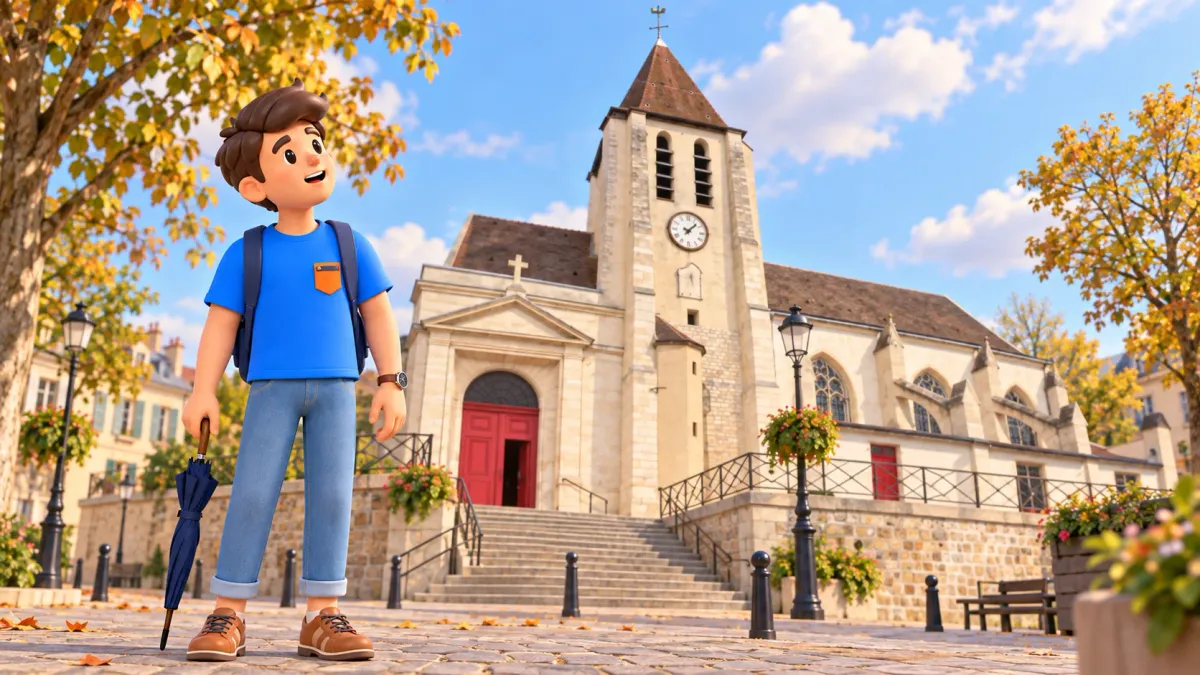
Charonne makes a rewarding Paris walk when you want to understand a small neighborhood without collecting a long list of landmarks. Rue Saint-Blaise leads towards an old church, with the former parish cemetery still beside it. Together, street, church and burial ground reveal something of the village that became part of the capital while retaining traces of its earlier shape.
Allow around two hours between Maraîchers and Gambetta metro stations. The main stops are Rue Saint-Blaise, Saint-Germain de Charonne church and Charonne cemetery. This is a daytime walk built around the church exterior and a short cemetery visit. Going inside the church is optional and depends on services. A full meal or a separate Père-Lachaise walk needs additional time.
A two-hour walk through old Charonne
Start at Maraîchers on metro line 9. Follow Rue des Pyrénées towards Rue Vitruve, then turn along Vitruve towards Rue Saint-Blaise. From their junction, near Place des Grès, take Saint-Blaise towards the church. Its bell tower gives the street a recognizable destination. Check street names at junctions rather than following the skyline alone, particularly while crossing traffic.
The church stands at 4 Place Saint-Blaise. Look at it from the square first, then step inside briefly if the circumstances allow. For the cemetery, use the main entrance at 119 Rue de Bagnolet. Leave through the same gate afterwards, follow Bagnolet towards Rue des Pyrénées, and take Pyrénées uphill to Place Gambetta. Finish at Gambetta, served by metro lines 3 and 3bis.
A workable estimate gives 25 minutes to Saint-Blaise, 25 to the church, 25 to the cemetery and 45 to all transfers, a short rest and reaching the final station. The church allowance includes 15 minutes outside and an optional ten inside. Those 120 minutes are a planning estimate, not a measured duration. Add the journey from your accommodation to Maraîchers separately.
Try RoadMe for a fully worked-out personal trip plan built around your dates, interests, pace and budget. A coherent day-by-day itinerary is much more convenient to use while traveling, giving this Charonne walk a suitable place among your other visits and breaks.
For an ordinary daytime schedule, 2–4pm is a useful example. It leaves room before the cemetery closes and avoids the usual Sunday morning Mass. It does not guarantee an available church interior: weddings, other ceremonies or temporary restrictions can change access. If that happens, keep the exterior stop and continue. The walk still has a clear purpose without waiting for a service to finish.
What remains of the village?
Charonne became part of Paris in 1860. Before that it was a village, with vines cultivated on the surrounding slopes. Its spatial relationships are more useful for this walk than a catalogue of former trades. The street leads to the church, and the cemetery remains beside it. That arrangement helps explain how the neighborhood once organized everyday life and communal occasions.
You are also walking through a contemporary residential district. Small houses coexist with larger developments, cafés and ordinary traffic. Treating it as a perfectly preserved medieval village would miss the interesting part: older street directions and buildings continue to function within a changing city. Look for the connections between periods rather than trying to remove everything modern from your view.
Choose one observation to guide you. What makes this stretch feel intimate: its short perspective, the scale of doorways, the proximity of façades, or the tower above them? You do not need to answer through every architectural detail. A few attentive stops give the walk a personal focus and help you remember a neighborhood rather than just a sequence of map pins.
Rue Saint-Blaise: follow the street's perspective
The section between Rue Vitruve and the church is the focus here. Smaller façades and the rise towards the tower give it a clear visual direction. Further along Saint-Blaise towards Boulevard Davout, the buildings change character. Keeping to this compact northwestern stretch preserves the walk's theme without turning it into an exploration of the entire district.
Pause near the start of the section, then again closer to the church square. First take in the overall perspective; later notice how the tower and tiled roof relate to neighboring houses as you approach. The church emerges above everyday façades. That relationship makes it part of an inhabited street, rather than an isolated monument visited only for a single photograph.
Saint-Blaise takes its name from a chapel dedicated to the saint within the church; the present street name dates to 1867. Some older houses date from the eighteenth century, though later restoration and rebuilding have also shaped the streetscape. Its historical appearance does not mean every façade survives unchanged from medieval times. This small amount of context is enough to enrich a first walk.
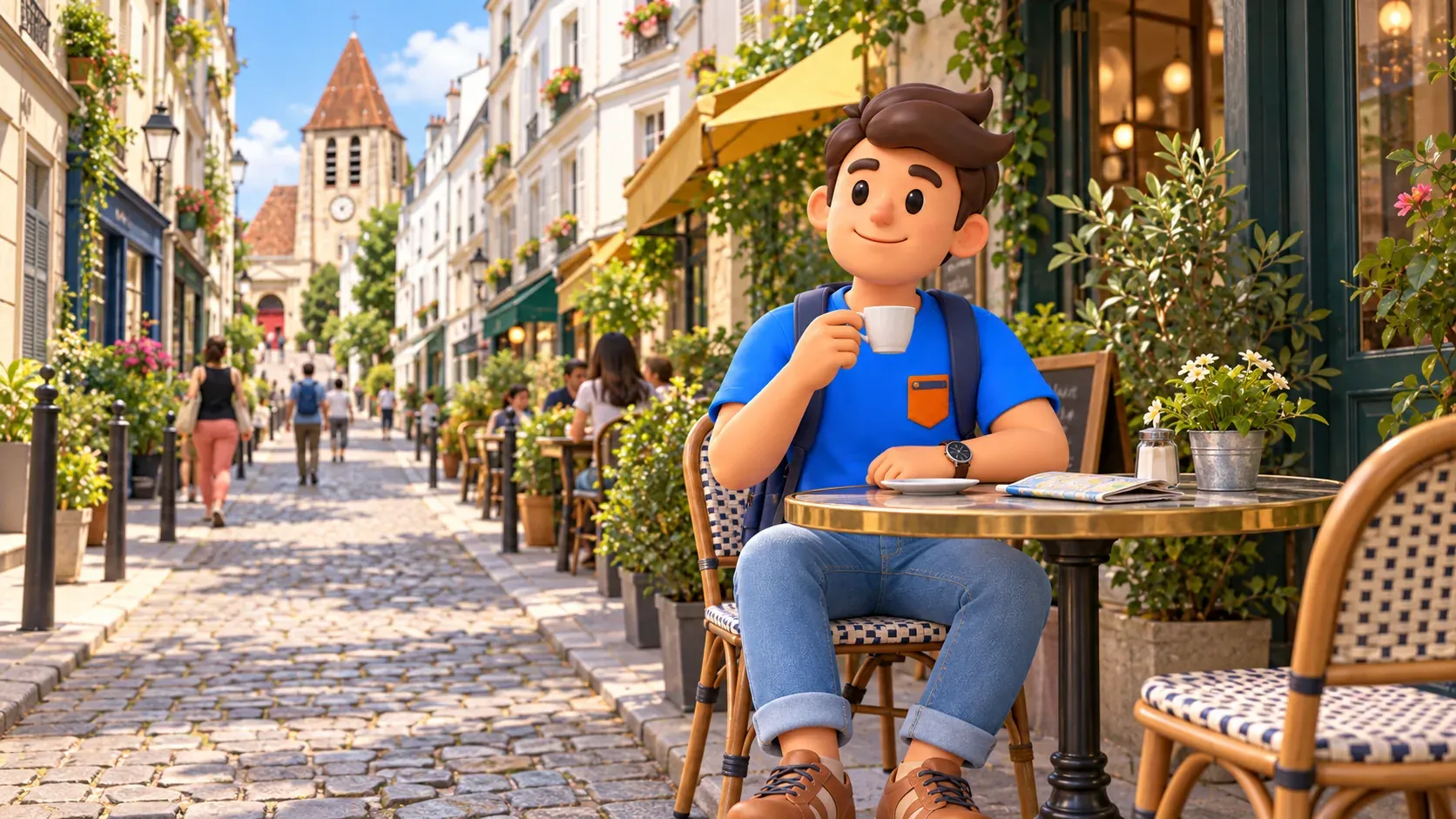
Wear shoes comfortable on uneven paving. Choose photograph positions that leave doorways, café entrances and the walking route clear. Terraces and planting give the street an everyday character, but their appearance can change. Look at how the space works instead of expecting to reproduce the decoration in an old image exactly.
If you want coffee, take a short break here before the cemetery, choosing a place actually open that day. Waiting for service or ordering a full meal requires extra time. The two-hour plan does not depend on one business: the street and gradual approach to the church are its main attraction. A modest pause simply helps keep you attentive for the next stop.
Saint-Germain de Charonne: a church shaped over centuries
Saint-Germain de Charonne has a medieval core, but the church took shape in stages. Gothic parts from the thirteenth and fifteenth centuries sit alongside elements from other periods. This is more accurate than imagining a single twelfth-century building that never changed. From the square, consider the tower, roof and entrance as different parts of a long architectural story.
The steep-roofed bell tower is visible while approaching along Saint-Blaise. At the entrance, notice the steps, pale stone and classical treatment of the doorway. Following an eighteenth-century fire, the former western entrance disappeared and a new entrance was created on the south side. That brief history explains why the doorway greeting visitors does not look Gothic, although much of the church does.
Begin far enough back to see the overall silhouette, using whatever space is available in the square. Then approach the steps and compare the doorway's horizontal lines with the tower's vertical emphasis. You need not photograph every detail. One general view and one chosen feature support this walk better than trying to assemble a complete architectural survey in fifteen minutes.
If the church is open and no service or ceremony prevents a visit, step inside for a few minutes. Look at the nave spaces and the light through the stained glass. The current windows were made between 1950 and 1958, showing that the building's history continued into the twentieth century. Older architecture and later colored light give a short visit enough substance without locating every artwork.
This remains a working place of worship. Enter quietly, follow instructions and avoid moving through occupied areas for a better camera angle. If the doors are closed or a ceremony is under way, the exterior already conveys the main idea. Your shortened walk may take slightly less than two hours; there is no need to fill every spare minute or wait until access becomes possible.
The small cemetery beside the church
An old parish church with its cemetery still beside it is unusual in Paris. Here the relationship connects the building with the history of its local community. The cemetery became communal in 1791 and was incorporated into Paris with Charonne in 1860. Think of it as a continuation of the old village core rather than a competitor to the much larger Père-Lachaise.
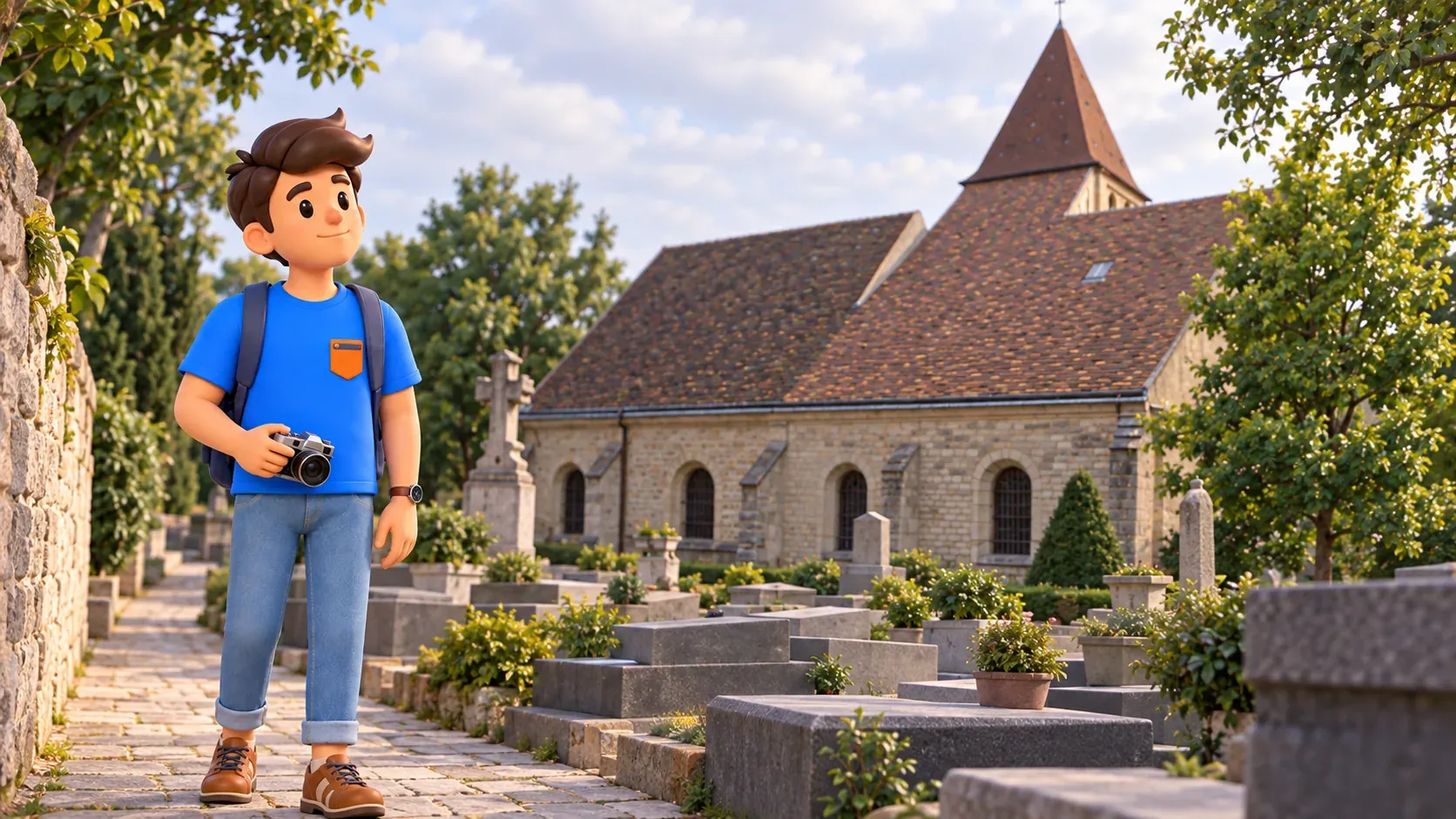
Allow around 25 minutes for a few accessible paths. From this side, the church changes character: a close stone wall, sloping roof and gravestones in the foreground replace the street perspective. The new angle helps you understand the same building differently. You do not need to visit every burial or compile names beforehand to appreciate the relationship between church and cemetery.
It is an active cemetery where relatives may be visiting. Keep your voice low, give others space and leave private ceremonies out of photographs. Stay on paths, do not sit on tombs or rearrange flowers for a picture, and eat elsewhere. If people or maintenance work occupy a section, choose another available path without trying to complete a fixed checklist.
The number of famous graves is not the measure of this visit. Charonne's interest lies in the adjacency of church, modest burial ground and surrounding residential streets. After a few attentive observations, you can return towards the gate. A short, respectful stop preserves time for the last part of the route and avoids a rushed departure as closing approaches.
Opening times and practical access
Checked on 13 October 2026, the church's published opening times are Monday 9am–7.30pm, Tuesday–Saturday 8am–7.30pm and Sunday 8.30am–7.30pm. These describe building opening, not permission to walk around during worship. Consult the parish calendar before a separate interior visit. Office opening times and service schedules are different kinds of information.
For the cemetery, the published period from 16 March to 5 November 2026 gives Monday–Friday 8am–6pm, Saturday 8.30am–6pm and Sunday 9am–6pm. Entry stops and visitors begin leaving fifteen minutes before closing. For a later trip, check the seasonal timetable rather than carrying the summer evening allowance into winter.
The main cemetery entrance is at 119 Rue de Bagnolet. The secondary entrance on Chemin du Parc-de-Charonne also serves visitors with reduced mobility, but some areas remain difficult to negotiate. There are no toilets inside. Slopes, paving and the church's entrance steps need individual assessment; this itinerary and its metro stations should not be assumed entirely step-free.
Make space for Charonne in your trip
The basic public-street and cemetery walk needs no admission ticket. Coffee, meals and separate activities are additional expenses. In rain, shorten the outdoor stops, take care on wet paving and do not treat the church as guaranteed shelter. If the cemetery closes unexpectedly, the street and church exterior still provide a smaller walk.
To combine quiet neighborhoods, museums and your favorite themes, use RoadMe for a fully worked-out personal plan of the whole trip. Following an itinerary tailored to your interests and pace is much more convenient and effective in the app than arranging each day from disconnected lists.
Finish at Gambetta. For a different kind of Paris cemetery visit, set aside another slot for our two-hour Père-Lachaise walk to well-known graves. The routes have different purposes: Charonne explores the link between street, parish and former village, while Père-Lachaise introduces a larger memorial landscape. After this smaller walk, leave the next part of your day flexible enough to suit your own energy and interests.


