
Père Lachaise in Two Hours: Music, Literature and Old Paths
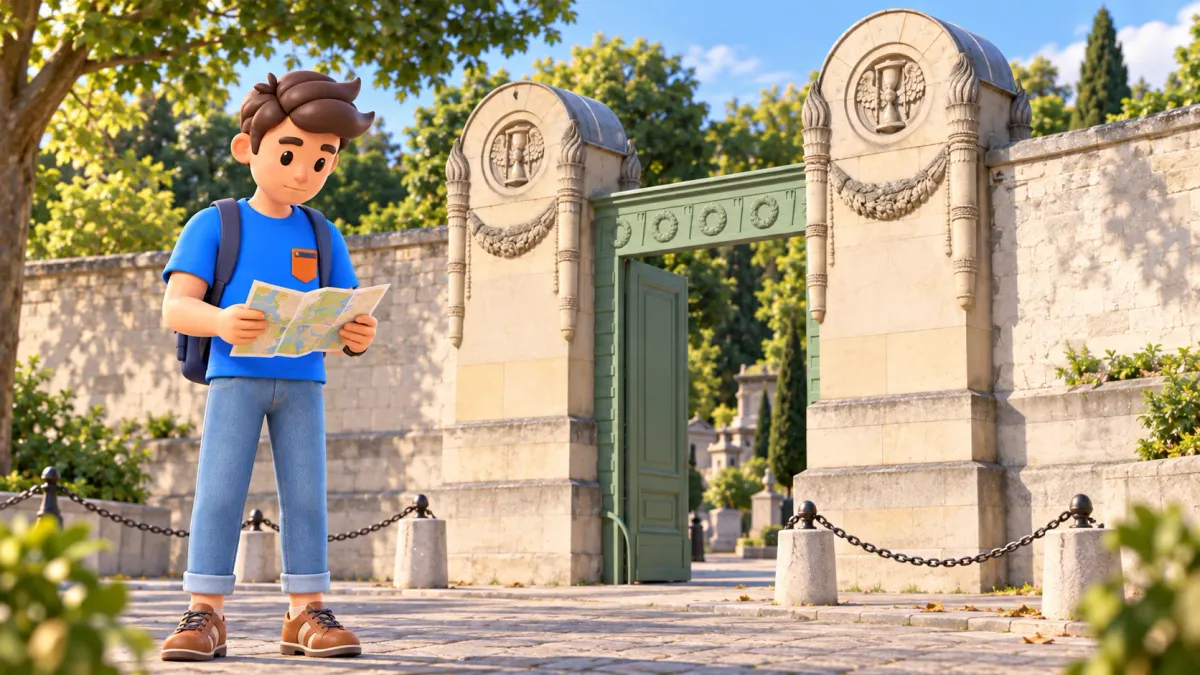
Père Lachaise offers a way to understand Paris through the memory of people whose writing and music travelled far beyond the city. A short visit can connect familiar names with expressive sculpture, older architecture and leafy paths. Choose a few stops for your first visit, allowing time between them to notice the setting.
This walk allows roughly two hours inside the cemetery. It starts at the Gambetta entrance on the upper side, visits Oscar Wilde, Édith Piaf, Frédéric Chopin and Jim Morrison, and finishes at the Rue du Repos exit. Père Lachaise remains a working cemetery, so a thoughtful pace and consideration for bereaved families belong at the heart of the outing.
A two-hour route from the upper entrance to the old paths
For this order, use Porte Gambetta at 55–57 Rue des Rondeaux, on the upper side of the cemetery near Gambetta station. The monumental main gate on Boulevard de Ménilmontant is elsewhere.
The four stops are Oscar Wilde in Division 89, Édith Piaf in Division 97, Chopin in Division 11 and Morrison in Division 6. The first two lie on the upper plateau; the following pair belong to the older hillside section. Finish at Porte du Repos, 16 Rue du Repos, on the Philippe Auguste station side. The overall direction takes you from the upper area towards the lower part, although individual paths still have slopes and uneven surfaces.
Take the official plan marking notable burial places. A general layout identifies divisions and paths but may omit individual names. Avenue Circulaire and Avenue Transversale No. 3 provide useful upper-area references; transverse avenues and Avenue de Saint-Morys help with the descent. In the older area, check path names as well as the direction indicated on a screen. A straight line across neighbouring graves is not a walking route.
A suggested allowance is 15 minutes for entry and orientation, 15 each at Wilde, Piaf and Chopin, 10 at Morrison, around 35 for transfers and 15 as an exit buffer. That totals two hours, but it is an estimate rather than a measured timetable. Travel to the cemetery, a café stop and a lengthy search for a grave require additional time outside this allowance.
To make this walk part of a trip shaped around your interests, try RoadMe for a fully worked-out personal itinerary using your dates, pace and budget. A complete day-by-day plan is much more convenient to use on the trip, combining favourite subjects with time to relax.
If locating the first grave takes longer than expected, reduce the number of stops. A division is a substantial area, and its number does not identify an individual monument. Seeing three chosen places attentively and leaving calmly is better than speeding along uneven paths to reach a fourth. Keep the return to the exit in mind before making your final stop.
Why the setting combines a garden with a city of stone
The cemetery opened in 1804 as the Cemetery of the East, beyond the Paris boundaries of the time. Architect Alexandre-Théodore Brongniart used existing hillside paths and vegetation in a landscaped composition. The older lanes therefore often curve, revealing monuments gradually. Their arrangement makes more sense when understood in relation to the terrain and the history of the property.
The name recalls François de La Chaise, a Jesuit and confessor to Louis XIV who enjoyed staying at the order’s country estate here. The cemetery was established long after his lifetime.
An extension onto the Charonne plateau in 1850 established the contrast between the older garden cemetery on the hillside and the more orderly upper area. This walk moves between those settings. Compare a long avenue, the density of memorials and a bend in a path.
Oscar Wilde: literature expressed through sculpture
Your first stop is Oscar Wilde’s grave in Division 89. The Irish writer maintained close connections with Paris and wrote his play Salomé in French. His presence here recalls the city as a meeting place for different literary traditions. For a short visit, bring to mind a work or character you know, then consider how the writer’s memory is expressed in stone.
Wilde died in Paris in 1900 but was initially buried at Bagneux. His remains were transferred to Père Lachaise in 1909, and Jacob Epstein’s monumental sculpture was installed on the tomb in 1912. Death, reburial and the creation of the memorial belong to separate moments.
Notice the substantial single form and the stylised sphinx image. It differs from a familiar portrait bust or family chapel. View it from the permitted approach and respect protective barriers. Kisses, inscriptions and marks on the stone or its protective surfaces are unnecessary expressions of admiration.
Édith Piaf: a familiar voice and a family story
Continue to Division 97 using the upper-area plan. Piaf rests in the Gassion-Piaf family grave. Several names may appear on the memorial, so do not rely only on the singer’s stage name. The burial place returns a celebrated performer to a family story, changing the idea of a monument devoted entirely to a single public figure.
Piaf grew up partly in Belleville, and her connection with eastern Paris gives the stop another layer of meaning. La Vie en rose and Non, je ne regrette rien belong to the cultural memory many visitors bring to the city. Save listening for after your visit: sound equipment and musical instruments are prohibited in the cemetery, except with prior exceptional authorisation.
The family vault also holds her father, her daughter Marcelle and her last husband, known as Théo Sarapo. Noticing the names places human relationships behind the stage image. The connection between a voice, neighbourhood, family and listeners’ memory is enough to give this stop substance.
After Piaf, head towards the older section along paths shown on the official plan, using the transverse avenues and the direction of Avenue de Saint-Morys. This transfer is longer than an approach within one division. Avoid adding every familiar surname encountered along the way: the walk already has a selected literary and musical thread.
Chopin: music remembered in a gesture and a portrait
Frédéric Chopin’s grave is in Division 11. The Polish composer and pianist lived in the nineteenth century, and his music gives the stop a personal connection even for travellers who seldom visit cemeteries. Choose one piece you know and consider the impression of its creator that you have formed through hearing his work.
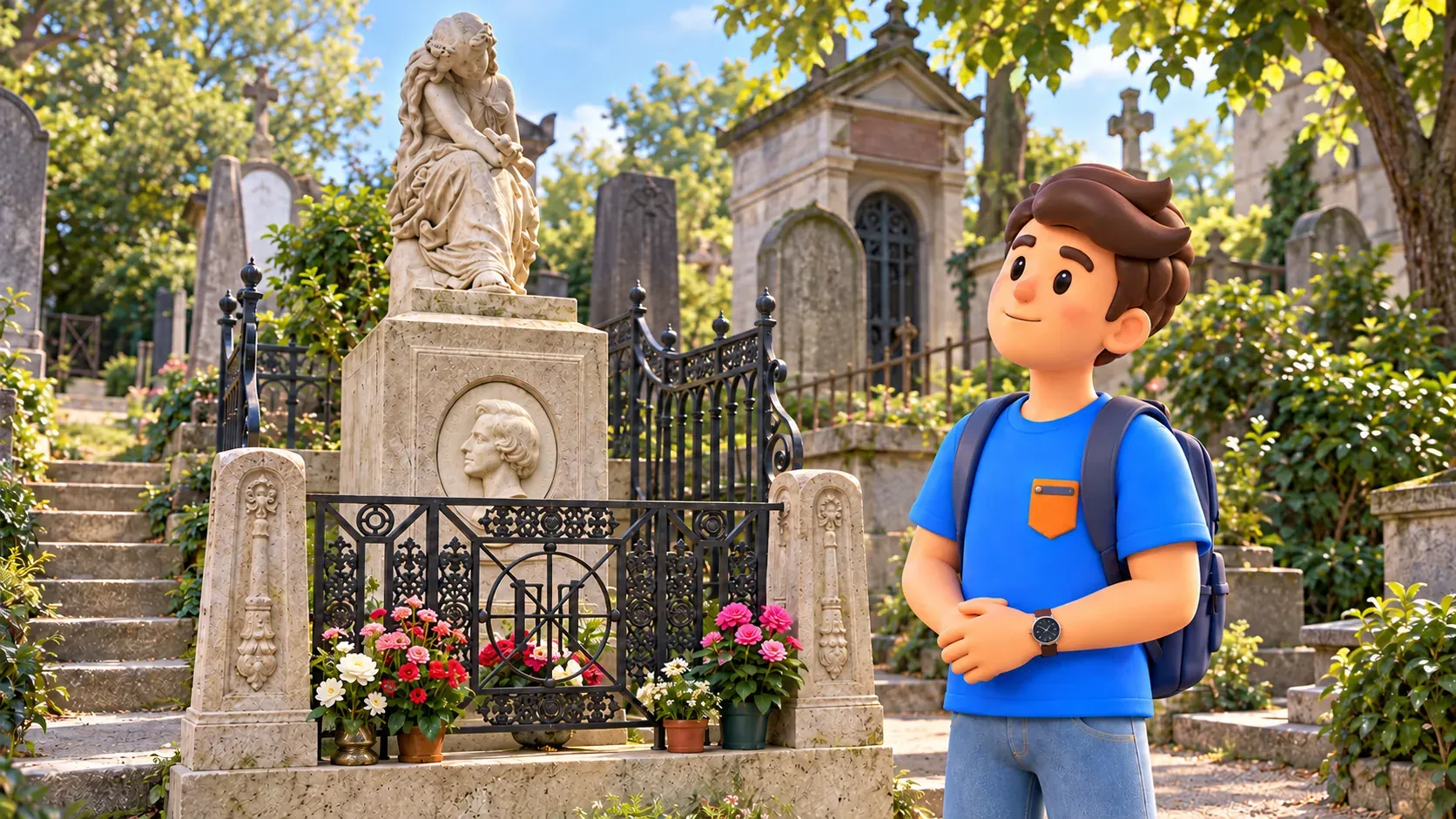
The memorial features a grieving muse and a portrait medallion. Compare their purposes: the portrait preserves a recognisable individual, while the allegorical figure conveys loss through posture and gesture. These details invite you to look at the monument as sculpture, giving the stop more meaning than simply confirming that a familiar name has been located.
Observe the folds of the drapery, the inclination of the head and the figure’s relationship to its pedestal from a permitted path. An iron enclosure separates the burial place from the passage; stay outside it. You do not need to rearrange flowers, lean on the stone or move between adjacent memorials for a closer photographic angle.
Jim Morrison: remembering a poet and musician
The final selected grave is in Division 6. Jim Morrison is remembered as The Doors’ singer and a poet; he died in 1971 and was buried in Paris. The stop brings different musical eras into the same walk. Following Chopin and Piaf, consider how performance and the relationship between a musician and an audience changed across those worlds.
Remembering his work is more useful here than repeating unverified accounts of his death. A respectful visit needs neither a legend nor an attempt to recreate a concert atmosphere. If other visitors occupy the approach, wait in a clear area or settle for a broader view, keeping enough space for people to pass rather than blocking the narrow route.
Afterwards, return towards Porte du Repos on marked paths. In the lower-area official plan, Avenue Casimir-Périer and Avenue de la Conservation provide references towards the exit zone. Do not assume that a nearby stretch of wall contains a gate: exits are in specific locations, and reaching the right one takes part of your time allowance.
Between the stops: stone, trees and birds
Give some attention to memorials without famous names. A small chapel, a simple slab and a portrait relief express remembrance through different means. Compare silhouette, material and ornament from the path you are already using.
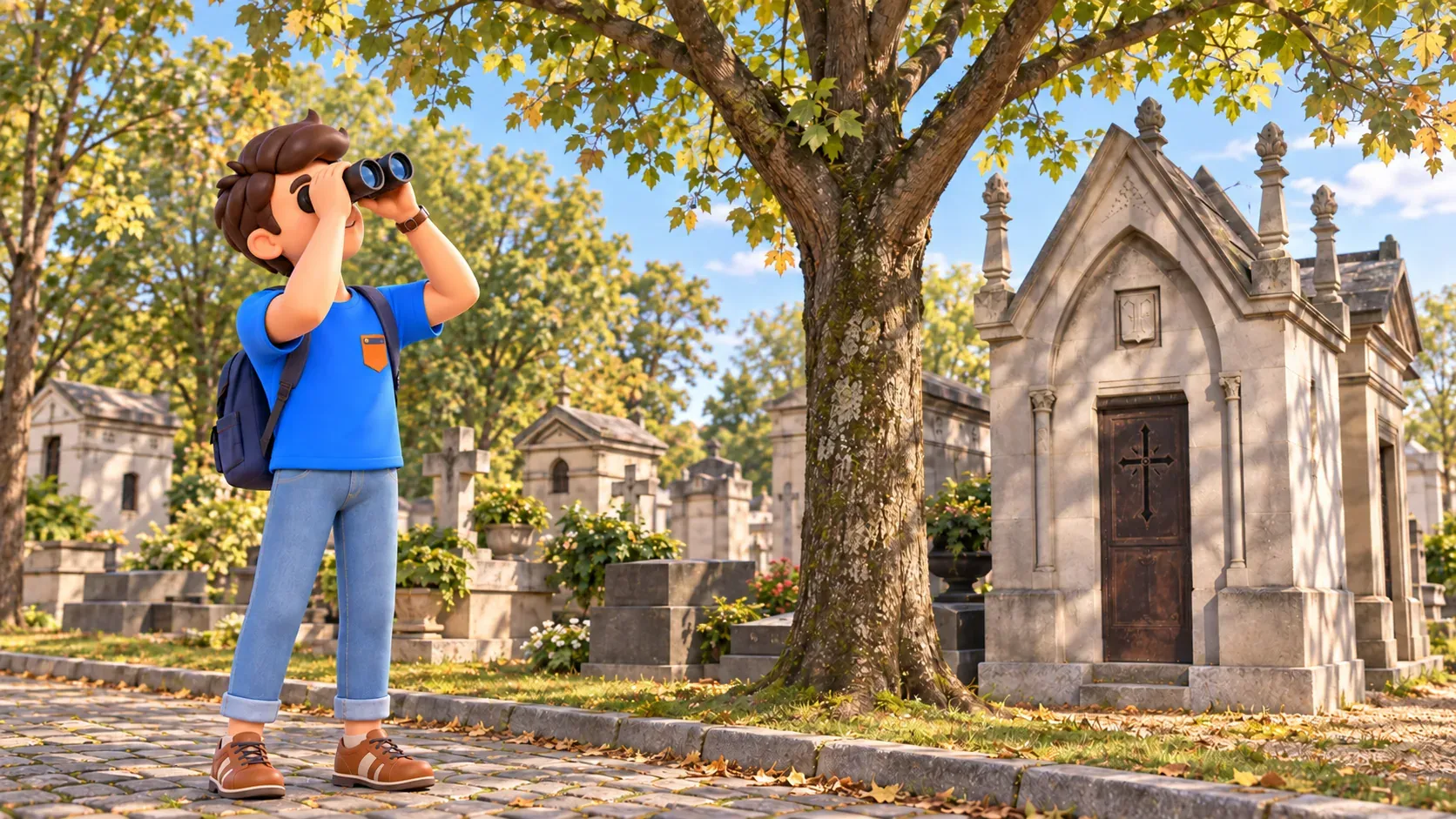
The greenery also belongs to the place’s history. The city’s nature information describes trees and a variety of birds, including tits, thrushes and woodpeckers. You might pause beneath the canopy and look upwards; small binoculars can help with observation from a distance.
Remain on permitted passages, avoid nests and do not feed animals. If the green surroundings interest you more than the names, use a few minutes of your allowance for observation and reduce the number of graves. The illustrations convey the visit’s atmosphere and subject. An actual site plan is needed for orientation; a drawn scene does not supply navigation.
Admission, opening hours and the ground underfoot
Independent admission is free, and the cemetery opens daily, including public holidays. Purchasing a guided tour is a separate service rather than an entrance requirement. The cemetery itself does not organise tours and has no guides that it designates as official or accredited. If you prefer a guided visit, check arrangements with the individual provider you choose.
From 16 March to 5 November, regular hours are 8am–6pm on weekdays, from 8:30am on Saturdays and 9am–6pm on Sundays and public holidays. From 6 November to 15 March, closing is at 5:30pm. Admission stops and evacuation begins 15 minutes before closing. Check the schedule for your travel date and leave time to reach the exit, particularly in winter.
The terrain is hilly, with some narrow old passages, cobbles and uneven ground. Access for visitors with reduced mobility does not make every grave approach suitable. Amandiers and Réunion entrances have steps; this itinerary uses Gambetta and Repos. If needed, discuss an appropriate part of the visit with the administration beforehand rather than assuming complete accessibility across all four stops.
Wear comfortable shoes and shorten the walk after rain if surfaces make it difficult. Exceptional closures may occur in unfavourable weather. Keep a food break for a café outside, since picnics are prohibited. Funeral ceremonies and visits by relatives take priority over a tourism timetable, so occasionally the right decision is to omit a section or change your order.
Connecting the walk with your wider Paris trip
The suggested plan brings together literature, music and sculpture, but one personal interest may give a stop greater importance. If Chopin is your main reason for coming, spend longer in the old section. If Piaf matters most, begin on the upper plateau and feel free to choose fewer than four places. Your visiting time changes with your selection, while the exit remains an essential reference.
For a trip focusing on music, literature or small museums, use RoadMe to prepare a personal travel plan around your interests, pace and budget. It makes it easier to distribute different experiences across your days and use a complete itinerary while travelling.
For another day, our Montparnasse walk with the Bourdelle and Zadkine studios offers a separate half-day plan with its own museum conditions. After Père Lachaise, leave space for ordinary city life: lunch, rest and the journey onwards.


