
A Bernini Half-Day Walk: Barberini to Piazza Navona
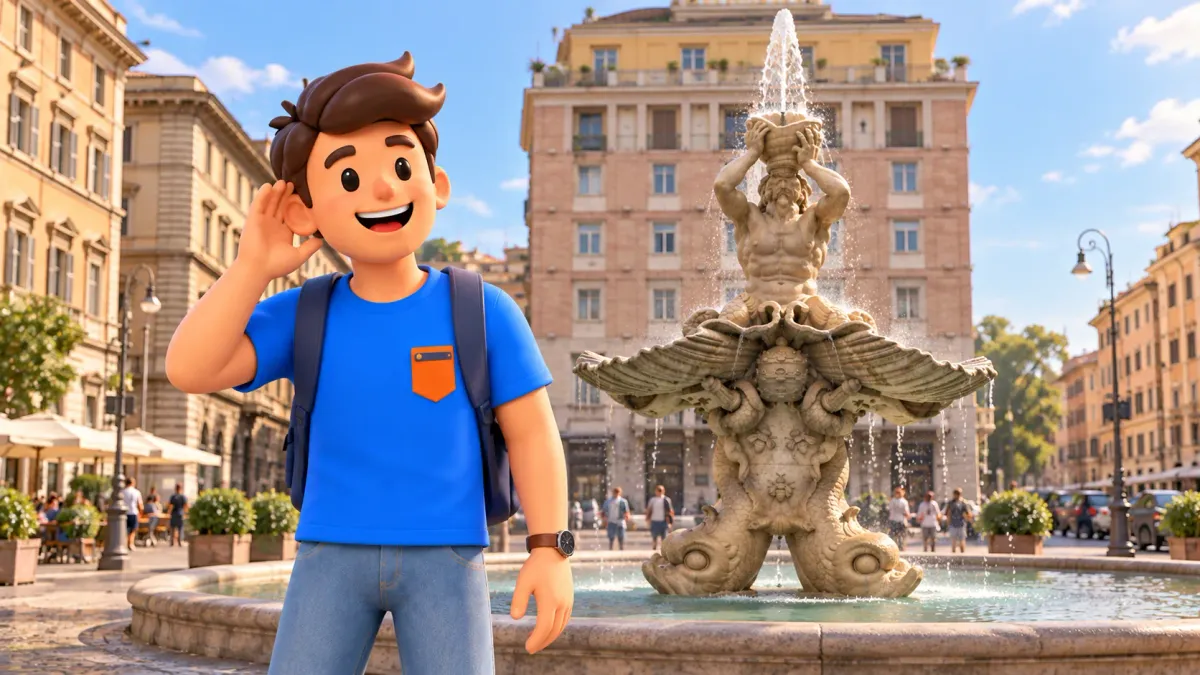
Bernini is easy to discover while walking through Rome. His fountains still animate everyday squares, while a sculptural ensemble inside a small church changes what marble seems capable of doing. A first introduction needs a few connected experiences. It does not require collecting every masterpiece between the Vatican and the Borghese Gallery in one morning.
This half-day route starts on Piazza Barberini and finishes on Piazza Navona. Allow around four hours for two nearby fountains, one chosen church interior, Sant’Andrea al Quirinale outside, a rest and a walk across the centre. The principal interior stop is the Cornaro Chapel, containing the Ecstasy of Saint Teresa, in Santa Maria della Vittoria.
Choose a morning for one thoughtful interior visit
The walk suits anyone curious about how Baroque art works: flowing water, turning bodies, expressive drapery and an artwork’s relationship with its setting. No specialist preparation is needed. Leave room to look rather than treating the morning as an examination in art history.
For an entire trip shaped around art and your other interests, try RoadMe: the app creates a personal day-by-day plan based on dates, pace and budget. It makes fitting walks, museums and rest together much more convenient, so a considered itinerary is easier to use while travelling.
Choose an ordinary Tuesday-to-Saturday morning for the example below, after checking the church’s calendar. Sunday Mass at Santa Maria della Vittoria begins at 10:30, directly within our suggested visit. An open door does not mean sightseeing is permitted during worship or prayer.
The four hours run from the Triton Fountain to the Fountain of the Four Rivers. Reaching Barberini, onward transport and a proper lunch take additional time. Start and finish are different places; returning to the starting square is not included. This is a linear walk with a deliberate early detour, rather than a loop.
How to divide the half-day
| Minutes from the start | Programme |
|---|---|
| 0–20 | Triton Fountain on Piazza Barberini |
| 20–30 | Short move and the Bees Fountain at the beginning of Via Veneto |
| 30–55 | Urban pavements uphill towards Santa Maria della Vittoria |
| 55–85 | One interior: the church and Cornaro Chapel |
| 85–110 | Walk towards Sant’Andrea and the Quirinal |
| 110–120 | Sant’Andrea’s façade outside |
| 120–140 | Twenty-minute rest |
| 140–200 | Walk through the historic centre to Navona |
| 200–240 | Fountain of the Four Rivers and a relaxed finish |
Every interval is an estimate, not a measured walking time. A 9:30 start would put the church at approximately 10:25–10:55 and the finish at 13:30. The final hour-long connection allows for orientation and road crossings. It does not include an additional Pantheon or museum visit.
The route first heads uphill and east from Barberini, then turns towards the Quirinal before continuing west. That bend serves the chosen artwork. Expect slopes, entrance steps and stretches of cobbled surface. If a step-free route is essential, investigate the particular pavements and church entrance separately; this itinerary does not establish complete accessibility.
The Triton: begin with moving water
Use current crossings to reach a suitable public observation point beside the fountain. Barberini remains a busy urban square rather than a quiet museum courtyard. The twenty-minute stop lets you consider the whole silhouette before choosing one detail. A completely empty photograph is unnecessary for a satisfying first encounter.
Bernini created the fountain in 1642–1643 for Pope Urban VIII of the Barberini family. Four dolphins support an enormous shell, above which Triton raises a conch to his mouth. Real water turns the mythological figure’s effort into continuous action. The sculpture and the jet belong to one experience.
Look at the support. Instead of a conventional heavy central pillar, intertwined bodies leave open space between them. The large composition feels unexpectedly lively. Remember that solution for Navona: comparing two fountains can explain more than trying to learn the names of every decorative feature immediately.
The bees on the coats of arms identify the patron’s family. Seventeenth-century public art often joined urban beauty with the representation of power. That connection provides a useful thread for this walk without requiring a complete reading of inscriptions or a lesson covering every heraldic symbol.
The Bees Fountain: the same imagination at a smaller scale
Continue to the beginning of Via Veneto for the small Fontana delle Api. The ten-minute block includes the short move and a look. Beside Triton’s expansive gesture, this is almost an intimate object: an open shell, a lower basin and three bees. A practical urban structure receives an imaginative sculptural form.
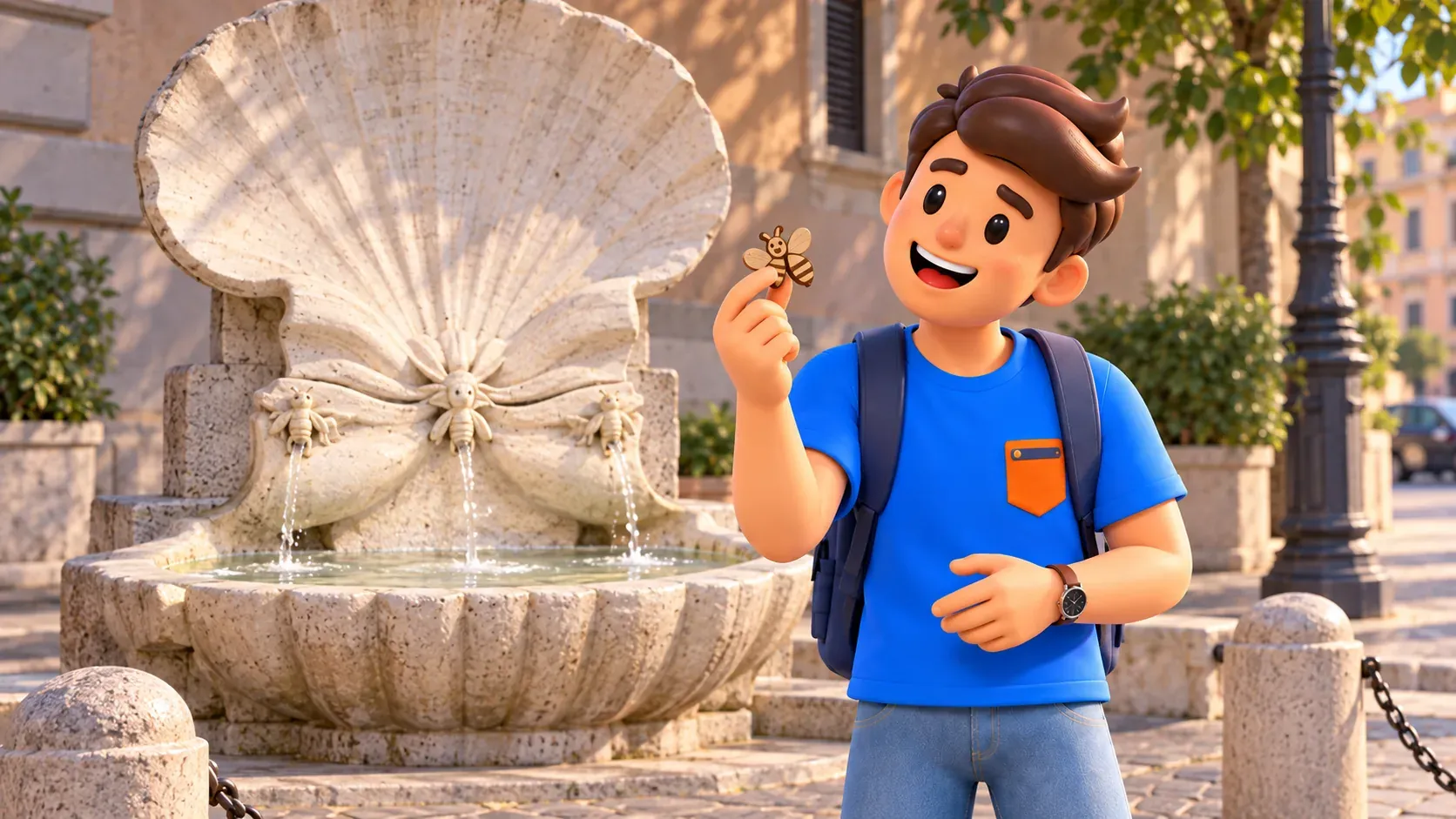
The design dates to 1644. Created as a public trough near the larger fountain, it originally occupied another corner of the square, beside Via Sistina. It was dismantled in the nineteenth century and reconstructed in 1915–1916 at its present Via Veneto position. Only small fragments of the original material survive in today’s monument.
Notice both Bernini’s idea and the object’s subsequent life. The shell now before you should not be described as entirely untouched seventeenth-century stone. Understanding its scale and original purpose is enough for this introduction. Historical water use also does not establish present drinking-water quality; bring your own bottle.
Walk uphill towards Santa Maria della Vittoria
Follow public pavements along Via Barberini towards Largo di Santa Susanna and Via XX Settembre, 17. The twenty-five minutes allow for signals and orientation. This is an ordinary city connection with traffic and crossings, rather than an uninterrupted pedestrian gallery.
Before entering, put food away and dress appropriately for an active place of worship. Keep conversation quiet. Do not build the visit around an essential photography session: check current instructions locally. Seeing images online does not grant permission to use any kind of equipment inside.
Carlo Maderno built the church in the early seventeenth century; Giovan Battista Soria designed its façade. Bernini’s contribution relevant here is the Cornaro Chapel. That distinction prevents a common mistake: a church containing a famous artist’s work does not automatically become a building designed entirely by that artist.
The Cornaro Chapel: marble becomes a scene
Allow around thirty minutes for the church and its principal ensemble. Begin slightly back, considering how the sculpture fits within its architectural frame. Then, where access allows, compare the softness of the face with deep folds and the rays behind the figures. Neither touching the work nor obstructing a passage is necessary.
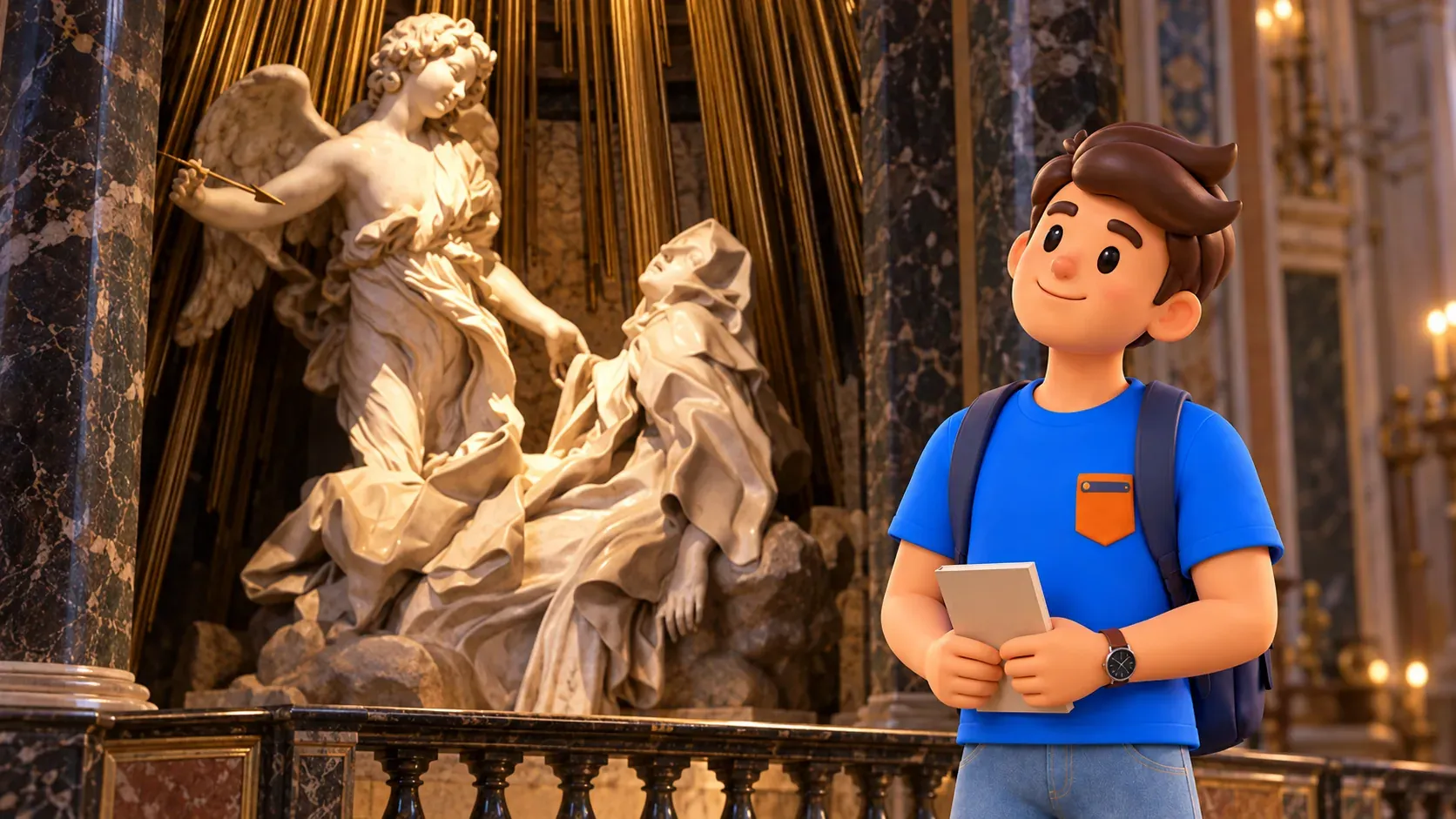
Cardinal Federico Cornaro commissioned the chapel; Bernini’s famous group was made in 1647–1652. It represents Teresa of Ávila’s mystical experience, described in her autobiography: an angel with an arrow and a state combining pain with spiritual joy. This is religious imagery of an inner experience, rather than documentation of a physical attack.
At the sides, members of the Cornaro family appear as though occupying theatre boxes. You become aware of people watching as well as the central figures. Sculpture and surrounding space work together: the chapel functions as a complete scene without requiring identification of every person or symbol.
There is no need to inspect every other chapel. One thoughtful stop preserves the walk’s theme. After the fountain’s noise, quiet, coloured stone and directed gestures provide another kind of encounter. Ask how the artist makes a composition feel active when there is no real moving water.
Visiting hours and a closed-door alternative
At the October 2026 check, the religious community lists sightseeing hours Monday–Saturday, 8:00–12:00 and 16:00–18:00; Sunday and solemnities, 9:00–12:00 and 16:00–18:00. Visits are not permitted during celebrations and prayers. This restriction matters more than the building’s broader opening hours.
Check the actual date with current community information before travelling. The 9:30-start example cannot simply be transferred to Sunday: it overlaps Mass. If choosing a later outing, recalculate the entire schedule around church closing, walking time and weather rather than retaining the same finish.
If the interior is unavailable, spend ten minutes outside instead of thirty inside and continue. The walk becomes approximately three hours forty minutes. Avoid waiting indefinitely for an unknown reopening or automatically adding another interior. This route deliberately includes one principal indoor ensemble.
Sant’Andrea and a Quirinal rest
From the church, head along Via XX Settembre towards Quattro Fontane, then follow Via del Quirinale to Sant’Andrea al Quirinale. Allow twenty-five minutes for the connection and ten for the exterior. Here Bernini’s architecture changes the street’s flat plane through a projecting entrance and curved framing.
An interior visit to Sant’Andrea is excluded. If church architecture interests you more than fountains, choose another day and our Quirinal walk. Adding that whole programme now would change both the duration and the character of this outing.
After the façade, retain twenty minutes for rest in a suitable available place. A vacant bench or café table is not guaranteed. Ordering a substantial meal may need longer; water and a simple snack can preserve the intended rhythm. Rest offers more value here than another stop added merely because it is nearby.
Use RoadMe to create a personal plan for the whole trip, fitting your Bernini walk alongside other interests, museums and quieter days. Set your pace and available time in the app to turn an appealing idea into a travel plan that is more convenient to follow.
Across the living centre towards Navona
Allow an hour for the final substantial connection: through Piazza del Quirinale, Via della Dataria and the Via Minghetti area towards Via di Pietra, then Piazza della Rotonda and Via Giustiniani towards Navona. Use current public passages and crossings. These are orientation landmarks for the corridor, not a promise of one permanently unchanged path through every future street work.
The Pantheon lies along the way, but admission is excluded, as are extra palace and church visits. If you decide to linger, move the finish accordingly. The longer connection can serve as a breathing space between artworks: other periods of Rome reappear before the Baroque spectacle takes over the square.
Four Rivers: compare the ending with Triton
Keep forty minutes on Navona for the Fountain of the Four Rivers and a comfortable conclusion. Bernini directed the project for Pope Innocent X Pamphilj, working with a substantial team of artists and craftspeople. A single famous name does not mean he personally carved every figure. The fountain was inaugurated in 1651.
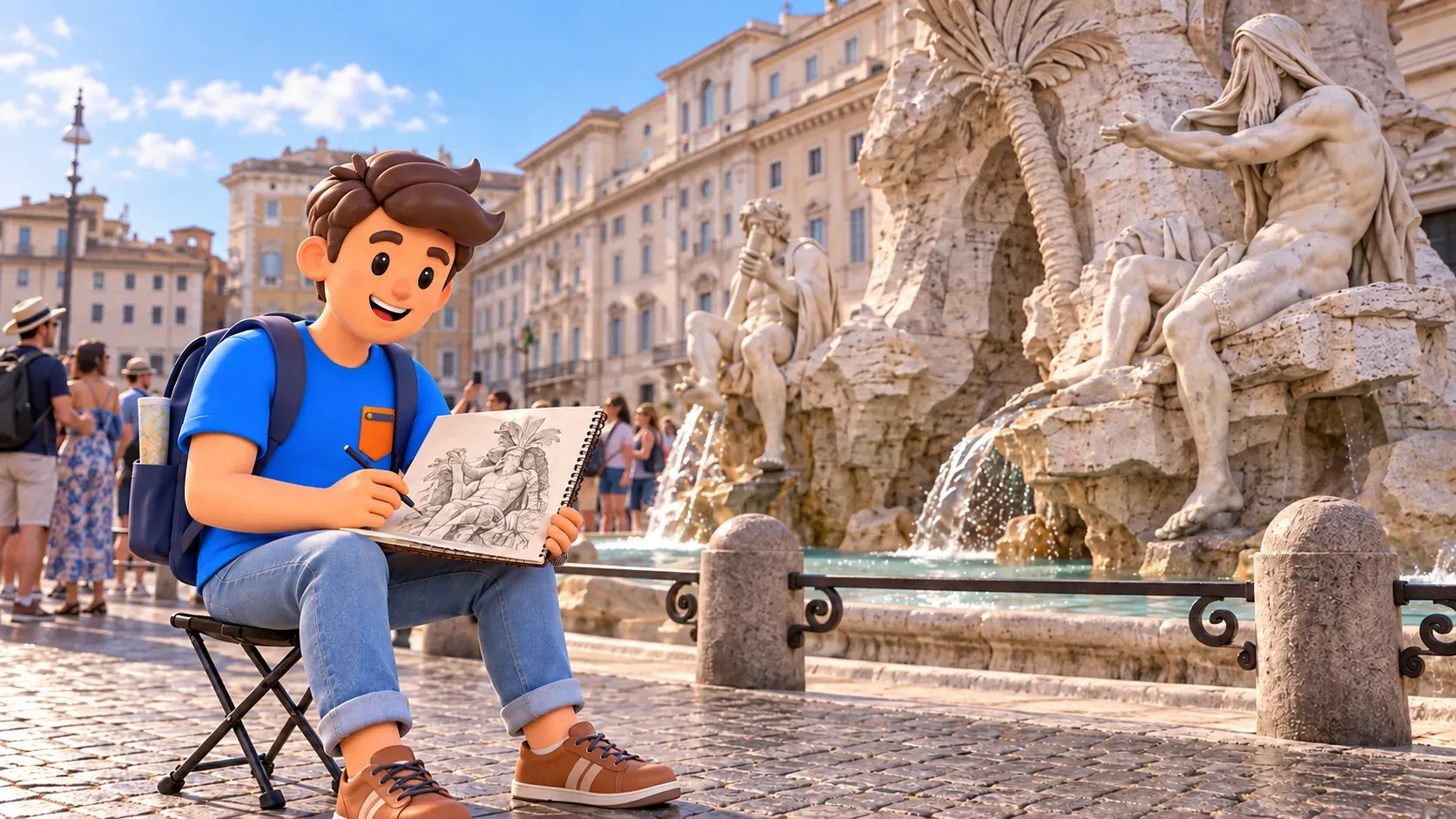
Look again at the support: a rocky mass with open spaces carries the tall obelisk. The solution noticed beside Triton now operates at monumental scale. The river gods represent the Danube, Ganges, Nile and Río de la Plata. Choose one figure and consider its position in relation to rock, water and neighbouring forms.
The Nile’s covered head refers to the then-unknown sources. A story claiming that he turns away from Borromini’s church is a city legend: the fountain was completed before that church was built. Correct chronology does not diminish the square; it distinguishes an entertaining tale from the artwork’s history.
The route ends here. Recall the changes in scale: a public fountain, a small urban shell and a complete sculptural scene inside a church. There is no need to extend the list by several more masterpieces. Half a day already provides a way to begin recognising Bernini’s visual language while keeping the desire to return.


