
Berlin’s architecture of memory: ruins, stelae and voids

In Berlin, inscriptions and museum objects are not the only ways to address loss. A preserved ruin, a deliberately created field of stelae or emptiness inside a building can draw attention to what is absent. Kaiser Wilhelm Memorial Church, the Memorial to the Murdered Jews of Europe and the Jewish Museum offer three different approaches. Begin without a long compulsory list: choose one place, understand its particular history and give it time. Architectural comparison is useful while it preserves each site’s specific historical meaning rather than replacing it with a general attractive idea about sadness or a damaged city.
This is not a short route through all three addresses. The church is in the western centre, the field near Brandenburg Gate and the museum on Lindenstraße. The independent frameworks below give 90 minutes to either outdoor outing and three hours to a selected museum visit. Accommodation travel is additional. Different days often work better than one crowded block. You can read, pause and return to ordinary city life without another immediate entrance. The purpose is to understand a place rather than satisfy a quota of difficult impressions. A shorter attentive visit remains complete if it respects the subject and your available time.
Give an attentive visit enough time
RoadMe makes preparing a personalised plan for your whole trip more convenient, distributing walks and museums across days according to your interests, dates and pace. Start planning in the app to leave time for content, pauses and comfortable journeys.
Begin with three questions: what does the place commemorate, what is physically before you and how may you visit it? A ruin is a surviving portion of a damaged building. A modern memorial is made later to address a historical event. A designed architectural void can be intentional rather than an unfinished room. These distinctions support more precise looking. Do not guess meaning from material or form alone: concrete does not explain itself, and damage without context cannot tell you who suffered, when or why. A few introductory lines may offer more than a long attempt to decode a space from appearance.
Do not demand a predetermined response from yourself. Some visitors notice sound and scale, others understand through biographies and documents, and some need conversation afterwards. Attention is measured neither by emotional intensity nor photograph numbers. Remain precise: different events, victim groups and commemorative decisions do not become identical because several places use emptiness or damaged material. Architectural methods can be compared without equating causes and responsibility. That boundary matters for a walk combining observation with historical respect. It lets curiosity remain open without making memory a set of interchangeable urban effects.
The Memorial Church: a retained ruin beside new buildings
Kaiser Wilhelm Memorial Church stands on Breitscheidplatz in Berlin’s western commercial centre. The old ruined tower and postwar architecture form an ensemble where the past is not concealed by a fully restored silhouette. Preserving the ruin resulted from public debate rather than a single predetermined solution. Architect Egon Eiermann revised his original design to incorporate the tower beside new volumes. The church and new bell tower were consecrated in 1961, while the ensemble’s completion continued until 1963. For a walk, the principle matters: a damaged fragment was kept visible and connected to the site’s continuing life.
From public parts of the square, look at how old and new change each other’s appearance. Begin far enough away to see the relationship, then approach available details. Entering every space is unnecessary. The ruin does not mean the whole church is abandoned, while a modern building does not cancel remembrance. Its commemorative role is also different from the field of stelae: this ensemble has its own context of wartime destruction and subsequent reflection. Architectural comparison cannot establish identical histories of suffering or bypass Nazi crimes. Urban memory consists of particular, different subjects rather than a general competition of losses.
For an exterior introduction, allow 90 minutes from a chosen public meeting point on Breitscheidplatz: 15 orienting, 25 comparing old and new, 20 for a quiet pause away from entrances, 15 returning to the meeting point and 15 in reserve. An example is 11am–12:30pm; hotel or station travel is excluded. Interiors remain a separate choice following the church calendar. From late 2026 the operator plans phased refurbishment of major postwar buildings, so views and access can change. Do not promise yourself angles completely clear of works. Our City West route offers a wider outing through the western centre.

The field of stelae: a new space with a specific dedication
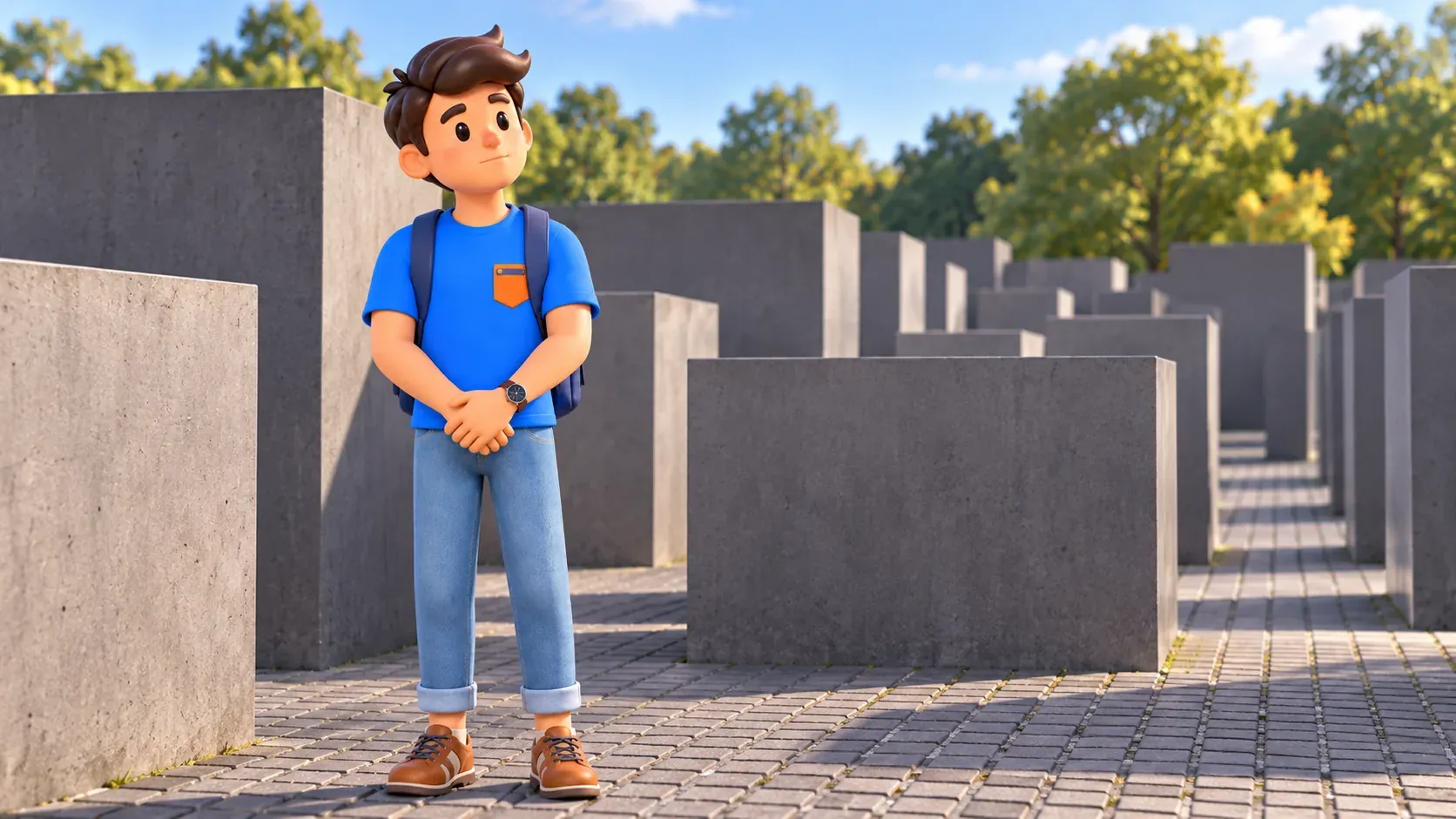
The Memorial to the Murdered Jews of Europe commemorates Jewish victims of the Holocaust. Peter Eisenman’s field of stelae opened in 2005. It is a created commemorative space, not a surviving camp, cemetery or ruined historical district. That matters: you encounter a modern way of addressing a crime rather than direct material evidence of the same kind as a damaged tower. Start with the memorial’s full name and brief historical context. Then notice repetition, passages, changing levels and visibility. The design can raise different questions; it does not replace knowledge of whom the place commemorates.
Do not treat the field as a puzzle requiring one compulsory feeling. Walk a small available section, pause at its edge and return. Seeking every effect or turning the space into a game is unnecessary. A short thoughtful introduction is enough. Rest, food and practical route discussions fit better outside the field, without disrupting others. The separate underground Information Centre offers a more documentary approach. It has its own visitor calendar and security procedures, so it is not an invisible part of a half-hour outdoor passage. Free admission does not remove possible waiting before an interior exhibition.
The 90-minute exterior option begins at the street exit of U Brandenburger Tor: 15 minutes approaching, 30 in a selected field section, 20 for a quiet pause outside it, 15 returning and 10 in reserve. An 11am start returns around 12:30pm. The outdoor field is free; the Information Centre is excluded. These are editorial allowances, not measured navigation or a required duration of reflection. In uncomfortable weather or fatigue, shorten the passage. Length of stay should not replace attention simply because the itinerary leaves spare time before another appointment or a walk through the centre.
The Jewish Museum: absence as an architectural decision
In Daniel Libeskind’s Jewish Museum building, the voids address the loss of Jewish life through expulsion, destruction and annihilation in the Shoah. They are an intentional architecture of absence rather than accidentally unfilled galleries. Not every void is accessible. Look from permitted visitor routes rather than trying to enter service areas to understand the design. Connect impressions of light, material and distance with the museum’s explanation. Your response remains personal, while historical meaning need not be invented from one striking fragment of concrete. Architecture can invite a question without answering every historical question on its own.
The museum itself is not reduced to the Holocaust and absence. Its core exhibition explores Jewish history and culture; architectural interpretation is one part of a visit. Make time for people’s lives, activities, relationships and different historical periods, so the account is not only about loss. Documents, objects and voices give spaces context. Choose one modest subject in the core exhibition and attend to it. For a first visit, this can be more useful than searching quickly for every famous architectural element while treating the rest as a gap between them. The museum remains a place of knowledge as well as spatial experience.
The suggested three-hour framework begins at the visitor entrance in the Old Building, Lindenstraße 9–14. Give 20 minutes to entry and orientation, 45 to available architecture, 60 to selected core displays, 20 to rest, 15 to exit and 20 in reserve. An example is 11am–2pm, finishing at the same entrance; accommodation travel is additional. It promises neither the entire museum nor every void and garden. Paid temporary exhibitions, tours and the ANOHA children’s world are excluded. Start at the visitor entrance instead of searching for a door directly in the expressive metal exterior of the Libeskind Building.
The core exhibition is free. The museum recommends reserving a time slot, although tickets are also available on arrival. Ordinary opening is Tuesday–Sunday, 10am–6pm, last admission 5pm; Mondays close. Additional 2026 closures include 14 November and 24 December. Temporary exhibitions follow their own conditions. Do not transfer an outdoor memorial’s calendar here or assume every museum programme is equally available. For a broader historical context, our Berlin Jewish heritage guide suggests an independent continuation while preserving distinctions between living culture, communities’ histories and places commemorating crimes.
Leave space for content and pauses
RoadMe helps prepare a personalised trip plan more conveniently and efficiently, distributing historic places, museums and ordinary walks around your interests and pace. Plan in the app so attentive visits receive enough time and fit comfortably with the other days.
You do not need all three places within one trip. The Memorial Church suits comparison of old and new in the western centre, the field an independent exterior introduction to a particular memorial, and the Jewish Museum a longer connection between architecture, history and culture. Agree with companions whether to discuss things immediately or after rest. Someone may have no ready words without being inattentive. Practical reserve helps finish without haste and choose a calm continuation. Every available pause need not be filled by another difficult historical subject. Leave room for a conversation to develop at its own pace.
Afterwards, name one fact learned and one architectural method noticed. Keep them distinct: a fact needs evidence; an impression describes your perception. You can note that a ruin was retained, a memorial created later or a void designed. One feeling cannot supply missing histories of people and places. The distinction makes an outing both meaningful and considerate. Memory in a city does not always resemble a restored façade with a concluded story. Sometimes it leaves a visible break, inviting you to learn why it exists rather than fill it with an attractive guess.


