
Barcelona seafront sculpture walk: from the Head to Gehry’s Fish
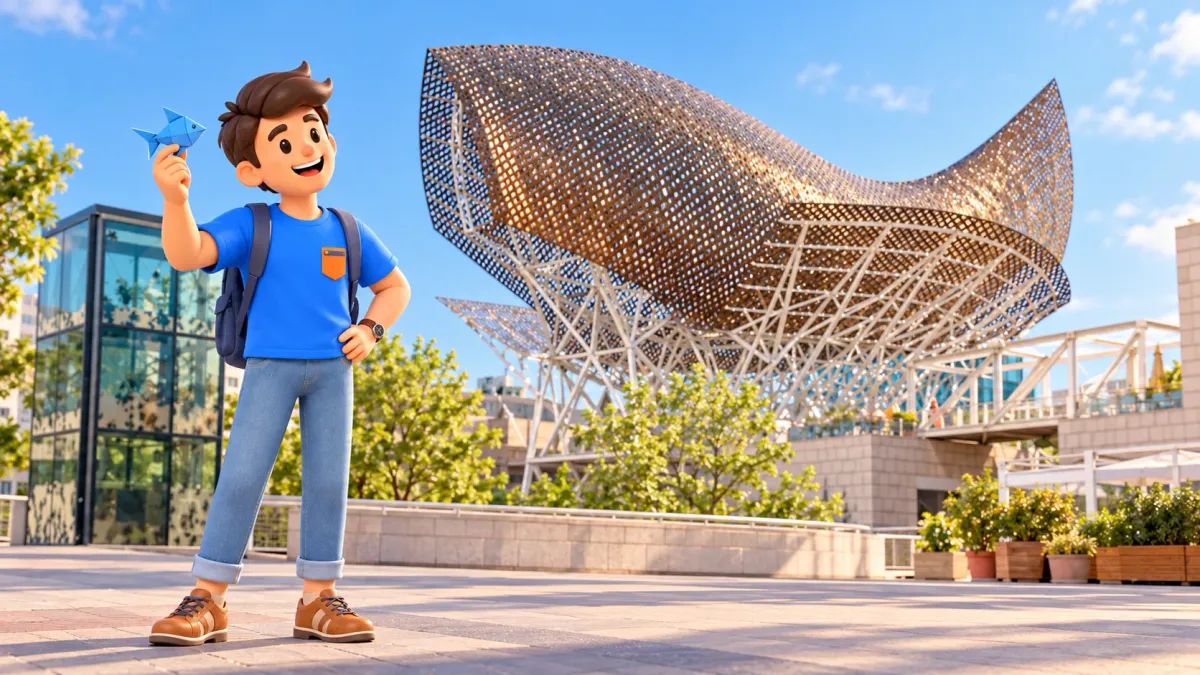
It is easy to walk Barcelona’s coast looking at the sea and barely notice the art beside it. The tall, colourful Barcelona Head, Rebecca Horn’s four windowed volumes and Frank Gehry’s shimmering Fish can seem part of the usual scenery. Connecting them deliberately reveals another story: how sculpture helped the city reshape its relationship with the shore.
Allow about two hours, 10:00–12:00, from Roy Lichtenstein’s El Cap de Barcelona via Horn’s L’Estel ferit to Gehry’s Peix beside Port Olímpic. All three stops are free exterior visits. There is time for the connections and a short rest, while swimming, lunch, museum galleries and returning to the start are additional activities.
Two hours and three ways of looking
Start beside Barcelona Head on Passeig de Colom at 10:00 and allow twenty minutes. The next thirty minutes take you towards L’Estel ferit, with 10:50–11:05 for looking. Walk along the seafront for twenty-five minutes towards the Fish, giving it 11:30–11:50. Keep the final ten minutes for a pause and finish near the sculpture’s accessible public approach.
The total is 120 minutes: twenty, thirty, fifteen, twenty-five, twenty and ten. These are estimates for planning, not timings measured on site. This is a linear route, starting beside Port Vell and finishing near Port Olímpic. They are different harbours, linked here through Barceloneta. Returning to the start is not necessary simply to make a loop.
To distribute the sea, art and city walks across several days, try RoadMe: the app develops a personal trip itinerary around your interests, dates, pace and budget. A complete programme is much more convenient to use in Barcelona than repeatedly assembling each day from scattered notes.
Choose daylight and weather that makes lingering beside an exposed shore enjoyable. The morning example gives a clear schedule; it does not promise an empty promenade or the only worthwhile light. In heat, strong wind or restricted access, shorten the walk. The three works need not receive identical attention if one captures your interest more strongly.
Barcelona Head: a face assembled from colour
El Cap de Barcelona, also known as Cara de Barcelona, stands on Passeig de Colom opposite Moll de la Fusta. Its artist is Roy Lichtenstein, associated with pop art. The monumental version was fabricated in 1992 in the context of preparations for the Olympic Games. It should not be confused with the small model held in MACBA’s collection.
Find a suitable public approach and begin a little further back. The work has a tall, complex silhouette, so getting as close as possible does not necessarily explain it better. Coloured planes, dark contours and repeated dots recall the language of a printed image. What could look like a drawing on paper becomes an object among buildings, roads and pedestrians.
The Lichtenstein Foundation’s catalogue identifies concrete and glazed ceramic tiles. That makes the surface worth studying alongside the overall colour. Small elements build up a large form. References to Catalan Modernisme meet the artist’s own visual language; this is not a work by Gaudí, nor a reason to classify every tiled surface as the same technique.
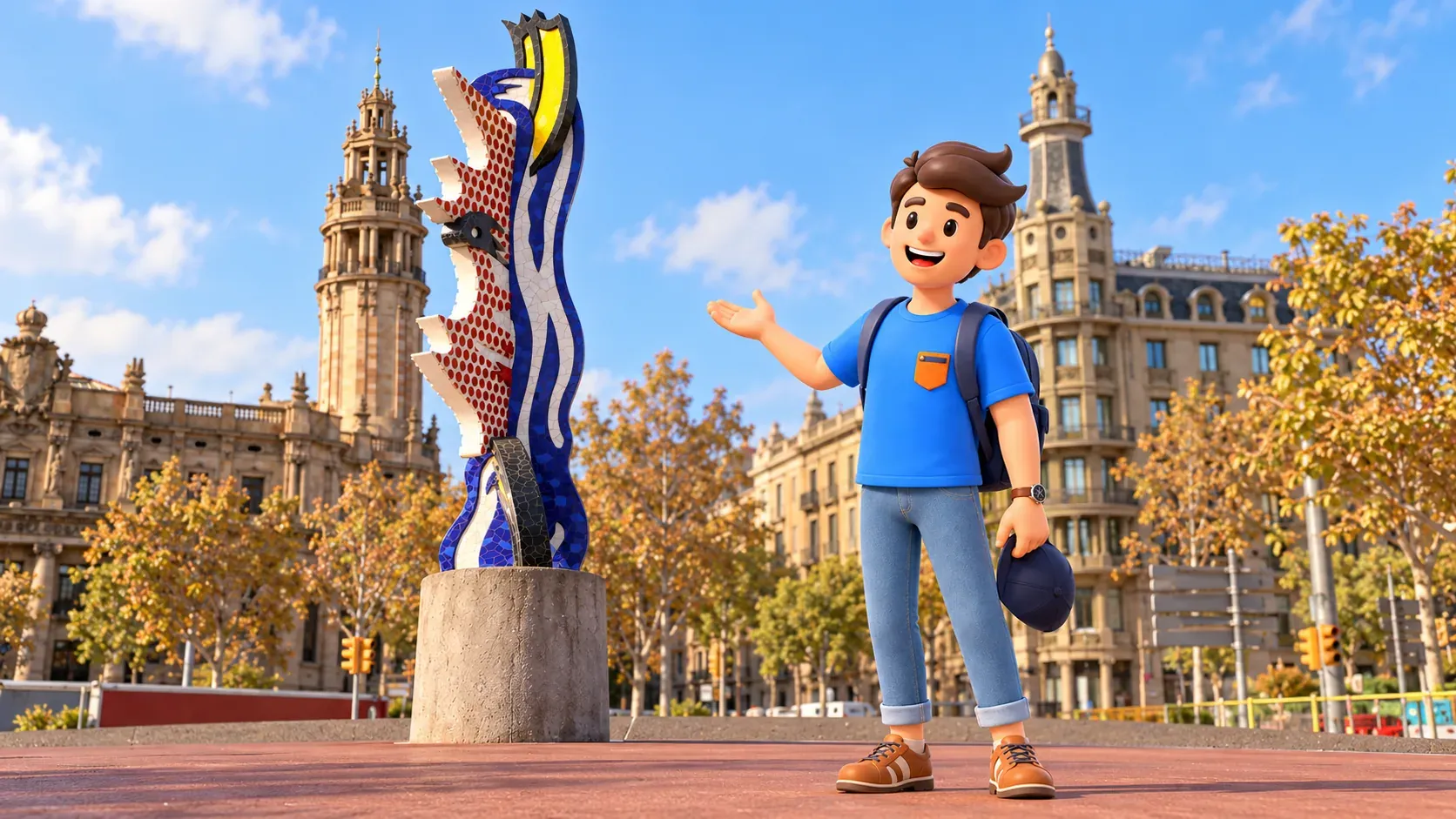
Use the remaining time to change position within permitted public space. How does the suggestion of a face change from another side? Which parts seem flat, and which project? There is no requirement to find a single correct viewpoint. Outdoor sculpture rewards a moving viewer: the reading changes as you shift your relationship to its form.
Nearby roads are not part of the artistic exercise. Use ordinary crossings when changing sides, avoid blocking the pedestrian flow and stay out of traffic for photographs. A single comfortable approach can provide enough to see. If temporary works reduce the available space, limit the stop rather than seeking a route across a closed area.
From the old harbour to the open sea
Around 10:20, use open public approaches towards Plaça de Pau Vila, then follow the direction of Passeig de Joan de Borbó towards Plaça del Mar. Reach the public seafront promenade and continue towards L’Estel ferit. The thirty-minute connection includes crossings and orientation. It does not use private pontoons, a hotel or restricted fishing-port land.
This stretch distinguishes a harbour from a beach shore. In the basin, quays and vessels hold attention; beside the open sea, the horizon organises the view. You need not add several more monuments to make the connection meaningful. The changing background already explains why works along the same coast can produce different impressions.
Food and waterfront seating can be tempting along the way. Decide whether you want a brief interruption or a new main activity. A proper lunch easily changes a two-hour outing. For this walk, reaching the next sculpture without rushing is more useful than ordering several dishes and then trying to recover the time.
L’Estel ferit: four volumes and the memory of the shore
German artist Rebecca Horn’s L’Estel ferit dates from 1992. Find it on Sant Miquel beach beside Barceloneta’s promenade. Four steel volumes with glazing are stacked with irregular offsets. People often call them simply the cubes, but the work’s title, commonly rendered as the wounded star, introduces fragility and a disturbance of familiar order.
The fifteen-minute stop can stay on the paved promenade, without crossing sand to the base. Compare the uneven vertical outline with the steady sea horizon. Then study the windows: they make the work suggest a building, although it is not a house visitors can enter. Apparent leaning belongs to its composition, rather than being an invitation to test its stability by touching.
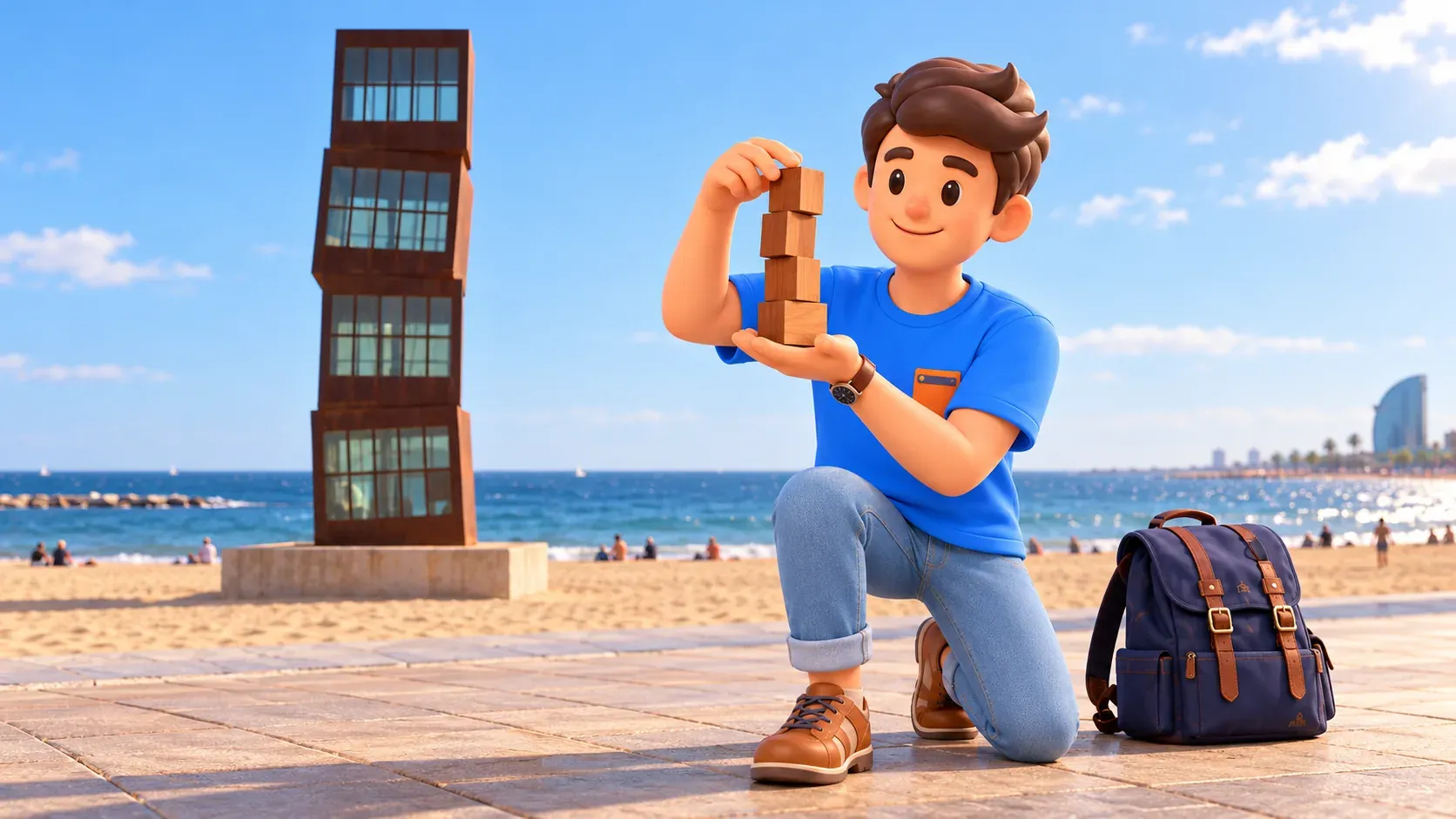
Barcelona’s tourism organisation connects the work with former coastal chiringuitos and the district’s small homes before the Olympic transformation. This interpretation gives a beach view a memory of a lost setting. There is no need to make each cube the precise image of one particular dwelling. The work allows an imaginative comparison rather than demanding one literal decoding.
Look beyond the attractive photograph for a moment. Urban change creates new places to walk while altering earlier ways of living and using the shore. The sculpture leaves room for both impressions. Enjoying the open horizon and noticing that the present landscape had another history can belong to the same visit.
Do not climb the work or make its base an essential resting place. If the sand is unavailable, or you simply prefer an ordinary urban walk, a promenade view is sufficient. Comparing form and background does not require reaching every window. Where a temporary barrier limits access, use the permitted approach or leave out the stop.
Along the coast: let the connection be part of the experience
At 11:05 continue northeast on the public promenade, towards Somorrostro and Port Olímpic. The next landmark is the Fish beside Hotel Arts, near Carrer de Ramon Trias Fargas. Allow twenty-five minutes for this connection. Walking on the sand or going down to the water is not necessary to follow the route.
Notice how a distant landmark begins to work. At first a sculpture belongs to a skyline; later it acquires individual details. This sequence particularly suits a large metal form, whose overall curve appears before the separate strips become clear. Put the screen aside for part of the approach and let that changing scale become part of seeing the work.
Pause outside the main pedestrian movement and cycling areas. A broad waterfront does not make every point suitable for spreading out belongings or stopping as a group. Choose a quieter position before taking a photograph. This improves your own experience while leaving space for people using the promenade as an everyday route.
Gehry’s Fish: a golden appearance, not a golden material
Frank Gehry designed Peix for the 1992 Olympic Games beside the Olympic harbour. Its metal mesh skin suggests scales, although this is a large sculptural structure. Golden fish describes an appearance: the material is stainless steel, rather than solid gold or copper cladding. That distinction explains why light matters as much as the familiar animal outline.
Begin with the complete curve from an available public approach. Then look at the woven strips and supports. The interest lies partly in the relationship between an expressive outer skin and the structure that allows it to exist. You need not understand the engineering calculation to notice where the surface seems continuous and where light passes through.
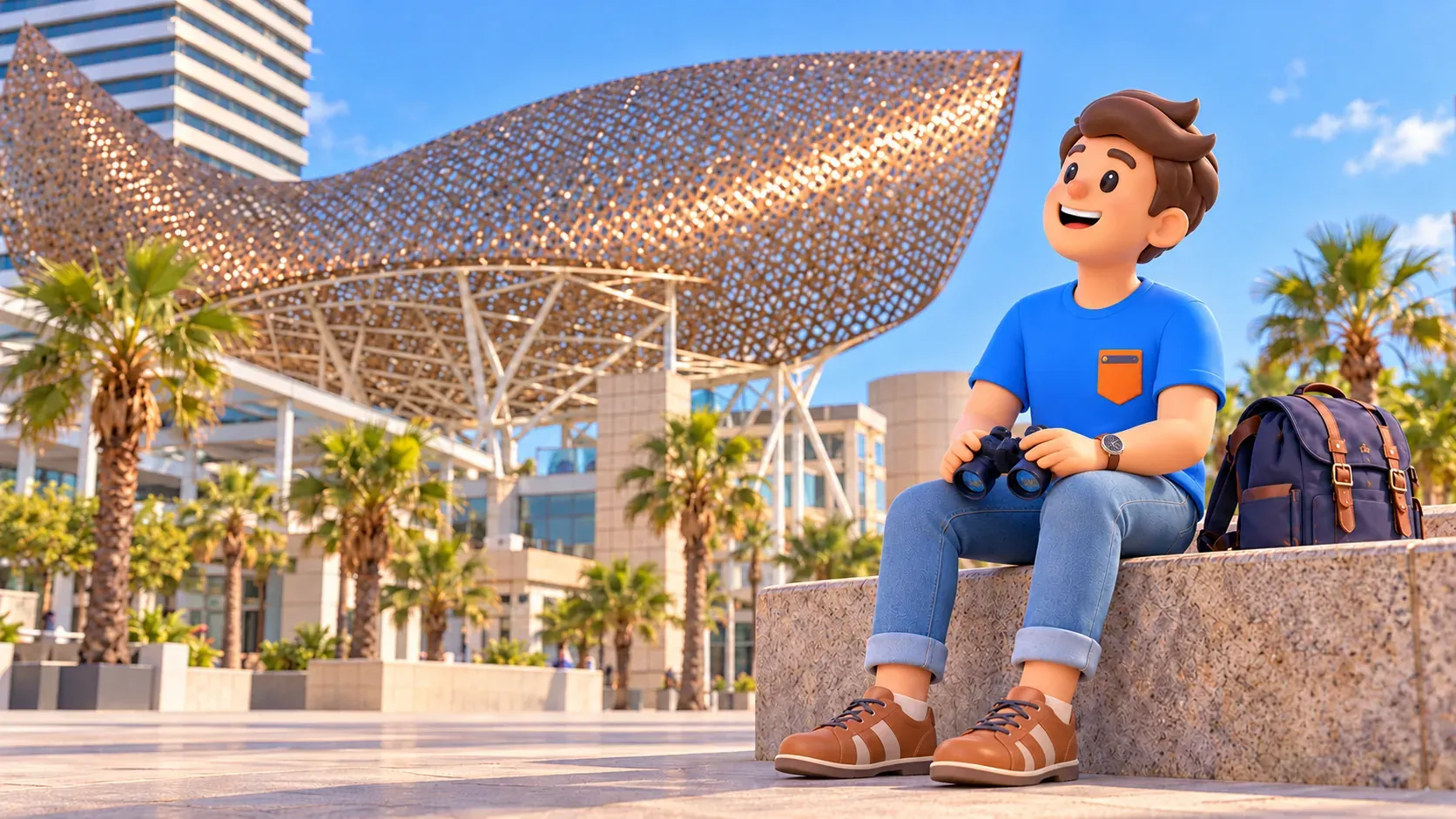
Lighting changes the highlights and colour. That does not establish a guaranteed hour when every visitor can reproduce the same photograph. Clouds, viewpoint and the sun’s position produce different results. Twenty minutes of attention in the conditions you have can be more rewarding than organising the entire day around a promised perfect golden image.
Commercial spaces lie beneath and around the structure, but this exterior walk includes no hotel terrace, casino or restaurant visit. A drink is not required to enjoy an overall view from public ground. If a particular venue interests you, check its own conditions and give it additional time, rather than counting it as part of the free sculpture stop.
What links the three works beyond a date?
All three relate to 1992, yet none repeats the others. Lichtenstein brings colour and contour into urban scale, Horn raises questions about the memory of an earlier shore, and Gehry works with a shimmering metal skin. A shared walk makes those differences visible without requiring a complete catalogue of coastal sculpture.
Today’s seafront has not remained frozen in an Olympic moment. Port Olímpic’s managing organisation describes subsequent renewal of public squares and walking spaces. Avoid treating everything visible as an exact copy of 1992, or imagining that residents had no relationship with the sea before the Games. The shore’s history consists of several stages, uses and experiences.
To connect walks like this with museums and rest in a personal trip, prepare your itinerary in RoadMe. The app builds a day-by-day programme around your interests and pace, making the whole route easier and more effective to use in the city.
A pause and a clear finish beside Port Olímpic
Keep 11:50–12:00 for water and a calm decision about where to go next. The finish is beside the Fish, not on a hotel terrace or at the far end of the marina. Reaching transport or returning to Passeig de Colom remains a separate part of the day. Swimming also requires its own decision based on current conditions and local instructions.
The practical kit is simple: comfortable shoes for urban walking, water, weather-appropriate sun protection and another layer when wind is forecast. For particular mobility needs, check the complete connection and temporary barriers. Viewing from a paved promenade does not guarantee the absence of every kerb. If weather closes the shore, choose another date for this self-contained walk.
For a different day, consider the El Raval public art walk. Here, three impressions are enough: bright ceramic surface, offset windowed volumes and light on steel mesh. Together they reveal the coast as more than a handsome background, with different ways of speaking about the city.


