
Auteuil Architecture Walk: Guimard to Le Corbusier
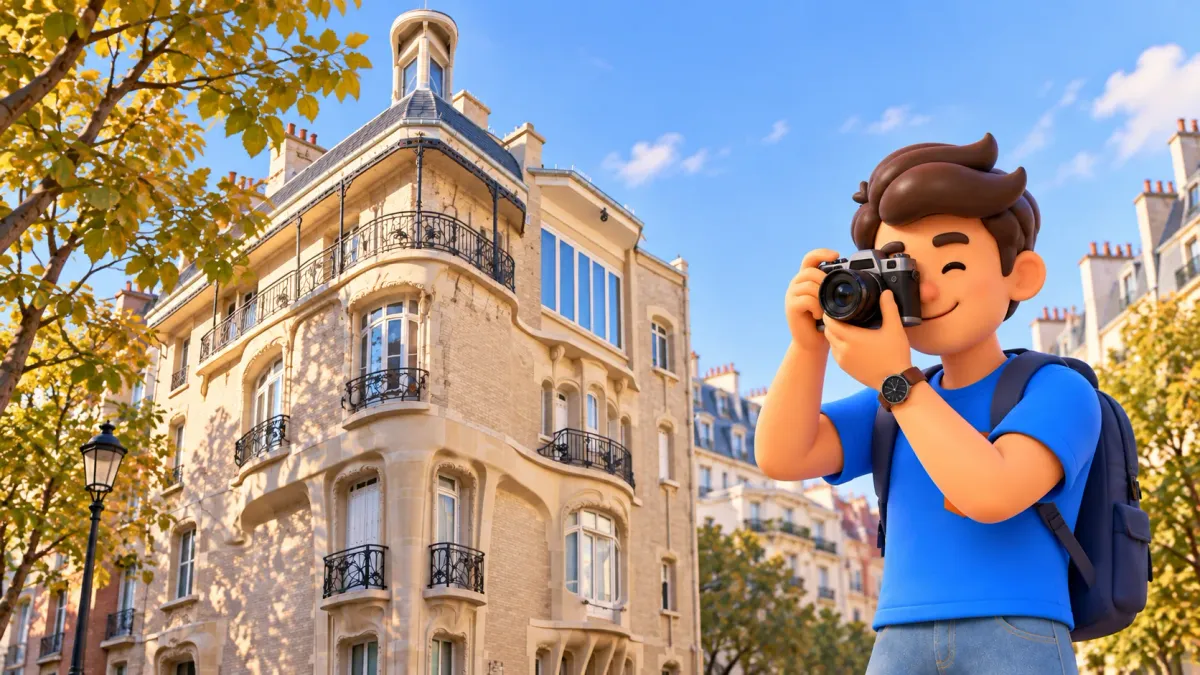
Auteuil is a rewarding part of Paris to explore through the architecture of houses. Organic curves sit within walking distance of the clear geometry of the twentieth century. The interest lies in seeing different answers to familiar questions: how a home should feel, how light should enter it, and how a building can express the people who use it.
This walk connects Castel Béranger, Hôtel Mezzara, Hector Guimard’s own house and Maison La Roche, designed by Le Corbusier with Pierre Jeanneret. View the three Guimard buildings from public pavements, then visit Maison La Roche with an advance online reservation. Allow roughly two and a half hours for this version. The final visit has a scheduled 30-minute self-guided slot, so organise the street portion around the time you book.
A compact architecture walk through Auteuil
Start at Castel Béranger, 14 Rue Jean de La Fontaine. Follow the street southwest to Hôtel Mezzara at number 60. Continue to Rue George Sand and turn right towards Avenue Mozart, then turn left along the avenue. At number 122 you will reach the house Guimard created for his own family and architectural practice.
After looking at its exterior, return northeast along Avenue Mozart to Rue Jasmin and turn left. Follow Rue Jasmin to Rue Henri Heine, then go along Rue Henri Heine to Rue du Docteur Blanche. The visitor approach to Maison La Roche begins at 55 Rue du Docteur Blanche. The house itself is numbered 10 Square du Docteur Blanche; distinguish the street entrance from the address within the square.
A useful allowance is 50 minutes for walking, crossings and finding the entrances, an hour for three façades and short breaks, and 40 minutes for arrival and the 30-minute house visit. These are planning estimates rather than a timed test of the route. Getting to Auteuil, eating a meal or choosing a longer guided visit requires additional time.
To fit Auteuil into a trip built around your interests, try RoadMe for a fully worked-out personal plan using your dates, pace and budget. It makes it much easier to turn an architecture walk and your other favourite activities into a practical day-by-day itinerary.
Choose a day with an available Maison La Roche slot if the interior is central to your plans. Without that booking, the three public street stops still form a coherent shorter outing. You can finish before the private visitor approach instead of assuming that a closed gate provides access to the square or a useful exterior viewpoint.
Castel Béranger: everyday housing with an extraordinary character
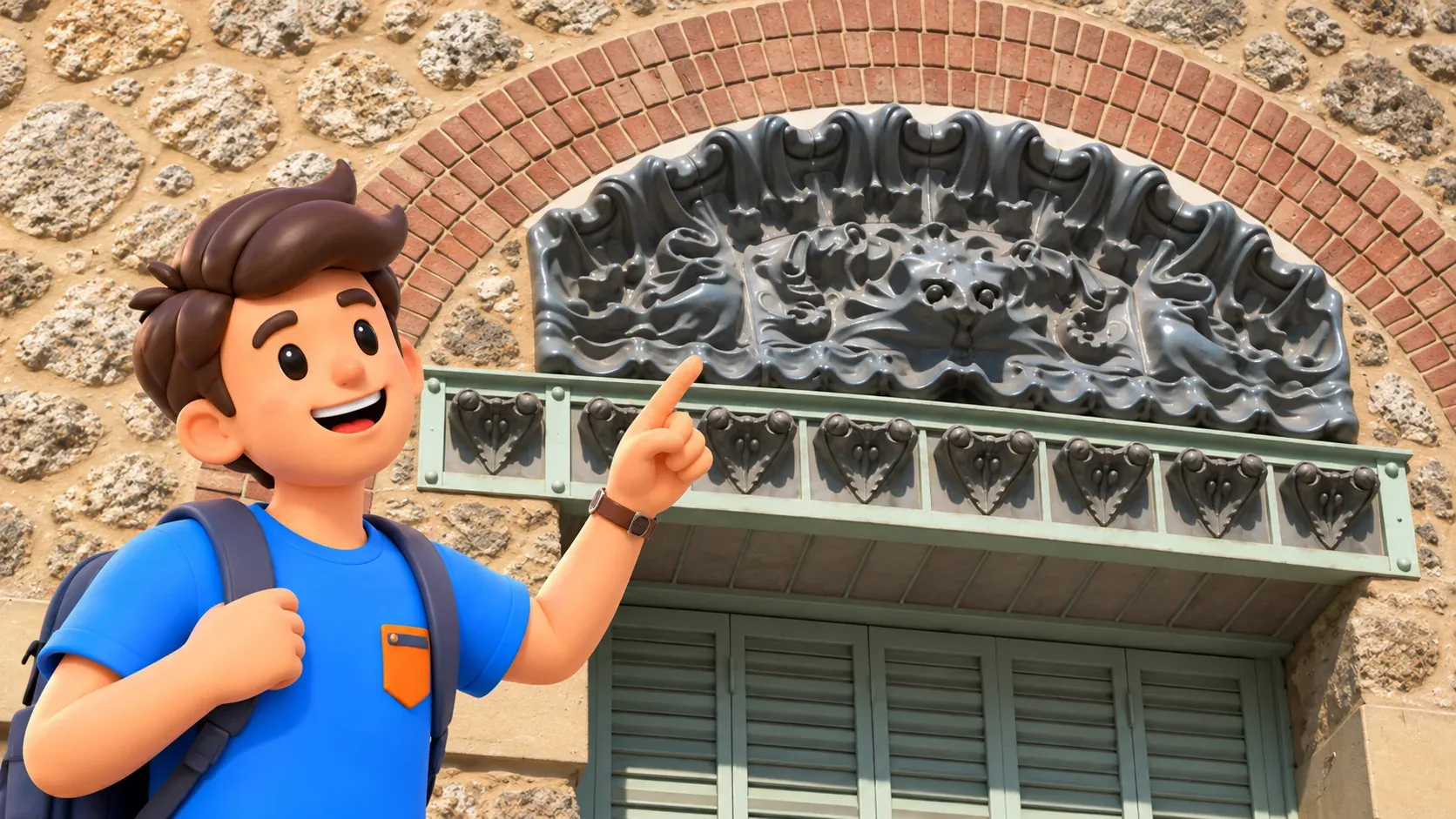
Despite its evocative name, Castel Béranger is a residential building rather than a castle to tour. Guimard created it towards the end of the nineteenth century. For this walk, its value is the way a familiar urban building becomes a highly individual composition. You can appreciate that achievement without memorising every motif or identifying every historical resident.
Begin with the materials. Brick, stone and metal create a varied surface that invites closer observation. Then look at an opening and the ironwork around it. Curves suggest organic movement without needing to depict one particular leaf or flower. Compare their changing direction with the straight boundaries of a window, noticing how the two kinds of line work together.
Choose one detail rather than rushing to photograph every visible feature. Follow a metal curve above an opening and look for a related movement nearby. This small exercise makes the façade feel connected: an individual element contributes to a larger visual language. It also gives you something specific to compare with the quieter exterior at the next stop.
The building remains a home for its residents. Stay on the public pavement and leave its entrance clear. An opening door does not turn the hallway or courtyard into a public attraction. A street view is enough for the purpose of this stop; wait for a suitable moment to take a photograph without following someone into the building.
Hôtel Mezzara: a house for a maker of lace and embroidery
Hôtel Mezzara stands at 60 Rue Jean de La Fontaine. In this context, hôtel particulier means a private town mansion rather than a commercial hotel. Paul Mezzara began as a painter before developing a business in lace and embroidery. In 1910 he commissioned Guimard to create a house accommodating family life, professional encounters, receptions and creative work.
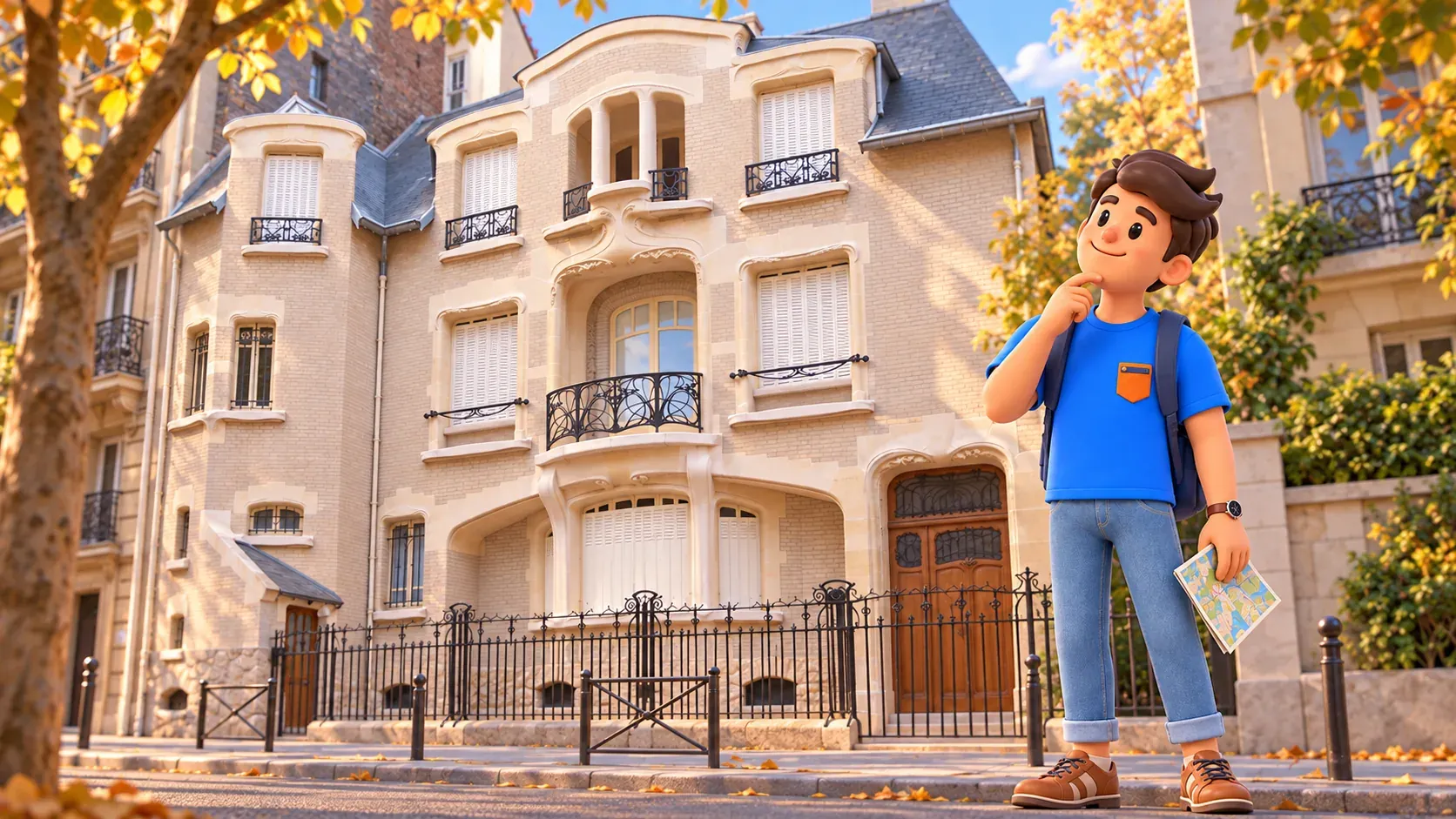
Knowing the client’s connection with decorative art gives the exterior a useful human story. Compare it with Castel Béranger: light brick, flowing stone surrounds and metal railings provide a calmer combination. The same architect’s language remains recognisable while the overall impression changes. Art Nouveau does not mean that every house has to produce the same degree of visual drama.
Look at the central balcony, then at the neighbouring windows. Start with the whole composition before selecting a single fragment. This helps you see how relatively even stretches of wall balance the curves of the details. You do not need to reconstruct the position of every room; the client’s needs already explain why domestic life and artistic work belong in the same story.
As checked in October 2026, the project partners describe Mezzara as the future home of a Guimard museum. Plan an exterior stop here. A restoration and museum project does not mean that regular museum admission is already available. Any special opening has its own conditions; treat a future opening date as unconfirmed until the organisers announce the applicable visitor arrangements.
Hôtel Guimard: designing a home for himself
At 122 Avenue Mozart, the architect becomes his own client. Built between 1909 and 1912, Hôtel Guimard combined the family home, his architectural office and a studio for his wife, the painter Adeline Oppenheim. This makes the stop a useful change of subject: alongside the appearance of the house, think about how several kinds of work and living could fit together.
The plot is triangular. From an appropriate public pavement position, compare the two sides of the building. Projecting volumes and bay windows help you understand the response to a confined site. Changing your angle within the permitted pedestrian space can reveal more than trying to squeeze every part into a single photograph. Do not step into traffic to obtain a wider view.
Ask which elements mainly decorate a surface and which also alter the volume behind it. A curved railing and a projecting window both contribute to the exterior, but the latter increases the interior space. That simple comparison provides a way of discussing architecture in everyday language. It can be more memorable than a long list of stylistic terms detached from what you see.
The house is now divided into private apartments. It is neither a regularly open house museum nor a hotel where a historical lobby can be visited. The former studio explains the building’s original purpose; it does not establish present access to the rooms. The planned interior experience on this route is Maison La Roche, reached with your own advance reservation.
Maison La Roche: understanding a building by moving through it
After three Guimard exteriors, Maison La Roche offers a different way of looking. Le Corbusier and Pierre Jeanneret designed and built it between 1923 and 1925 for the banker and modern art collector Raoul La Roche. The commission combined a gallery for his collection with private living accommodation. Keep both functions in mind rather than treating it as an isolated exhibition room.
Inside, pay attention to light, colour and the relationships between spaces. The gallery’s curved ramp helps explain how the experience changes as you move. Compare your impression on entering with a view from another permitted part of the visit. Your attention shifts from a decorative detail to walls, passages and volumes that unfold through a sequence of viewpoints.
This makes the idea of an architectural promenade easier to grasp. The expression can describe an experience within a building as well as your walk around the neighbourhood. You do not have to learn every theoretical principle associated with Le Corbusier. Notice one spatial transition and one use of colour, then compare those observations with the three façades you have already seen.
In 2016, the La Roche and Jeanneret ensemble became part of the UNESCO World Heritage property comprising Le Corbusier’s architectural work. That recognition explains its wider significance, but it does not give a visitor unrestricted entry to neighbouring premises. Follow the areas open during your Maison La Roche visit and the instructions provided on arrival.
Reservations, opening days and access
According to the Foundation’s information checked in October 2026, regular public visits run Tuesday to Saturday, from 10am to 6pm, with last admission at 5:30pm. Public holidays and seasonal closures also apply. Check the available dates and slots when planning: a regular weekly timetable is not a guarantee of admission on every date within those weekdays.
Online reservation is mandatory. Arrive with your ticket at the beginning of your slot; the Foundation states that late arrivals cannot be accommodated. The self-guided visit lasts 30 minutes. Standard admission is paid, with concessions subject to their specific conditions. Guided visits have a separate format and duration, so do not silently substitute one into this two-and-a-half-hour estimate.
Maison La Roche has no lift. Wheelchair access is limited to the entrance hall, and the toilets are not adapted for wheelchair users. The Foundation asks visitors to contact it so the gate and double entrance door can be opened. The presence of a gallery ramp does not make the whole house step-free. Discuss the possible visit before relying on an accessible interior route.
Suitcases and large bags are not accepted inside the house. Plan this outing when your luggage is already at your accommodation. In rain, shorten the street stops while preserving your booked arrival time; the façades do not promise sheltered waiting space. On Sunday or Monday, choose the public street version and finish before any closed visitor approach.
Giving the rest of the day its own rhythm
For a relaxed day, leave time after Maison La Roche to eat and talk about what you saw. Compare one Guimard curve with one spatial transition at La Roche. This creates a personal takeaway without requiring a catalogue of dates. If literature or river views appeal next, our Passy walk with Maison de Balzac and Pont de Bir-Hakeim offers a different subject and needs its own time allowance.
If architecture, literature and time to relax all matter to you, use RoadMe to work out a personal plan for the whole trip. Its day-by-day itinerary follows your interests, pace and budget, making the plan easier to use while you travel.
Two complete walks should not be treated as one short outing. After the house visit, consider your remaining energy and the time needed to reach another area. Auteuil already provides a complete story: three Guimard responses to urban housing and a different understanding of space by Le Corbusier and Jeanneret. You can end with that comparison and leave the next neighbourhood for another day.


