Ancient Hong Kong: a Han tomb, MTR finds and coastal markings

Ancient Hong Kong does not always announce itself with a vast museum or a dramatic ruin. Sometimes it appears as a brick chamber behind glass, a few vessels in a station display or faint lines on a coastal rock. These places reward a different pace: less expectation of spectacle and more attention to what has survived, where it was found and what the evidence actually allows us to say.
This selection brings together Lei Cheng Uk Han Tomb, the archaeological display at Sung Wong Toi station and markings at Big Wave Bay, Po Toi and Lung Ha Wan. They are not a single day’s route. An urban museum, a transport concourse and a remote coast offer different encounters with the past. Choose one format that fits your journey, leaving the others for another district or island day.
The past need not look like a monumental ruin
An object’s archaeological value is not measured by its size or visual impact. A small bowl can open questions about everyday life, a brick about construction, and a findspot about people’s relationship with their surroundings. Start with three simple questions: what is this, where was it found, and why do researchers associate it with a particular period? They give even a short visit a useful direction.
RoadMe makes it easier to turn your interest in ancient Hong Kong into a personal travel plan, connecting museums, neighbourhood walks and nature with your available time, interests and preferred pace.
Distinguish the object from its interpretation. A brick chamber exists as physical heritage; its dating rests on characteristics and finds. A pattern on rock may be visible while its maker or purpose remains uncertain. That difference does not make one visit worthwhile and another pointless. It changes the questions you can reasonably ask and the experience you should expect before setting out.
Avoid rebuilding an entire ancient village in your imagination from a single vessel. Research connects an object with a broader historical account. Good interpretation helps you follow that connection rather than replacing it with an attractive, confident legend. If an explanation says “possibly” or “believed to”, keep that uncertainty when you tell someone else about the place afterwards.
Discovery and creation are also different events. Something reported in the twentieth century can be much older, while the date of protection is not the date it was made. Keep three kinds of time separate: when an object originated, when it was recognised and when it received legal protection. You do not need to remember every date to avoid confusing the history of an object with the history of studying it.
Lei Cheng Uk: an ancient chamber within the city
Lei Cheng Uk Han Tomb was discovered in 1955 during work associated with housing development. Its structure, brick inscriptions and finds support a dating to the Eastern Han period, AD 25–220. That gives a grounded connection with the territory’s deep past. It does not require the visitor to imagine a complete personal biography for the person buried there or treat every unanswered question as a mystery needing a dramatic solution.
The most important practical distinction is that visitors do not enter the tomb. It is closed for conservation, and part of the interior can be viewed through glass. The visit does not involve descending into a dungeon, walking between chambers or touching the brickwork. Expecting that sort of archaeological adventure can obscure the quieter experience the museum actually offers.
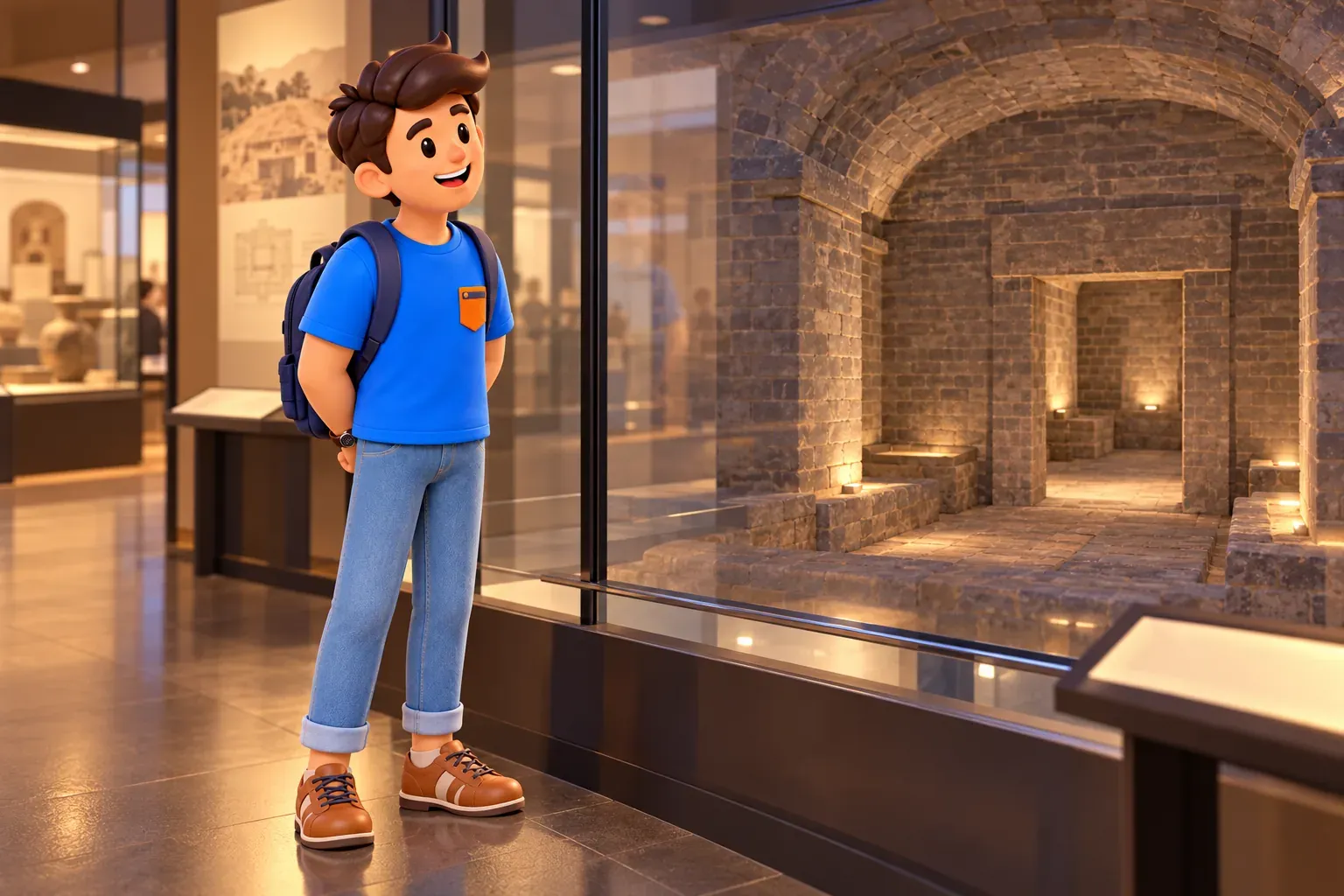
The neighbouring exhibition helps explain the discovery through objects and interpretation. First notice the overall shape and construction, then choose one object or image to consider more carefully. You do not have to memorise everything. A single understandable example of how a physical thing supports a historical conclusion can become the most valuable discovery of a compact museum visit.
Allow roughly an hour as a relaxed planning guide. The museum normally closes on Thursdays except public holidays; check current exceptions before a special journey. Combine it with the surrounding area rather than treating it as the start of a compulsory tour of every ancient site. Sham Shui Po offers ideas for a wider walk through this part of Kowloon.
Do not confuse the monument’s age with that of its surroundings. Modern streets do not reduce the importance of an ancient find. Their coexistence shows different periods occupying the same territory. You do not need to search for a complete “Han atmosphere” outside. It is more revealing to recognise that deep history can survive inside an ordinary urban day, alongside the routes residents use for present purposes.
Sung Wong Toi: archaeology in a working station
At Sung Wong Toi, the past appears within a contemporary transport space. Archaeological work associated with construction of the station investigated the former Sacred Hill site and uncovered Song and Yuan material. The concourse display uses finds to explore life and maritime connections. It is not an open excavation that passengers can enter by going downstairs from the platform.
Part of the interest comes from the contrast in pace. Most people are passing through the station on their own business; you can stop beside something belonging to a different time. Choose one case and look at an object’s shape, material or purpose before reading the explanation. The text becomes more meaningful when it answers a question prompted by something you have actually observed.

The name Sung Wong Toi is linked to a tradition about Southern Song rulers. A tradition and an archaeological find are not the same kind of evidence. The display can illuminate life, economic activities and exchange without turning every bowl into a named ruler’s personal possession. Keep that distinction intact. The city’s story remains interesting without confident claims that the objects themselves cannot establish.
About twenty to forty minutes can make a useful pause if the display suits your existing route. Access follows station opening, but check current arrangements before travelling specifically for it. Leave room for the passenger flow instead of stopping in the middle of a busy passage. Continue with Kowloon City if you want a neighbourhood walk: the district provides a modern setting while the cases add historical depth.
Coastal markings leave room for uncertainty
Big Wave Bay offers another format: an encounter with old markings within a coastal landscape. Geometric designs and forms resembling animals are visible, but precise questions of date, maker and purpose are difficult to settle. A relationship with the sea can support possible explanations. It does not justify presenting a proposed ritual as a fully documented event whose details the visitor can confidently reconstruct.
Separate observation from interpretation. “I can see curved lines” describes a visible feature; “this line represents a particular animal” needs further support. Waves and surrounding rocks can make the visit memorable, but a beautiful setting does not itself prove a theory. Here uncertainty is part of understanding the place, rather than a sign that your trip was poorly prepared.

On Po Toi, groups of motifs include spirals and lines described as resembling animals and fish. The island nevertheless requires its own plan, including a checked return ferry. A short inspection of a carved surface is not the same thing as a short excursion from central Hong Kong. Travel, walking, weather and waiting for transport shape the day far more than the minutes spent looking at the rock.
Lung Ha Wan is especially useful for thinking about the limits of knowledge. The official account explicitly describes a debate: the pattern may be human work, but another interpretation considers natural processes. Legal protection allows further study. It does not automatically prove a particular age or authorship. A visit can be interesting precisely because that question remains open rather than because a confident answer has been supplied.
Do not collect all three coastal places in one day for completeness. Big Wave Bay, Po Toi and Lung Ha Wan are different directions with different logistics. Choose one when the coast already interests you. If you mainly want archaeological explanation in a clear museum setting, begin in the city. An urban visit is not a lesser version of the subject simply because reaching it involves less travel.
Look closely without changing what you came to see
Use designated approaches and respect barriers and restrictions. Do not outline marks with chalk, make rubbings or clean a surface to improve a photograph. An attempt to increase visibility can damage the very evidence that brought you here. The purpose is to see what has survived, rather than alter it into a more convenient illustration with your own hands.
Choose daylight and suitable weather for coastal outings. Being outdoors does not mean a site is safely accessible at every hour. Suitable shoes, time for the return and willingness to abandon a slippery approach matter more than obtaining a particular picture. Postponing a walk keeps the interest alive; it does not turn the whole idea of the trip into a failure.
With children, replace a treasure hunt with questions. What can we actually see? What does the explanation say? What remains unknown? This encourages curiosity without suggesting that visitors may excavate or collect material. Use your own notebook from a safe place if you want to draw. The souvenir can be an observation rather than a piece of the monument or its surroundings.
Afterwards, try describing one find in an accurate sentence and naming one unanswered question. You might remember that a tomb is dated using several kinds of evidence without knowing the occupant’s name. Or notice a pattern without settling its origin yourself. Modest accuracy often produces a richer memory than an exciting but entirely invented ancient story.
You can also compare the kinds of attention each setting asks for. A museum gives interpretation close to the object; a station asks you to pause amid movement; a coast makes the journey part of the encounter. These differences help choose a visit according to your energy and companions. None requires turning every available stop into an obligation merely because the subject is shared.
Choose a format that fits the whole journey
Lei Cheng Uk is a good first introduction when you want a compact museum connecting an object with explanation. If your day already crosses Kowloon City, pause at Sung Wong Toi’s cases. If nature interests you more, give one coastal direction its own outing. These are three reasonable ways into a subject, rather than stages of a programme everyone must complete.
RoadMe helps develop a personal itinerary for your whole trip around your interests. The app makes it easier to balance historical discoveries, neighbourhood walks and rest while keeping the journey’s overall pace realistic.
Before leaving, confirm access to your main aim and the route back. Do not overload a day merely because the places share a theme: a museum, station and island need different decisions. Ancient Hong Kong becomes more visible when there is time to look, read and think. One well-chosen stop can be enough to make the modern city around it feel a little deeper.