
An evening on the Amstel: Blauwbrug to Magere Brug
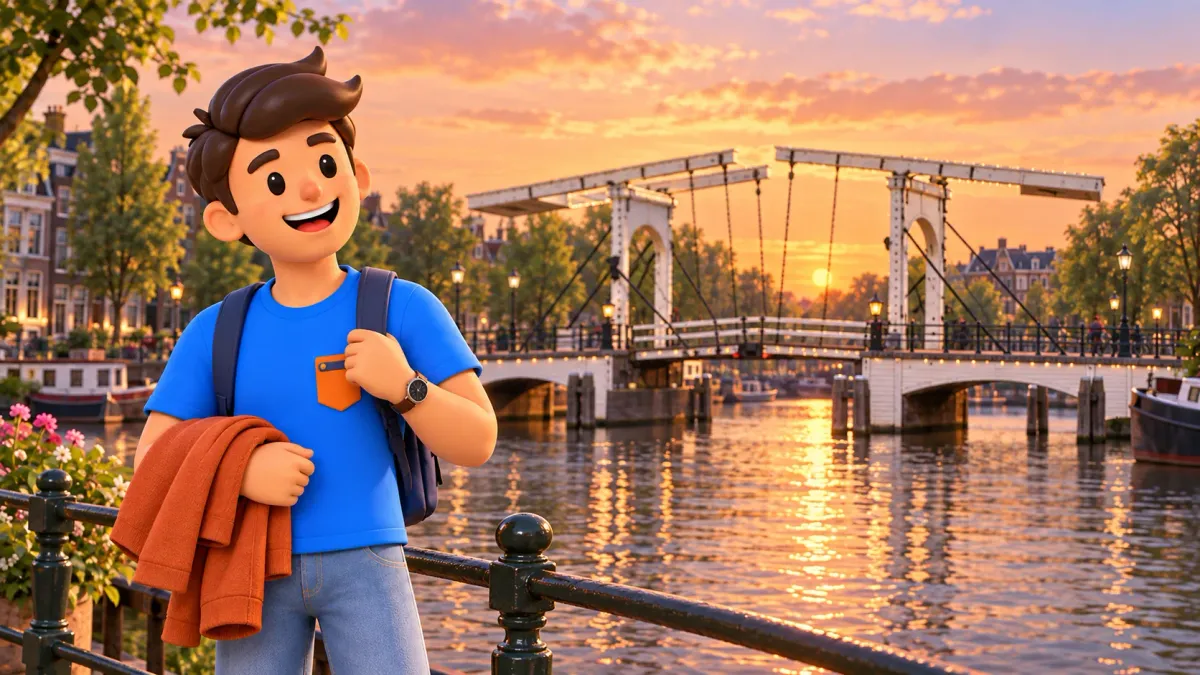
An evening beside the Amstel works well when you stay with one short stretch rather than add several more neighbourhoods to a full day. Between Blauwbrug and Magere Brug, the walk has a clear story: a broad river, two different kinds of crossing and the long façade of the former Amstelhof. A few pauses are enough to notice the city changing with the light.
Start at Blauwbrug’s eastern end on the Waterlooplein side, follow the public eastern riverbank south past H’ART Museum and finish by Magere Brug. Allow roughly seventy-five minutes for a relaxed walk and exterior stops, without dinner or museum galleries. After a long sightseeing day, you can shorten it while keeping the two main landmarks and a connected sequence beside the water.
Give the walk a place in your evening
A useful starting point is around thirty to forty-five minutes before local sunset. This is a planning suggestion rather than a condition: it leaves some architecture in daylight and the finish for dusk. Look up sunset for your travel date. The same clock time means a very different evening in summer and winter, so a fixed year-round departure would not serve this walk well.
RoadMe makes it easier to get a personal evening or whole-trip plan around your interests, dates and usual pace. Tell the app whether you want architecture, relaxed waterside walking or more time for dinner, then use a complete route it has worked out for your visit.
For the main version, give Blauwbrug about fifteen minutes, the walk to H’ART ten, its exterior fifteen, the next approach ten and Magere Brug’s bank views and finish twenty-five. These are estimates with small pauses and orientation included, not a measured track. If one view holds your attention, change the allocation rather than turning a short riverside outing into an exercise in maintaining a constant speed.
The start and finish are different places. You approach Magere Brug from the east and may finish on its western end by Kerkstraat when the crossing is ordinarily available. Calculate the route to dinner, accommodation or transport afterwards separately. If the bridge opens or passage is temporarily controlled, follow local instructions. The walking allowance is not a prediction of the bridge’s operating schedule or a reason to ignore a temporary stop.
This makes a good conclusion to a day with one substantial museum. If you are still distributing the daytime programme, our two-day Amsterdam itinerary provides a broader structure. Keep the river as a quieter separate section, with permission to finish sooner if you have already had enough walking and impressions.
Blauwbrug: begin with a detail rather than a panorama
The present Blauwbrug opened in 1883, designed by Bastiaan de Greef and Willem Springer. Its name comes from a previous wooden crossing painted blue. You therefore need not search for a completely blue bridge: the name remembers an earlier structure, while today’s crossing has its own later decorative character.
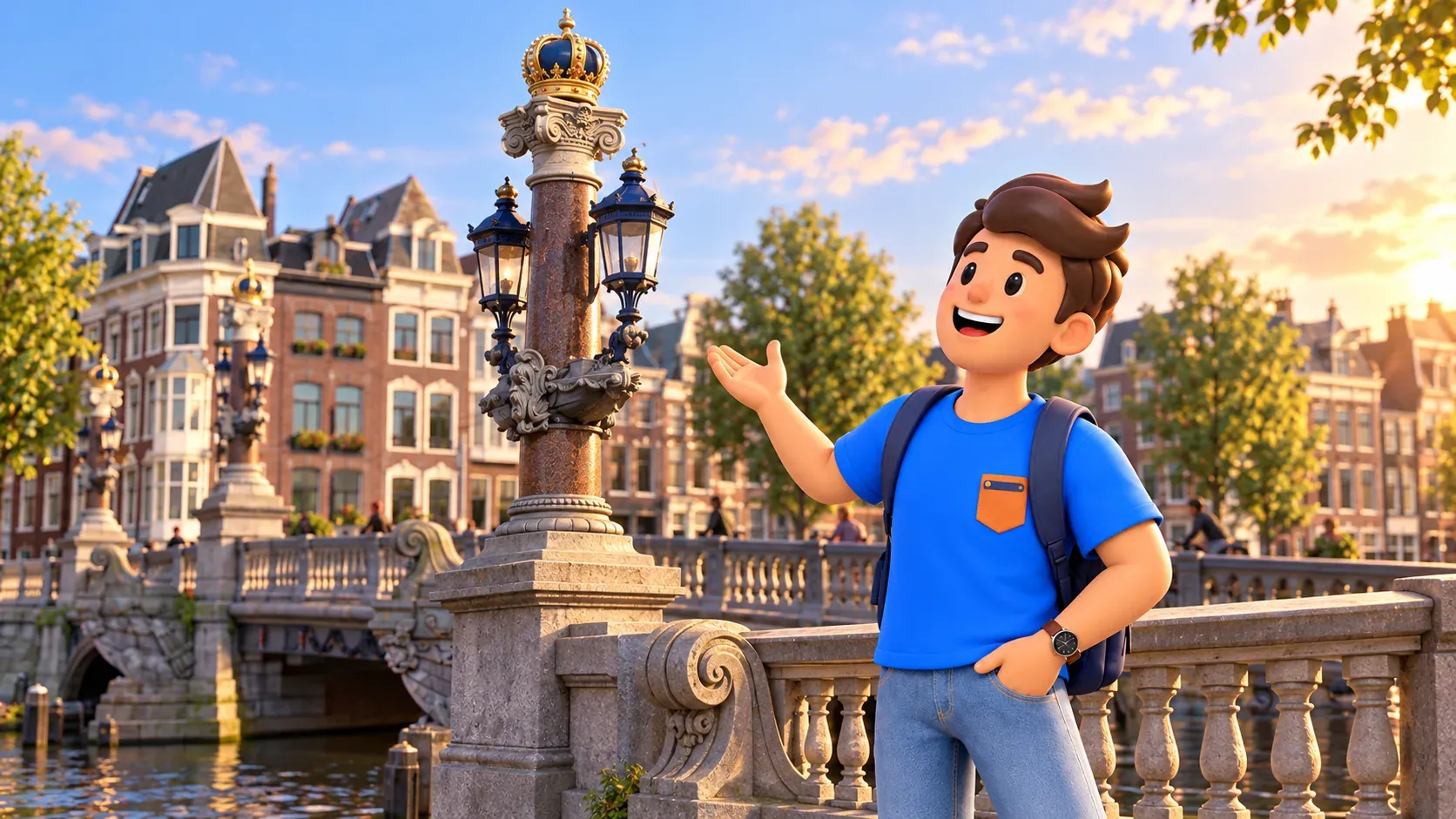
Choose a public pavement position where you can pause without interrupting movement. Begin with a nearby element rather than a photograph along the entire river: a lamp, a column or a section of railing. Remaining daylight makes such detail easier to read. Then look towards the water, contrasting the crossing’s concentrated decoration with the Amstel’s more open space, and let the broad view follow the close one.
The bridge is worth considering as an object, rather than only as somewhere from which to look into the distance. Give yourself one task: find a repeated motif and see how it links different parts of the structure. You do not need to identify every symbol or count every ornament. A pattern you notice yourself can give the stop more substance than a quick image of a location already named on your screen.
If you arrived from the central streets, do not leave the stop on a bank chosen by chance. This sequence needs the eastern end, towards Waterlooplein, for the continuation to H’ART and Magere Brug. Check direction before moving off. A brief pause now is easier than crossing back later, when the light has changed and you would rather be enjoying the river than correcting a simple navigation decision.
Avoid building the evening around an empty bridge or a perfect reflection. Weather, water and other people change the scene. If the area is busy, take an available view and continue; the walk still has room ahead. The first stop should establish an unhurried rhythm, rather than hold the whole route hostage to a single photograph that requires conditions you cannot arrange or know in advance.
Follow the eastern bank towards H’ART Museum
From Blauwbrug, head south along available public paths on the eastern bank towards H’ART Museum at Amstel 51, checking your own map. The ten-minute allowance is flexible and includes brief pauses. This stretch gains value from continuity: the river stays beside you while the perspective changes. You do not have to keep finding new addresses or crossing the water to make the walk feel like it is progressing.
Try looking at the scene without a camera for a while. Notice which façades still receive light from the sky, where the water looks brighter and where movement breaks up a reflection. The evening becomes more interesting when you observe these changes yourself. You do not need a history for every house or a prediction of which bank must be the prettiest on the particular date you happen to visit.
H’ART occupies the seventeenth-century Amstelhof, a former home for elderly residents. It is now an art museum. That change of purpose gives the walk a small historical layer: the long riverside façade did not begin as an exhibition setting. Here it remains an exterior stop. A museum visit needs its own preparation and time, rather than an assumed evening entry squeezed between the two bridges and their viewpoints.
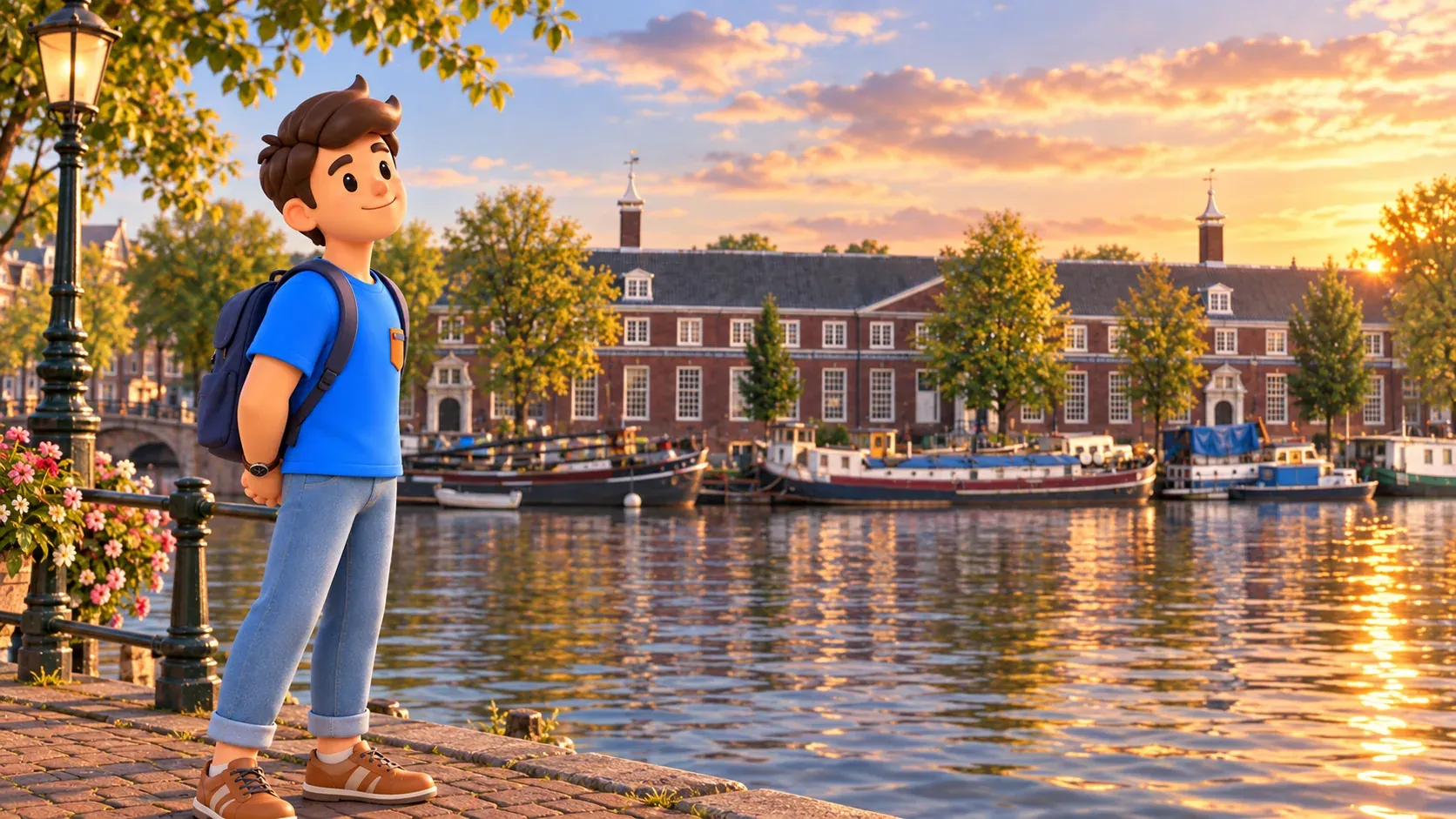
Pause outside as far as public space permits. Look at the building’s length and repeated windows: after Blauwbrug’s decoration, it offers a different way of organising an impression. Take in the broad mass first, then choose a smaller fragment. Moving between these scales helps an ordinary riverbank become more noticeable, without requiring a detailed architectural account of each component or an interior tour to explain the building.
Do not depend on a courtyard passage as part of the route. The evening plan uses the public street side and does not need entry to the museum complex. If a garden or exhibition interests you, give it a separate visit with its own access check. That preserves the walk’s clear structure and avoids spending the remaining daylight waiting at a door you had never planned to use.
Approach Magere Brug with time for the river
Continue south from H’ART on the eastern bank towards Magere Brug. Allow around ten minutes including ordinary pauses. You do not have to accelerate because the next stop is already visible. The point of this short transition is a changing scene: the crossing gradually becomes the main figure, while the façade where you were standing retreats into the background.
Choose a bank position from which you can see the bridge’s silhouette before stepping onto it. From the bridge, attention goes mainly towards the river; from the bank, towards the bridge in its setting. These views complement each other. One broader view and a short crossing can be enough for a complete finish.
For two people or a small group, this is a useful moment for a shared pause. Find somewhere outside the through route first, then decide whether to stay or move towards dinner. Avoid trying to photograph one another, research tomorrow and choose a restaurant on the phone simultaneously. Giving one activity your attention at a time helps the evening retain the relaxed character that brought you to the river in the first place.
If the evening needs to fit around a museum day, dinner and onward travel, RoadMe can prepare a personal plan around your interests and available time. Using a route the app has worked out for the whole trip is much more convenient than repeatedly joining individual recommendations yourself.
Magere Brug: an old appearance with a later history
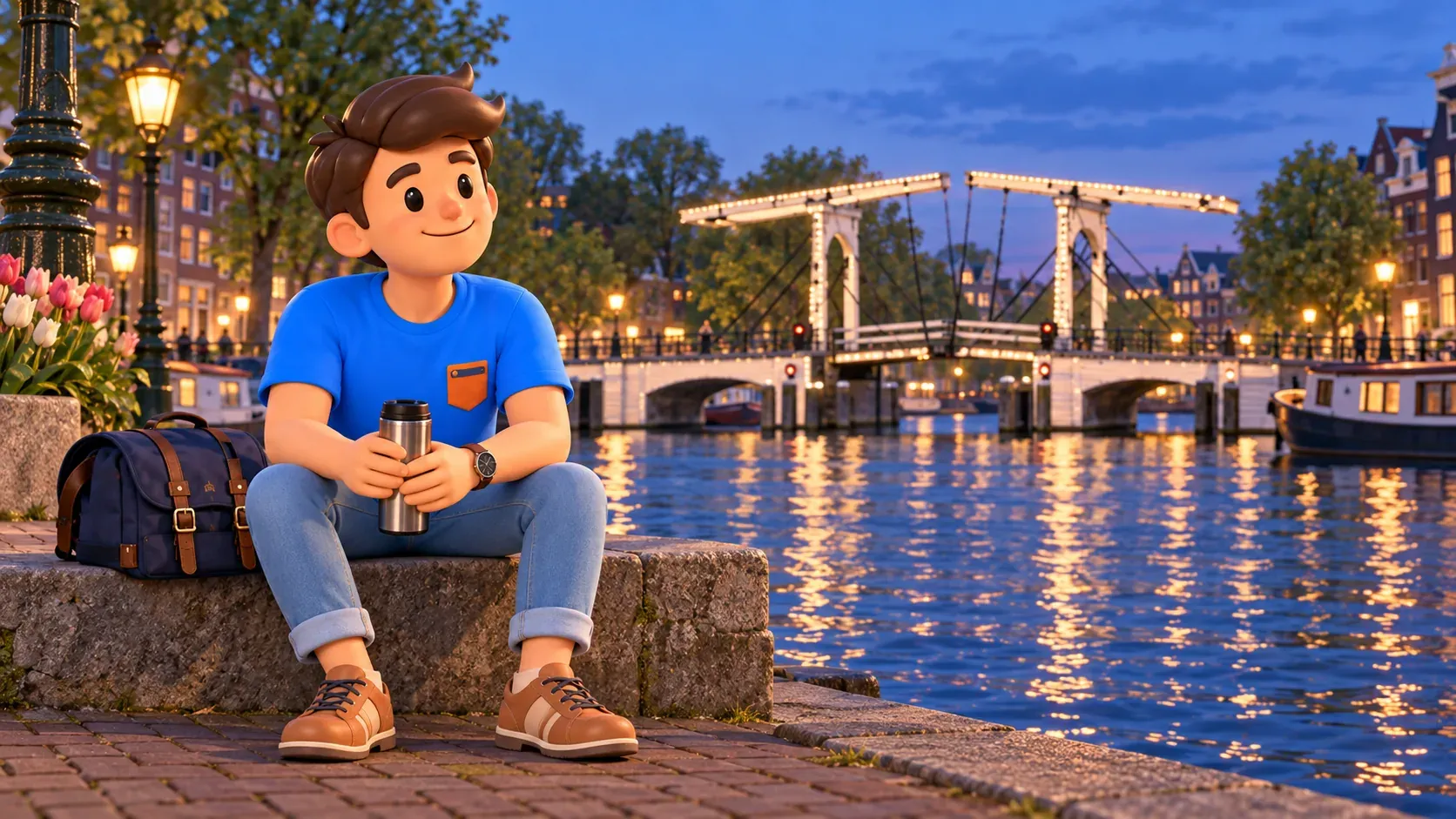
The white wooden Magere Brug is a double drawbridge. In 1934 it was renewed in the old style to a design by Piet Kramer. A traditional city scene therefore does not mean the whole visible structure survives unchanged from the seventeenth century. That distinction between a familiar form and a later phase of its history is enough for a short stop, without a complete technical chronology.
Its name has a straightforward explanation: the earlier crossing was so narrow that people struggled to pass one another. The popular story of the Mager sisters supposedly living on opposite banks is identified as a legend in the municipal historical account. It makes a small conversation for the evening, but should not be presented as a documented biography of the people who commissioned the bridge or as a reason to believe every appealing local tale.
Compare this crossing with Blauwbrug at the start. There, attention went to weight and decoration; here, to the light-coloured structure and the line across the water. Asking what has changed connects the two stops better than a technical table. In one evening, you see two different answers to the same city task: joining banks in a way that makes the crossing part of the place’s identity and visual memory.
As darkness gathers, details give way to silhouettes and reflections. If bridge and riverbank lighting are visible on your evening, let that become part of the impression; if not, the walk still has a purpose. Do not attach it to a promised illumination or switch-on time. River, crossing and the space between the banks already form a complete scene without a guaranteed lighting performance arranged for your arrival.
On the bridge, keep passage clear and choose any photo position with other people in mind. If movement stops temporarily, wait for permission to continue. The main version ends on the western side by Kerkstraat after crossing. You may also finish on the eastern bank if it suits your next journey. The value of the walk does not depend on crossing solely to complete an entry on a sightseeing checklist.
Keep the rest of the evening easy
Plan dinner after the walk, with time to reach the venue and settle in. If you have a reservation, count backwards from it and from the actual bank where you intend to finish. A proper restaurant visit does not fit into the same seventy-five minutes. For a shorter outing, retain both bridges and one pause between them, leaving more of the evening for whatever you would prefer to do next.
For photography, arrive early enough to examine the crossings before darkness; for conversation, choose a pace that does not require catching up with a schedule. In rain, shorten stationary stops, and finish earlier if wind makes the river uncomfortable. Assess surfaces, approaches and crossings against your needs: this route has not been checked as step-free. Let the result be a view you remember, rather than another completed list after a long day.


