
Women in Zurich’s History: Abbesses, Writers and a Legend
Women's history is visible in central Zurich when you look beyond the familiar monuments to men. Fraumünster connects the city with abbesses who exercised religious and secular authority. The surrounding district recalls Johanna Spyri's literary work. Ricarda Huch introduces another history of university access and professional employment. At Lindenhof, a fountain preserves a legend about women defending the city, a story that should be distinguished from a documented individual biography.
Build a manageable walk around Münsterhof and Lindenhof, adding literary Hottingen only if you want a separate extension. This is not a complete list of notable Zurich women or a contest to collect plaques. The purpose is to see different forms of historical presence: government, writing, education and public memory. A medieval abbess's authority did not mean equal opportunities for every woman living at the same time.
Begin with Fraumünster beyond the stained glass
Use RoadMe to make a personalised plan for the whole trip around interests and pace. If history and literature appeal, combine a few meaningful stops with time for reading, walking and a pause.
At Münsterhof, architecture and art usually attract attention first. For this walk, ask another question: who led the community based here, and what position did it hold in the city? Fraumünster was more than a place of prayer. Estates, income, rights and administration supported the abbey. Its history therefore reveals women participating in political and economic life, rather than appearing only as exceptional figures in a colourful local tale.
A documentary starting point is 21 July 853, when Louis the German endowed the convent and entrusted it to his daughter Hildegard, its first abbess. That charter is associated with the abbey's foundation. The present church should not be mistaken for a building wholly surviving from the ninth century: it developed through many alterations. The institution's early history and today's visible architecture belong to different layers of the same place.
Remember Hildegard as the first leader connected with the royal endowment. Abbesses administered the religious community and its estates, while their position included secular powers. This was not a modern elected office, nor did it make medieval Zurich a place of general gender equality. Birth, status and institution mattered. Keeping those distinctions makes the authority more intelligible without diminishing its importance to the history of the city.
Authority that had to be exercised and negotiated
Behind the title stood daily administration: property, revenue, dependent holdings, rights and relationships with the city council. The abbess's influence was not limited to religious ritual. It also did not remain unchanged across every century. As the city developed, balances of power shifted and government required negotiation. The abbey's story is an extended relationship between centres of authority, rather than a single uninterrupted personal command over everyone and everything nearby.
On the square, imagine the institution's less visible side: documents, accounts, appointments and disputes over responsibilities alongside the church interior. These details prevent the misleading fairy-tale image of one woman simply owning the whole city. An abbess acted within a particular order that granted possibilities and imposed limits. The urban setting becomes an opportunity to think about how authority worked, as well as to admire a façade.
You need not memorise every abbess. Two figures provide a useful frame: Hildegard near the beginning and Katharina von Zimmern at the Reformation. Centuries of administration lie between them. That scale helps prevent Fraumünster's entire history being compressed into one decision in 1524. It also distinguishes the medieval institution from today's Reformed church, which continues an active religious life under a different set of arrangements.
Katharina von Zimmern and the change of 1524
In 1524, the last abbess, Katharina von Zimmern, transferred the abbey to the city council. During the Reformation, this ended the convent's centuries-long history and involved relinquishing important rights and standing. Her action contributed to Zurich's peaceful transformation. Claiming one woman single-handedly and certainly prevented a civil war would oversimplify a political process involving many decisions and participants. Her importance does not depend on such an absolute statement.
Avoid inventing an exhaustive explanation of her private motives. Historians consider the balance between independent choice and pressure from a changing city. The documented result matters for a visitor: the abbey passed to the council, and Katharina was an actor in that transitional period. She was not merely a person who disappeared when the convent ended, even though familiar Reformation narratives often concentrate on male reformers and civic leaders.
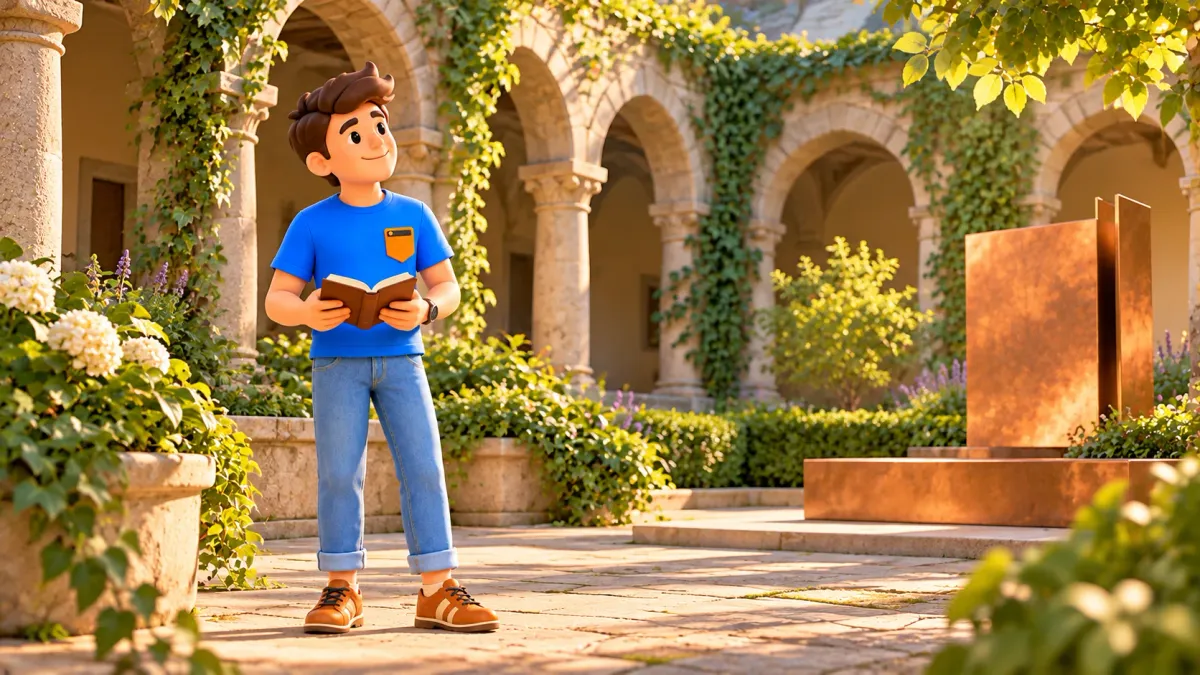
In the former cloister between Fraumünster and the Stadthaus is Anna-Maria Bauer's memorial to Katharina, inaugurated in 2004. It is an abstract block sculpture in copper, not a woman in historical costume. No authentic portrait of Katharina survives; the artist made the compact form itself carry the commemoration. Looking for a recognisable face therefore misses how the work functions. Its relationship with a pedestal is part of the question it raises.
If the passage is accessible, pause and compare this memorial with the familiar hero above a plinth. Why is one person represented by a recognisable figure while another needs an explanation of an abstract form? No compulsory answer is required. The question encourages closer attention to public art. Do not assume round-the-clock access: the cloister, church interior and open square are different spaces, each with its own practical conditions.
Johanna Spyri: an Alpine story written in a city
Near Fraumünster, remember Johanna Spyri, the author of Heidi. Although the story is strongly associated with mountains, it was created in central Zurich. From 1868 to 1885, Spyri lived with her husband, the city secretary, in an official apartment in the former Stadthaus on Stadthausplatz. Urban surroundings were not just an incidental stop in her life but a setting for literary work. That contrast makes the familiar story worth reconsidering.
Do not point to today's Stadthaus as though it were the preserved apartment. The district changed substantially, and the earlier building is not identical with the present one. City research describes demolition of the old Kratzquartier and the area's transformation. For a walk, seeing the setting and understanding what has disappeared is enough. An invented preserved writer's room or a promise of public entry would create a false expectation.
The two Heidi books are generally dated 1880 and 1881; the first appeared in late 1879 with an 1880 publication date. This small detail separates writing, publication and later readership. There is no need to retell the whole novel on the square. Instead, consider how a writer surrounded by urban rebuilding could create a narrative about nature, home and belonging. The city and the mountain imagination were not mutually exclusive worlds.
Ricarda Huch: university, employment and a writing voice
Ricarda Huch came to Zurich in 1887, when the university already offered women an opportunity to study. She studied history, gained her doctorate in 1891, then taught at the higher girls' school and worked at the city library. Here is a different form of participation: education, paid professional work and literary development. It was not a continuation of an abbess's medieval privilege but another historical route into intellectual life.
Her library work included processing printed material and correspondence. A book therefore belongs not only to a story of inspiration but also to an everyday working environment. Zurich connected study, earnings and writing for Huch. However, today's Zentralbibliothek building should not automatically be identified as her nineteenth-century workplace. The history of an institution and survival of a specific interior are separate questions, particularly when walking through a city that has repeatedly rebuilt itself.
Literary Hottingen, including the Zeltweg area, offers an optional continuation. Zentralbibliothek connects the district with Spyri, Huch and other writers; Huch later remembered her Zurich years in Frühling in der Schweiz. This is a reason to explore a neighbourhood, not permission to enter private houses. If the central walk has used your energy, leave Hottingen for another day and begin with a text rather than extending the route automatically.

Lindenhof and the legend of the city's defenders
At Lindenhof, the fountain figure by Gustav Siber is associated with a legend about Zurich's women. According to the story, in 1292 they assembled on the hill in armour, giving the impression of a strong defending army and deterring an enemy attack. Later retellings identify a leader as Hedwig ab Burghalden. It is a compelling civic story, but should not be presented as a fully documented biography of a medieval battlefield participant.
The city's historical report traces how memory developed: the story of the women belongs to an earlier tradition, while Hedwig's name as their leader appears only in the eighteenth century. The present figure dates from 1912. Large intervals separate the supposed event, development of the legend and creation of the memorial. Those intervals make the place interesting: a city does not only preserve the past, but repeatedly chooses how to represent it.
Look at the figure, then at the terrace above the Limmat. You do not need to reconstruct the military episode as a certain event to understand its commemorative force. The legend expresses readiness to act and recognition of women within the city's story. Documented decisions by abbesses, writers' biographies and a tale of collective defence are different kinds of history. Holding them together while preserving their differences gives the walk more depth.
A manageable route with room to consider what you see
With RoadMe, distribute the whole trip around interests and pace: central historical sites can share one walk, while the literary neighbourhood can have another day. Leave time to look and discuss rather than only move between stops.
Begin at Münsterhof, add the cloister memorial if access is available, then continue through the western side of the Old Town towards Lindenhof. Account for the climb separately from a map's distance. Around ninety minutes to two hours is an editorial allowance for a relaxed exterior walk with pauses, not a measured standard. The church interior, a guided visit or longer reading needs additional time and its own opening check.
Tourist admission to Fraumünster is paid, and services or events can change access. Check the calendar before coming; the outside walk can still make sense by itself. In wet weather, assess surfaces and the Lindenhof ascent, and finish earlier if tired. An accessible entrance to one memorial does not establish that every route or part of the church works for every visitor. Specific access needs deserve a specific approach.

The result is another way to read a familiar centre. Women governed, wrote, studied and became subjects of public memory here. Not every trace is a recognisable portrait on a pedestal: some remain in documents, others in books, abstract art or legend. Distinguishing these forms reveals a fuller Zurich history while preserving the pleasure of an ordinary urban walk. A few well-understood places can change what you notice afterwards.


