
Giacometti at the Police Building and Zurich’s Station Angel
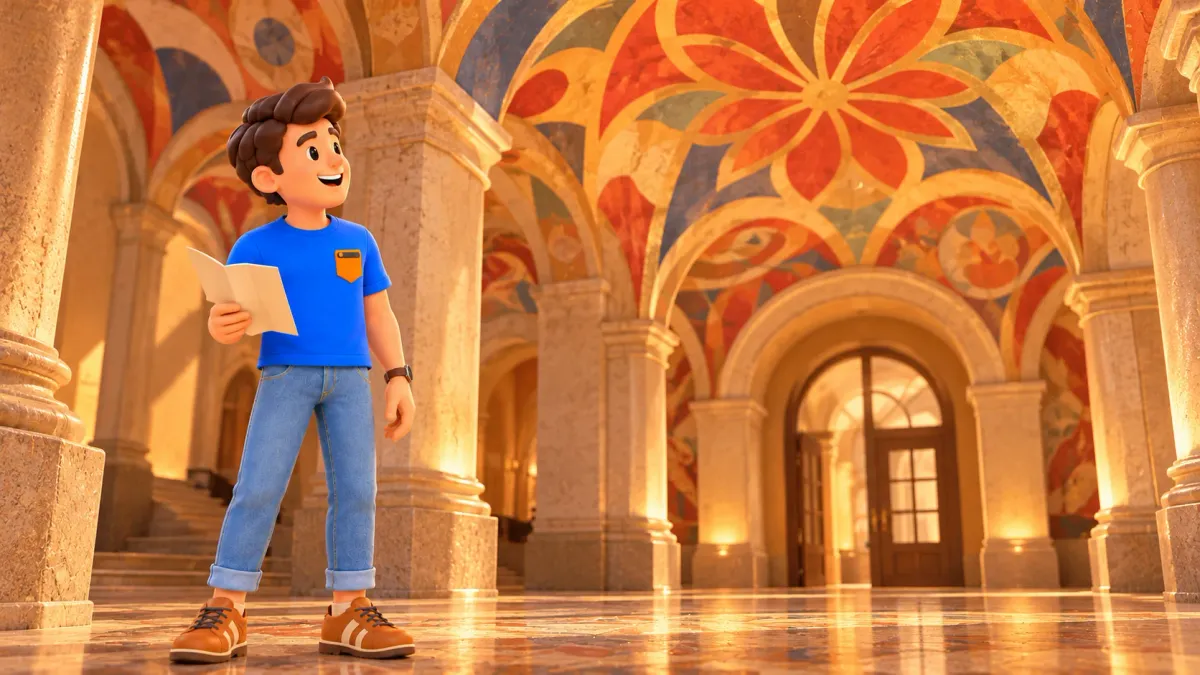
Some of Zurich's memorable art appears where people usually come for other reasons. At Bahnhofquai 3, Augusto Giacometti's paintings transformed an administrative entrance with a police function into an environment of colour. In Zürich HB's main hall, Niki de Saint Phalle's L’ange protecteur hangs above travellers. The sites are close, but access works differently. One visit must fit a controlled schedule; the other takes place within an active public station.
Giacometti-Halle is visited only with an escort during limited hours and may close unexpectedly for police work. The angel is in the public station hall, where passenger movement continues while you look. A compact walk can connect them through one question: how do colour and form alter everyday space? It does not replace a museum visit, but offers a complete artistic experience in its own right.
Two encounters, two visiting arrangements
Use RoadMe to build a personalised plan for the whole trip around interests and pace. Fit this walk to Giacometti-Halle's visiting window and allow time for waiting, the approach and an unhurried look in the station hall.
Start with the day. The city's current information lists Wednesday to Friday, 14:00–17:00, with escorted visits only, for groups of no more than twenty people. Advance registration is not possible. This is not daily unrestricted entry to police premises. Older advice about morning opening, Saturday access or advance group reservations should not be carried into the present arrangement without checking. The current owner information takes precedence over an appealing older itinerary.
Roughly sixty to ninety minutes can be an initial editorial allowance for the two sites, not a measured duration or promise of immediate admission. Waiting and operational circumstances can alter the plan. If the painted hall is unavailable, the station art remains worthwhile by itself. A closed door does not mean the whole walk has failed, nor is another service entrance an alternative way to gain access.
During a short train connection, the departure is the main constraint. Count back from reaching your platform before deciding whether a separate police-hall visit fits. Map proximity does not make the journey from a particular carriage instantaneous. A large station, luggage and unfamiliar exits require margin. When time is tight, seeing the angel within the main hall can be a complete choice without attempting both sites.
The painter is Augusto Giacometti
The paintings are by Augusto Giacometti, who lived from 1877 to 1947. Do not confuse him with the better-known sculptor Alberto Giacometti and his elongated human figures. At Amtshaus I, the subject is colour, ornament and monumental painting. The correct first name changes expectations immediately: you are looking at a room transformed by paint, rather than searching for a single freestanding sculpture on a pedestal.
The city dates the overall work to 1922–1926. Giacometti won the competition in 1922 and involved Jakob Gubler, Giuseppe Scartezzini and Franz Riklin in its execution. This was the technical realisation of an artistic conception with collaborators, not an instantaneous individual gesture. The background reveals sustained work with surfaces, scale and a particular building. It adds another dimension to the initial impression of brilliant colour without requiring extensive prior art knowledge.
The commission addressed two practical concerns: brightening a dark entrance and helping local artists facing economic difficulty. Its unexpected location was therefore not a whim or a picture accidentally left among offices. Art became part of solving an urban problem. That relationship to ordinary function makes the hall compelling. The artistic effect operates within a working administrative setting rather than removing it from the city's daily activities.
How a former basement became a colour environment
Amtshaus I is connected with Zurich's former municipal orphanage. During Gustav Gull's conversion of the complex, the surrounding terrain changed and a former basement became an entrance. Light remained a problem: vaulting and stone supports produced a dark, unwelcoming hall. Colour was intended to change the experience of existing architecture. Knowing that before arrival helps explain why the paintings occupy these surfaces instead of appearing as isolated framed additions.
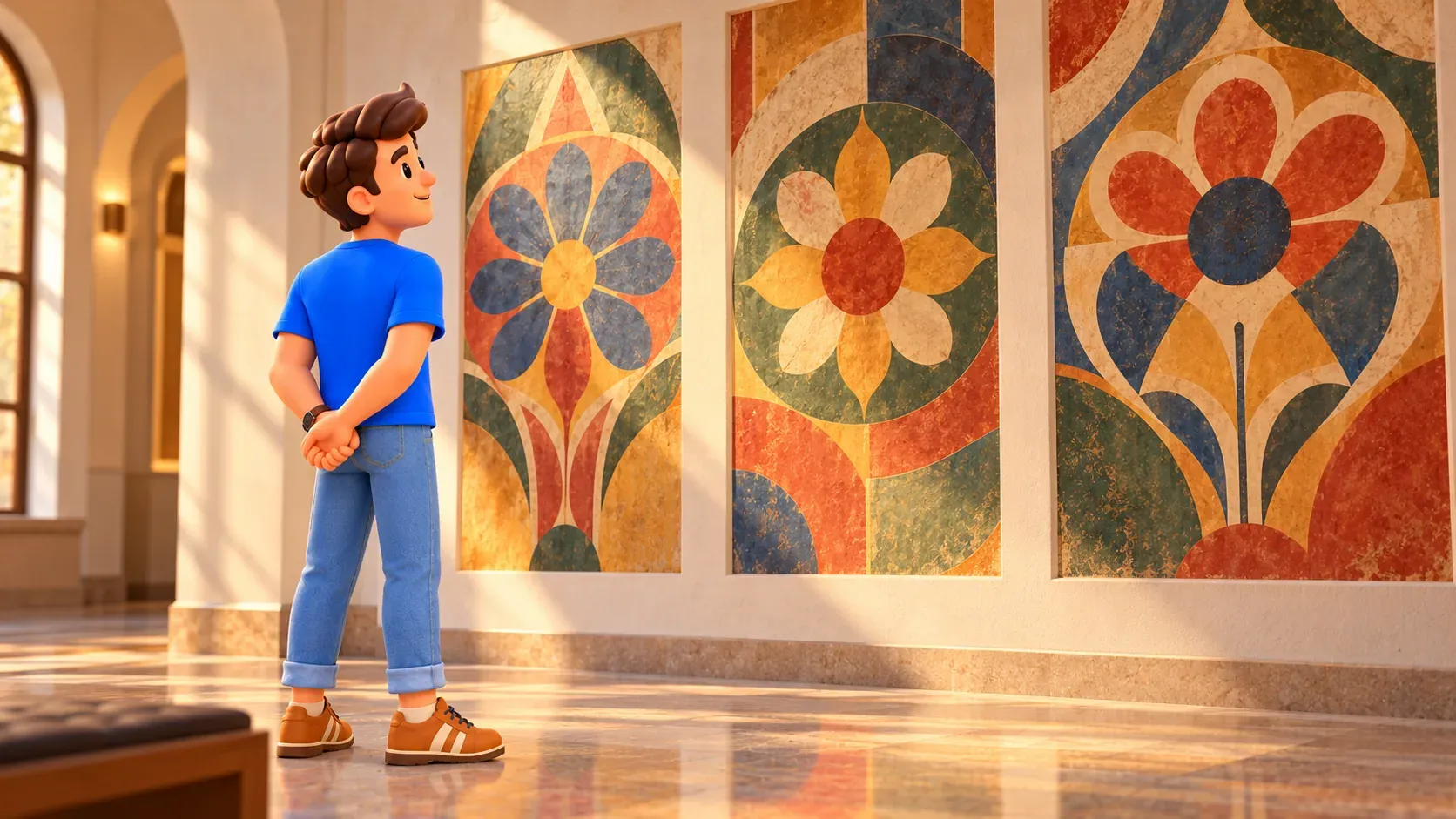
The nickname Blüemlihalle refers to flower motifs. Imaginary blossoms and rosette forms spread through the vault decoration in saturated colour. The walls, however, are more than an ornamental wrapper. Figures associated with work and knowledge introduce harvest, crafts, building and intellectual activity. You need not identify every scene beforehand. Begin by comparing the ceiling's decorative rhythm with the calmer wall compositions, then let an individual figure draw your attention.
The work combines painting on fresh and dry plaster, a fresco and a secco. Describing the whole room as exclusively wet-plaster fresco would be inaccurate. For an ordinary visit, the central point is that painting belongs to the building's surfaces, rather than forming a set of portable pictures. Moving beneath the vaults changes how colour and architecture are perceived together. Look at the hall as a whole before reducing it to a collection of details.
Allow an initial moment without a camera. Look up, turn to a wall, then notice the stone structure again. Try describing what colour does as well as what is depicted: does it make the vault feel lighter, denser or warmer? Your response can be personal. This approach needs no specialist vocabulary and develops the first reaction of unexpected beauty without turning a short visit into a lengthy lecture.
Entering the painted hall
The address is Amtshaus I, Bahnhofquai 3. The meeting point is outside the building; follow the Meeting Point sign and current directions. The city warns that police operations can cause unannounced closure. Closures are separately listed for 25 December 2026 and 1 January 2027. Checking before setting out is useful, but does not remove the possibility of a change on arrival. Keep the itinerary flexible enough to accommodate that uncertainty.
Follow the escort and remain in the permitted area. An art visit does not open every police room. The city marks the access as barrier-free, while particular needs should still be discussed in relation to the escorted entrance. Building access and absence of a wait are different questions. A group must account for the size limit rather than relying on an old offer of bookable private access.
Professional photography and filming, tripods and images of staff are prohibited. Ask about personal photographs under the current on-site directions. The absence of an overall camera ban should not be taken as permission to record service activity. Look first, then ask about a photograph. The visit need not end with an image, particularly when time is short or other visitors are sharing the limited space.
A short approach to the station, with works considered
Amtshaus I is beside the main-station area, but the approach follows current traffic arrangements. Bahnhofquai/HB tram stop is out of use for reconstruction from December 2025 until a planned return in mid-December 2026. Do not treat an old diagram as proof that the stop is operating. For the walk, follow temporary signs, barriers and crossings rather than cutting through a construction area. Conditions on the ground matter more than an apparently shorter line on a map.
Inside Zürich HB, look for the large historic Haupthalle, not just any underground passage or platform hall. The station has several levels and flows, so establish your position calmly. If a train follows the visit, identify the route to its platform beforehand. Stop to look away from the main flow, keeping cases and maps clear of other people. This remains a working transport interchange, not a separate exhibition pavilion.
Niki de Saint Phalle's L’ange protecteur
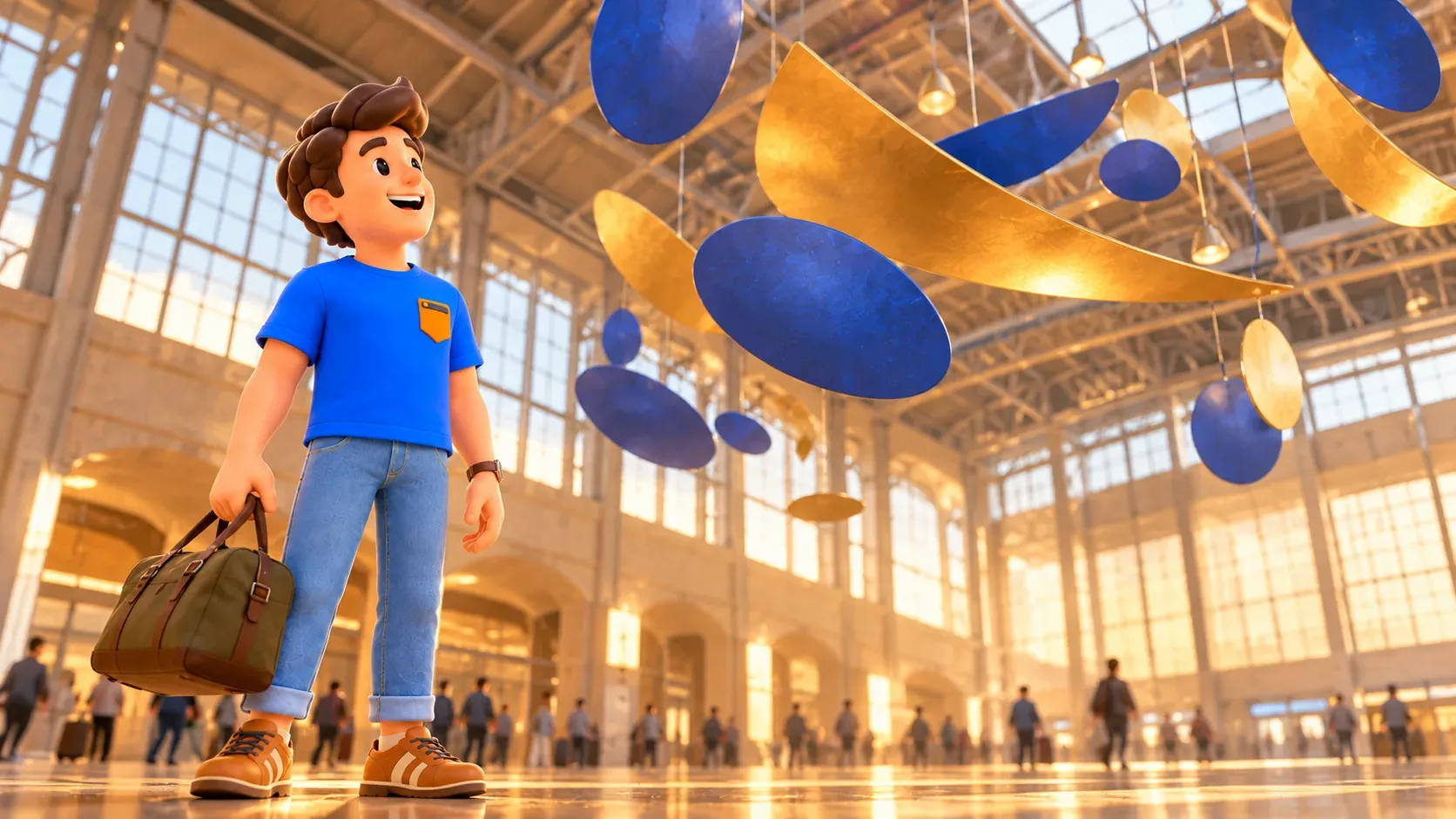
The large suspended angel appeared in the station hall in 1997. Niki de Saint Phalle is known for colourful, voluminous female Nana figures. A blue body, bright clothing and golden wings contrast with the architecture and ordinary railway surroundings. L’ange protecteur means the protecting or guardian angel. It is an artistic image of care for travellers, not a literal guarantee about the safety of a particular journey. The title can be understood without treating the station as a religious monument.
The sculpture was a gift from Securitas for the 150th anniversary of Swiss railways. Do not confuse railway history with the age of today's SBB company. It travelled from the United States in sections through Rotterdam and Basel and was assembled in Zurich. For a first look, exact weight and measurements are unnecessary. Scale becomes apparent in relation to people below and the high space of the hall.
Change viewing distance while leaving passage clear. From farther away, the figure acts as a coloured marker above movement; closer positions reveal individual forms and its suspension within space. Do not search for the conventional austere male angel of religious sculpture. The work continues Saint Phalle's own language of volume, colour, female physical presence and affirmative expression. Personal responses can differ. You do not need to admire it in order to look carefully at how it changes the hall.
The station environment places demands on the work's surface, making conservation a professional task. Historical cleaning reports do not establish a present closure or absence of the figure. Do not touch accessible elements or seek unusual angles from restricted areas. Public art offers an encounter within urban life, without cancelling the rules of the space around it. The relationship between care for an artwork and ordinary station operation is part of its continuing story.
What connects the two places
With RoadMe, distribute the whole trip around interests and pace: a short art walk can be a complete part of the day. After two attentive encounters, leave room for a pause rather than adding a museum solely to increase the total.
In Giacometti's hall, painting covers architecture and changes the feeling of an entrance. At the station, a single object enters a large space of movement and becomes visible from different positions. Compare what affects you more: immersion in colour or an encounter above a human flow. That question connects the route meaningfully. It is not a competition between artists, but two ways in which art relates to its location.
If interested, you can also notice other works in the Haupthalle, including Mario Merz's Philosophical Egg, listed by SBB among the station's art. An extended list is optional. If the main question has already found an answer, finish and continue the day comfortably. The impression does not automatically grow with the number of names, especially between trains or after a full programme of city exploration.

This walk offers another way to look at everyday Zurich. An institutional entrance and a station hall can become places of artistic experience while keeping their normal functions. Knowing the correct artist, actual visiting arrangement and where to pause is enough to begin. The city opens through colour, scale and the surprise of an encounter, as well as through deliberately selected museum addresses.


