
Why Is There a Mammoth in Barcelona’s Ciutadella Park?
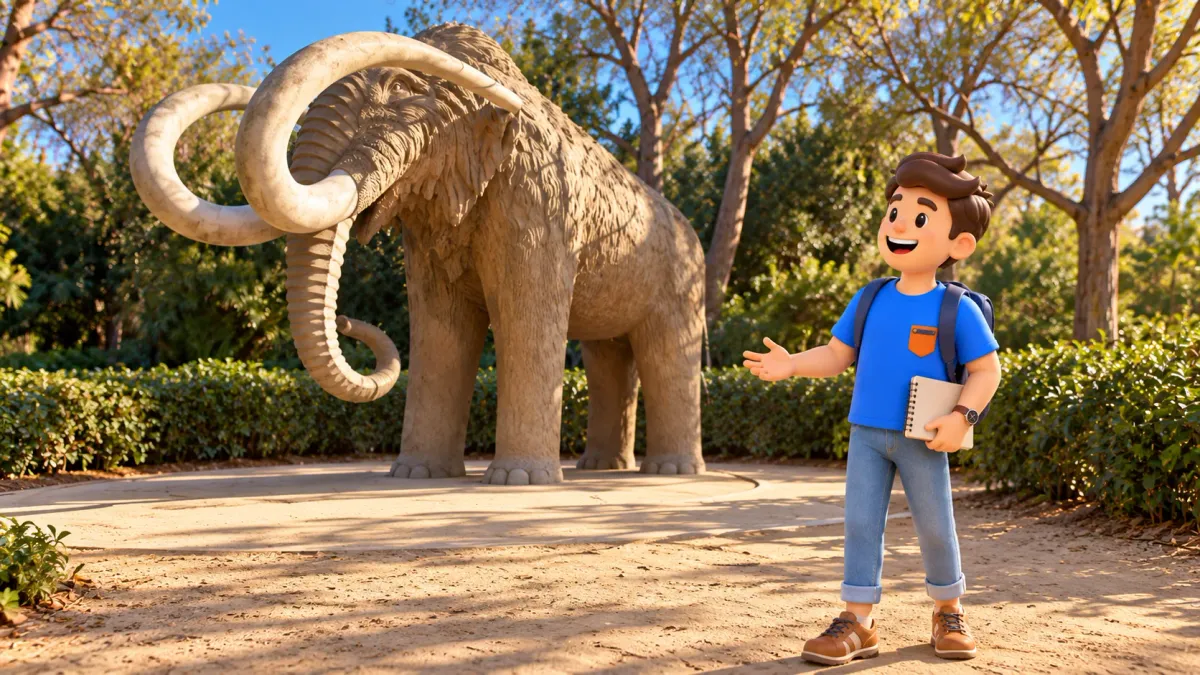
Among the trees of Ciutadella Park stands a mammoth with enormous curling tusks. Encountering it on an ordinary Barcelona walk is surprising even if you have already seen a photograph. At first, it can seem like a playful park curiosity. Its history leads to a more serious ambition: bringing animals from the distant past into view for the public.
The mammoth arrived in 1907 as the beginning of a planned series of life-size extinct animals. It was the full-size example that actually materialised. The interesting question is therefore not only why a mammoth stands in Barcelona, but how one object from a public-science project became a familiar character in everyday walks.
A sculpture, rather than a discovery beneath the park
Start with an important distinction. This is not a fossil, an ancient animal uncovered on this spot or a living inhabitant of the zoo. It is a life-size representation of a woolly mammoth made in reinforced concrete. The surface suggests hair, but the material belongs to early twentieth-century public sculpture, rather than natural remains.
The familiar description “stone mammoth” appears in sightseeing lists. It conveys the general impression without precisely describing how the object was made. “Sculpture” and “model” are more useful words: people were trying to represent an extinct animal so that a visitor could encounter its scale and outline beside their own body.
That distinction does not diminish the interest. Actual remains answer one set of questions; a human-made model answers another. Here you can look at an image of an animal and a historical way of communicating science at the same time. A park unexpectedly becomes the setting for both stories without requiring a long museum visit.
If unexpected city stories appeal to you, try RoadMe: the app prepares a personal trip plan around your interests, dates, pace and budget. It makes fitting a small discovery into the right day much more convenient, with room left for the experiences that matter to you.
The larger project that began with one mammoth
In the early twentieth century, Barcelona’s natural-history institutions wanted to bring knowledge into public space. The proposal envisaged around a dozen life-size extinct animals. It included more than mammals, with other groups of ancient fauna involved. The idea was a kind of outdoor educational display, capable of surprising a passer-by through scale.
The mammoth, unveiled towards the end of 1907, became the first and only full-size member of the proposed series to be realised. There is no need to look for the remaining giants behind every turn in the path. Smaller historical models associated with the project form a different museum story; they are not other large sculptures installed around the park.
Sculptor Miquel Dalmau worked on the representation with the scientific circle involved in the project. It is not a work by Gaudí or an ordinary elephant later supplied with an ancient biography. The purpose concerned communicating natural science, even if a visitor today first experiences the object as an enjoyable photograph stop.
Avoid turning the unfinished project into an invented drama with one certain explanation. For a walk, the documented result is enough: the larger full-size series did not appear, and one object remained. A fragment of an ambitious scheme can become especially memorable when it is no longer one of many similar exhibits.
Why a scientific story belongs in Ciutadella
Ciutadella was more than a place for leisure. Cultural and scientific institutions played a role in the park’s design and later development. The Martorell museum, botanical structures and natural-history activity formed a setting where walking could meet observation and learning. The mammoth did not arrive in an urban story entirely unrelated to its purpose.
Keep the sequence of dates clear too. The park developed during the nineteenth century, the Universal Exhibition took place in 1888, and the mammoth sculpture came later, in 1907. Not every unusual feature in Ciutadella belongs automatically to that exhibition. A green space can contain several historical layers rather than one shared birthday.
This offers a way to look around without trying to study the whole park. Decorative sculpture, leisure space and a trace of a scientific project can stand near each other. Appearance does not tell the entire purpose. One object may have begun as ornament, another as education, while their everyday roles later moved closer together.
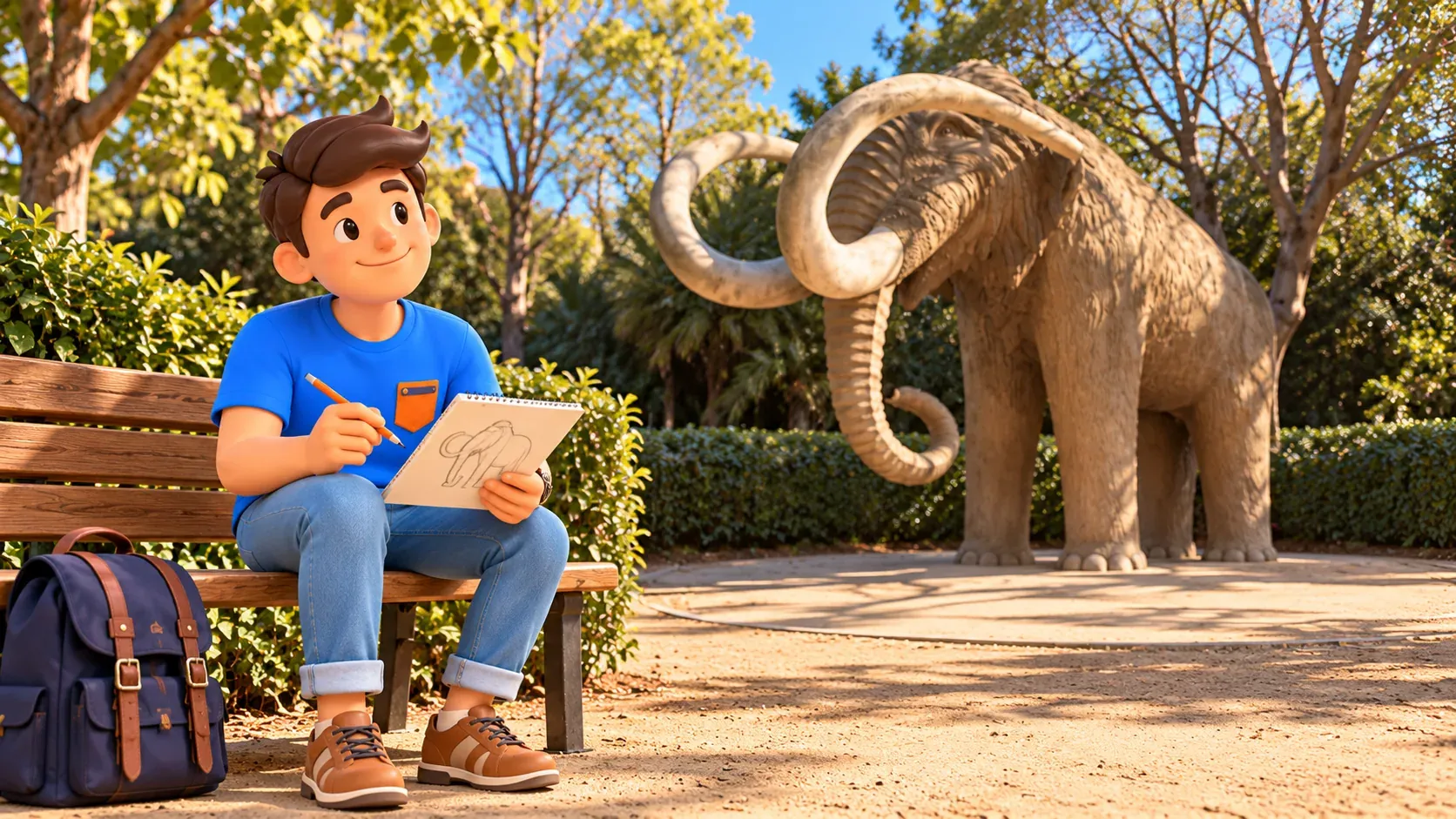
The mammoth is in the public part of the park near the monumental cascade. Its story is separate from visiting the zoo: the sculpture is not among its living animals. Nor does its historical museum connection mean that the present main natural-science museum at the Fòrum is hidden here just beyond the trees.
What to notice when you arrive
First, look at the overall silhouette from a little distance. The broad curves of the tusks, the lowered and curled trunk, the heavy body and raised shoulder area make the figure recognisable. You do not have to begin with exact measurements. Its relationship with people and trees already suggests why a model close to natural size mattered.
Next, look at the surface. Hair is represented through material, grooves and relief. This is neither a fluffy toy nor a photographic copy of a living animal, but an image made by a sculptor. The gap between animal and sculpture is interesting in itself: how do you suggest texture in something intended to stand outdoors?
Third, notice the setting. How does the figure separate from the greenery? Where can you read the tusks distinctly from the head? What changes after a few ordinary steps along a permitted path? It becomes a small observation exercise, rather than a compulsory search for the one correct camera angle.
For a photograph, a person standing nearby at a sensible distance provides enough comparison. There is no need to sit on a tusk, pull at details or copy a historical pose that treats the sculpture as play equipment. Scale can be appreciated perfectly well without touching a historic object.
Why an old model is not the last word in science
The sculpture reflects the knowledge and reconstruction practices of its period. The natural-history museum points out that older representations of prehistoric animals do not fully match present knowledge. It is useful to read the mammoth in two ways: as an attempt to show an animal and as evidence of the history of public science.
That does not make the old object unworthy of attention. A historical globe, early reconstruction or old illustration can remain valuable after knowledge changes. The key is not to transfer every represented feature into an account of the real mammoth as an unquestionable biological fact.
The word “prehistoric” can cause particular confusion. It does not mean that every extinct animal lived at the same time, or that a mammoth was a dinosaur. For a family walk, a few distinctions suffice: this was a mammal, it became extinct, and people made the park object much later. Further questions can lead to another encounter with science.

A small wooden figure and a full-size sculpture both help suggest an animal, but neither becomes its actual remains. If a child asks how people know what an animal looked like, that is a useful opening for talking about evidence. There is no need to answer everything immediately; separate what you can observe from what you would still like to learn.
How a science object becomes a familiar city character
The mammoth has another life in family photographs and memories. In 2023, the natural-history museum gathered historical and contemporary pictures of visitors with the sculpture. That shows how an object from a scientific ambition entered ordinary urban memory. Not everyone in a photograph knows the project’s history, but their connection with the place still matters.
The combination works particularly well in a park. You can arrive without a specialist purpose, recognise a shape from a book and become interested in why it is there. Science does not always begin with a long lecture. Sometimes it starts with a question on a walk, when something interrupts ordinary expectations.
There is no need to assign one universal emotion to the sculpture. Different people may associate it with childhood, animals, drawing or simply a smile. One clear historical fact can give those impressions more depth without replacing them with a compulsory response. The visitor’s experience does not have to reproduce the original institution’s intention exactly.
You might record a sentence about your surprise as well as a photograph. What did you first assume: decoration, a museum exhibit or an exhibition relic? What turned out differently? A small question can make a trip more attentive without turning every pause into a lesson or requiring a notebook full of research.
Keeping the walk light
The mammoth works well as one meaningful episode during a Ciutadella visit. It does not need a dedicated day of intensive sightseeing. Afterwards, continue through the park, give attention to trees and open space or take a break if you have already absorbed enough. A short stop can have a complete story.
The public park has entrances and access arrangements, so a general “free” description does not mean that every path is available around the clock. Daylight makes the form and surface easier to appreciate. A sunny illustration with flowers conveys a mood rather than guaranteeing identical seasonal conditions on your chosen date.
If you want a museum too, choose it as a separate visit with a suitable programme. Do not transfer one site’s hours, address or admission arrangements to another merely because they belong to the same institution. Nor should an older photograph create an automatic expectation of working boats or cascade jets; neither is necessary for the mammoth’s story.
Let RoadMe work out a personal plan that gives walks, unusual stories and museum visits the pace you prefer. Planning around your interests in the app is more convenient and effective than collecting every appealing idea into one tiring day.
For choosing the green part of your trip, see our guide to Barcelona’s parks. Beside the mammoth, one question is enough: why does an ordinary stroll suddenly introduce an extinct animal? The answer connects a sculpture, an early twentieth-century scientific ambition and a city’s habit of encountering the remarkable along everyday paths.


