
Why Abu Dhabi builds circles, leans and waves

A circular office building, a tower that deliberately leans, a bridge whose arches seem to ripple: Abu Dhabi gives even a short journey some memorable outlines. The useful question is what each form helps you notice. Shape can make a building recognisable, create an encounter with its setting or give everyday infrastructure a distinctive presence.
Aldar HQ, Capital Gate and Sheikh Zayed Bridge offer three different ways into that subject. They do not share one explanation, and a photograph cannot reveal every technical decision behind them. A little context, followed by a careful look, is more rewarding than treating each as another unusual object to collect.
Begin with three layers: appearance, use and setting
First ask what you can actually see: a circle, an inclined outline or a sequence of arches. Then ask what the place does: offices, occupied rooms or a road crossing. Finally look at its surroundings. Distance, roads, water and neighbouring buildings influence how that shape reaches you.
Want architecture to fit naturally into your trip? RoadMe makes planning more convenient by developing a complete personal itinerary around your interests, dates, pace and budget. The app helps turn a visual curiosity into a well-balanced day, with room for culture, meals and rest.
These layers prevent an easy mistake: assuming that the most eye-catching feature explains the whole building. A memorable silhouette matters, but the people using the place need entrances, workspaces and connections. Architecture becomes more interesting when you keep the image and that ordinary life in view together.
Aldar HQ: a circle becomes a city landmark
At Al Raha, the round building known as Aldar HQ makes a clear impression before you know its name. Designed by MZ Architects, it uses a circular face as its defining image. Start by looking at that outline rather than trying to memorise a list of dimensions or awards.
The important observation is that a circle in a photograph is still a building with depth. An angled view changes the apparent shape and reveals a different relationship between the broad face and the side. You are seeing a three-dimensional object through a particular position, not a flat emblem suspended in the city.
Try holding a plain round object upright and turning it gently in your hand before the visit. The visible circle narrows as the angle changes. That small exercise gives you something concrete to look for outdoors, without pretending to reproduce the building's structure or the architect's design process.
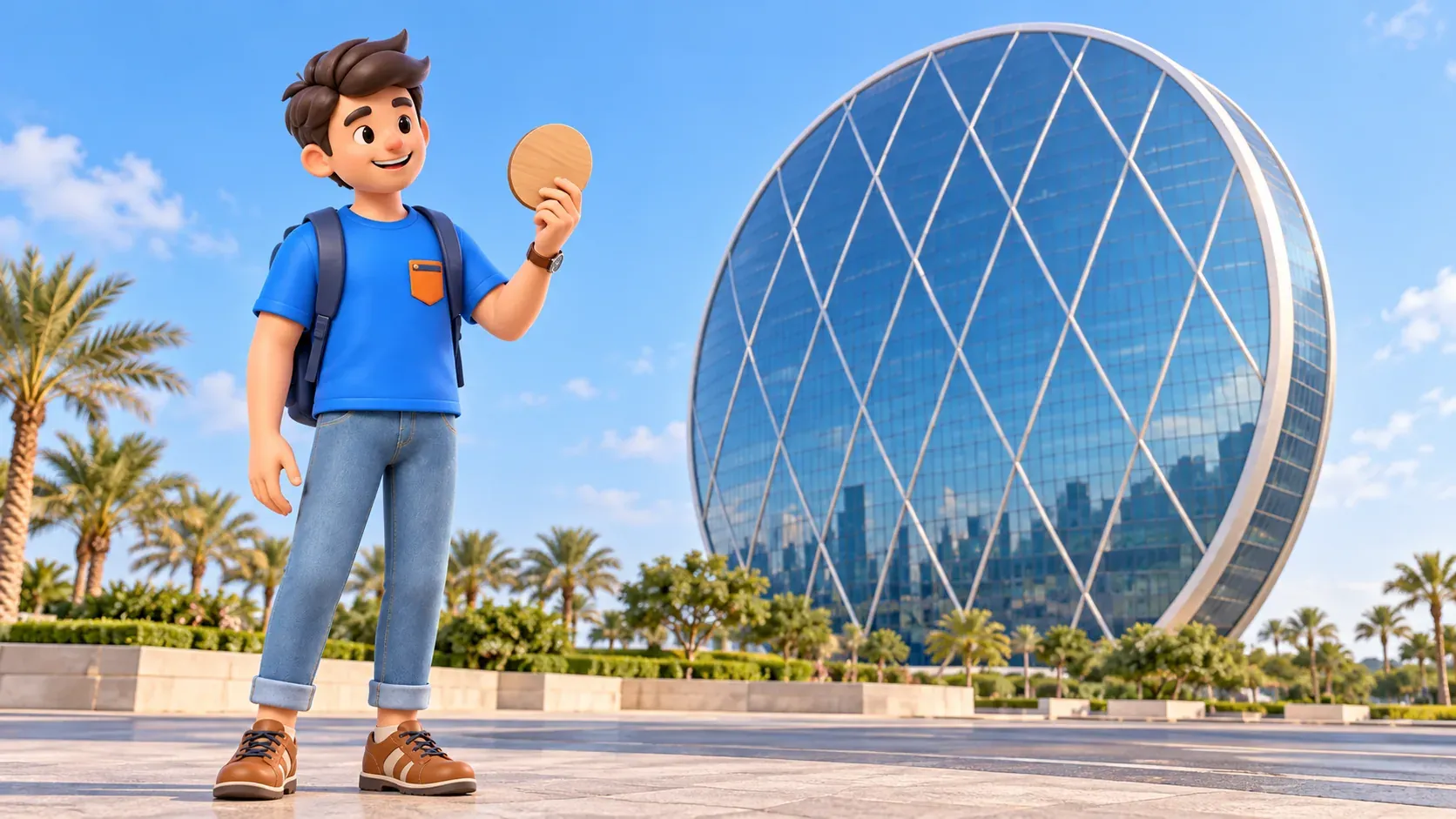
A memorable outline is one answer, not every answer
A strong form is easy to recognise in a wider view and easy to remember afterwards. That helps explain its appeal to a visitor. It does not prove that a circle is automatically the most efficient office layout, or that every part of the design followed a single symbolic idea.
Avoid attaching an attractive story to the architect without evidence. You can describe the building as a disc-like shape because that is your visual comparison. Claiming that a particular symbol was the confirmed reason for every decision is a different statement. Keeping that distinction leaves space for your own response without inventing history.
The property is a working office building. An exterior look does not include a tour, roof access or an unrestricted waterfront viewpoint. Choose a genuinely available public position and notice what it reveals. The place can be interesting without access to every angle imagined from photographs.
Capital Gate: the lean is intentional
Capital Gate, designed by RMJM, introduces a different idea: a building deliberately inclined eighteen degrees. The angle belongs to the design. Looking at it as an intentional composition changes the experience from a moment of surprise into a question about how the building presents itself.
Find the verticals around it, such as an ordinary lamp post or the edge of another building in your view. They provide a visual reference for the inclination. You do not need to compare it with famous towers elsewhere or turn the visit into a competition over records.
A photograph can exaggerate or disguise the effect. Tilt the camera and the surrounding verticals tilt too; change your position and the outline reads differently. Make one straightforward image with a clear reference, then put the camera down and compare it with what your eyes actually see.
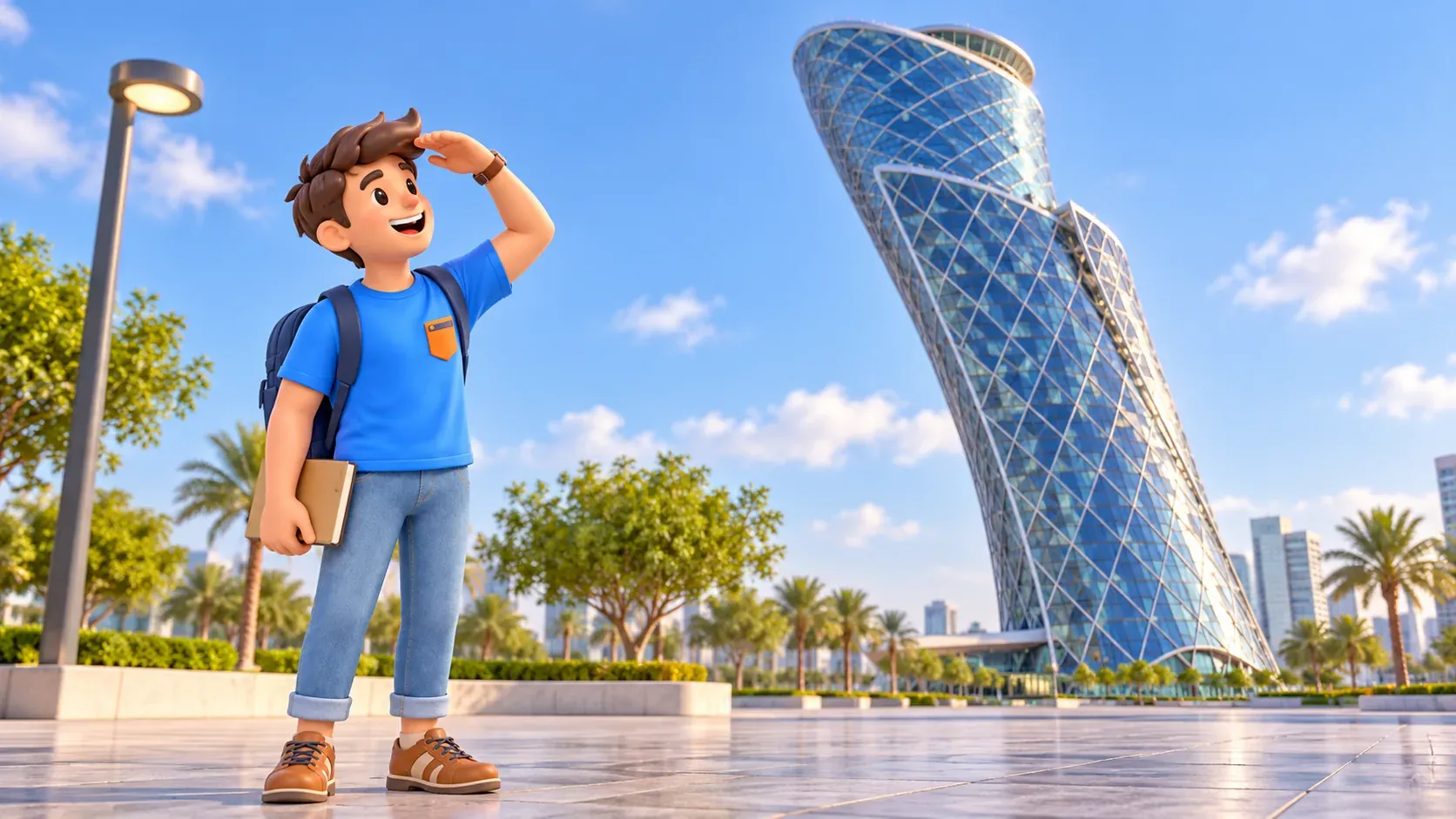
A striking appearance is not a structural explanation
The fact that a building leans does not tell you how its loads are carried. That answer belongs to its engineering, materials and construction. From the street, you can appreciate the overall design without treating a visible line or surface pattern as a complete diagram of its support.
That boundary is useful for a curious traveller. Say what you observe, separate it from what you have learned, and leave unknown technical details open. Understanding one reliable fact often gives you more than repeating a dozen impressive figures whose meaning you cannot connect to the building.
Capital Gate also has an everyday setting around it, with arrivals, working spaces and separate visitor activities. If you want an interior experience, arrange the relevant visit or reservation on its own terms. Recognising the exterior form and entering a particular part of the property are different parts of a trip.
Sheikh Zayed Bridge: movement enters the picture
The bridge by Zaha Hadid Architects crosses the Maqta Channel between Abu Dhabi Island and the mainland. Its flowing arches take inspiration from the region's sand dunes. Here the relationship with landscape offers a documented starting point for looking at a practical piece of transport infrastructure.
Watch the line of the arches rather than searching for a literal copy of a dune. Inspiration can work through rhythm and a sense of rising and falling. The result remains a bridge that carries traffic; the sculptural outline gives that crossing an additional visual identity.
A bridge also changes your relationship with observation. You may see it as a passenger while moving through the city, or from an appropriate separate place. Those are different experiences. A brief moving view can communicate the larger rhythm even when it does not allow detailed photography.

Read a landscape reference without turning it into a rule
The bridge's dune inspiration does not mean that every curved building in Abu Dhabi represents sand, or that every repeated pattern has the same cultural meaning. One documented design story should make you more attentive to the next place, rather than become a ready-made explanation for everything.
Try a simple comparison after your visit: what belongs to the natural reference, and what belongs to the structure's actual job? A wave-like outline and a road deck can share the same view while doing different things for your understanding. The pleasure lies in seeing those layers meet.
For a longer look, establish a permitted viewing place and a real way to reach it. Do not assume that the bridge has a public photography platform or that an attractive roadside position is a valid stop. If the practical approach does not suit the day, keep the experience to a passenger's view.
Why there is no single reason for the city's shapes
These three examples bring together recognition, an intentional inclination and a landscape reference. They show why the question “Why is it shaped like that?” needs a different answer at each site. The visible result can be memorable for the visitor while coming from several decisions rather than one universal formula.
Climate is another important architectural subject in Abu Dhabi, but it should be connected to the right example. Al Bahr Towers, for instance, have an external modular shading system. That is a specific response to the sun; it is not evidence that a circular silhouette or any dramatic curve automatically performs the same function.
Keep your own interpretation clearly personal. A building may remind you of an everyday object, a movement or a drawing. Sharing that response with a companion can make the visit enjoyable. You do not have to promote it into an official design intention for it to be worth discussing.
Turn one observation into a small architecture experience
Choose the example whose question appeals to you most. Aldar suits an interest in silhouette and viewing angle; Capital Gate invites a closer look at inclination; the bridge adds form and movement to an appropriate road journey. They occupy separate areas, so there is no need to combine all three in one outing.
At the chosen place, begin with a broad look, select one detail and finish by describing what changed when you looked again. With children or less enthusiastic companions, turn it into a short shared observation. One good question can be enough; leave before the experience becomes a compulsory lesson.
Plan arrival, the actual accessible observation area and the next part of your day together. Choose comfort over an exhaustive sequence of photographs. Exterior architecture can fit a wider trip well precisely because you decide how much attention to give it.
RoadMe makes that choice easier to use in practice: the app works through a personalised trip plan, balancing the architecture you care about with your other interests and preferred pace. Let a complete itinerary handle the connections while you enjoy discovering what makes each place distinctive.
You may leave with only one new way of looking: noticing depth behind a circle, an intentional lean among vertical lines, or the rhythm of arches over a channel. That is already enough to make Abu Dhabi's skyline feel more readable, and the journey through it more interesting.


