What Should You Plan Ahead for in Bruges?

Before visiting Bruges, choose your most important experience, check its calendar and access requirements, then decide what to book. For the Belfry, reserving a time online is useful; for lace making, the demonstration hours matter; for a brewery tour, choose the right format and language. You do not need to buy everything ahead. Some of the city's best walking time can remain uncommitted.
A useful sequence is interests, date, access, specific experience and finally purchase. It avoids both arriving at a closed door and filling every hour with paid commitments. The examples below show where advance decisions make a difference in Bruges. The aim is a comfortable visit, not an appointment at every attraction.
Start with one experience you care about
Ask what matters most to you and anyone travelling with you. Painting, a city panorama, craft and brewing reward different kinds of attention. If several appeal, start with one main visit per half-day and build around it. That is an editorial suggestion for a relaxed pace, rather than a limit set by the city or a claim about how much everyone can comfortably see.
RoadMe makes developing a personalised plan for your whole trip much more convenient, using your interests, dates and available time. Try planning Bruges in the app so the visit you care about fits naturally among walks and breaks at your own pace.
Record duration, approach, entry preparation and a pause as well as the admission time. Two neighbouring museums may not fit a short window, even if the walk between them takes little time. In a compact historic centre, attention and the experience itself often create the real constraint. A small distance on a map is not evidence that another complete visit will fit comfortably.
Decide what you would happily leave out. A painting enthusiast may prefer a longer encounter with art to an additional tower. A family interested in making things may value a demonstration more than another façade. This narrows preparation too: you check the important places instead of trying to investigate every building before leaving home. Choosing less can produce a clearer and more enjoyable day.
The Belfry: choose your climbing time ahead
The Belfry on Markt is a good example of advance timing being useful. Because capacity is limited, the museum recommends booking online. That recommendation also applies to Musea Brugge Card holders: admission entitlement and a suitable time slot are separate questions. Do not assume that having a museum card alone settles the practical arrangements for your preferred climb.
Read temporary closure notices as well. Maintenance closure has been announced for 19–22 October 2026. A reservation cannot override the venue's calendar, and a well-designed itinerary cannot open a closed staircase. For later visits, check the current museum information rather than transferring this particular October interruption automatically to another year. Exact dates matter more than a general statement that the tower usually opens.
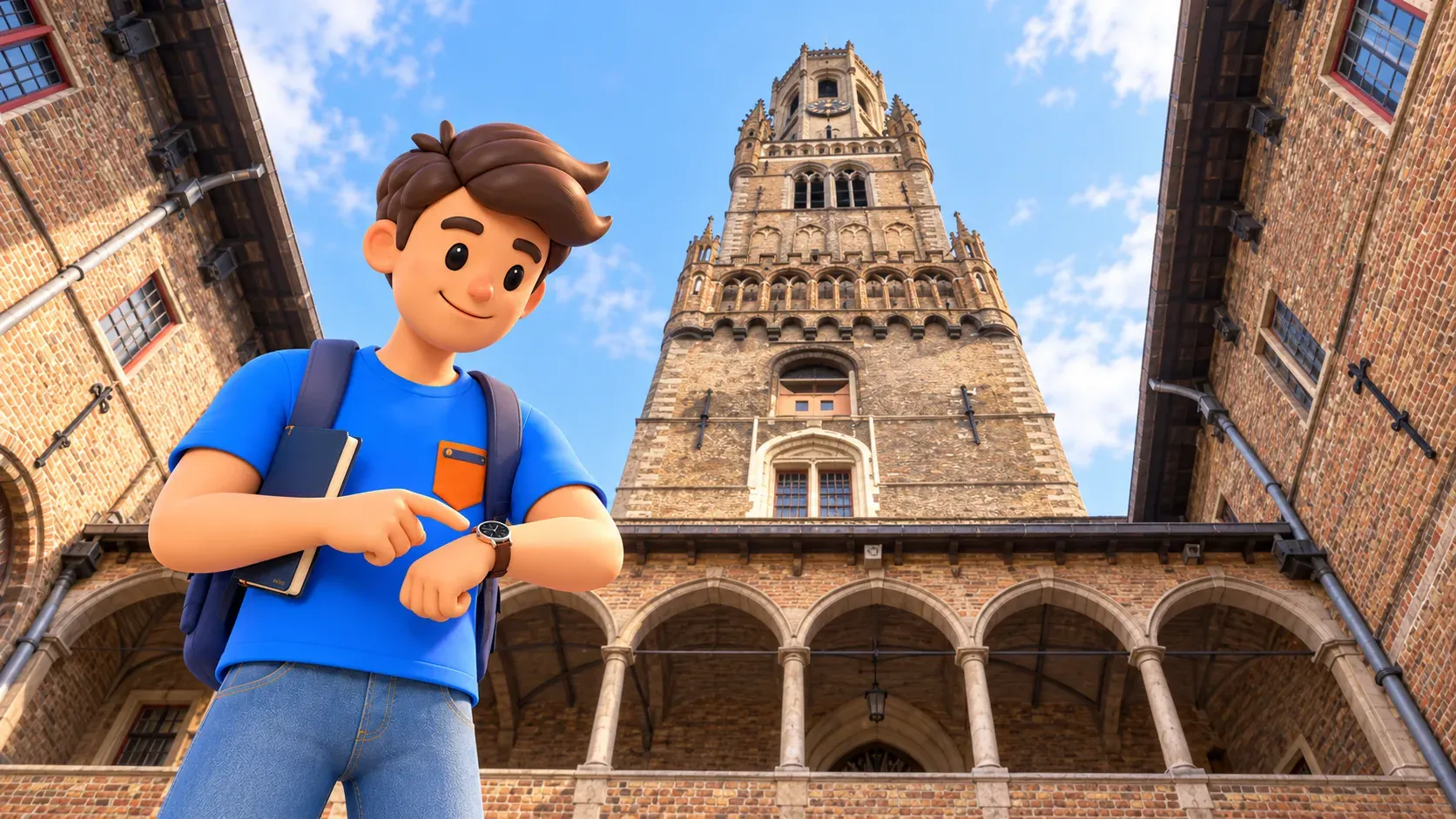
The climb involves 366 steps and takes around an hour according to the museum's guidance, with approach and preparation needing their own allowance. Its appeal includes civic history and the carillon as well as height. Establish whether that experience interests you and whether the stairs suit your party before looking for the first available slot. A convenient ticket time cannot answer those questions.
Leave a margin before your next fixed commitment. An additional 20–30 minutes could serve as your own planning buffer, but it is an example, not an official standard or a guarantee against delay. A train departure also requires a separate return journey. A buffer is only useful if you leave it genuinely free instead of filling it with another supposedly quick interior.
Historium: understand the product before buying
Historium Tower, on the same square, illustrates a different kind of preparation. Under current arrangements, its tickets can only be bought at the ticket desk. The complex's general advice to book online does not automatically cover this product. Here, advance planning means understanding which experience you want and avoiding a different purchase simply because the building's name looks familiar.
The tower ticket includes Historium Exhibition, but not Historium Story or VR. These are different experiences requiring their own time. If you want a view of the Belfry, do not build expectations around a story-based visit. If an immersive historical experience is the priority, a staircase alone does not replace the appropriate programme. One building does not make all its offers interchangeable.
The tower has 145 steps, a narrow entrance measuring 45 centimetres and a minimum visitor height of 1.40 metres. Do not substitute an age rule from another Historium activity. Fewer steps than the Belfry does not mean a spacious climb suitable for everyone. Check the practical requirements before comparing attractive panorama photographs or promising that the whole family will go up together.
For the full comparison, see Belfry or Historium Tower: which Bruges view to choose. The planning lesson is straightforward: deciding in advance and purchasing online in advance are not the same thing. Sometimes understanding restrictions and allowing time for the ticket desk is more useful than trying to prepay every activity located on one square.
Museum days: check the actual door
Do not give every Bruges museum the same weekly closing day. Groeningemuseum normally closes on Monday; Gruuthusemuseum closes on Wednesday. The updated schedule for these museums applies from 1 April 2026. Holidays and special circumstances can bring further changes. If you have only one available day, start with the actual calendar rather than a general assumption about museum Mondays.
The Folk Museum has a seasonal difference: during 1 April–2 November, its regular closure is Monday; during 3 November–31 March, it closes on Monday and Tuesday. A winter Tuesday cannot be planned using the summer schedule. This small example shows why establishing the right date can save more trouble than buying several admissions without considering their sequence.
A larger change affects 2027 trips. Groeningemuseum closes for renovation from 11 January 2027. A display of its collection at BRUSK is scheduled from 12 March 2027 to 30 June 2031. There is no promised continuous replacement between closure and the start of that display. Reopening the renovated museum is planned for 2031, without an exact reopening day being promised here.
Establish which collection is available in which building on your date. A future display announcement does not guarantee every individual work. If you want just one museum, use the comparison of painting, art and care, and city history through objects. A choice by interest still needs to match a real venue and a workable visiting day.
A brewery: choose the format and language
For De Halve Maan, establish the tour format and language before selecting a time. The standard guided visit takes around 45 minutes, with Dutch, French and English as the principal languages. Choose one your group understands rather than assuming that information in your own language means a tour will be delivered in it. Comprehension matters to the value of the experience.
A separate longer XL format exists, but it should not be mistaken for the standard tour. Read the selected offer before checking availability. Comparing only the word brewery hides differences in duration, presentation and what is included. The entry in your day plan should reflect the actual product you choose, rather than a mixture of appealing details from several different options.

The standard route includes 220 steps, some steep. The rooftop view forms part of the tour, rather than a separate free viewpoint to visit between walks. If you only intend to pause near the courtyard, do not expect the entire tour experience without joining it. Preparing ahead also means understanding the physical route, not simply securing an admission.
Afterwards, you do not automatically need another brewery. One substantial visit can sit comfortably alongside a walk and a proper break. Discuss different interests in your group before booking, rather than choosing a paid compromise nobody particularly wants. An early decision about what to leave out can make the trip as convenient as deciding what to buy.
Lace and chocolate: admission, demonstration or workshop?
At Kantcentrum, the museum and demonstrations connect with the same craft, but do not equal hands-on instruction. Regular demonstrations run Monday to Saturday, 14:00–17:00, with holiday and special-date exceptions. The museum opens earlier, so morning admission does not promise the same live craft activity. The time you choose changes the nature of the experience, even at the same address.
If watching skilled hands is your priority, organise around the afternoon. If you want to try the technique, enquire about a separately arranged workshop: ordinary museum admission is not a lesson. The former lace-school setting makes this a meaningful place to consider how skills are passed on, without turning every visitor's ticket into practical teaching.

Choco-Story offers a similar distinction: a museum demonstration does not mean an included hands-on workshop. Advance booking is recommended for individual admission, while separately arranged private workshops require reservations. Do not promise a child chocolate making if you have selected only the museum. Agreeing expectations before buying is much easier than discovering a different programme at the display case.
The museum suggests around an hour and a half for a visit. A short approach to its entrance does not reduce the exhibition to a brief stop. For a family day, choose the format and time first, then add food and rest. An additional activity needs its own allowance, rather than slipping unnoticed into a central walk that already fills the available afternoon.
Resolve access and belongings before paying
A convenient approach does not guarantee an equally convenient interior. Reaching the Gruuthuse courtyard differs from following the palace museum's stair route; that museum visit is not wheelchair accessible. Choco-Story has four entrance steps without a ramp, and its internal lift does not serve every level. Those conditions matter more than a general description of the short distance between attractions.
Ask the venue about the actual part of the visit you need. Steps, pushchair arrangements, belongings and individual rooms are different questions. Do not buy for an entire group on the strength of one broad accessible label. Storage arrangements differ too: a small place for belongings does not mean every suitcase can be accommodated. Specific questions before purchase can prevent a much larger change on arrival.
Leave some of Bruges uncommitted
Street-level views of Markt and Burg, canals and ordinary pauses need not be attached to individual tickets. Choose a sensible geographical sequence and leave time simply to look around. Enclosed gardens, courtyards and religious spaces still have gates and visiting rules: a flexible walk does not imply round-the-clock entry everywhere. Keeping a day open means choosing fewer fixed commitments, not ignoring the places you enter.
With RoadMe, it is much easier to develop a personalised itinerary for the whole trip and connect important visits with your interests, time and pace. Try the app to spend less effort assembling each day manually and more attention on Bruges itself.
Before leaving, briefly check the dates, times and confirmations that matter, rather than researching the entire city again. Keep a clear day outline and room for travel. If one visit is unavailable, return to the original interest instead of choosing any nearby replacement. A considered Bruges plan makes space both for resolved practical questions and for an enjoyable walk that unfolds without constant appointments.