Belfry or Historium Tower: Which Bruges View Should You Choose?
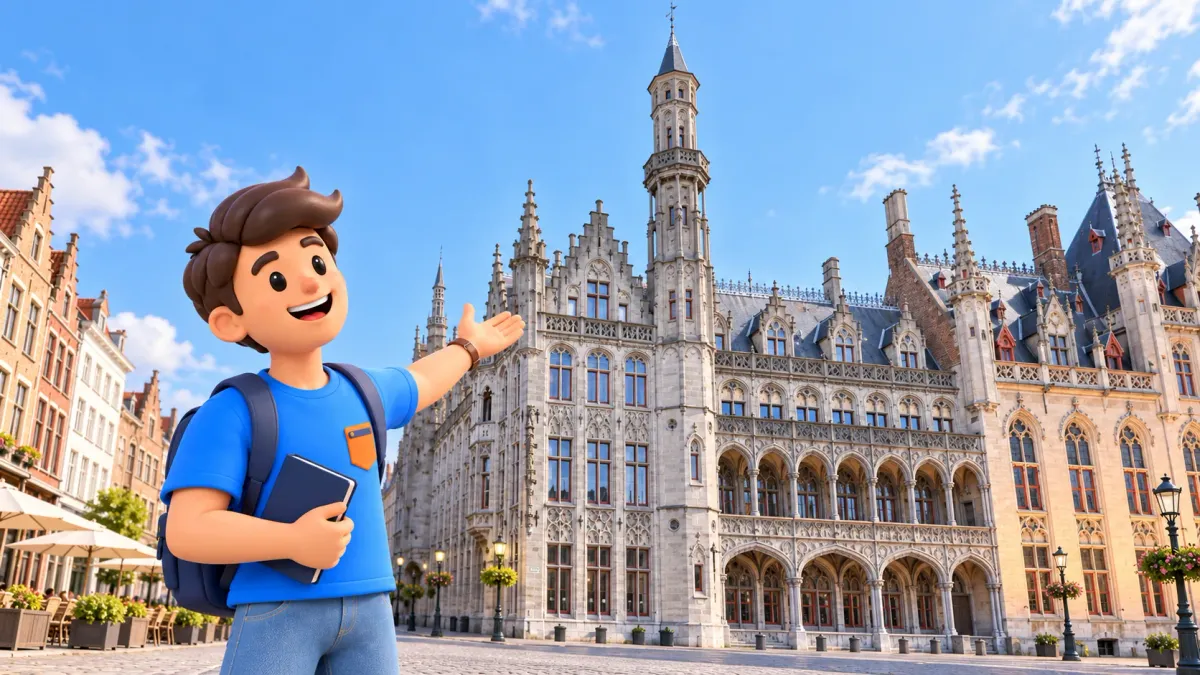
If you want just one tower climb in Bruges, choose the Belfry for its high perspective, civic history and carillon, or Historium Tower for a view that includes the Belfry itself. Historium has fewer steps, but its small lookout and narrow access deserve attention. The better choice depends on what you want to see and the conditions you find comfortable, rather than a universal ranking of the two panoramas.
For an imminent visit, note that the Belfry has announced a maintenance closure on 19–22 October 2026. On those dates, the decision starts with the calendar. At other times, check the particular tower's opening arrangements too. A museum complex being open, or a bar in the building still serving, does not mean its tower remains available for climbing.
Choose the view before counting the steps
The Belfry rises over the market halls on Markt, Bruges' central market square. Climbing it takes you inside one of the city's defining landmarks. Historium stands across the same square, so its tower offers the Belfry as part of the scene. If you want that recognisable silhouette among the roofs, seeing the tower is a different goal from standing inside it.
RoadMe makes it much easier to develop a personalised plan for your whole trip around your interests, dates and pace. Try planning Bruges in the app so your chosen climb fits naturally among the walks, museums and breaks you actually want.
One climb is enough for a first visit. Both can interest someone particularly keen on architecture or elevated views, but they are not a compulsory pair. The buildings are close together, with the square between them rather than a separate lengthy route. The real time commitment comes from entry, the visits themselves and a pause afterwards, rather than the walk from one door to the other.
There is also a satisfying option with no stairs: appreciate both buildings from Markt, then continue towards the canals. An elevated view adds a perspective without determining whether you have properly seen Bruges. If narrow stairs would dominate the experience, the square and waterfront offer a different enjoyable day. Staying at ground level need not become a disappointing substitute for a compulsory ascent.
The Belfry: civic history on the way up
The Belfry is 83 metres tall, with 366 steps leading towards its upper level. These describe the building and climb; do not automatically turn the tower's total height into an exact observation-platform elevation. The visit offers more than a final panorama. Documents, the treasury, bells and the carillon's workings help explain why the tower mattered to the city below.
Its construction developed in stages from the thirteenth century. This is a civic tower associated with urban administration and independence, rather than the bell tower of a neighbouring church. Important charters and seals were kept here, while bells communicated time and events. Understanding that role helps make sense of its prominent position over a commercial square and market halls.
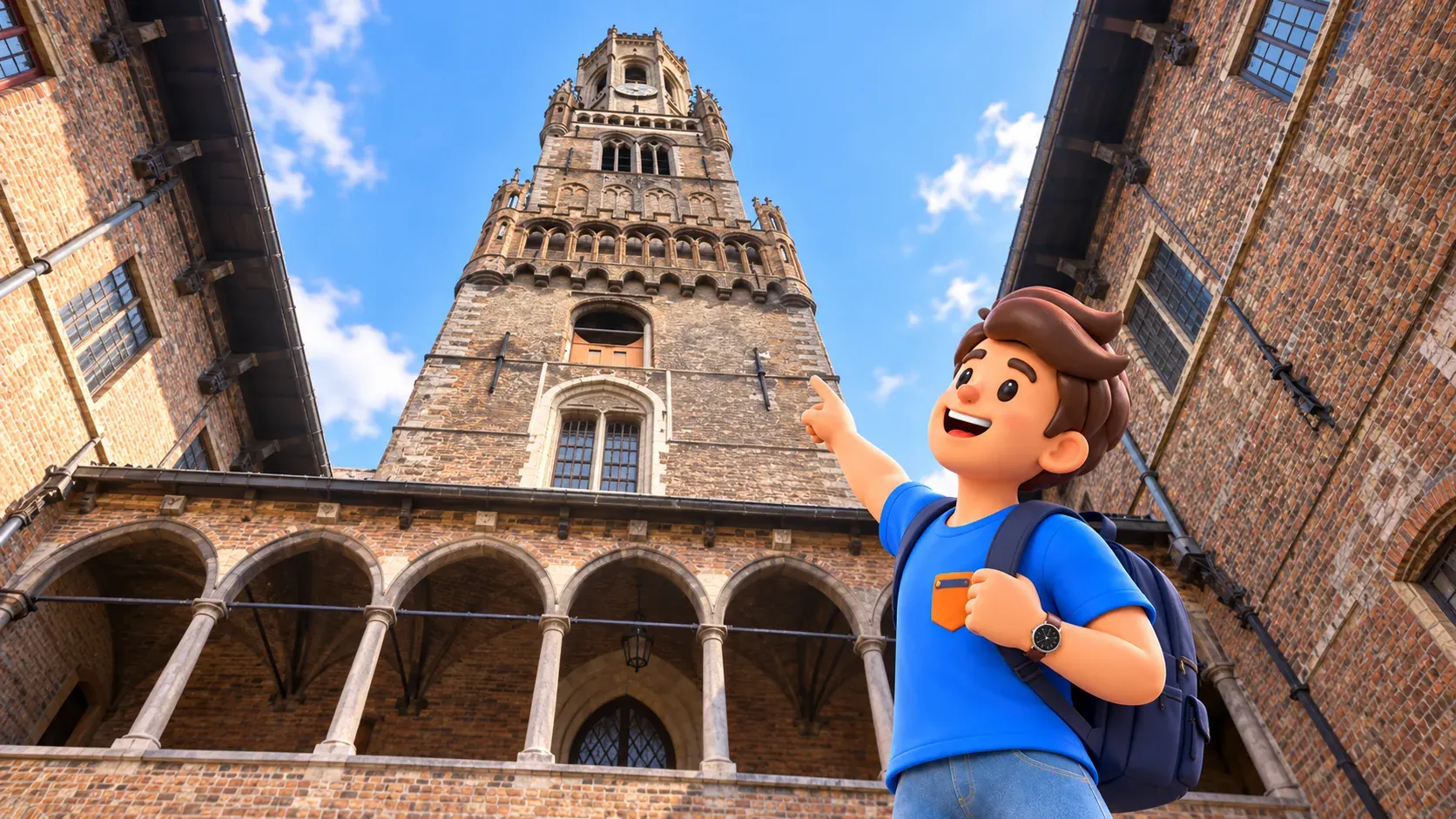
The present carillon has 47 bells. Hearing a performance at a particular moment is different from discovering the instrument and its setting, so do not assume every visit includes a concert. Ask staff about hearing protection if you find the sound too strong. For many visitors, the relationship between the city, mechanism and bells gives this climb its distinctive purpose.
There are intermediate stopping points, rather than a requirement to climb all 366 steps in one uninterrupted effort. Nevertheless, the staircase is narrow and becomes steeper higher up. Visitors ascending and descending share the same spiral stair, with those descending given priority. Pause where you can do so without blocking others, and allow for passing people rather than treating the climb as a timed challenge.
What the Belfry viewpoint is actually like
At the top, you look through large openings protected by metal mesh from inside the tower. For photographers, that is an important expectation to establish. This is not an open rooftop with a broad terrace to wander around. The mesh and architectural frame are part of the viewing conditions, rather than an unexpected obstruction that can simply be removed for your preferred composition.
Photography is allowed without flash or a tripod. Do not push a phone or camera through the protective mesh. Good equipment cannot remove the need to share the space with other visitors. If your main photographic goal is the Belfry's complete silhouette, this climb cannot fulfil it: standing inside the tower does not give you a view of that same tower across the square.
The museum suggests around an hour for a visit. Add a separate allowance for entry and preparation, particularly before a fixed meeting or train. Booking a time online is recommended because capacity is limited; a reservation does not promise that every stage involves no waiting. Last admission is earlier than closing, and strong winds can affect whether the climb is available.
Avoid putting the Belfry into the last spare minutes between lunch and departure. Both the stairs and shared movement benefit from an unhurried pace. After descending, sitting on the square may be more appealing than immediately attempting another climb. An hour is a useful visit guideline, rather than a guarantee covering everything from approaching the entrance to reaching the next attraction.
Historium Tower: put the Belfry in the picture
Historium Tower is 35 metres tall, with 145 steps across five levels. Although lower than the Belfry, it faces that landmark across Markt. The square, surrounding façades and market-hall roofs make the relationship between buildings easy to appreciate. Choose it if you care more about that composition than reaching the highest of the two towers.
The building dates from 1921 and was designed by architect Jules Coomans. Its tower takes inspiration from the stair tower of the Poortersloge. A Gothic appearance therefore does not mean that this is another thirteenth-century structure. It offers a small example of later architecture contributing to Bruges' historic image, without needing an entire architectural chronology to make the visit interesting.
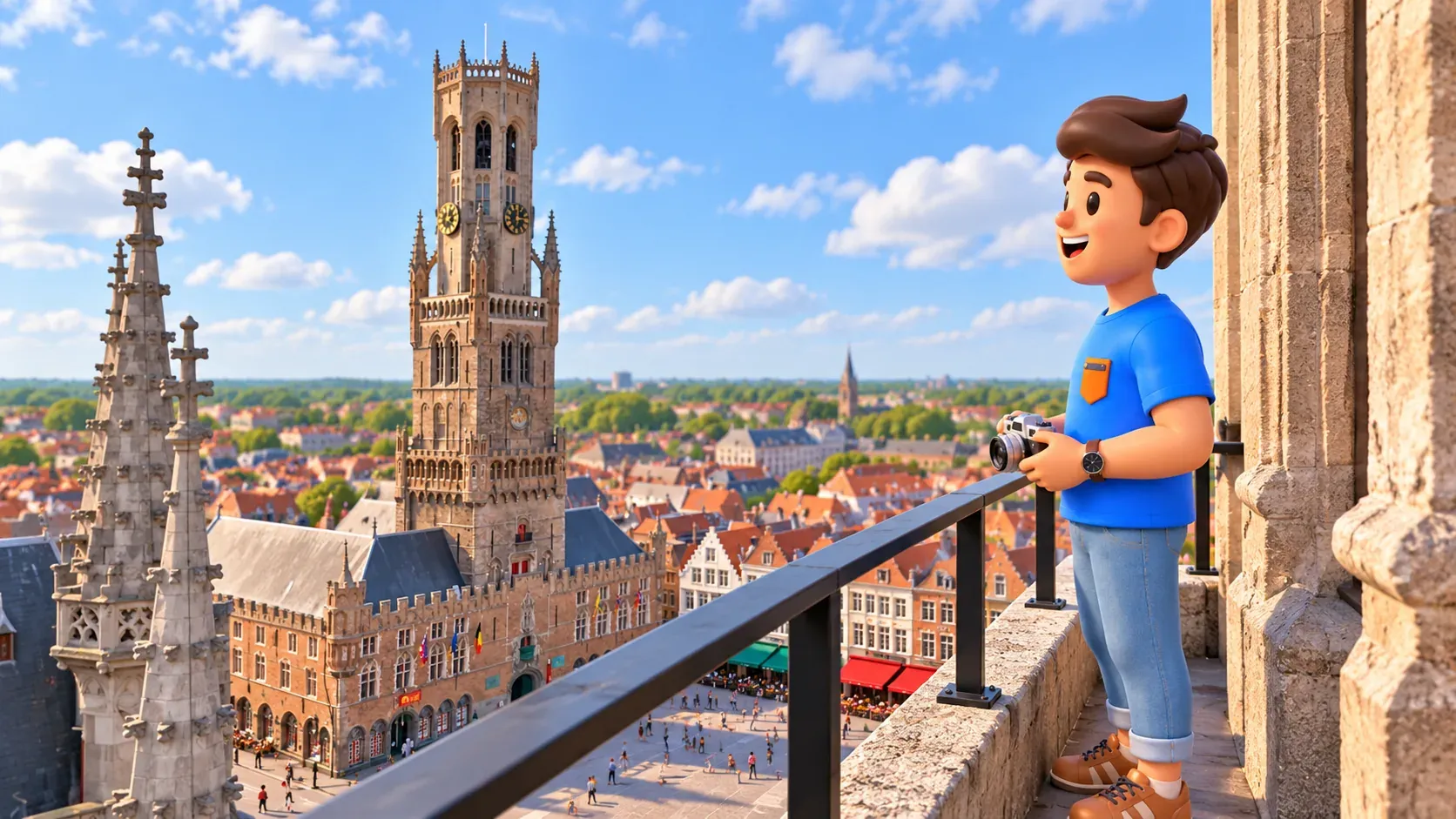
The view extends around the tower, but the lookout is small and narrow. The entrance opening measures just 45 centimetres, with a way to assess that width at the entrance. This is not a spacious promenade terrace. Fewer steps do not remove the effects of tight spaces or height for someone uncomfortable with either. Consider the actual arrangement, rather than choosing solely from attractive panorama photographs.
Visitors to the tower must be at least 1.40 metres tall. This is a height requirement, not a child-age rule borrowed from another Historium experience. The Story visit and virtual-reality activity have their own arrangements. Before promising a family climb, check who can actually take part. An inviting façade and a shorter staircase cannot resolve an admission condition at the door.
Understand the separate Historium Tower ticket
Under the current arrangements, Historium Tower tickets can only be bought at the ticket desk. Do not transfer the complex's general advice about booking online to this particular product. The Tower ticket also includes Historium Exhibition, but not Historium Story or the VR experience. Name the experience you want first, then establish what the chosen ticket actually contains.
The owner suggests about 15 minutes for the tower itself, excluding waiting. For planning, roughly 30–45 minutes with a buffer is a sensible editorial allowance, rather than a promise from the ticket desk. A queue can increase it. Other Historium experiences need their own time: the tower's short duration does not describe a full visit to everything in the building.
The tower's regular opening is 10:30–17:30, extending to 20:00 on Saturdays. Check your specific date before travelling. Later opening elsewhere in the building does not automatically extend access to the staircase. In particular, a bar's closing time and the tower's final visiting hours concern different activities. Choose the right timetable for the experience you intend to purchase.
Handbags and backpacks are not allowed on the tower. Discuss your belongings with staff before climbing, rather than expecting to leave them on the lookout or assuming suitable storage is guaranteed for every bag. A large suitcase creates a different practical question from a small day bag. Thinking about what you carry helps make a walking day simpler before reaching either entrance.
Fewer steps do not mean fewer practical constraints
Neither tower has a lift to its viewpoint. A lift serving other areas in the Historium building does not make the tower accessible to wheelchairs or pushchairs. Historium Tower also has no seating. If you need regular seated pauses, establish the actual conditions before paying, rather than discovering them after the first flights. The word viewpoint does not describe one standard visitor experience.
Children, people with individual mobility requirements and tired travellers may reach different decisions. Personal comfort matters more than completing an expected sightseeing list. If the width of the passage, passing arrangements or opportunities to pause are important to you, ask staff specific questions. A comparison of total steps alone cannot answer those concerns, even when one number looks much more manageable.
Rain, wind and poor visibility change the value of a climb too. Check access with the venue and leave room to change a day's priorities. Looking at the square briefly and choosing a museum or café can be more satisfying than treating an earlier plan as an obligation. Neither an advertised panorama nor a carefully chosen date guarantees distant roofs will look clear when you arrive.
Give one tower a comfortable place in the day
Make the climb one substantial episode in your central Bruges visit. Look at Markt from street level first so the relationships between buildings are familiar from above. Leave a break, a canal walk or another calm section afterwards. You do not need a second ascent just because its entrance is visible across the square, and repeating stairs is not the only way to deepen a city visit.
With RoadMe, developing a personalised itinerary for the whole trip is much more convenient, with climbs, museums and rest organised around your interests and available time. Try the app to turn those choices into a considered Bruges plan at your own pace.

If travelling together, discuss why each person wants a tower. One may care about civic history, another wants the Belfry in a photograph, and somebody else would prefer no stairs. Two tickets are not the only compromise. Those who want to climb can do so while agreeing a clear meeting place and enough time for the next shared part of the day.
For an outing without climbs, consider the walk through squares, canals and parks without paid admission. If the decision depends on the length of your stay, compare one, two or three days in Bruges. Choose the Belfry for civic history, the carillon and a higher viewpoint; choose Historium for the Belfry in the panorama, accepting its narrow access and visitor rules. One suitable climb can be quite enough.