
Washington Memorials at Sunset: A Two-to-Three-Hour Walk

Sunset gives Washington’s western memorials a different rhythm. The broad western perspectives gradually give way to smaller details, illuminated stone and places where people stop to reflect. A selected walk of two to three hours can bring together the World War II Memorial, Lincoln Memorial and the memorials to veterans of the Korean and Vietnam wars without turning the evening into a cross-city tour.
Keep the route in the western part of the National Mall. You do not need to begin at the Capitol or add the Tidal Basin to make the evening worthwhile. The suggested times are planning estimates. Actual public paths, conditions, pauses and your onward journey determine how much of the programme fits comfortably.
Choose a compact western route
Access update, 22 October 2026: the Reflecting Pool, its waterside walkways and specified adjoining grass areas are closed through 20 November 2026 at 11:59 p.m. local time. Use only the signed open outer routes and diversions; this programme does not include access to the water’s edge.
Start at the World War II Memorial and use the currently signed open outer walks towards Lincoln, staying out of the closed pool-edge area. A southern approach can take in the Korean War Veterans Memorial before the Lincoln Memorial; the Vietnam Veterans Memorial then provides a possible final visit to the north. Check the public paths available on the day and keep the main direction simple rather than forcing an exact line through a closure.
For an evening organised around your interests, try RoadMe: the app builds a personalised route around the time and pace you choose, making Washington much more convenient to explore. It brings the places into one plan so the evening can reflect what you actually want to see.
If two hours are available, give priority to the pool, Lincoln and one additional memorial. With closer to three hours, the full selected group is more comfortable. You can linger at a place that matters to you and omit another. The value of the walk comes from time spent looking, not the number of memorial names completed before dark.
| Stage | Experience | Planning allowance |
|---|---|---|
| World War II Memorial | A first moment of remembrance and orientation | Around twenty to thirty minutes |
| Western landscape and outer approaches | Walking, changing light and a pause | Around thirty to forty-five minutes |
| Lincoln Memorial | The building, seated figure and view back | Around thirty to forty-five minutes |
| Korean or Vietnam memorials | One or two focused visits within the western area | Use the remaining time without rushing |
Begin at the World War II Memorial
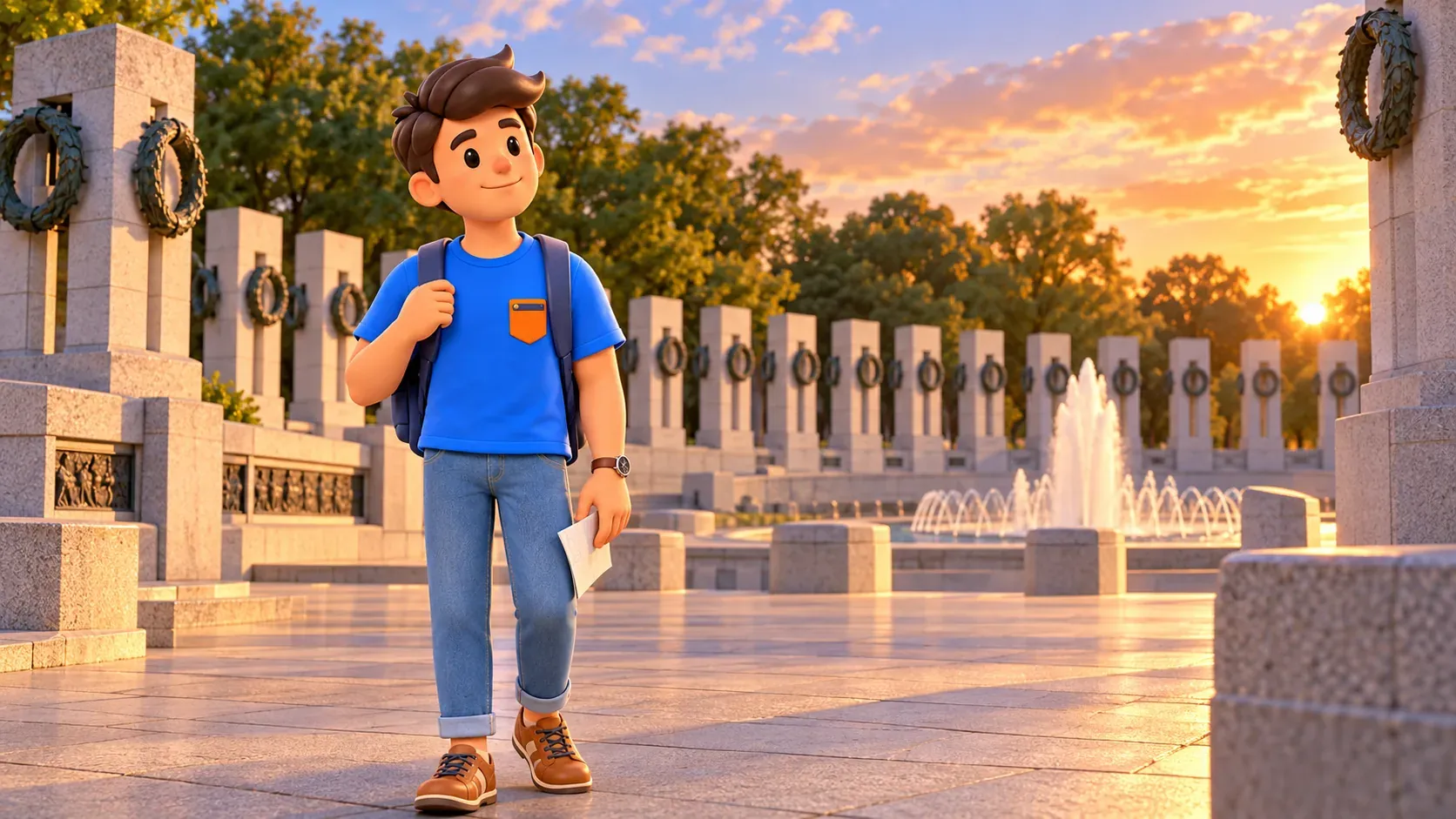
The World War II Memorial gives the evening a clear starting point near the eastern end of the Reflecting Pool. Columns, water and inscriptions form a collective setting rather than a single statue to photograph. The columns represent the states and territories of the wartime United States, while the memorial as a whole honours service and sacrifice.
Take time to move through the public spaces and look at how the individual elements relate to one another. You do not need to study every inscription to appreciate the difference between this place and the city’s larger architectural landmarks. Dedicated in 2004, the memorial adds a more recent layer to a landscape whose monuments were built in different periods.
This is also a practical moment to assess the evening. Check the weather, choose your next path and decide whether the whole group still wants the longer version. Water features and lighting may not always operate as they appear in photographs. Let the actual scene guide your attention rather than spending the visit trying to reproduce a particular image.
Let the western landscape set the walking pace
The path towards Lincoln is part of the experience, not simply a transfer. The long axis holds together the western view, with the memorial ahead and the Washington Monument behind; restoration can alter the nearby scene. Stop occasionally and turn around. A perspective that seemed familiar in a photograph becomes easier to understand when you see how distance and the changing sky affect it.
Use the public paths that suit the conditions and current signs. A quiet pause on the way can be more useful than trying to maintain a brisk pace through the entire route. Leave room for the people walking in both directions and for anyone who needs to stop. Keep to routes signed open outside the closed waterside walks and adjoining grass areas.
If the sky is changing quickly, choose one viewpoint and stay with it for a few minutes. Repeatedly rushing between positions can use up the best part of the light without giving you time to notice it. The trees, open perspectives and distant buildings provide several ways to frame the scene from permitted positions.
Choose the Korean War memorial on the southern approach
The Korean War Veterans Memorial sits within the western group, to the south of the Lincoln Memorial area. Its sculpted figures and memorial elements create a more immediate human scale than the long open axis. This can be a meaningful stop before Lincoln if you have chosen the southern path and enough time to visit attentively.
The memorial honours Americans who served in the Korean War. Let that purpose guide the pace. Look at the relationship between the figures, the surrounding materials and the landscape without turning the stop into a hurried photography exercise. A small amount of historical context is enough for an initial visit; the place does not need a complete account of the conflict to make an impression.
If the evening is short, this may be your one additional memorial. You can then continue to Lincoln and finish there. The alternative is to preserve the time for the Vietnam Veterans Memorial afterwards. Choosing one thoughtfully is a better fit for two hours than treating both as compulsory final errands.
Give the Lincoln Memorial time of its own
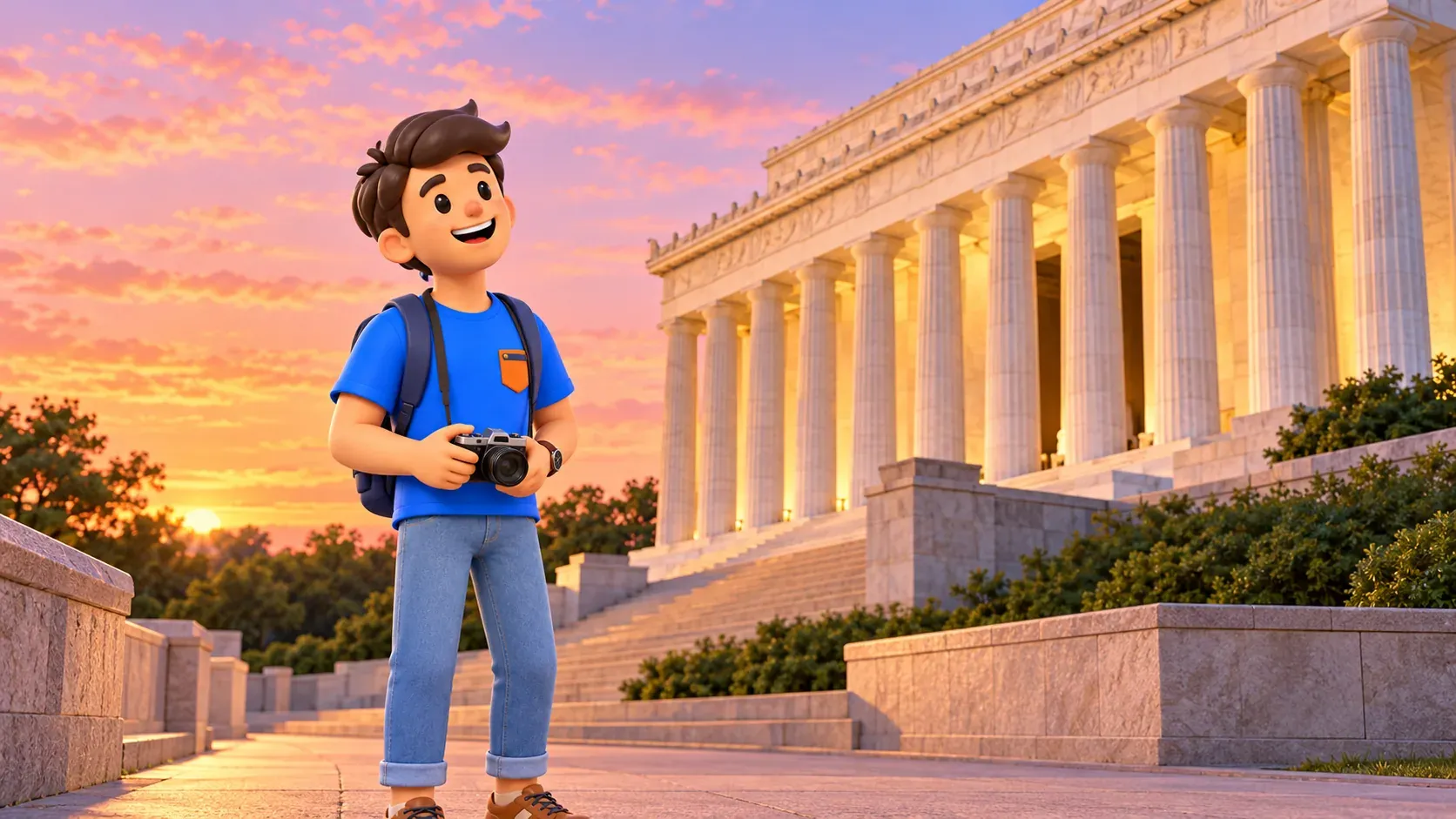
Approach the building slowly enough to notice its setting before entering the main memorial space. Architect Henry Bacon drew on ancient Greek architecture for the design, while Daniel Chester French designed the seated figure of Abraham Lincoln. Those two contributions help explain why the memorial feels both monumental at a distance and focused on one person at close range.
Inside, let the first look at the figure settle before moving on to the surrounding details. Outside, turn back towards the Reflecting Pool and Washington Monument. These are different experiences, and the evening is more satisfying if neither becomes a brief interruption between photographs.
You may want to spend longer here than the initial allowance. That is a reasonable choice: remove an optional stop rather than racing through the place you most wanted to see. Follow the public access routes and any current instructions. The memorial’s appeal does not depend on everyone using the same approach or standing at the same viewpoint.
Finish with a different kind of remembrance
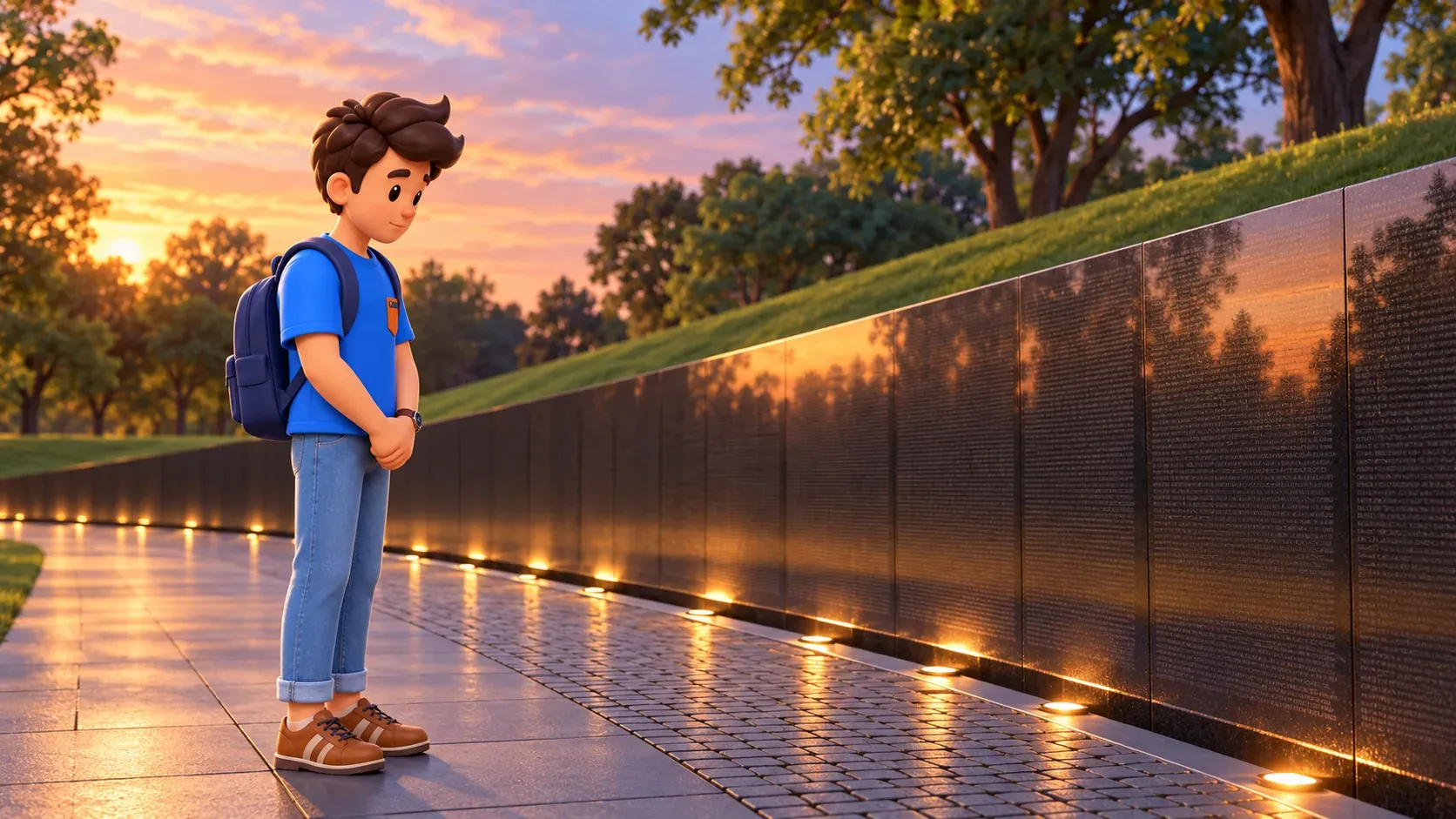
The Vietnam Veterans Memorial, to the north of the Lincoln area, offers a different relationship between the visitor, the landscape and names in stone. It is a place to give people room and allow a slower pace. Some visitors have personal reasons for being there, and the meaning of the stop may be very different from a general sightseeing visit.
Give your attention to the memorial itself rather than the pressure to complete the route. Notice how a more restrained setting changes your response after Lincoln’s temple-like architecture. You do not need to attach a long explanation to every visual detail. A quiet interval may be the right way to end the evening.
If you visited the Korean War memorial earlier, these two stops show how different forms can carry the purpose of remembrance. If you chose only one, the walk is still complete. The route is a framework for an evening of looking and reflection, not an instruction to pass every monument in the western group.
Plan for the light you will actually have
Look up the sunset for your date before fixing the starting time. Beginning roughly an hour to an hour and a half beforehand can let part of the walk happen in daylight and part in the changing evening light. This is a suggested rhythm, not a promise of particular colours or a fixed illumination schedule.
Allow more flexibility when the weather is uncertain or the daylight period is short. A cloudy evening can still be worthwhile, but it will produce a different atmosphere from the warm photographs that often introduce the Mall. Use your own observations on the day instead of choosing a timetable around an image made in another season.
For photographs, keep the path clear and avoid making other visitors part of the scene without consideration. A few careful frames leave more room for the actual visit than constant movement between camera positions. The memorial setting deserves the same respectful behaviour whether you are photographing, reading or simply passing through.
Finish with an easy onward plan
Decide how you will leave the western area before the walk begins. The last memorial is not the end of the time needed for the evening: your next transport connection, a meal or the journey back to your accommodation must also fit. Check current public routes and use the actual conditions rather than assuming every path remains open.
To make the wider evening fit your visit, RoadMe can prepare a complete personalised itinerary around your interests and preferred pace, bringing the planning together much more conveniently than separate recommendations. That helps you keep the memorial walk as a considered part of your Washington trip.
If you are choosing between this evening and another part of the city, see the guide to planning a first Washington visit around your interests. For the western memorials, a compact route and a little unassigned time are enough: an open view, a few meaningful pauses and a finish that does not require hurrying away from the place you came to experience.


