
How the Capitol Columns found a new home in a Washington meadow
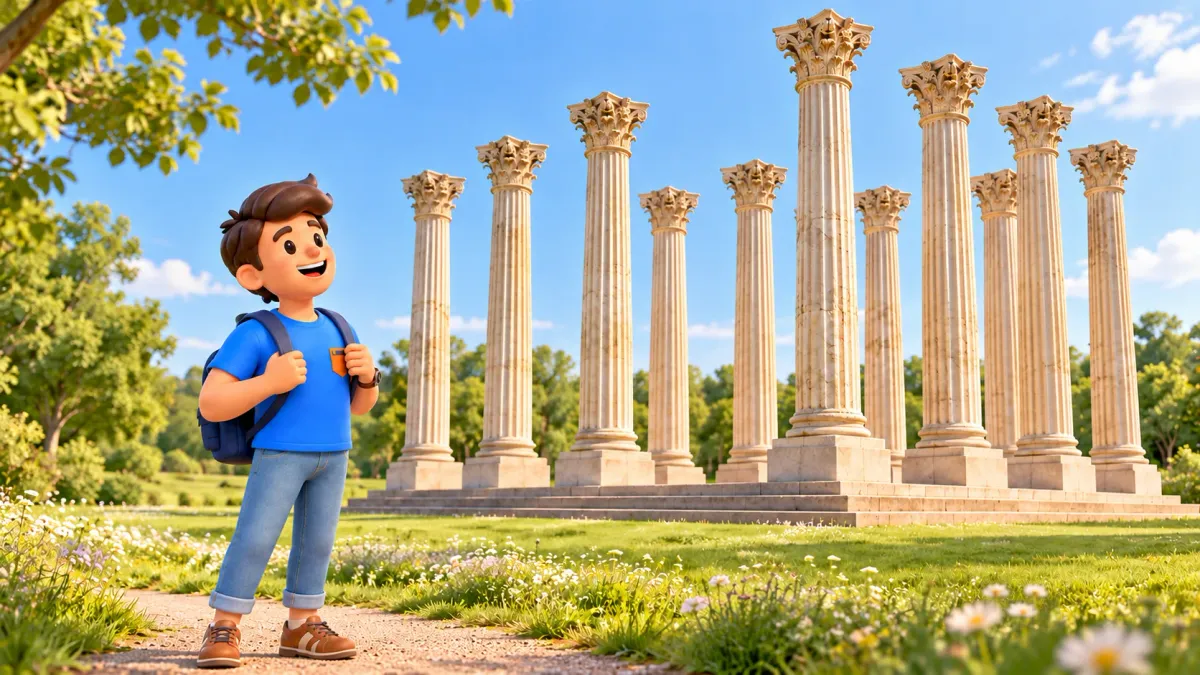
In an open meadow at the United States National Arboretum, pale Corinthian columns stand without a roof. Trees and sky appear between their shafts. The place can look like the remnant of a vanished building, but it is something different: historic architecture given another setting after relocation.
The connection with the Capitol is real. These columns once belonged to its East Portico. Their story is interesting not only because of the surprising address. At a government building, they were part of a facade; in the meadow, they became an independent composition. Their new surroundings change how a familiar classical element is experienced.
Capitol architecture, rather than ancient ruins
The National Capitol Columns are genuine historic sandstone elements, not a recently invented ancient monument. Official Arboretum information connects them with the Capitol’s East Portico in 1828. The present arrangement includes 22 columns. They remained at the building until its mid-twentieth-century expansion and later found a home elsewhere in Washington.
Corinthian capitals refer to a classical architectural language, but that does not make the objects ancient. Distinguish the age of a piece from the origin of its form. Leaf decoration may recall antiquity while the material itself belongs to a nineteenth-century American building, arranged again in a later landscape.
RoadMe makes it easier to turn an interest in stories like this into a personalised route or whole trip. Try the app to bring architecture, green spaces and rest together in a programme shaped around your interests and comfortable pace.
This is not a chance discovery on a short walk away from the Capitol. The Arboretum is a separate large destination requiring its own journey. This article explains one story and offers an observation idea. It does not require a full collection circuit or replace a broader half-day plan.
Stone that once belonged to a working facade
The sandstone came from the Aquia Creek area of Virginia and reached Washington by water. That detail restores a sense of physical work: the columns represent quarrying, transport and craftsmanship as well as an elegant outline. A substantial civic facade emerged from many practical tasks.
At the East Portico, the columns were read in relation to the rest of the building. Shafts, bases and decorated tops had roles within a larger architectural system. The absence of walls and a roof now makes individual parts easier to notice, but this is a new presentation of old material.
Calling the site a ruin can suggest the wrong story of a building destroyed here. The meadow does not conceal a vanished Capitol. Architectural pieces were moved after changes to another structure. Their open arrangement is a later decision, not evidence of an ancient disaster at this location.
Imagine the difference between a column framing an entrance and a column standing as an outdoor exhibit. In the first case, your eye expects a room and a roof beyond it. In the second, the view passes through towards trees and grass. The same form works differently without needing to be redesigned.
Why the East Front changed
The Capitol evolved over time. Its larger dome changed the visual relationship between the old portico and the upper structure. The Arboretum’s official history explains that the earlier arrangement appeared insufficient beneath the larger form. This is about the impression of scale, not a claim that the columns suddenly failed to support the dome.
The 1958 East Front expansion changed the facade and the old columns were removed. Do not picture an immediate move into a finished garden: years passed between dismantling and the present composition. Architectural pieces can have a long intermediate existence after their original use ends and before another becomes possible.
Preservation consequently means more than simply deciding not to throw something away. A suitable setting and the means to assemble substantial stone elements had to be found. Even without studying every organisational record, it is easy to understand why a project of this scale needed persistence and time.
Keep three stages separate: the columns at the nineteenth-century Capitol, their removal during expansion, and their new landscape setting later in the twentieth century. You do not need every technical date to appreciate the relationship. The important thing is not to compress original construction and relocation into a single event.

A new setting chosen for its scale
Ethel Garrett advocated a permanent home for the columns, and landscape designer Russell Page helped establish their position. On a 1984 visit, he selected a location beside Ellipse Meadow. The open space allowed large vertical forms to remain expressive rather than become a cramped decoration among trees.
Consider the role of distance in that choice. Columns need room to be seen together as well as a physical foundation. The meadow establishes a first view, then permitted approaches allow closer attention to a shaft or capital. The object stays the same while the way you look changes.
The supporting composition incorporates stone steps also associated with the Capitol’s east side. This is not an arbitrary row, but a new whole using historic elements. It does not pretend to restore the entire former facade. Missing walls and roof allow the landscape to become part of the experience.
The columns may seem to have occupied the meadow for a long time. Knowing about their move makes that impression more interesting. You are looking at a chosen setting for preserved material rather than discovered antiquity. That distinction appreciates the landscape design without turning an impression into an archaeological claim.

Look at the shaft, capital and spaces between
Begin with the overall view. Notice how separate vertical elements establish a rhythm and how the gaps reveal the background. Then choose a column visible from a permitted position. Long flutes guide the eye upwards towards a more elaborate carved capital.
A Corinthian capital is recognisable through foliage associated with acanthus leaves. Rather than only identifying a style name, notice how stone becomes something resembling a living form. Layers of leaves create depth and shadow. Real trees in the background make that relationship an especially fitting subject for observation.
Do not try to see every detail from one position. The complete composition and a small carved feature call for different viewing distances. Change position only through open permitted areas. Do not climb elements, touch delicate carving or use historic stone as a support for a photograph.
Sandstone, light and traces of time may appear different on different faces. Colour alone is not a basis for judging structural condition. The purpose here is to observe material and composition, not conduct a technical inspection. If particular areas are unavailable, keep to the open view.
The meadow changes the experience of architecture
At a civic building, columns are understood through the facade’s function and the activities behind it. At the Arboretum, the same forms meet sky, grass, trees and seasonal change. There is no single correct interpretation. You might notice formality, calm or the unusual absence of a wall where one is expected.
Try two views: the group as a whole, then a landscape fragment framed by one gap. The first emphasises repeated verticals; the second brings the background forward. This small exercise explains the setting more effectively than a compulsory walk around every element.
Do not schedule an ideal seasonal picture in advance. Grass, foliage, cloud and light vary. An illustration can suggest the idea, but does not promise the same flowers or an empty background on arrival. Less dramatic conditions can still reveal the relationship between architecture and open space.
Water features belong to the composition, but their operation on your date is not guaranteed. Avoid making a reflection the necessary goal or treating an inactive water element as a failed visit. The relocation story and the columns’ visual presence remain meaningful without a particular pool condition.
Include the stop without expanding the whole day
Make the columns the main architectural subject of an Arboretum visit, or one of a few deliberately selected stops. Check the operating entrance and internal approach using the current visitor plan. Travel from the gate also belongs in the programme; a nearby-looking label on a map is not the same thing as an effortless arrival.
For a wider outing with living collections, use our National Arboretum half-day plan. Here, leave enough time for this composition and the return journey. The entire property should not become an unnoticed extension of a short architectural story.
RoadMe helps develop a personal trip around your group’s interests, organising visits and rest in a practical order. In the app, the Arboretum and other Washington days are easier to bring into one coherent plan than trying to fit every idea into a single walk.
Confirm the current calendar, grounds access and photography rules, especially for a posed or professional session. Do not expect food, water or available seating beside every destination. Ask directly about particular access needs; this article does not establish a verified step-free route from the entrance to the columns.
Keep the connection, rather than only the photograph
Remember not just “columns in grass,” but why they are there. Historic architecture can continue after its original building changes. New surroundings do not restore the former function, but they reveal another experience and preserve a relationship with the past.
If you later see the Capitol, this story adds a sense of a changing building to the familiar dome. If you reach the Arboretum first, the columns provide a personal reason to notice classical forms elsewhere. That connection does not require both places on the same day or a long route between them.
The meadow does not make the columns a random backdrop. It allows them to appear as historic objects and part of a considered landscape at once. A piece of a large facade becomes a complete impression of its own, given a calm look, a few clear facts and time nearby.


