
Washington Architecture: Capitol, National Gallery and Building Museum

Washington’s architecture is more varied than a continuous procession of domes and columns. One selective day can compare the U.S. Capitol, the National Gallery of Art’s East and West Buildings and the red brick National Building Museum. Their differences reveal several ways a public building can address the city through shape, material, scale and the experience of approaching from a street.
The proposed sequence begins with the Capitol exterior, continues to the East Building and West Building, then turns north towards the Building Museum. Leave much of the day available, including breaks. This is an observational city itinerary, not a measured short walking loop. Interiors are optional choices, and the route remains worthwhile without entering every building or attempting to see its full collection.
Choose what you want to notice
Three questions are enough for a first architectural outing: how is the building arranged as a whole, which material shapes its impression, and how does a person approach it? You do not need to identify every column order or remember all construction dates. Concrete observations can make differences visible without turning each facade into a test of specialist vocabulary.
RoadMe can create a complete personal itinerary around your interests, dates and preferred pace, giving architecture a useful place in the whole Washington trip. Planning in the app makes it more convenient to distribute exterior walks, museum interiors and rest across suitable days instead of reducing interesting buildings to points on an overloaded list.
The basic version uses open public approaches and exterior views. Each institution retains its own restrictions and arrangements. A familiar photograph does not guarantee identical access today. If a side is unavailable, follow a permitted route or use another accessible perspective rather than trying to recreate the standard view from behind a barrier.
If you want an interior, choose the principal one first. The Capitol, National Gallery and Building Museum require different levels of organisation and attention. One confirmed indoor block is more useful than several speculative attempts to enter along the way. An exterior architecture itinerary does not lose its value because you leave exhibitions and working spaces for another visit.
Keep a small record of the day
Choose one detail for each building: silhouette, repeated element, material transition or entrance. A few words or a permitted photograph can preserve it. There is no need to record every decorative fragment. Four considered observations will be easier to compare later than a long sequence of similar facade images without a clear personal question.
A sketch can be equally simple: a dome, an angle, a line of columns or a band of windows. Artistic accuracy is not the purpose. Drawing for a moment can reveal something that remained background in a photograph. Let it be a way to look rather than another task whose successful completion is required before the group can continue.
The Capitol: silhouette and public scale
Begin with the dome and the building’s extent from an available public position. The subject is not only one attractive feature but the relationship between centre, wings and surrounding space. Stand far enough back to read the composition as a whole. A governmental building feels different when attention is not fixed solely on the nearest column or the most detailed possible photograph.
The Capitol’s association with Congress gives the public image its immediate context. For this walk, that is enough to start. Every construction phase need not be recounted on the pavement. Notice how symmetry, height and repetition create a sense of a centre, then choose one detail for a closer permitted view.
Historical interior rooms are visited on a guided tour, rather than through unrestricted independent access. Reservations are recommended, while opportunities without a booking depend on availability. The tour does not automatically include the House and Senate galleries. If the interior matters, confirm the actual format and allow time for it instead of treating it as a quick incidental stop.
The Visitor Center is underground on the east side. That process differs from an exterior approach for looking at the building: security and rules for belongings have their own requirements. The basic architectural day does not need an interior entry. If you choose a tour, reduce other components so the route keeps a comfortable pace rather than becoming a race to catch up.
After the overall view, consider the relationship between building and person. How far away do you want to stand, and where does the arrangement become clearest? These questions make scale tangible without technical terminology. Follow current boundaries and do not use restricted stairs, platforms or service approaches to get closer for a more dramatic perspective.

The East Building: a different kind of geometry
Continue towards the National Gallery’s East Building by open public routes. Leave time for the connection and avoid turning every Mall attraction into another compulsory visit. The architectural day already has a clear selection. The journey changes the scale and prepares the eye for a building in which angles, planes and the relationships between volumes play a major role.
The East Building was designed by I. M. Pei. The gallery’s own educational material connects its geometry with the particular site. That principle is more useful here than a full biography: form responds to a specific urban place. Notice how sharper and wider angles change the impression as you move along an available public approach.
Begin outside. Material, the meeting of planes and the transition from enclosed volume to entrance supply enough of a subject. You do not need to search immediately for resemblance to another famous building by the architect. It can be more interesting to see how this one works here and how it differs from the Capitol despite their shared central public setting.
If choosing the interior, give the common space its own attention before deciding whether to enter art galleries. Ordinary gallery admission is free, but a complete collection visit is not part of this architecture plan. Check current hours and restrictions separately. An exterior look and a detailed museum programme are different scopes and cannot quietly fit into the same unchanged number of minutes.
Before continuing, choose one spatial observation: perhaps how a turn changes a form or how the entrance differs from a long wall. No final judgement on modern architecture is required. One precise detail is enough to prepare a comparison with the West Building without making the street connection a lecture on which architectural approach is correct.
The West Building: a classical language
Approach the West Building on an available public line, allowing for actual streets and current signs. Its neoclassical design is associated with John Russell Pope. After Pei’s angular geometry, consider repetition, the colonnade and a more familiar organisation of entrance. This is not a contest between old and new, but two ways to provide a setting for art.
Compare where the eye moves first. One building may lead attention along a plane and a turn, another towards a centre and repeated features. Do not impose the same response on everyone. A companion may notice material, another proportion and another the feeling of approach. Different observations can enrich the shared outing without requiring architectural terms at each stop.
A visit to the East Building should not automatically become a promise to complete the whole National Gallery. Its collections and spaces are extensive. If you want to look deeply at art, give that another day. In this itinerary, the West Building’s main role is exterior comparison, and an additional interior must honestly reduce the time and energy available for later components.
Leave a proper break before the Building Museum. It is a useful time to eat and let the eye rest from searching for details. No single lunch address is guaranteed by this route. Choose according to current arrangements and your preferences, leaving a margin for the next urban connection and the option of finishing earlier if attention is already full.
The Building Museum: a large brick urban presence
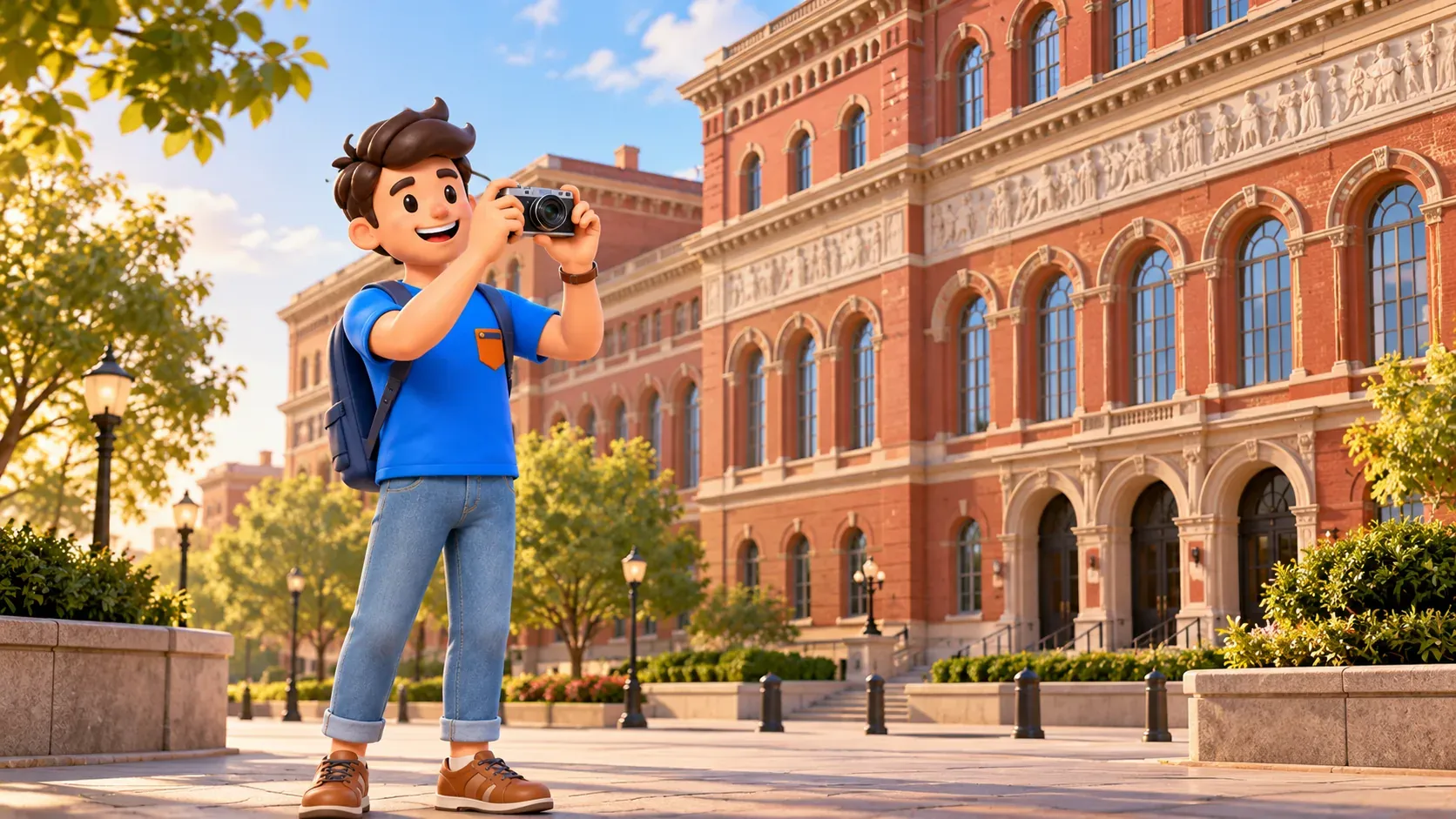
The National Building Museum lies north of the Mall. Approaching it completes a sequence of architectural images: after a dome and two gallery languages comes an extended red brick building. It occupies a city block, so its overall scale can be considered from permitted public space. You do not need to stand immediately against every detail to understand the length of the facade.
The museum occupies the historic Pension Building, associated with the administration of pension payments. That context shows that impressive public architecture also served practical administrative work. The building is connected with Montgomery Meigs. Those few anchors are enough for a first introduction, without a long list of dimensions, dates and every event that has taken place inside.
Look at the rhythm of windows, horizontal bands and the relationship between brick and lighter elements. Compare that extended presence with the Capitol dome. One image gathers attention vertically; another can hold it along a facade. The observation depends on position, so choose a suitable permitted view without disrupting ordinary movement along the pavement.
At checking, the museum lists Thursday through Monday opening, normally 10am to 5pm, with Tuesday and Wednesday closed. The Great Hall and shop are free during available operation, while exhibitions use a separate ticket. Free hall access does not establish free admission to all displays. Confirm the specific space for your date if you want an architectural interior addition.
If the Great Hall is available, it can become a distinct short stop instead of adding exhibitions. Its interior scale differs from the exterior. If closed or the date does not suit, the outside route remains coherent. A guided programme is not promised: such offerings depend on the current calendar and guide availability, rather than the building’s general opening hours alone.
Do not make a children’s exhibition the foundation of the architecture day. As of 23 October 2026, Brick City is closed for a refresh, with an announced return in late November. Other activities have their own dates. This route concerns buildings and does not depend on one exhibition being accessible merely because it appears in an older review or photograph.
Connect four architectural impressions
Compare silhouette, geometry, classical repetition and brick urban scale. No winner or single style needs to explain all four. The differences are the value of the day. Washington becomes clearer when public architecture stops appearing as one continuous line of similar ceremonial facades and instead reveals different purposes and ways of addressing a person approaching from the city.
A shorter version keeps the Capitol and the two gallery buildings, leaving the Building Museum for another outing. A deeper version chooses one interior and reduces exterior detail. In a group, agree on the preferred level before leaving. Everyone need not spend identical time sketching, reading or photographing to share a sequence and a few useful observations afterwards.
Use RoadMe to prepare the complete trip around your interests, dates and comfortable pace, with a personal plan connecting architecture, art, neighbourhoods and rest. The app makes it easier to choose each day’s depth and leave time for journeys and pauses, rather than trying to pass every attractive building in one attempt.
Finish with a margin for the return and one detail from each place you chose. For other ways to encounter the centre, consult our guide to choosing a Washington route around your interests. The architectural day can remain selective: recognising differences matters more than assembling a complete catalogue of facades and museums.


