
Wall Street in Two Hours: Finance and the First President

Wall Street is a large idea packed into a small part of Manhattan. Within a few blocks, a church spire, a presidential memorial and the stock exchange tell different stories about the city. A two-hour walk gives them space to register without turning the Financial District into an all-day checklist.
Begin at Trinity Church, continue along Wall Street to Federal Hall and the New York Stock Exchange, then return to Broadway and head south towards Charging Bull and Bowling Green. This is primarily an outdoor plan. It works without a trading-floor visit, a museum tour or a queue for a particular photograph.
Give two hours to one connected story
The theme is how public life, finance and remembrance occupy the same compact neighbourhood. You do not need specialist knowledge of markets or American government. The pleasure comes from noticing the contrasts: a narrow street with an international reputation, classical columns beside office towers, and a small green space after the stone façades.
Try RoadMe to turn the places that interest you into a personal route, with a plan built around your dates, pace and preferences. It makes arranging an architecture or history walk within your wider New York trip much more convenient.
Keep the World Trade Center, a harbour ferry and a long museum visit for separate time blocks. Their proximity does not make them small additions. This walk has a clear southern finish at Bowling Green, so you can decide what follows after enjoying the district rather than committing to another attraction before starting.
Wear shoes comfortable on varied paving and allow for crossings, barriers and other pedestrians. The route is compact, but that does not establish a step-free journey or guaranteed seating. Choose a daylight outing for looking at buildings, and check the weather before treating an outdoor walk as the main plan.
A practical shape for the walk
Allow roughly 25 minutes around Trinity Church, 25 at Federal Hall, 20 by the stock exchange, 20 for the connecting streets and crossings, 15 near the bull and 10 at Bowling Green. That leaves five minutes spare. These are editorial planning allowances, not measured walking times or guaranteed visit lengths.
The route is approximately one to one and a half kilometres, depending on approaches, detours and the paths open on your date. Trinity stands where Broadway meets Wall Street. Walk east along Wall Street to the Federal Hall and Broad Street area; afterwards return west to Broadway and continue south. Charging Bull is near the northern end of Bowling Green.
Check your arrival and onward journey separately. Similar station names and different exits can make a simple-looking plan less obvious at street level. This article gives the sequence and the reason for each stop; use a current map for the station entrance you actually need. No airport or train connection is included in the two hours.
Do not spend the spare five minutes in advance. They absorb a missed crossing or a pause to find your bearings. If you choose an interior, use time from another stop or extend the outing. Two hours can support a satisfying outdoor visit, but cannot quietly contain every tour offered by the buildings along the way.
Trinity Church: a spire among the towers
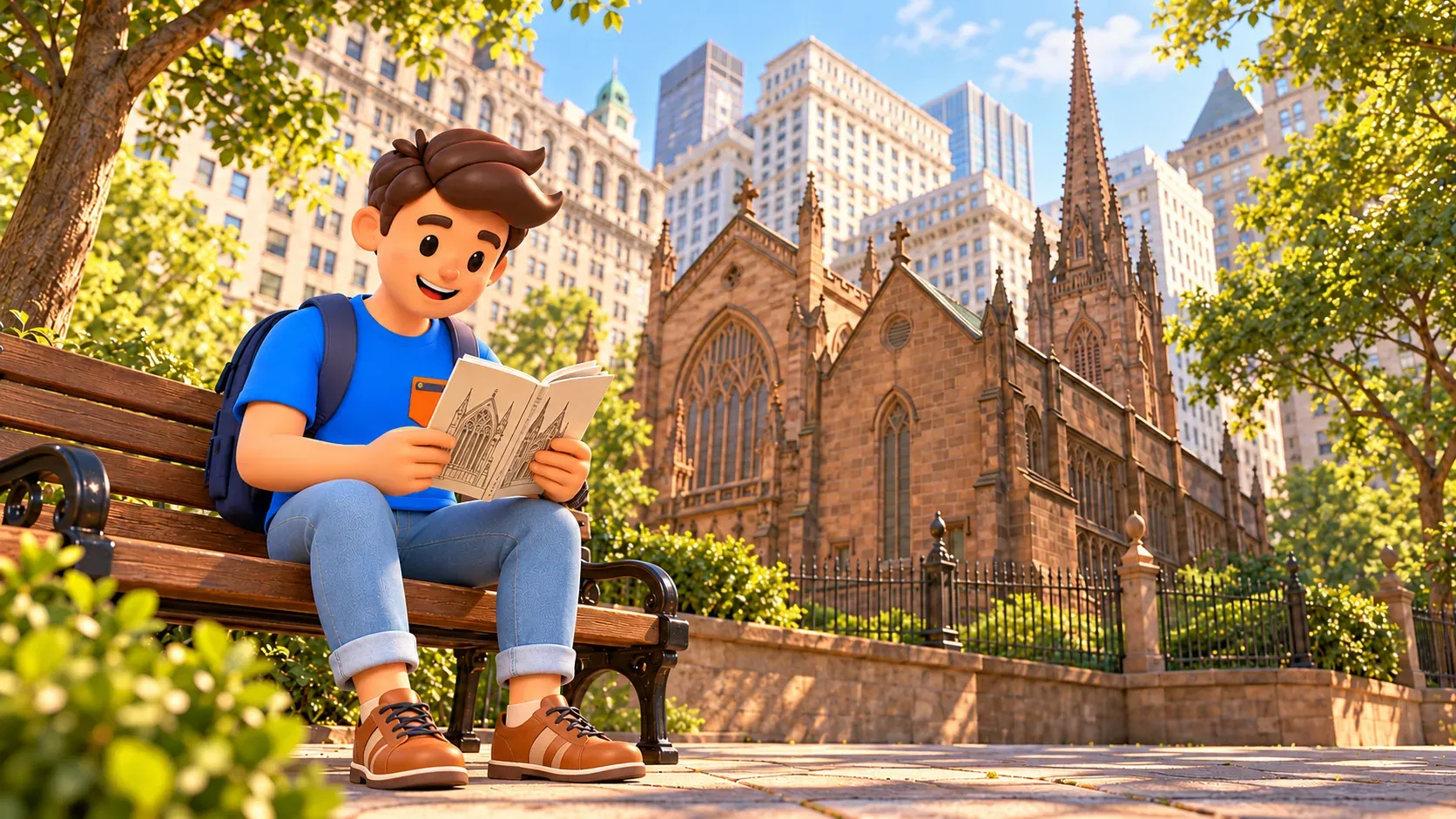
Start by looking at Trinity Church from a permitted position on Broadway. Its spire provides a useful visual anchor at the western end of Wall Street. Against the neighbouring commercial buildings, the pointed shapes and brownstone have a different texture and rhythm. Take in the whole composition before searching for individual details.
The present building is the parish's third church on this site. Completed in 1846 and designed by Richard Upjohn, it is an important example of the Gothic Revival. That distinction matters: the history of the parish reaches further back than the building in front of you. The church is neither a surviving colonial structure nor simply a decorative interruption in the business district.
The churchyard connects the neighbourhood with Alexander Hamilton, who is buried here. He was the first United States Secretary of the Treasury, making the location particularly meaningful on a walk about the beginnings of American finance. You can understand that connection without adding a long biographical tour or trying to locate every notable burial.
Trinity remains a place of worship. Look at the current visitor arrangements before planning to enter the church or churchyard, and respect services and any restricted areas. If access is unavailable, spend the allowance on the exterior and the view along Wall Street. A gate or closed door does not remove the architectural contrast that makes this a useful beginning.
Federal Hall: remember the place and its different buildings
Continue east along Wall Street towards Federal Hall National Memorial. The Washington statue and columned front make an immediate visual counterpoint to Trinity. Stop where access permits and leave the path clear. You are now close to the stock exchange as well, but give the memorial its own attention before crossing to the next subject.
George Washington took the first presidential oath here on April 30, 1789, on the balcony of the original Federal Hall. The site also recalls the first Congress under the Constitution. It is a compact way to encounter New York's role in the early federal government, a story that can be easy to miss when the neighbourhood is introduced only through finance.
The building visible today is later. It opened as a customs house in 1842 and subsequently served as a sub-treasury. Washington did not take the oath inside this surviving columned building. Separating the historic place from its successive structures makes the stop more interesting: several chapters of public administration occupy the same small footprint.
Use the exterior as the reliable core of this route. Federal Hall admission is free when the interior is open, but check the National Park Service's current visitor information and alerts for your date. The site publishes changing access information, and an older weekday schedule should not be assumed. A guided tour is a separate time commitment.
If an interior visit matters more than the rest of the walk, make it the main appointment and shorten the remaining stops. There is no need to fit a complete museum experience into the 25-minute allowance above. You can also enjoy the memorial's public face and return another day when you have more time and confirmed access.
The stock exchange: look at the architecture from the street
The New York Stock Exchange's monumental frontage is on Broad Street. Find an available public position from which to see its columns and pediment together. The surrounding street is much smaller than the institution's global reputation suggests. That mismatch is part of the experience: a familiar name suddenly acquires a particular doorway, façade and place in the city.
The exchange traces its origins to the Buttonwood Agreement of 1792. Its present George B. Post-designed building opened in 1903. Keep those two dates separate: one concerns the institution's foundation, the other the building. You do not need a detailed lesson in trading to appreciate why an organisation handling money chose such a monumental architectural language.
This walk includes the exterior only. An advertised Wall Street walking tour does not by itself provide admission to the trading floor, and the exchange's hosted events are different from a walk-up tourist visit. Do not plan around entering the building or watching a bell ceremony from inside. The street-level architectural stop is complete on its own terms.
Take a photograph only where you can stop without blocking movement or security arrangements. A façade viewed slightly from the side may be more useful than waiting for a centred frame. Barriers and working activity belong to the present-day district. Let them shape where you stand rather than treating an old image as a promise of today's access.

Back to Broadway, then towards Charging Bull
Return towards Broadway and walk south. The short return is deliberate: it links the financial and governmental buildings with the public sculpture near Bowling Green. Look up occasionally, from a stationary position, to notice how the streets frame the sky. There is no need to identify every tower for the sequence to feel connected.
RoadMe can build a day-by-day trip plan around your interests, dates, budget and pace, so this short walk fits into a visit that feels like yours. Try the app when deciding how much history, architecture and unhurried exploring to include across the trip.
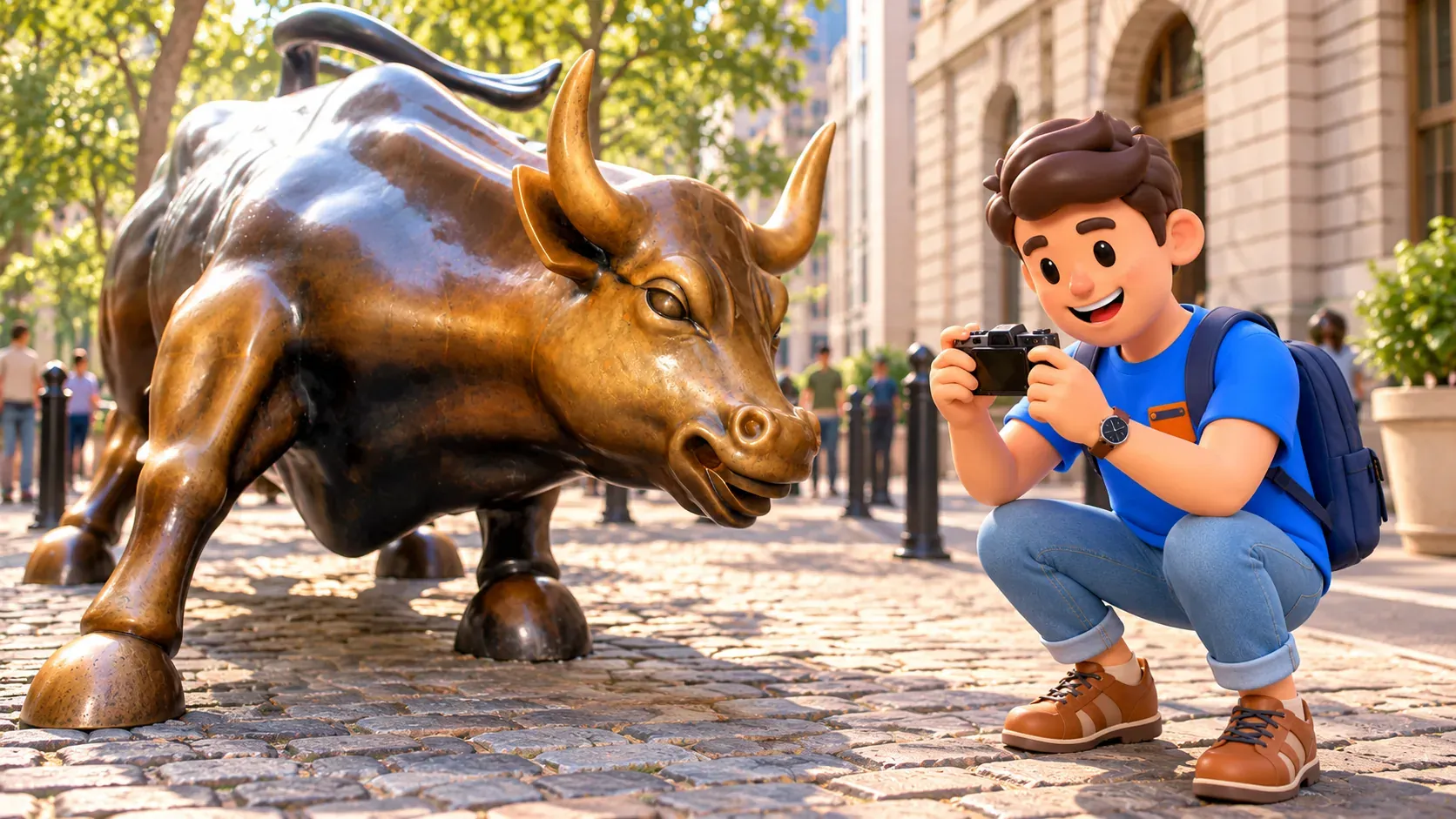
Arturo Di Modica's bronze Charging Bull dates from 1989. Its lowered head and tense body give a familiar financial symbol a physical presence. The sculpture stands by Broadway just north of Bowling Green, rather than directly outside the stock exchange. Thinking of it as a separate stop prevents an unnecessary search around the exchange's entrance.
Allow about 15 minutes to look, with no obligation to join a long photo queue. If the space around the sculpture is crowded, see it from a permitted position and continue. Do not step into traffic to obtain a wider view. A brief look at the pose and material can be enough to understand why the object became so recognisable.
Bowling Green: finish with a smaller scale
Bowling Green was designated a public park in 1733 and is New York City's oldest park. After the monumental façades, its scale provides a useful change of emphasis. Follow the paths that are open and pause when space allows. The park is a destination in this short plan, rather than an invitation to add the whole waterfront immediately.
Do not depend on a particular bench, fountain display or access through every gate. Events, maintenance and local conditions can change the available space. If you find a comfortable place to pause, use the final ten minutes to decide what appealed most: the church's architecture, the presidential story, the exchange's presence or the sculpture's energy.
That answer can shape the next outing. Choose a longer interior visit if the history caught your attention, or a different neighbourhood walk if street architecture was the highlight. A meal, ferry or observation deck should receive its own allowance and any required booking. Finishing this route is already a complete use of two hours.
Shorten the outing without losing its thread
With less time, concentrate on Trinity, Federal Hall and the exchange exteriors, then finish before the southern extension. In rain, reduce the outdoor plan and choose a separately checked interior that interests you. On a hot or cold day, shorter pauses may suit you better than following every allowance precisely.
Visitor conditions were checked on October 17, 2026. Recheck any interior you want to add and the transport arrangements for your own date. Keep the walk focused on a few connected places, and Wall Street becomes more than a financial name: it becomes a readable piece of New York.


