Venice from Above: St Mark’s or San Giorgio for Your First Bell Tower?
For a first elevated view of Venice, St Mark’s Campanile is currently the practical choice, provided it is operating on your date and its entry arrangements suit you. It stands on the main square, making a panorama easy to combine with the centre. San Giorgio Maggiore’s bell tower, often recommended as an alternative, is temporarily closed for extraordinary maintenance as checked on 17 October 2026. No reopening date has been announced.
The main difference is the direction of your view. From St Mark’s, you look out from the famous centre; from San Giorgio, once visits resume, you can look back towards it across the water. One ascent is enough for a first stay. Choose the experience you want and give it space in the day.
Choose a view, an accessible visit and a place in your day
Start with what you want from the panorama. For the relationship between rooftops, domes and water around St Mark’s, the central tower complements time on the square. For the silhouette of the centre across open water, the island offers another perspective. An attractive photograph in an older guide does not establish that its viewpoint is currently available.
Try RoadMe to develop a personal plan for your whole trip around your interests, dates and pace. It makes choosing one suitable viewpoint and arranging it alongside walks and visits across the rest of your stay much more convenient.
| Consideration | St Mark’s | San Giorgio Maggiore |
|---|---|---|
| Location | On St Mark’s Square | On a separate island across the water |
| Character of the view | Rooftops, domes and lagoon from the centre | Looking back towards San Marco |
| Ascent | Lift only | A lift exists, but visits are suspended |
| Current planning priority | Ticket, time, weather and specific access | Wait for confirmed reopening |
There is usually no need to visit both during one day simply to compare them. Another ascent takes time, while the island adds approaches, waiting and return transport. Leave room to observe one view rather than treating each tower as a brief stop between museums. San Giorgio is currently unavailable as a substitute if St Mark’s closes.
St Mark’s: understand the city from a familiar square
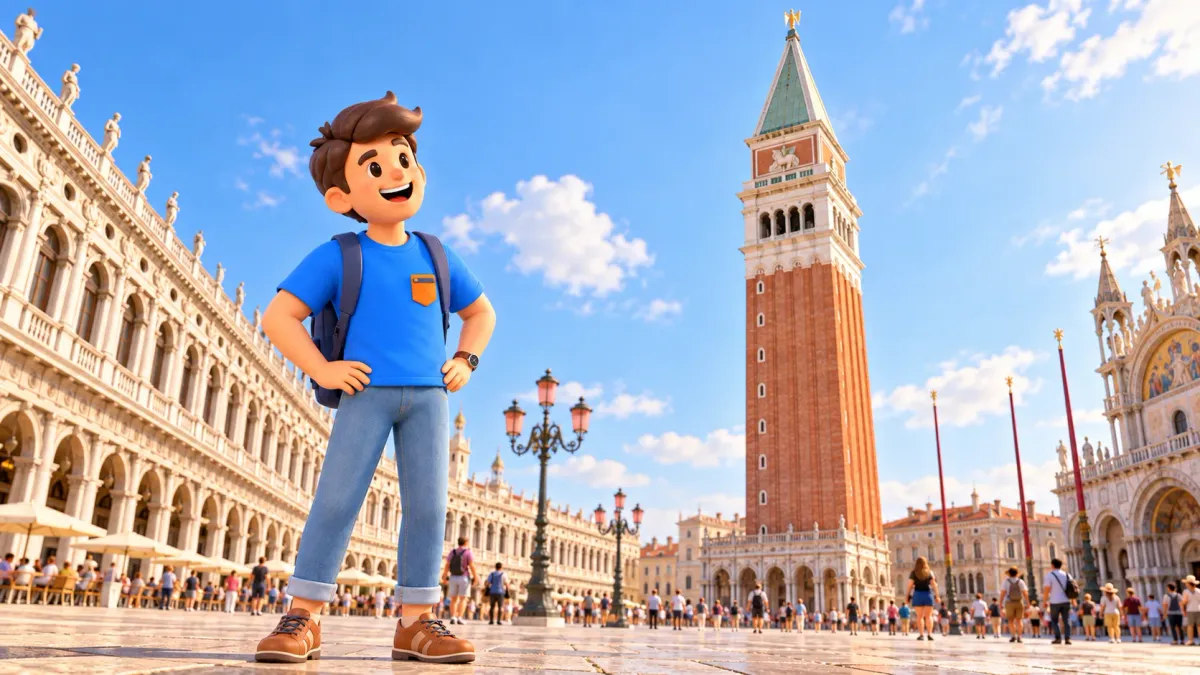
The campanile stands apart from the basilica. Its outline is distinctive: a tall brick shaft, a lighter upper section and a spire crowned by the Archangel Gabriel. The complete structure is 98.6 metres high. The visitor bell chamber is around 60 metres up. These measurements describe different things; you do not ascend to the top of the statue.
From the bell chamber, look at the scale of the square, nearby domes, dense buildings and open water. First find the place where you were standing below, then look farther out. Seeing a familiar space at a different scale can be more satisfying than immediately searching for distant mountains. Visibility towards islands and the horizon depends on conditions.
Different directions offer different impressions. The height helps explain the city’s arrangement, but does not reveal every small canal between houses. Some water disappears behind rooftops. Walking and ascending give complementary experiences, so returning to a little passage at ground level afterwards can be rewarding. Neither viewpoint needs to replace the other.
The operator recommends roughly 30–40 minutes for a visit, allowing you to ascend, look and descend. The lift ride occupies only part of that time. Add entry procedures and possible waiting: a short vertical journey does not make the whole visit a one-minute activity. Leave a separate margin before any subsequent timed booking.

Why the familiar tower is younger than its history
The old campanile collapsed on 14 July 1902. The reconstructed tower was inaugurated on 25 April 1912, preserving its familiar appearance and location. You are therefore not looking at a completely surviving medieval structure. Its story includes both the older city and the decision to restore an important part of its silhouette after disaster.
A lift was installed in 1932. It belongs to the modern history of visiting, rather than an ascent imagined as hundreds of ancient steps. Galileo also features in the tower’s story: he visited in 1609 while presenting his telescope to the doge. A few such connections give the panorama a historical setting beyond its value as a photograph.
Understand the ticket and the visit time
An ordinary campanile ticket excludes the basilica, Pala d’Oro, museum and Horses Loggia. Nearby buildings do not share admission simply because they belong to the same familiar ensemble. Check what a product includes, especially when an offer adds audio or reseller services. Decide whether you want the view alone before comparing options.
A tower booking has a selected start time printed on the ticket. The operator requests punctuality, allowing five minutes before and after that time. This is not an all-day arrival window. If booking another interior, leave a gap between appointments instead of putting two visits into consecutive half-hour slots.
The usual opening time is 09:30; evening hours and last admission vary with season, month, events and weather. Use the current arrangements and selected booking for your date. Last admission and closing time are different. A late available appointment does not guarantee daylight or a sunset during your time above the square.
Purchased tickets do not offer unrestricted date changes. Refunds depend on the sales conditions, so do not assume an automatic refund merely because the distant horizon is hazy. Match the appointment with the rest of the trip before paying. Limited visibility and an official change to operations are different circumstances.
Morning, midday or evening?
A morning booking works if you can reach the square comfortably beforehand. Calculate the journey from your accommodation before choosing the earliest available time. Avoid placing an ascent immediately after a train arrival if you still need to arrange luggage and reach San Marco. A first visit is easier to enjoy without racing towards an already paid appointment.
A midday booking can anchor a neighbourhood programme, with a short exterior walk before it and a meal or rest afterwards. It does not promise particular weather or fewer visitors. An evening appointment needs a separate check of daylight and the return journey. Choose it for your own schedule rather than a universal claim about the best hour.
Lift, belongings and the actual entrance
Visitors ascend and descend by lift only. There is no open tourist stair route to choose instead. If a lift does not suit you, enjoy the square at ground level. Do not buy admission expecting to negotiate another way up on arrival. Feeling comfortable with the visit matters alongside wanting the panorama.
Backpacks and bags larger than 40 × 30 × 20 centimetres are not admitted; wheeled suitcases are prohibited regardless of size. Arrange storage before arriving. A ticket does not promise a free cloakroom at the entrance. A small bag with essentials makes the visit easier without an extra search for somewhere to leave luggage.
A lift alone does not establish step-free access to it. As checked on 17 October 2026, a specific initiative runs from 10 to 18 October: a temporary ramp to the right of the Loggetta and ordinary entrance reaches lift-entry level. Under this initiative, disabled visitors and one companion enter free without booking; ramp availability is stated as 09:30–20:00.
Those are the arrangements for that dated initiative, not a confirmed permanent rule. For visits after 18 October, ask the owner about access to the lift and applicable conditions. Information about a ramp into the basilica or its museum lift should not be transferred to the separate tower. Check the attraction you actually intend to visit.

San Giorgio: a different perspective to save for reopening
San Giorgio Maggiore’s campanile stands on the island opposite central Venice. From there, the San Marco waterfront becomes the subject across the water, explaining the viewpoint’s popularity. The abbey’s current notice, however, suspends tower access for extraordinary maintenance. It gives no reopening date. That restriction is essential when comparing available visits.
An open basilica on the island does not mean an open tower. Historic descriptions of its lift can remain online alongside the closure announcement. The current restriction governs planning. Do not cross the water solely for a promised ascent, or treat an old page showing a ticket price as evidence of admission today.
The tower has its own history: after the previous structure collapsed in 1774, it was rebuilt in 1791 by Benedetto Buratti. It should not automatically be attributed to Palladio because he is associated with the neighbouring church. Different periods coexist within the same monastic ensemble, adding interest beyond a single famous name.
Once reopening is officially confirmed, the choice will again involve your desired view and the island journey. A short crossing from San Zaccaria is only the time aboard; approaches, waiting and the return are additional. For now, the island can be a separate outing with other interests and no ascent, rather than an automatic way around a queue at St Mark’s.
Build a short outing around one ascent
RoadMe makes developing a personal itinerary for your whole stay much easier, shaped around your interests and pace. Try distributing viewpoints, museums and neighbourhood walks across different days, so one memorable visit complements the trip while leaving time for rest.
For a compact plan, start and finish at the base of St Mark’s Campanile near the Loggetta. Allow 40 minutes in the tower including ascent and descent, 30 for entry and possible waiting, 15 for all walking, 20 for exterior views, 25 for coffee and 20 spare. That totals 150 minutes, about two and a half hours, without lunch.
After the tower, follow the public Piazzetta to the Molo, pause at a suitable nearby café and return to the tower’s base. All those walking links are included. Travel from your accommodation and the journey after finishing are extra. Basilica and palace interiors, the Bridge of Sighs and boat travel are outside this small circuit.
This is a planning estimate, without guaranteed queue or service times. Arrange the ground-level section around the actual ticket appointment; the entry allowance is not a requirement to spend exactly half an hour at the door. If waiting exceeds the reserve, extend the outing or reduce exterior stops. Your main experience is already chosen.

Keep the ground-level St Mark’s walk for suitable conditions, or explore the island with the separate San Giorgio Maggiore plan. One clear choice is more useful than comparing heights alone: decide what you want to see, establish whether access is available and leave time to look at Venice calmly.