
Unusual Madrid sculptures: from the Fallen Angel to Julia
Madrid’s unusual sculptures reward more than a search for curious subjects. Two works show how differently public art can change an ordinary walk: the Fallen Angel in Retiro conveys tense movement, while Jaume Plensa’s Julia in Plaza de Colón suggests stillness and inward attention. Connect them in a three-hour outing including the walk and a break. Start at Puerta del Ángel Caído on Alfonso XII and finish near Colón. This is a selective encounter with two works, not a complete sculpture directory. Before travelling, check access to Retiro and the current arrangements for Julia’s placement.
Look before reading the title
At each stop, allow a minute without a photograph or description. What registers first: posture, expression, material or height? Then read the title and compare that information with your first impression. This does not replace the work’s history; it gives you an observation of your own. Two questions are useful here: where does movement seem to lead, and how does the sculpture make you change position? At the fountain, attention rises towards a figure. In the square, an enormous face affects its surroundings. Those are different encounters despite sharing a category in a city guide.
Turning an interest in art into a personal trip is much more convenient in RoadMe, which develops an itinerary around your interests, dates, pace and budget. Try planning the whole journey there so discoveries, museums, walking and rest come together in proportions that suit you.
The calculation begins at the park gate, not at accommodation or a Metro platform. Reaching the first sculpture has its own fifteen-minute allowance. Travel before the start and after Colón is extra. The main version remains outdoors, without museum collections or a National Library visit. Timings are editorial estimates, not a measured field walk. Add separate time for the large lake or an extended Recoletos outing. Choosing few objects gives you room to look closely; it does not automatically make the connection between different parts of the centre a very short distance.
The Fallen Angel: a figure caught in a moment
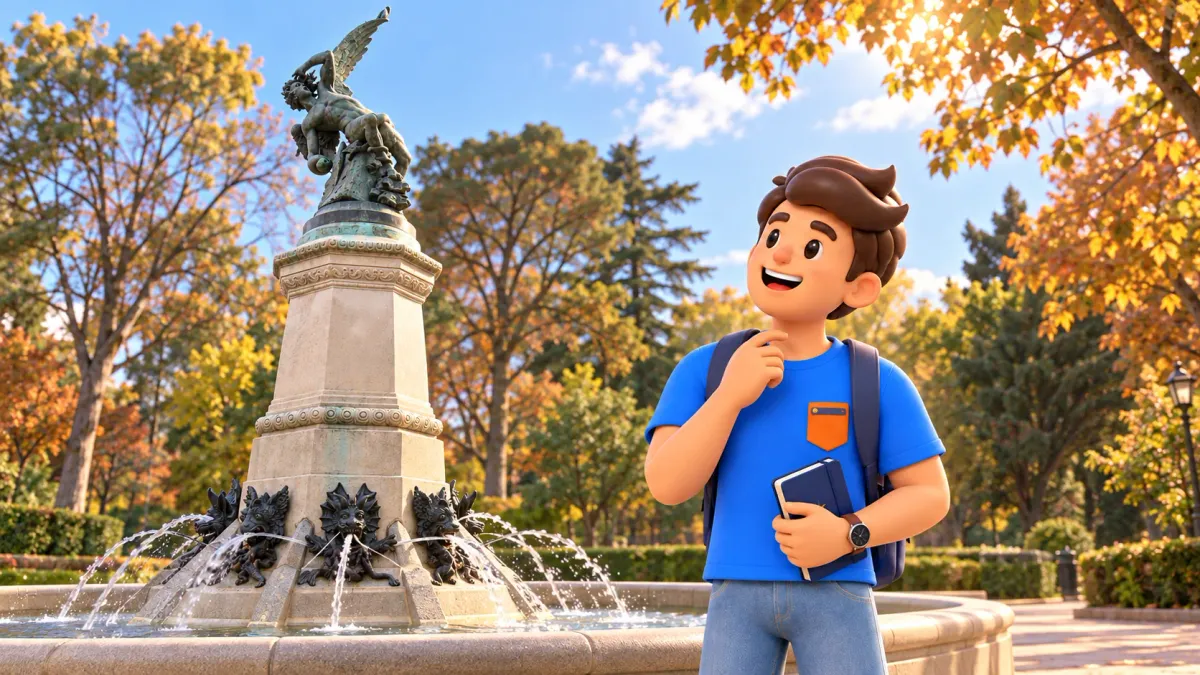
From Puerta del Ángel Caído on Alfonso XII, follow available park paths to the fountain’s namesake roundel. The gate and fountain are different places, so do not finish the search at the park entrance. First take in the upper figure as a whole. The lifted face, turning body, wings and serpent create the impression of an event still unfolding. This is not an official portrait standing evenly at rest. Follow a line from its support towards the shoulders and head without deciding beforehand which detail must matter most. Let the posture establish your first reading.
Ricardo Bellver created the bronze figure, drawing on John Milton’s Paradise Lost and Lucifer’s expulsion from Paradise. The work received recognition at the exhibition of 1878, while the fountain ensemble in Retiro was inaugurated in 1885. Architect Francisco Jareño designed its pedestal. These dates concern different stages: the figure’s conception and exhibition history are not identical to the installation of the completed public monument. For this walk, distinguish sculpture and setting. The high support, water and figure operate together while performing different compositional jobs. The ensemble is more than a statue placed on an incidental base.
Walk around an available section of the surrounding path. There is no need to find a single correct viewpoint. From one position the silhouette may stand clearly against the sky; elsewhere trees change its outline. The impression of movement alters while the bronze stays still. Give the lower arrangement a brief look too: pedestal and fountain direct attention upward while anchoring the work in its park setting. Stay outside the basin and off the base. An ordinary viewing distance lets you see the whole comfortably and leaves space for other visitors to do the same.
The Fallen Angel attracts dramatic retellings. You do not need a claim about the world’s only monument to the Devil, or an occult reading of an elevation figure, to appreciate it. Those are not the foundation of this outing. The visible tension and literary source already make a distinctive subject without competition for worldwide uniqueness. Explaining a religious and literary image does not mean the park invites participation in a ritual. It is public sculpture that can be approached through form, material and the history of its making, whether or not its subject initially feels familiar.
From Retiro towards Plaza de Colón
Continue towards the Parterre gardens and Puerta de Felipe IV. Outside the gate, turn north on Alfonso XII towards Puerta de Alcalá, then take Alcalá west to Serrano and Serrano north towards Colón. Allow around fifty-five minutes for the complete connection from the fountain to Julia, including the park section. Use permitted crossings; a sculpture visible in the distance does not justify cutting across traffic or planted areas. Stop to check your direction on an ordinary navigation map when necessary. The walk is a practical connection, not a claim that every junction offers a direct uninterrupted view.
The change of setting prepares the comparison. In Retiro, paths and trees surround the figure; at Colón, you return to a large urban space with movement nearby. Do not turn the connection into another complete sightseeing itinerary. Our separate two-hour Retiro walk gives the park its own allowance. Here, keep the first figure’s posture in mind and notice the different effect of the next work. You need not photograph every statue along the way to make a meaningful comparison. Fewer competing impressions can help the two selected encounters remain distinct rather than dissolve into a long visual list.
Julia: an enormous face with closed eyes
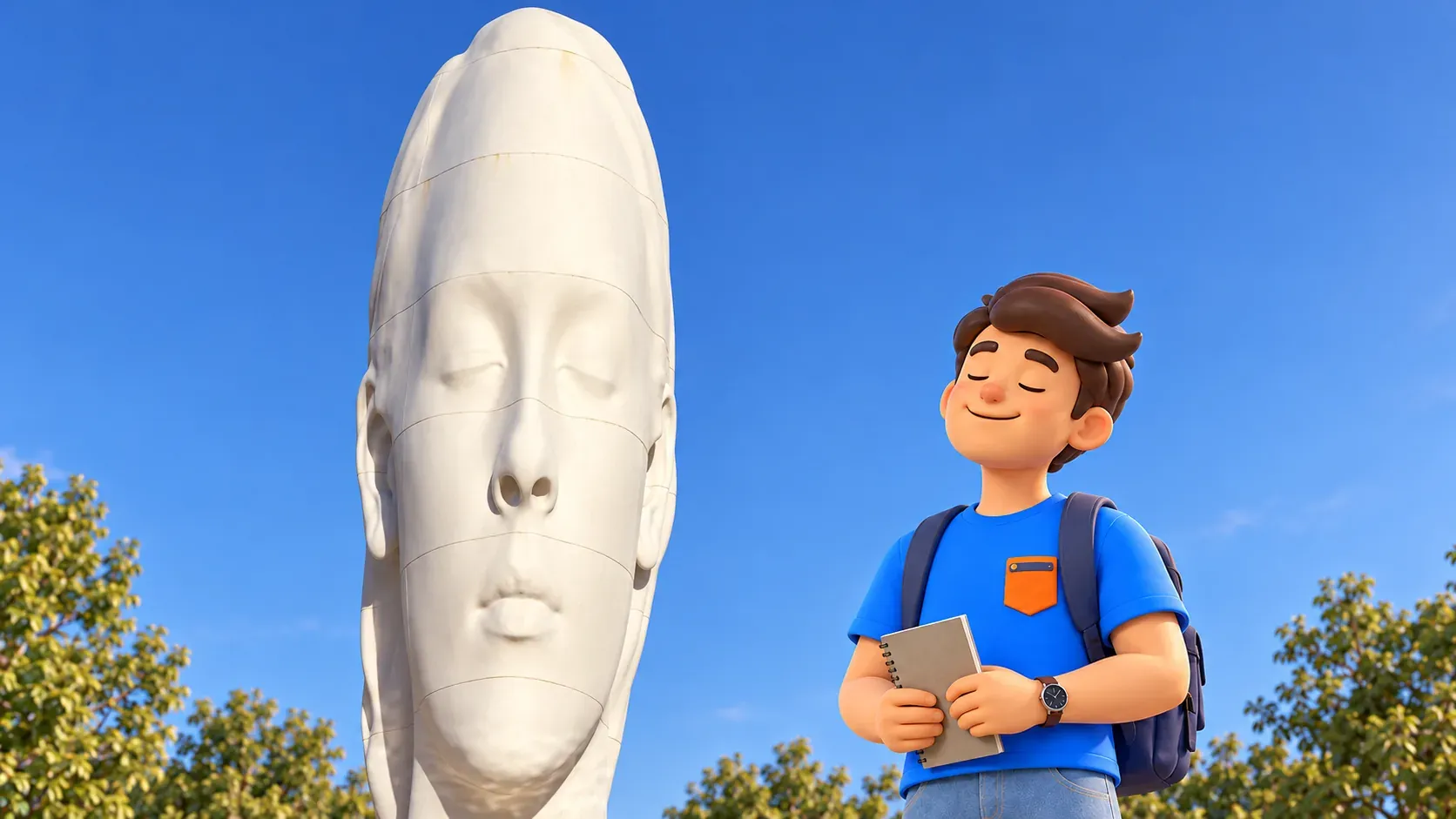
At Plaza de Colón, look for Jaume Plensa’s Julia, the elongated white head with closed eyes. It appeared here in 2018 through the involvement of Fundación María Cristina Masaveu Peterson and the city. The work is twelve metres tall. Scale matters beyond the possibility of a striking statistic: a familiar human image becomes comparable with its urban surroundings. Closed eyes and calm features offer a different impulse from the tense bronze figure in the park. Look first from farther away, then move a little closer through available public space, keeping a comfortable distance from the base.
Its whiteness does not mean it is carved from one solid block of marble. Julia is made from polyester resin and white marble dust. The head of a real model was scanned, and the digital image was subsequently transformed to elongate its shape. The unusual proportions are intentional rather than an accidental photographic distortion. Change position and compare front and side views. A few gentle steps can reveal the difference between an ordinary expectation of portraiture and a deliberately altered volume. You do not need to measure the face with a phone or seek access to its internal structure.
For Plensa, closed eyes relate to a person’s inner world; the calm expression can be understood as an invitation to personal reflection. It does not promise that the square itself will be quiet. Noise, meetings and ordinary city events continue around the work. That juxtaposition matters: a still expression exists within public life. Compare your own attention at the two sculptures. Perhaps the first led your gaze along gestures and wings, while the second held it on the overall facial form. People need not feel the same emotion, or agree with this interpretation, for the walk to be worthwhile.

A dated placement and two different Julias
Julia’s placement is confirmed until December 2026. The agreement allows the possibility of extension until December 2027, which is different from a guaranteed additional year. For a later trip, check information from the city and foundation again. Conservation work was also announced in 2026; an older photograph without scaffolding does not prove an unobstructed view today. Respect any current barriers or maintenance arrangements. Public art needs care, and temporary restrictions do not justify finding a way around them for a familiar photograph. A planned visit should allow for the practical life of an outdoor artwork.
Another confusion is worth resolving before setting out. Plensa’s Julia at Colón is not the bronze young woman by Pez and San Bernardo, a different work with another author and story. A shared name does not unite the sculptures. Search with both Jaume Plensa and Plaza de Colón to avoid a journey to another neighbourhood. This route does not visit the student figure or transfer her biographical narrative onto the large white head. When matching a picture to a destination, check artist and surroundings as well as the name. A quick distinction prevents an entirely different walk.
A notebook offers a simple personal exercise. At the fountain draw one line conveying the movement you noticed; beside Julia draw another showing the main direction of the form. Artistic likeness is unnecessary. Compare the sketches during your break and add one observation about material. The result is a memory made through attention, rather than another photograph from a standard viewpoint. Work where standing or sitting is comfortable and keep passages clear. If drawing does not appeal, a short written note after each stop serves the same purpose. The exercise is optional, not a public workshop or organised museum activity.
Three hours with a proper pause
The example begins around 10am at Puerta del Ángel Caído and finishes near Colón around 1pm. Free outdoor viewing does not include meals or transport. Julia has no museum session in this plan, while access to the fountain depends on Retiro opening. Regular park hours are 6am–10pm from October to March and 6am–midnight from April to September. Adverse weather can cause closures; do not attempt another gate to evade them. Postpone the park section and consider an outdoor visit at Colón separately according to actual conditions. This remains an outdoor outing rather than an all-weather indoor alternative.
- 15 minutes: from the Fallen Angel gate to the fountain on open paths.
- 30 minutes: Bellver’s figure, silhouette and fountain ensemble.
- 55 minutes: Parterre, Felipe IV gate, Alfonso XII, Alcalá and Serrano towards Colón.
- 30 minutes: Julia’s scale, material and changing viewpoint.
- 35 minutes: food or a gentle break nearby.
- 15 minutes: a margin before finishing.
Personal planning in RoadMe makes it more convenient and efficient to fit this walk into your trip. The app builds days around your interests and pace, distributing public art, major visits and rest without an unnecessary rush.

Do not rely on identical weather, an empty bench or a clear photographic background. Much of the outing is outdoors and the connection includes normal city junctions. With slower movement, shorten the second viewing while preserving the break you need. A clear comparison is more valuable than rushing to cover neighbouring streets. You might keep one word for each sculpture, such as tension and stillness, then ask whether those words truly match your experience. Your own answer matters more than reproducing someone else’s expected reaction to a famous object.
For a separate continuation along the boulevard, our Recoletos walk from Colón to Cibeles has its own timing. It is not included in these three hours. This outing already offers a complete encounter: a nineteenth-century literary figure and a contemporary portrait volume address the passer-by in different ways. Public art becomes more interesting when you notice not just its name, but how it alters your attention to a place.


