
Tokyo Waterfront Evenings: Choose One Shore
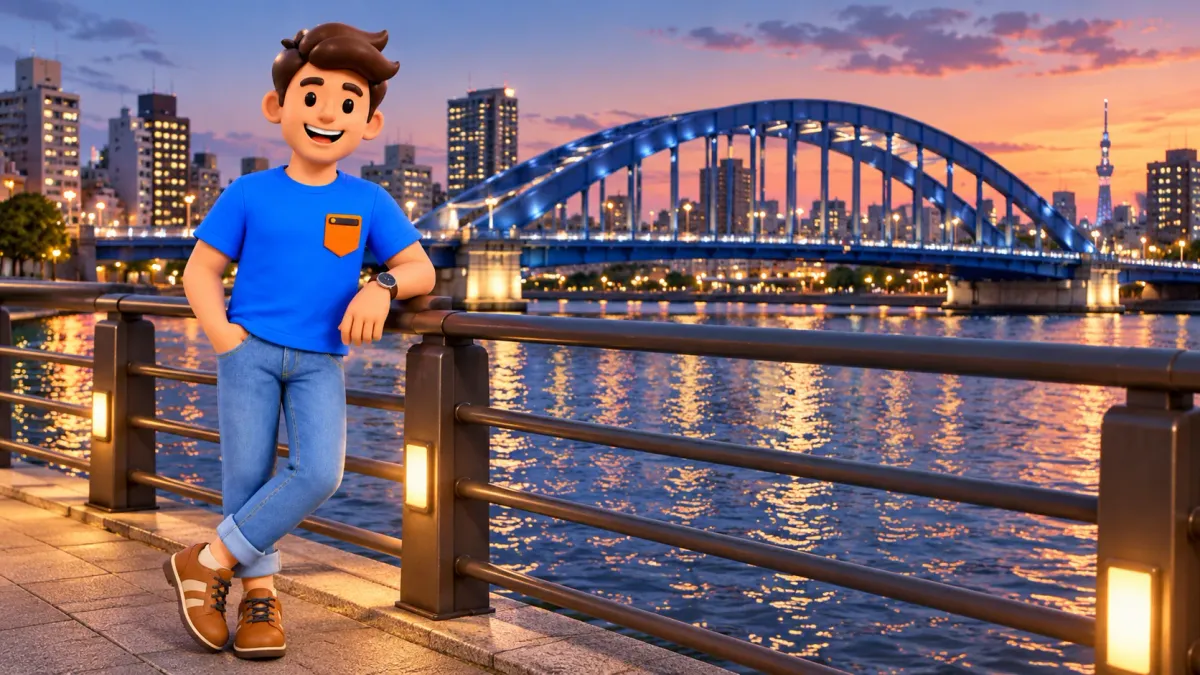
A Tokyo waterfront evening should begin by choosing one direction. For a close urban scene, consider the Sumida near Eitai or Kiyosu Bridge. For a broad horizon and a distant Rainbow Bridge view, choose Odaiba's shore. Walking across Rainbow Bridge is a separate plan with operating hours and its own finish, rather than an obligatory continuation of a bayfront stroll after dinner.
Do not combine every place into one walking route. They offer different scales and require different approaches. Roughly one and a half to two hours for one chosen section, a pause and food is an editorial orientation if that suits your pace, not a measured time. Count the journey to the area and back separately. One bridge can provide a complete evening without moving to another shore across the city.
Choose the character of the evening
For nearby facades, lights and a bridge's structure, choose the Sumida. For open space and a distant silhouette, consider Odaiba. If walking above water is the main interest, prepare Rainbow Bridge separately. This is not a ranking of the best shore. The useful choice depends on accommodation, onward travel, weather and how much walking has already taken place during the day, before the evening begins.
RoadMe helps develop a personal programme around your interests and pace, choosing one suitable waterfront area for the evening. Try leaving time for the actual landscape and rest instead of combining distant shores simply to increase the number of stops.
Before leaving, identify a start, an available public waterfront section and a practical finishing station. An attractive bridge symbol does not guarantee a public way down to the water on every side. Barriers, works and closed passages can change the route. The outing should still work after omitting one small section rather than depend on a single staircase pictured in an old report.
| Choice | Main experience | Check first |
|---|---|---|
| Eitai | Blue arch and dense city background | The chosen public Sumida approach |
| Kiyosu | Suspension lines and river perspective | Available bank and useful finish |
| Odaiba | Broad bay and distant Rainbow Bridge | Current park paths and weather |
| Rainbow Bridge walk | The crossing itself | Hours, last entry and operating day |
Eitai offers a close urban evening
Eitai Bridge crosses the Sumida between Shinkawa and Eitai. Its recognisable blue arch can anchor a short evening around one legible silhouette. Begin from a suitable approach around Kayabacho or another practical station according to the current map. There is no need to cross the entire neighbouring district first when your reason for coming is a view from an available public bank.
Find one broad view showing bridge, water and city together. Then move a little along a permitted path and compare the same silhouette with a different foreground. A couple of perspectives can be enough for a worthwhile evening. Continually pursuing another bridge can turn the outing into rapid transit in which each view receives only seconds between repeated checks of the next navigation instruction.
Crossing Eitai itself may suit the route, but a side view and a bridge-deck view are different tasks and neither pair is compulsory. Stop where permitted and spacious enough without obstructing pedestrians. Do not step backwards towards an edge to reproduce another photograph exactly or set equipment across the passage. A clear public position can preserve the view and keep ordinary movement possible at the same time.
Kiyosu has a different outline on the same river
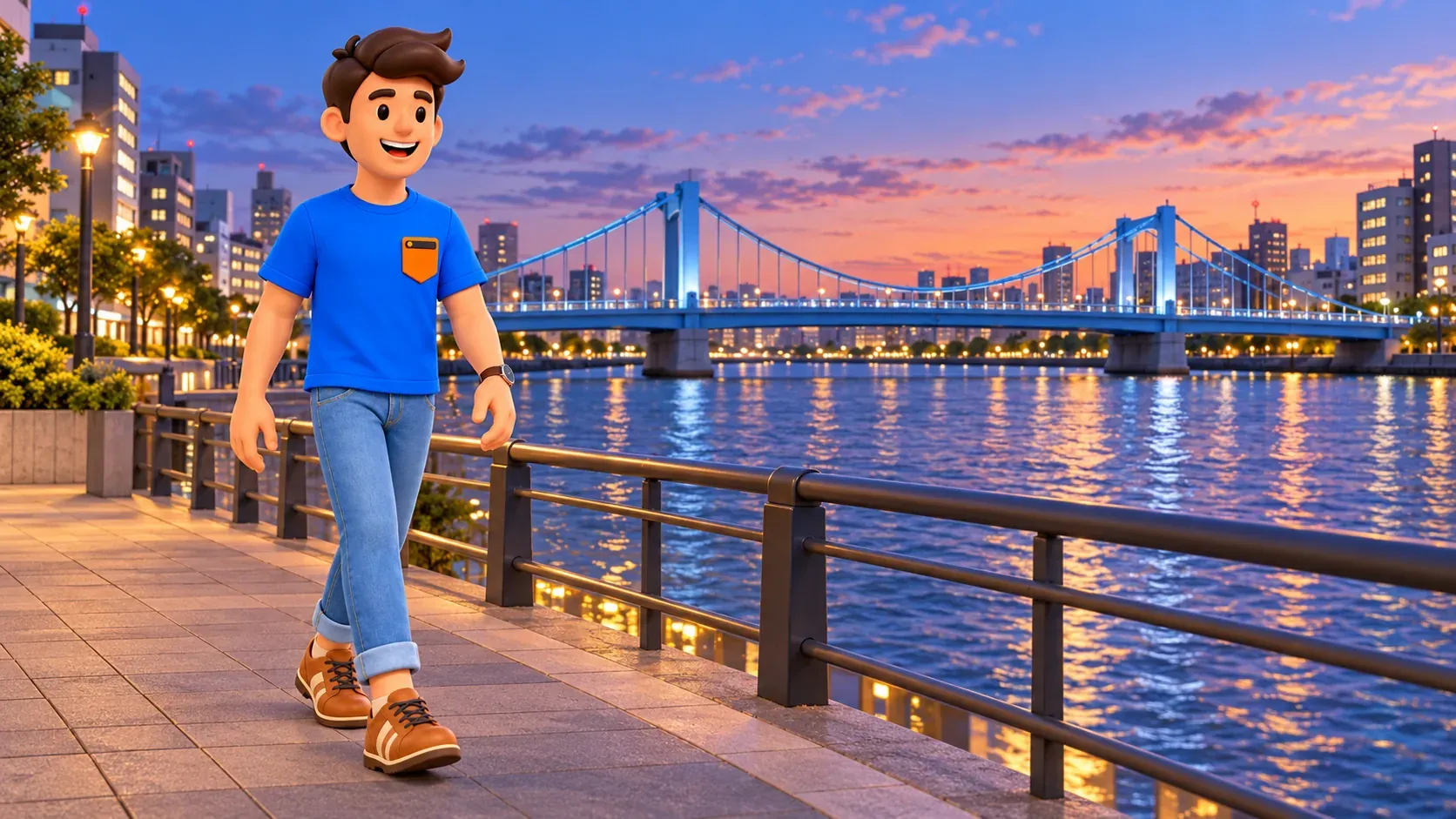
Kiyosu can replace Eitai as the evening's main subject. The municipal source describes a self-anchored suspension bridge completed in 1928. For the walk, the difference in form matters: a finer suspended outline rather than a strong arch, with lines extending over water. Observe from an accessible public position instead of requiring yourself to decipher every engineering element during a relaxed evening visit.
Consider an approach from Kiyosumi-shirakawa or Suitengumae according to your journey and side of the river. Check the actual public access first. Stations and bridge crossings are not interchangeable markers allowing you to emerge anywhere and immediately stand beside the water. With a pushchair or difficulty on steps, choose the suitable connection in advance and avoid unnecessary descents and climbs between road and river level.
Eitai and Kiyosu belong to one river context without making the entire connection compulsory. If you want both, check the current public route and time including detours. For a short evening, choose one and keep the other for another visit. At the water it becomes particularly clear when the outing stops being a set of markers and becomes attention to one city space, changing slowly as light changes.
Check Sumida lighting without promising a colour
At the check, the official bridge-lighting page listed a general operation from fifteen minutes after sunset until 23:00. That published system timetable must be read alongside current notices about particular bridges and temporary outages. Do not promise the same colour on every evening. Colour programmes and technical arrangements can change, and an older photograph is not a schedule for the date of your visit.
You can arrive before dark to see the change from daytime structure to evening light, but sunset depends on season. Do not rely only on a convenient round clock time when that transition matters. Keep some flexibility to find a permitted position. Even with altered lighting, water, structure and urban background remain the subject for which the river section was chosen, rather than the entire evening becoming invalid.
Odaiba gives a bay and a distant bridge
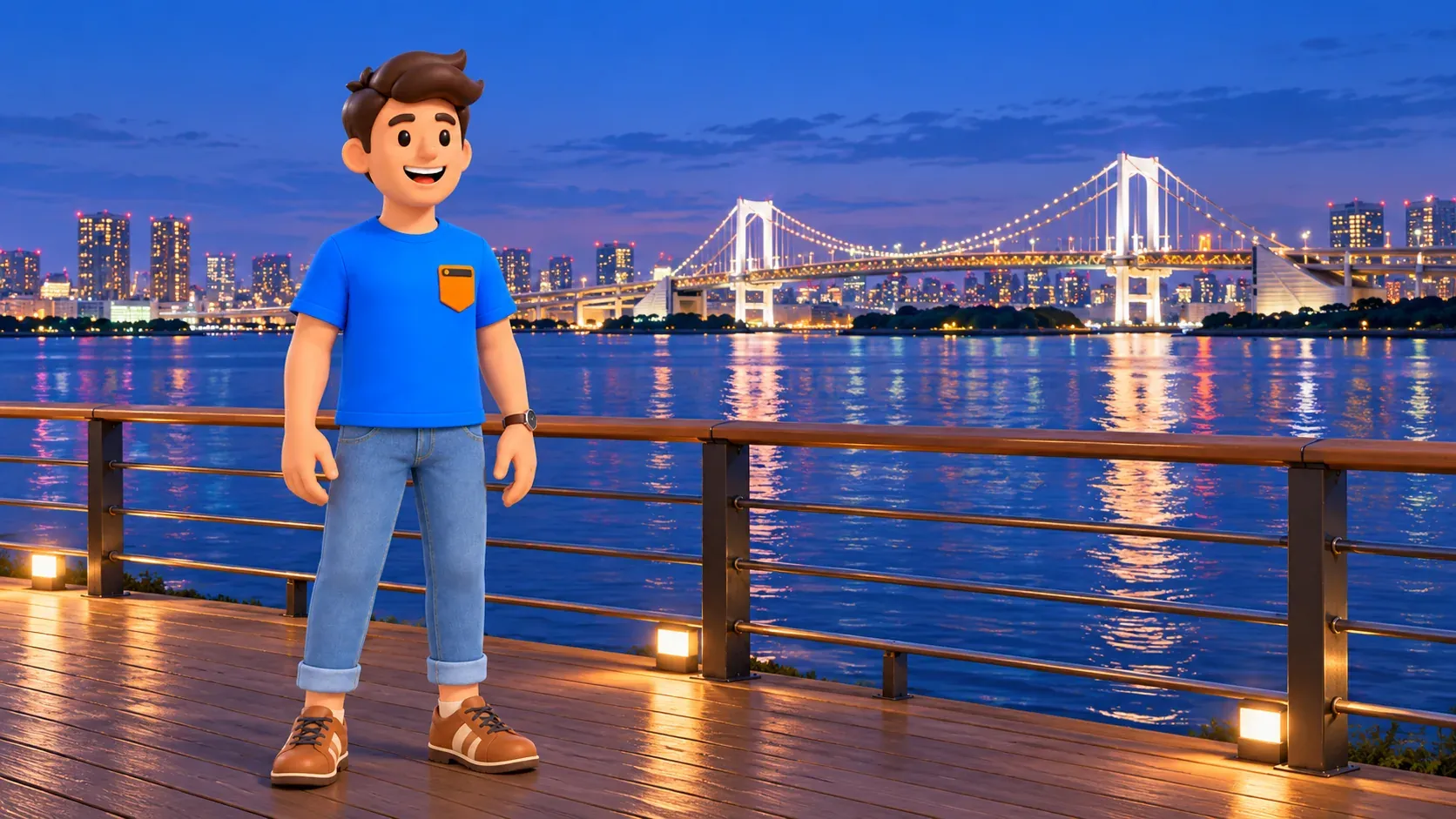
For a wider view, choose Odaiba Marine Park with an approach from Odaiba-kaihinkoen or Daiba on the current map. Here the main relationship is water, distant bridge and city rather than a tightly framed river street. It is an independent evening district. Do not make Eitai and Kiyosu compulsory first: transfers and new approaches use time that could be spent calmly observing your selected horizon.
The official park plan marks areas restricted by works and separate no-entry zones. An attractive shoreline does not guarantee a continuous public path along its whole outline. Follow current signs and genuinely available connections. If a desired section is closed, choose another public view or shorten the circuit rather than trying to get around barriers closer to the water in order to preserve a line drawn earlier.
The park includes a beach area, but an ordinary evening visit does not imply swimming permission. Its official map identifies swimming and fishing restrictions in particular areas. This version needs only walking paths and bay views. Do not import seaside-resort expectations to an urban waterfront or make entering the water a required part of resting after a long hot day. The shore can be enjoyed from public dry paths.
Looking at Rainbow Bridge differs from crossing it
From Odaiba, the bridge remains a distant part of the panorama. Seeing it does not require going to the pedestrian entrance and changing the entire finish. First take in a wide view, then choose another angle along the available shore. A small change in position can compare foreground and distant silhouette without prescribing a long circuit around every section of the park before the evening may end.
Do not promise fireworks, a fountain programme or a specific bridge-lighting colour simply because such images appear in descriptions of the district. Each event has its own calendar and conditions. If important, check separately and build around a confirmed programme. The basic shore version is complete without a show, boat ticket or previously selected photograph with an ideal sky that the actual weather may not provide.
Use RoadMe to develop a personal plan in which waterside walking, food and travel get time according to your interests. The app helps prepare one suitable shore and convenient finish, preserving the evening for the experience rather than unnecessary transfers.

Prepare Rainbow Bridge separately if you want the crossing
The pedestrian route has its own hours: April 1 to October 31, 9:00–21:00; November 1 to March 31, 10:00–18:00. Last admission is thirty minutes before closure. A late autumn evening on the shore therefore does not mean the bridge remains open for crossing. Check season and time before heading towards an entrance, rather than after a long approach ending at a closed door.
The regular closing day is the third Monday of each month, shifting to the next day when it is a holiday; maintenance and weather can also restrict entry. The operator gives approximately 1.7 kilometres between entrances and about twenty to thirty minutes on foot. That is the path itself, not your whole station-to-station evening. Approach, entry, stops and the journey after emerging on the other side must be added.
With a pushchair or reduced mobility, check the route and conditions beforehand. The operator notes significant slopes and asks wheelchair users to have assistance. Riding bicycles along the pedestrian route is prohibited, while rules for carrying or wheeling them are separate. A shore view can be the simpler choice when the crossing creates additional strain or an awkward finish. Choosing it does not mean missing an obligatory part of Odaiba.
Let weather and energy set the limit
Open water does not guarantee a pleasant breeze or comfortable temperature. Humidity, rain and wind can change the experience, and warmth may remain after sunset. Check conditions and bring suitable clothing. In unpleasant weather, a brief view followed by indoor food can be the right ending. The walk need not become a test merely to reach a prescribed duration or tick an activity chosen before actual conditions were known.
With children or a tired group, choose a simple limit: one bridge and a modest public-bank section, or one broad bay view. Identify the transport return in advance. Do not rely on a free bench at the exact needed minute or move far from a suitable exit for one final reflection. A good evening should remain convenient after a decision to finish earlier rather than requiring the full outward distance again.
Food and the journey back
Choose an open venue by current menu, price, queue and route to the station. A restaurant's river or sea view is not guaranteed without checking actual seats. Sometimes eating first and then stepping out for one view works better than seeking a perfect table and losing the evening in a queue. The waterfront need not provide the backdrop for every action from dinner to the final cup.
If a boat ride matters, confirm operator, pier, direction and departure first. Water nearby does not guarantee a useful evening sailing towards your accommodation. Ordinary public transport and a clear finish are sufficient for the basic version. A complete evening at Eitai, Kiyosu or Odaiba is more useful than a chain of distant shores in which entrances, transfers and an attempt to reach several illuminations consume most of the available time.


