
Taganka and Goncharnaya: A Walk to the Kotelnicheskaya High-Rise

Taganka and Goncharnaya offer a walk with a clear change of scale: start around the theatre, look at a smaller historic church and follow the neighbourhood towards the high-rise on Kotelnicheskaya Embankment. The contrast between streets, decorative details and the large river-facing building provides the story. A visit does not need to include private entrances or an apartment tour to feel complete.
Allow roughly two to three hours for the main outdoor version, with pauses. St Martin the Confessor can be an optional opening detour, while the Ulanova Apartment-Museum is a separate possibility only when current visitor information confirms access. All times are estimates, not measured journeys. Streets have traffic, gradients and crossings, so use a current public pedestrian route rather than drawing a straight line between monuments.
Choose the main route before adding interiors
The core sequence runs from the Taganka Theatre area to the Assumption Church in Gonchary, then along the Goncharnaya neighbourhood towards the Kotelnicheskaya high-rise. Keep the end on a public approach that suits your return journey. You do not have to cross the river or continue into a second district. The change from smaller streets to the high-rise already creates a satisfying conclusion.
For a Moscow trip shaped by your interest in architecture, theatre and neighbourhood walks, try RoadMe: the app builds a personal route or day-by-day plan around your dates, interests and pace. It is more convenient to prepare a coherent programme than to connect separate addresses while trying to enjoy the city.
Use Taganskaya or Marksistskaya as general starting references and choose actual exits with current navigation. If St Martin is important to you, put it before the core sequence and allow an extra block. If you have a performance booked, consider the direction and time of the return before committing to a downhill finish near the river.
The theatre: an urban starting point
The Taganka Theatre's official address for its principal stages is 76/21 Zemlyanoy Val, building 1. Confirm the exact stage if you are attending a performance: the institution also uses other entrances and locations. A familiar theatre name does not by itself identify the doorway on your ticket. For this route, the exterior serves as a meeting and orientation point.
Before setting off, notice the movement around the theatre and its relationship to ordinary streets. Cultural landmarks do not stand outside the life of a neighbourhood. People arrive for performances, go to work or pass through. This starting contrast is useful because the next stops will change from an active public venue to religious and residential architecture.
Keep a performance separate from the walking estimate. A show needs its own admission, duration and arrival margin. If the evening is already fixed, eat and return in good time rather than extending the route until the last possible minute. Without a ticket, an exterior look is a complete part of the walk, not an unsuccessful attempt to get inside.

Optional opening: St Martin the Confessor
St Martin the Confessor on Alexander Solzhenitsyn Street, at 15/2, can add another church silhouette before you head through Goncharnaya. It is an optional initial extension, not the next doorway on the direct core route. Choose it because you want an extra architectural comparison and have enough attention for another stop.
Look first at the whole building and the space around it. You can compare its larger composition with the more intimate church you will encounter in Gonchary. There is no need to decide which is more beautiful or recite a full chronology. The useful question is how different religious buildings organise scale and approach within the same part of Moscow.
Entry depends on current religious use and rules, so the basic addition remains exterior. Use authorised crossings to return towards the main route. If time is already tight, omit this opening detour. A shorter walk with three clear impressions is often more enjoyable than arriving at every stop with the feeling of being late.
Goncharnaya: let the street connect the stops
Move towards Goncharnaya using public streets and available crossings. The neighbourhood is not merely a gap between the theatre and the river. Look at shifts in building height, the line of the street and the way older structures sit among later ones. These observations help explain why the high-rise will feel different when it appears ahead.
You do not need to give every facade a legend. A quiet comparison between two adjacent buildings can be more useful than another unverified story about an owner. Notice the difference between a public pavement, an entrance serving residents and a closed courtyard. Interesting architecture is not permission to step through an open door.
The route involves changes of level. Choose an approach appropriate for your group and check whether the saved pedestrian path uses steps or a steeper section. A short distance on the map does not establish effortless access. If anyone finds the slope tiring, shorten the outing and preserve a comfortable end rather than forcing the original drawing.
The Assumption Church in Gonchary: a closer scale
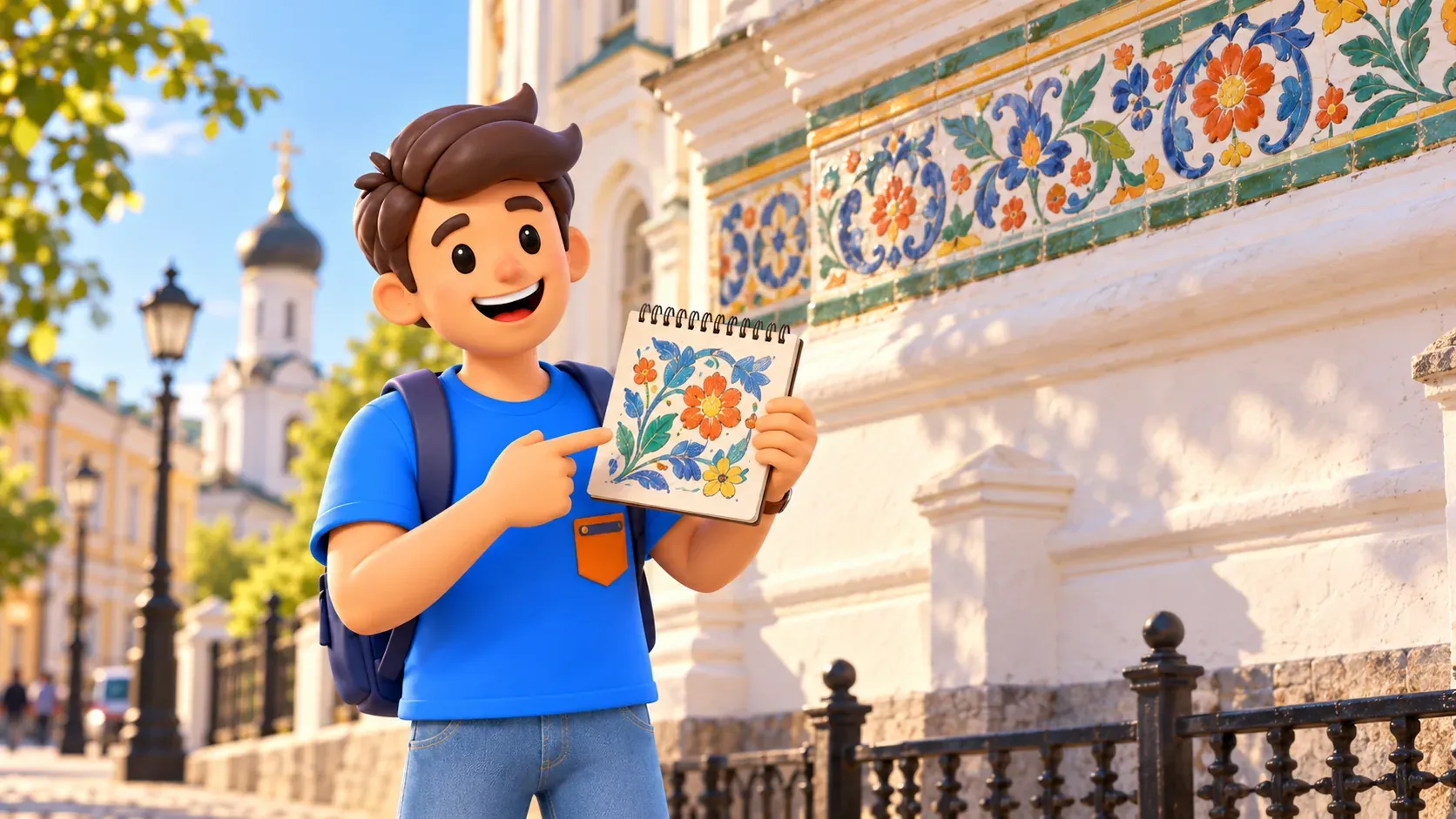
The Assumption Church stands at 29 Goncharnaya. Its stone building dates to the seventeenth century, with later additions, and colourful tiles give a reason to stop looking only at outlines. Keep the history brief: the relationship between materials, colour and modest scale is enough to make this a distinct encounter after the theatre area.
Find a viewpoint from the public approach where you are not blocking a gate or pavement. Start with the general form, choose one decorative detail and step back to place it within the whole. This is more rewarding than trying to photograph every fragment before understanding the building. An attentive exterior visit can take fifteen or twenty minutes without becoming a lengthy excursion.
It remains an active religious place. Respect signs about dress, worship and photographs and do not assume every part is open because a gate is unlocked. If you plan to enter, check that separately. The outdoor version does not depend on an interior and remains useful when the church is unavailable for a tourist visit.
Continue towards the river with room for a pause
After the church, continue through the neighbourhood towards the Kotelnicheskaya building. Let the direction and change of scale become the main experience. Some views will be partial, interrupted by street edges or nearer buildings. That is part of seeing a city from ground level, rather than expecting every approach to reproduce a famous panoramic photograph.
Take a proper pause before reaching the final building if the group needs it. A small snack or seated rest is more effective than calling another walking segment a break. The streets, slope and crossings can take longer than a simple map estimate, particularly if you stop to talk or photograph details.
If you would like to keep this balance between discovery and rest, RoadMe can create a personal trip plan around your interests and preferred pace. Planning in the app is more convenient than repeatedly choosing the next unrelated place when you would rather enjoy the neighbourhood.
Before the finish, check the next connection as well as the building marker. A residential address, a river viewpoint and a transport entrance are separate positions. Selecting the final public spot deliberately makes the walk easier to use, especially when you are meeting someone afterwards or returning for a performance.

Kotelnicheskaya: look at the high-rise without entering homes
The residential high-rise at 1/15 Kotelnicheskaya Embankment was completed in 1952. Near the meeting of the Yauza and Moskva rivers, it creates a much larger architectural scale than the earlier stops. You do not need to recite height and apartment counts to appreciate the contrast. First look at the main silhouette, then at the way the lower parts meet the street.
It is a residential building, not a freely accessible observation attraction. A walking itinerary does not authorise entry into staircases, courtyards or private apartments. Choose an available public position and leave residents' access clear. If barriers or works limit a viewpoint, adapt the stop rather than trying to reach behind them.
A short exterior encounter can be enough. Compare the building's distant impression with details visible from your permitted position, then decide whether to stay near the river or leave for transport. Do not promise yourself an unobstructed panorama from every corner: urban sightlines vary, and the particular viewpoint matters more than the general address.
The Ulanova Apartment-Museum is a separate question
Galina Ulanova's memorial apartment is associated with this high-rise, linking the large building to an individual artistic life. That connection can enrich an exterior walk without requiring admission. The existence of a museum in a residential building does not mean it is open on your date or that visitors can enter the building without instructions.
Check current notices directly with the museum operator before planning a visit. Older booking descriptions and opening hours are not a substitute for present access; restoration or programme changes may affect availability. Do not treat a tour advertised elsewhere as confirmation that the apartment itself is accepting visitors. Only an actually available arrangement should become part of your day.
When a visit is confirmed, reserve a separate time block and follow the stated meeting and entry process. When it is unavailable, the outdoor route is complete without it. The theatre, church, street and high-rise already provide several connected impressions. A museum can be a reason to return rather than a missing item.
End according to weather and energy
The river can feel more exposed than the streets above. In wind, rain or winter cold, keep the final stop shorter and plan a comfortable next destination. In warm weather, a calm pause may be enough; you do not have to expand into another long embankment route simply because the water continues.
With children, compare the different building sizes or choose one detail at the church and one on the high-rise. Do not promise an interactive museum activity without checking it. For limited mobility, confirm the actual slopes, crossings and rest points rather than assuming that a short central route suits everyone.
Before leaving, check the return journey, charge the phone and preserve time for a meal. Taganka's value here lies in the changes between places: a theatre, a small church, streets on a slope and a large residential landmark. Several well-chosen stops can show that relationship clearly without a race to get inside everything.


