
Art on the Strip: From Crystals through ARIA to The Park
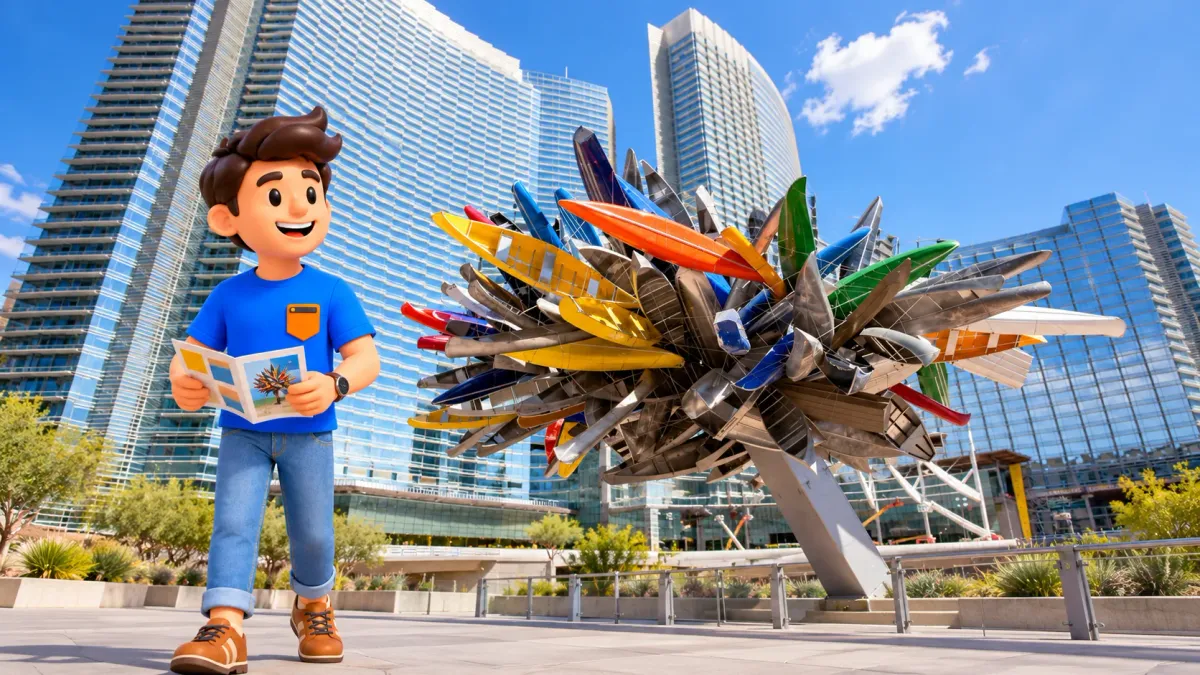
You can make an art walk around the central Strip without attempting to see every hotel collection. Begin with the architectural setting of Crystals, find a monumental typewriter eraser, enter ARIA for Silver River, and finish beside the dancing figure of Bliss Dance in The Park. If time and interest allow, add a separate detour to the boats of Big Edge near Vdara.
Allow roughly two to three hours for the relaxed main route; the detour, food and longer stops add time. This is an editorial estimate rather than a measured journey. Space to look matters more than collecting the highest number of names. ARIA presents its collection for complimentary independent viewing, while access to particular areas and passages still needs attention on the day.
Look at the work rather than complete the list
A simple question connects this outing: how does an everyday object, a river line or a human movement change when it becomes art in a large urban setting? You do not need every artist's biography. Choose a few stops and give each attention. The walk then differs from an ordinary trip along the boulevard, when an artwork may register only at the edge of your vision.
For a more convenient way to shape this walk around your preferences, try RoadMe: the app works out a personal plan based on your interests, pace and time. Choose art, architecture and unhurried pauses so your itinerary reflects the experiences you want to spend time noticing.
| Section | Main interest | How it fits |
|---|---|---|
| Crystals and the eraser | Architecture and the scale of an everyday object | Beginning of the walk |
| ARIA and Silver River | A river line in a hotel interior | Indoor stop |
| Big Edge | Boats assembled into a sculpture | Separate detour towards Vdara |
| The Park and Bliss Dance | Movement, metal mesh and light | Outdoor finish |
This is not one straight gallery. Transitions involve different levels and working hotel spaces. Big Edge lies away from the overall direction towards the southern finish, so decide about it beforehand. For a shorter outing with an even pace, save the sculpture for a separate approach. The main walk still has a clear beginning, middle and end.
Use the current collection map or ask ARIA staff about the location you need. An old photograph does not confirm that a work remains in its former position, and neighbouring resort names are not a substitute for orientation. Enjoying the route does not require finding every artwork that has ever belonged to the collection or matching an older visitor's list.
At Crystals, begin with the space itself
Look first at the relationship between building volumes, glass surfaces and pedestrian directions. Here art is not separated from architecture by a familiar museum threshold. Attention changes while you move: a façade reflects its surroundings, an angle narrows or opens, and an object gains scale through the building beside it. The environment helps you see why a sculpture works in a particular position.
The stop need not become a shopping overview. For this route, Crystals is part of the urban scene and a starting point for changing your usual way of looking. Choose one fragment to remember: an angled line, a reflection or a contrast between materials. Compare it with the artworks farther along instead of trying to catalogue the whole complex.
Establish the transition to the first sculpture. The level where an object appears and the level of your approach may differ. Follow current signs and available pedestrian routes, checking a step-free option beforehand if necessary. A short distance between buildings does not guarantee an equally short route inside. A little orientation at the start makes the rest of the visit easier.
The giant eraser: recognition and surprise
Typewriter Eraser, Scale X is by Claes Oldenburg and Coosje van Bruggen. The collection brochure places it at the pedestrian bridge near Waldorf Astoria. A once-familiar stationery object has become a monumental sculpture. Its red disc, metal holder and blue brush combine into a form you might initially read as abstract, before discovering what the title names.
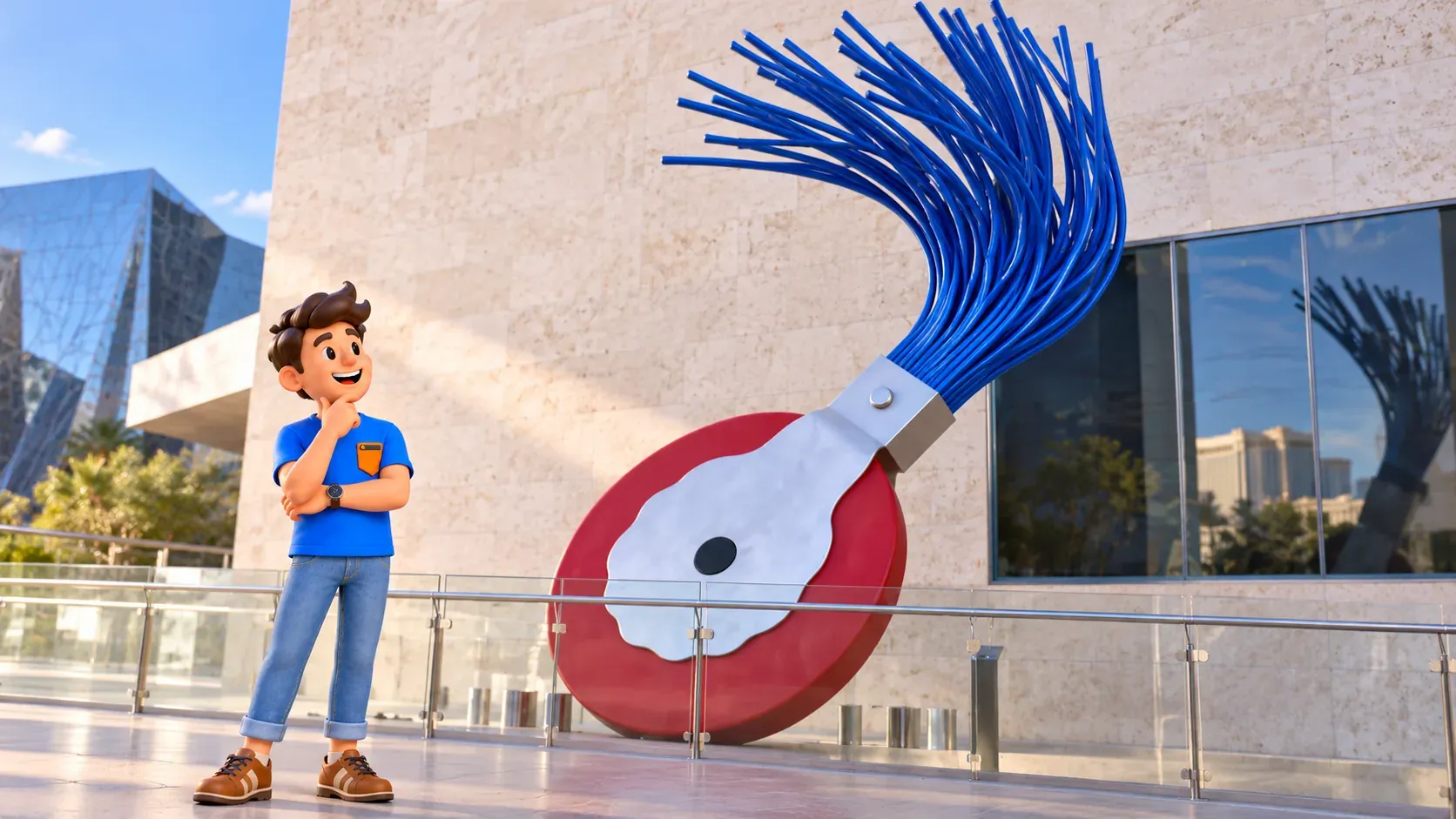
Look before reading the label. What does the circle beside curved lines suggest? Then learn the title and return to the form. The difference between first impression and recognition is part of the stop. For someone who has never used a typewriter, it can also prompt a conversation about objects that have disappeared from ordinary daily experience.
Notice how the brush gives direction to something stationary. You can see a large everyday object or a composition of colour and suggested movement. The readings do not contradict each other. Both are sufficient for a short encounter without a lengthy explanation of every device associated with Pop art or a detailed account of the artists' careers.
For a photograph, include part of the building or a human reference so the scale is apparent. Then choose a detail. You do not need to stand directly beside the work or touch it. A change of position on the available path already provides another angle. Keep the passage clear for people using the area as an ordinary route through the resort.
Silver River above the registration desk
Inside ARIA, find Maya Lin's Silver River above the registration desk. The 2009 work represents the Colorado River in cast reclaimed silver. For a first encounter, notice the winding line and its position in a large hotel interior. This is the kind of artwork you could walk past while concentrating on an everyday task, even though it gives the space a distinctive character.
Try seeing it first as a free line, then as a geographical form. In one reading, attention follows turns and reflected light; in the other, it considers a river and a territory. Switching between the two offers substance without needing to analyse a drainage map or identify every turn. A simple observation can carry more meaning than a long list of measurements.
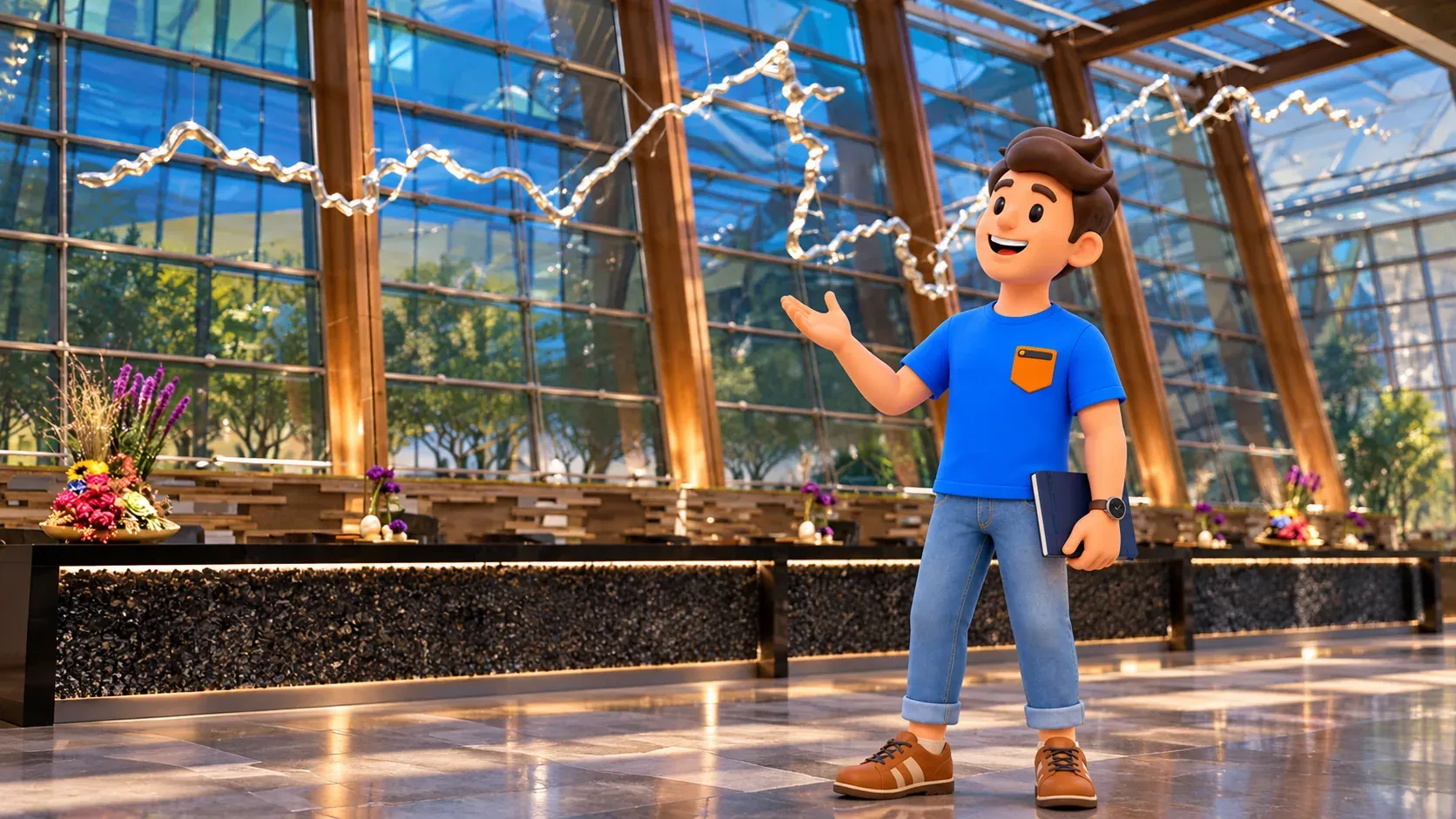
Stop on the visitor side without obstructing registration. Joining a queue just to approach the work or going behind the counter is unnecessary. The room's working function is part of the context rather than an obstacle to overcome for a picture. A comfortable overall view often conveys the relationship between artwork and architecture more effectively than an excessively close frame.
The comparison with the eraser is particularly clear. There an ordinary object became huge; here a large geographical form appears as a thin line. Both change a familiar scale through different approaches. You now have a subject connecting the stops without needing a complete art-historical commentary. The route becomes a sequence of observations rather than unrelated objects encountered between hotels.
Big Edge as a separate detour
Nancy Rubins' Big Edge stands around Harmon Circle near Vdara. It is a distinct diversion from continuing towards The Park. Choose it if you want to see how numerous boats and canoes become a large spatial composition. If time is short or you prefer fewer transitions, leaving it out does not break the main walk or make the rest less worthwhile.
From farther away, the work can resemble a coloured fan or a dense burst of forms. Closer in, individual boat hulls, edges and directions become identifiable. Begin with the whole, select one element and follow how it participates in the construction. An ordinary object again becomes art, but this time the effect arises from many things assembled together.
Do not enter the roadway for a symmetrical photograph. This is an urban circulation area with vehicle approaches, so choose a view from available pedestrian space. A suitable position showing the work with surrounding buildings is enough. The day's actual layout matters more than reproducing a particular image, and the sculpture does not require a perfectly central viewpoint to be appreciated.
Before continuing, assess the time remaining. The detour involves approach, orientation and regaining your onward direction as well as several minutes beside the boats. If you want coffee afterwards, extend the allowance rather than rush the final stops. Art benefits from attention more than a timetable preserved at the cost of every pause you wanted to enjoy.
Continue south towards The Park
For the finish, follow current pedestrian directions towards The Park. Between ARIA and the park area, resort approaches and sections with different patterns of movement need attention. Do not choose a path solely because the destination building is visible. Establish the available transition, then return your attention to looking and photographs rather than trying to solve navigation while crossing a busy approach.
After the interiors, The Park offers a more open urban context. Notice how art sits with landscaping, places to pause and the movement of people. Arena events can change the atmosphere, so consider the district's programme when planning a quiet visit. A photograph without visitors does not promise that you will find an empty space at the same viewpoint.
Pause before the final sculpture and look at the overall setting. A large work reads differently when the surrounding scale is visible. Take a broad photograph if you wish, then put the camera away and examine the material. That small change prevents the last stop from becoming only another quick background for a portrait and gives it an identity of its own.
At Bliss Dance, follow the movement
Marco Cochrane's Bliss Dance depicts a dancing woman. It debuted at Burning Man in 2010 and later found a permanent home in The Park. For this walk, that brief history is enough: the sculpture moved from another setting into an urban pedestrian scene. Movement and the construction of its metal surface offer useful ways to begin looking.
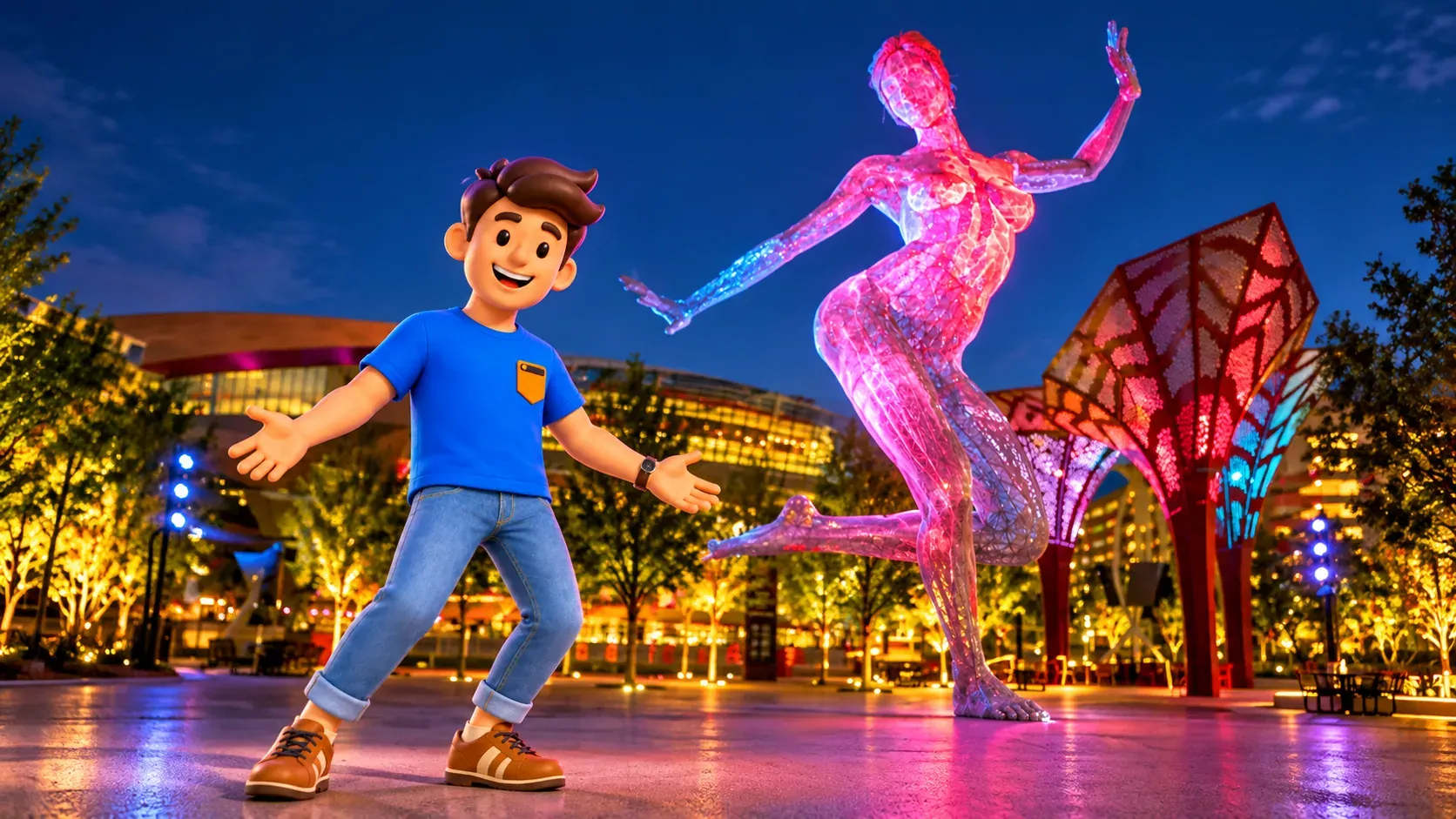
From a distance the pose matters, while closer viewing reveals the mesh and background visible through it. Lighting changes the impression, so daytime and evening visits are different. Choose a time that fits your day instead of requiring both versions within one short route. A single attentive encounter is already worthwhile, even if you decide to return under different light later.
If this way of discovering a city appeals to you, RoadMe can work out a personal itinerary around art and your other interests. The app makes it more convenient to distribute walks across your trip while combining them with rest and the pace you enjoy.
Before leaving, compare four approaches: enlarging an object, tracing a river, assembling boats and expressing a figure's movement. Even with only some stops, the comparison remains meaningful. You do not need to remember every name. More valuable is noticing how art changes your view of places that otherwise function mainly as transitions during an ordinary day.
Leave room for your own response
You do not have to like every work. Notice what attracted you and what remained unclear, then discuss it during a break. One clear question can be more useful than a long list of facts. Finish by choosing a convenient exit towards your next plan or hotel, allowing time for the journey after the final sculpture rather than treating its location as the end of all movement.


