
Spitalfields to Whitechapel: a Walk through Markets, Old Houses and Art

For a walk linking Spitalfields and Whitechapel, begin near Liverpool Street, look at the exterior of Dennis Severs’ House on Folgate Street, browse Old Spitalfields Market and continue past Christ Church into Fournier Street. Follow Brick Lane south towards Osborn Street and finish with a selected display at Whitechapel Gallery. Allow around two and a half to three hours, including a short food break and time for art.
The attraction is the change of scale: a domestic doorway, a market roof, a church spire and a gallery shaped by its neighbourhood. You do not need to collect every East End landmark to appreciate those connections. This version includes the house and church from outside; their interiors require separate arrangements. Choose a day when the gallery is open, rather than assuming the market and cultural venues share one timetable.
A manageable route through a layered district
From Liverpool Street, use the Bishopsgate side and head towards Folgate Street for the house at number 18. Afterwards, approach Old Spitalfields Market by its public entrances, then leave towards Brushfield Street and Commercial Street. Cross at the designated crossing to view Christ Church. Continue east along Fournier Street, south on Brick Lane and Osborn Street, then towards the gallery on Whitechapel High Street.
Try RoadMe to make your whole London day or trip easier to organise around your interests. The app develops a personal plan from your dates, pace and budget, giving markets, architecture, art and unhurried breaks a sensible place across the journey.
With browsing and small turns, plan roughly one and a half to two kilometres. That is an estimate, not a measured walking track. A three-hour outline allows fifteen minutes near Folgate Street, thirty-five for the market, twenty for food, twenty-five for the church and Fournier Street, twenty for connections, forty-five for a selected gallery visit and twenty of flexibility. You can shorten pauses, but a full exhibition or house visit needs longer.
The gallery is near Aldgate East station, which provides a practical onward starting point; it is not Whitechapel station. Check the actual transport service you need and add time for reaching the correct entrance and platform. The walk is linear rather than a loop back to Liverpool Street. If you have luggage or a reservation later, account for that before extending a market stop or entering a ticketed exhibition.
Folgate Street: start with a doorway
On Folgate Street, slow down enough to notice the rhythm of brickwork, sash windows and doorways. At number 18, Dennis Severs’ House gives the street a particular cultural association. The exterior is a worthwhile starting point even without an interior visit. Look from the public pavement, keep access clear and resist the idea that an atmospheric façade turns the whole street into a visitor attraction with open doors.
Dennis Severs was an artist who created an evocative recreation of a Huguenot silk-weaving family’s home. That distinction matters: the interior is an imaginative work, rather than an untouched household preserved exactly as a particular family left it. Knowing this changes the question you bring to the building. Instead of searching for a supposedly frozen past, consider how someone used domestic spaces to invite an encounter with history.
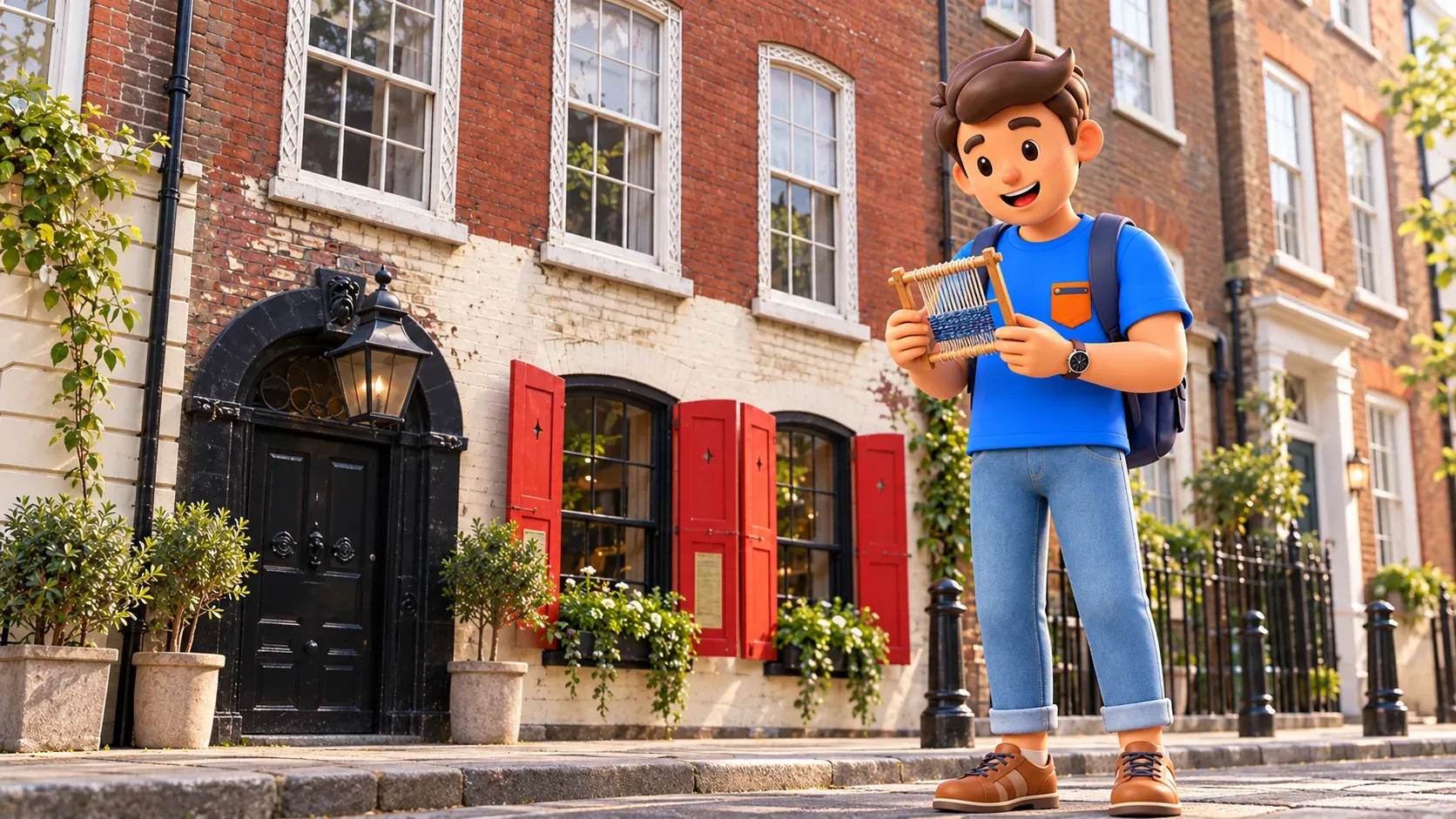
If the house is a priority, book a suitable visit separately and build your day around its confirmed time. The operator offers silent daytime and evening visits as distinct experiences. An evening atmosphere is not proof that every session takes place by candlelight. The house involves stairs and uneven floors, has no wheelchair access or visitor toilets, and does not permit interior photography or filming. Read the conditions for your chosen session.
For this short walk, remain outside and keep the interior as an additional option. You can still notice how a relatively modest frontage differs from the larger public buildings later on. Neighbouring homes and businesses remain places of daily life. Avoid photographing through windows, pressing against doors or blocking narrow pavement while discussing what might be inside. The street works best when observation leaves room for its ordinary use.
Old Spitalfields Market: look above the stalls
At Old Spitalfields Market, begin with the roof before deciding what to browse. The Victorian hall gives a shared frame to traders, food businesses and passing visitors. Ironwork, daylight from above and the brick perimeter help explain why this feels different from shopping along a normal high street. Take a moment to locate your exit towards Brushfield Street so the market does not become an accidental circuit repeated several times.
The market’s history is older than the surviving hall. In 1682 Charles II granted a charter allowing a market near Spital Square. Robert Horner began developing new market buildings after taking a lease in 1876, and that work was completed in 1893. These are different stages, not a claim that today’s whole roof dates from the seventeenth century. The building lets you see how an established activity acquired a new architectural setting.
Choose a small focus: perhaps one craft material, a piece of clothing or the design of an object. The market brings together independent businesses, local creatives and some familiar brands, so do not assume every item was handmade nearby. Ask about provenance when it affects your decision. An interesting conversation or one carefully examined object can be more memorable than trying to inspect every stand before moving on.
Old Spitalfields Market operates throughout the week, but individual shops, food businesses and specialist markets have their own arrangements. Thursday antiques and other themed events belong to particular schedules. Check the current programme if that is your main reason to visit. A general opening time does not guarantee that a specific trader will be present, and later restaurant trading should not be treated as proof that all stalls remain open.
A food pause that supports the walk
The market can supply a short lunch or snack before the architectural part of the route. Choose something manageable, include the ordering time and check dietary questions directly with the business. This plan allows a simple pause, not a survey of every kitchen. If you want several dishes or a long sit-down meal, enjoy it and add time rather than compressing the gallery into a rushed glance.
Do not count on a free seat beside your chosen vendor. Keep passages and entrances open, use the appropriate bins and pause in a suitable place before checking directions. The roof makes the market a useful covered section, but it does not turn the entire route into an indoor outing. You will still walk along ordinary streets between the market, the church, the old houses and Whitechapel Gallery.
Christ Church and Fournier Street
Cross Commercial Street at a proper crossing for Christ Church Spitalfields. Nicholas Hawksmoor’s church was completed in 1729, and its pale tower and spire give the neighbourhood a strong vertical landmark. Look at the large columns, the central arch and the way the different stages carry your eye upwards. You can appreciate that composition from the public approaches without adding an interior tour to the afternoon.

The church has limited public visiting arrangements, with services and events affecting access. An open vestibule does not necessarily mean the nave is available, and a worship time is not a sightseeing session. Keep the exterior as the reliable scope of this route. If you want to go inside, check the church’s current heritage information and allow extra time for the actual opportunity available on your date.
Turn into Fournier Street for a different scale of architecture. Spitalfields became an important centre of silk weaving after Huguenot refugees brought skills from France. The area’s houses and later adaptations preserve traces of that working history. Avoid imagining every fine Georgian house as an unchanged home of a poor weaver: merchants, skilled makers and changing uses all belonged to the neighbourhood’s development.
Look for the proportions of windows and the relationship between upper floors and the street. Notice one doorway carefully rather than photographing every entrance. The value lies in recognising how work and domestic life could share an urban setting. These are living streets, so leave private steps, windows and entrances alone. A detailed house-by-house history is a separate subject; this walk gives you a way to start noticing the evidence.
Brick Lane as a connection, not another full tour
At Brick Lane, turn south and continue towards Osborn Street. This short section connects the older streets to Whitechapel rather than attempting a complete shopping or street-art route. The district’s history includes Huguenot, Jewish and Bengali communities, with influences that overlap rather than fitting into a simple story of one people disappearing before another arrived. Let that complexity remain part of how you read the area.
You may notice changing shop fronts, food businesses and artwork along the way, but no particular mural is promised. Public art can change, and a picture from a previous visit may no longer match the wall. Keep to public routes and do not enter a closed yard to reproduce an old photograph. Following the street south provides a clear transition without detouring through every market and side lane.
Whitechapel Gallery: finish by looking closely
Whitechapel Gallery was founded in 1901 by Samuel and Henrietta Barnett to bring art to the people of the East End. Its history combines international artists with a commitment to its local surroundings. This makes it a meaningful conclusion after streets shaped by work, trade and movement. The gallery is not simply an unrelated indoor attraction added at the end because there happens to be time left.

General entry is free, while selected exhibitions require tickets. Choose an available free display for the short visit described here, or deliberately add time and a ticket for a show you want to see. This is a changing programme, not a promise of a permanent collection of famous pictures. Check what is actually on display and ask staff which spaces fit the time you have.
Give one work or a small group your attention. Look first, read the accompanying information, then look again for something you missed. Forty-five minutes can be satisfying when the scope is clear, although films, several galleries or a major exhibition may take much longer. A passenger lift serves the gallery floors, but that does not certify the whole street route as step-free. Contact visitor services for your specific access needs.
With RoadMe, it is more convenient to build a complete personal trip around your preferred balance of art, history, food and rest. Let the app organise your days according to your interests, pace and budget so this neighbourhood walk fits naturally into the wider visit.
The gallery normally opens Tuesday to Sunday, from eleven, with a later Thursday evening; Monday is closed. Confirm the programme and any special arrangements before setting out. For another market with a different musical and industrial setting, our two-hour Camden walk belongs on a separate day. Here, finish near Aldgate East with time to remember a few connected details, rather than a list of places passed too quickly.


