
Half a Day in Shiodome: Hama-rikyu, Old Station and Giant Clock

Shiodome is an easy place to notice several layers of Tokyo in one outing: Hama-rikyu Gardens, the reconstructed Old Shimbashi Station and Nippon TV's elaborate giant clock. Give the garden the largest share of attention, use the station for a short railway-history stop and treat a clock performance as a welcome possibility rather than the purpose of the whole day.
The contrast is the point. Water, planting and older landscape design sit close to office towers; a small historical-looking station appears among a much larger modern district. A generous half day can hold those changes of scale with a meal pause. It does not need a second garden, a boat journey or a full tour of every nearby building.
Choose one main visit and two shorter stops
Begin at Hama-rikyu when its opening calendar and the weather suit, then pause before the Old Shimbashi Station and the giant clock area. Finish toward a useful Shimbashi or Shiodome connection. Use current paths and station exits rather than assuming the closest map pin is the easiest approach. Shiodome has different pedestrian levels, so the final connection deserves attention.
For a personal trip that is easier to organize and use, try RoadMe: the app prepares a day-by-day plan around your interests, dates, pace and budget. Give the garden, railway history and playful city details a practical place in the journey instead of combining separate sightseeing lists yourself.
| Part of the outing | Main idea | Keep flexible |
|---|---|---|
| Hama-rikyu | A substantial garden visit | Every path, flower display and tea stop |
| Meal or drink pause | Rest between different settings | One specific address or a long queue |
| Old Shimbashi Station | Railway history and a reconstructed facade | A longer exhibition visit |
| Nippon TV clock | An unusual object in a modern district | Waiting for the next performance |
A half day is an editorial allowance, not a measured completion time. Travel from your accommodation is additional. If a clock performance matters greatly, fix that appointment first and place the two city stops on the appropriate side of it. Otherwise, look at the clock without waiting and let the garden remain the main experience.
Hama-rikyu: choose the entrance before the garden path
Hama-rikyu is a gated, normally paid garden, not an unrestricted neighborhood park. The regular schedule is 9 a.m. to 5 p.m., with last entry at 4:30 p.m.; the year-end closure runs from December 29 through January 1. Check current notices and do not use the final admission time as an ideal arrival for a relaxed visit.
The garden has different entrances, including Ote-mon and Naka-no-gomon. Choose according to your arrival and later plans, using the current access information. A station name alone does not establish the best route, particularly with a stroller or difficulty using stairs. Take time to find the appropriate public approach rather than following an accidental shortcut through another building.
Give the garden a generous block instead of setting out to collect every named feature. Choose a manageable route through areas open that day and leave time to stop. Access to a path, building or refreshment facility can differ; a garden ticket should not be read as a promise of all interiors, services and activities.
A tidal pond beside a changing city
Hama-rikyu's seawater pond is connected with the tides of Tokyo Bay. This is a useful way to read the landscape: the water is not simply a fixed decorative surface. Its relationship with the shore and the surrounding planting belongs to a garden shaped by a waterfront setting.
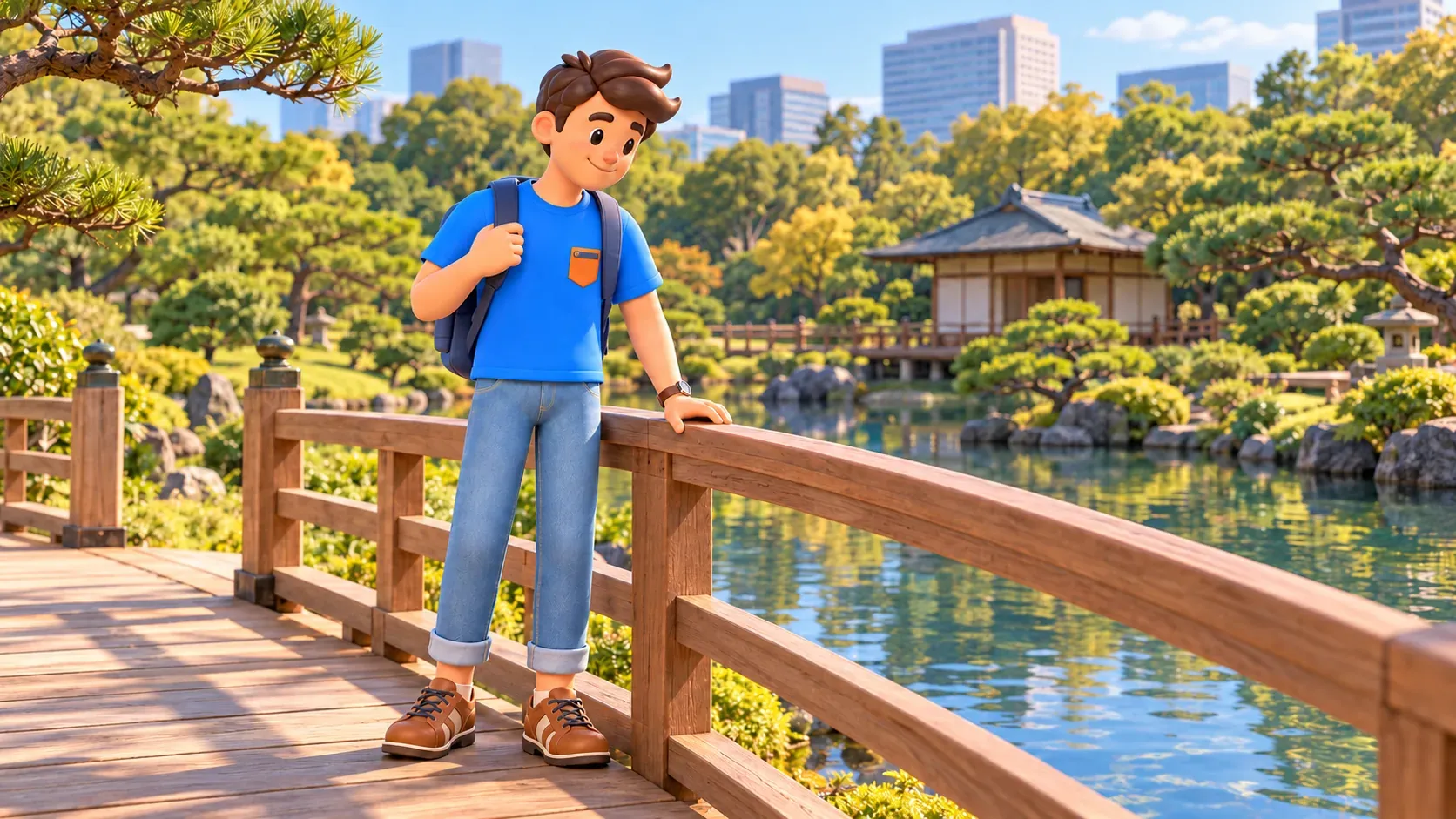
You do not have to understand every stage of garden history before looking. Notice how water, stones and trees organize the view, then how modern buildings appear beyond them. The towers do not need to be edited out of your experience. Their presence is part of the contrast that makes this particular Shiodome outing distinctive.
Move slowly enough to see the foreground change. A low branch, a curve of shore or a different position beside the water can alter the scene without another landmark. Choose two or three views you enjoy rather than chasing the idea of a perfect photograph. A quieter ordinary view can be as rewarding as the familiar image that first brought the garden to mind.
Seasonal planting changes, so do not promise yourself the same colors every month. If flowers are an important reason for coming, check their current condition before assigning the day. If they are not, let the water and spatial composition carry the visit. The garden does not have to recreate a social-media picture to be worth your time.
Keep the garden comfortable, not exhaustive
Use authorized paths and respect low barriers as real boundaries. Avoid entering planting beds or climbing for a better view. With children, ask one simple question about water or the contrast with the skyline instead of turning the visit into a long set of tasks. The walk can remain interesting without becoming an exercise in completing all the labels.
A tea stop may appeal, but it is optional and depends on the facility's own arrangements. Do not assume a seat or service will be available simply because the building appears on the map. If a wait would remove the rest of the outing's comfortable margin, choose between a longer garden visit and keeping the city stops intact.
Photography should remain considerate and follow current rules. Ordinary souvenir pictures are different from an organized photo session or commercial shoot. Keep routes clear and do not make other visitors wait while one spot is occupied. The purpose of this half day is to look at the place, not to turn its public paths into a private set.
In heat or strong rain, reduce exposed sections and keep rest time. A short garden visit may be the right decision, but the station exhibition is not an automatic shelter when it is closed. Check both calendars before changing the order. Practical adjustments work best when made before fatigue or weather turns the last connection into a rush.
A pause before entering modern Shiodome
Leave space for food or a drink between the garden and the urban stops. This is a change of attention as well as a meal. A straightforward place that is open can be more useful than a famous address with a queue. You do not need to visit every cafe near the route to understand the district.
Look at the pedestrian connection while you are still unhurried. Ground-level paths, underground passages and decks can point in different directions. Choose a clear route suited to your group instead of assuming that a nearby facade is directly reachable from your current level. A few extra moments of orientation are preferable to repeated stairs and backtracking.
If the group prefers a long lunch, keep it and shorten optional elements. The giant clock can be viewed without waiting for a performance; the station can be an exterior architectural stop when that matches your interests. Preserve the garden's main visit rather than reducing every part equally until none receives enough attention.

Old Shimbashi Station: a reconstruction with a clear story
The Old Shimbashi Station building here is a reconstruction completed in 2003, recalling the terminal associated with Japan's railway opening in 1872. It is not the present-day Shimbashi Station and not an untouched original building surviving from the nineteenth century. That distinction helps explain why the modest facade stands within a very modern setting.
For a short stop, look at scale and arrangement: the historical station form against the surrounding office district. You do not need a long railway chronology to appreciate that contrast. If the subject appeals, the railway-history exhibition provides a more focused indoor continuation; choose it deliberately rather than entering solely because admission is free.
The exhibition room normally opens from 10 a.m. to 5 p.m., with last admission fifteen minutes before closing. Mondays are regular closing days; when a Monday is a public holiday, it opens and the following Tuesday closes. Year-end, exhibition-change and inspection closures also occur. Check the actual day rather than assuming every free exhibition is available whenever the exterior can be seen.
Keep the exhibition proportionate to this outing. A quick introduction and a more detailed reading visit are different choices. If railways are a major interest, give the room a larger share and reduce something optional afterward. There is no need to hurry through the information just to preserve a clock performance that was never essential.
The giant clock: enjoy the object without depending on a show
Nippon TV's giant clock was designed by Hayao Miyazaki. That credit is enough context for this local walk: look at its unusual sculptural character in relation to the modern district. A detailed exploration of Miyazaki-related places belongs to a different day and does not need to be folded into this half-day plan.
The clock's moving performance runs at scheduled times rather than continuously. The official schedule checked on October 23, 2026 includes noon on weekdays and weekends, with the presentation beginning about three minutes beforehand. Other listed times differ by day. Recheck the current schedule and any operational notices if seeing the movement is important.
A noon performance can become a fixed anchor if you start the garden early and keep the connection realistic. Do not promise an exact transfer time or sacrifice the entire garden to make it. Alternatively, see the clock as a stationary work and continue. Missing one cycle does not make the outing incomplete or require waiting through a large empty interval.
To match these choices to your own holiday, set your interests and preferred pace in RoadMe and let the app create a personal itinerary for each day. It makes arranging gardens, small historical stops and breaks more convenient, without forcing every appealing detail into one crowded route.

Finish at the right station, not the last possible attraction
Before the final city stop, choose the station and connection that fit what comes next. Shimbashi and Shiodome are not interchangeable instructions to take any available escalator. Keep the correct line and entrance in mind, and leave enough time to reach them without turning the end of the walk into a search through different pedestrian levels.
Do not automatically add a boat journey or another garden. Those can be good separate experiences but change the time and access conditions of this plan. For a longer stay, place this outing alongside the Tokyo plan with distinct historical and modern days, giving it room of its own rather than treating it as an extra stop before dinner.
The useful result is a clear sequence: waterfront garden, a pause, railway memory and an unusual urban object. Confirm access, keep the performance optional unless deliberately scheduled and give the transitions their real time. Shiodome can then feel like a coherent half day of contrasts, rather than a collection of unrelated pins between tall buildings.


