
Seven Dials, Neal’s Yard and Soho: a Walk Through Small Streets
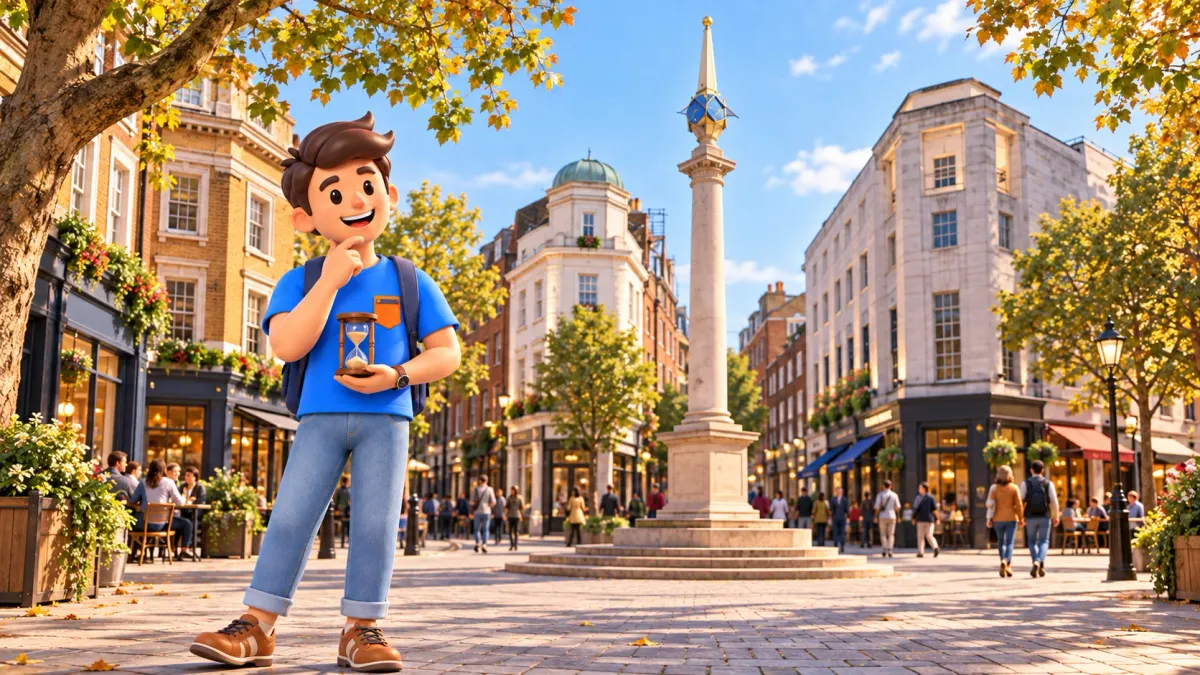
For a London walk built around small streets, connect Seven Dials and Neal’s Yard with the eastern side of Soho, then finish at Soho Square. Begin with the streets radiating around a sundial pillar, step into a colourful courtyard and cross towards a neighbourhood where music, invention and everyday café life overlap. Allow around two to two and a half hours with pauses.
Seven Dials and Neal’s Yard belong to the wider Covent Garden area; Soho comes later in the walk. Keeping that geography clear makes the outing easier to understand. This is a daytime introduction to a compact part of the West End, with an outdoor garden finish. A full meal, extensive shopping or an evening performance needs its own time.
Choose a direction and keep room to notice things
Start at the Seven Dials pillar, explore nearby Neal’s Yard and return towards the central junction. Continue west through the Earlham Street area towards Charing Cross Road and Cambridge Circus. Use the current public crossings around Shaftesbury Avenue to reach Greek Street. A short connection around Old Compton Street leads to Frith Street, which takes you north to Soho Square.
With RoadMe, it is more convenient to develop this walk into a personal London day or trip shaped around your interests, dates, pace and budget. The app helps give small streets, cultural history and a proper pause the right place in your own programme.
The outline covers roughly one and a half to two kilometres, including short detours and movement within the courtyard and square. This is an editorial estimate, not a measured walking track. The suggested time is for looking and pausing, rather than continuous walking. You can spend longer in one section, but keep Soho Square’s current garden closing time in mind before giving the beginning an open-ended café stop.
A useful balance is about half an hour around Seven Dials, twenty minutes for the courtyard, forty-five minutes for the transition and Soho streets, and twenty minutes at the garden. Leave the rest for crossings, a brief refreshment pause and small delays. Arrive in the Seven Dials area by the connection that suits your accommodation; the journey to the start is additional.
Read Seven Dials as a street plan
At Seven Dials, look along several streets before choosing one. The central pillar gives the junction a clear focus, while narrow buildings occupy the wedges between the radiating approaches. The layout is the main attraction here. You can understand it from the public pavement without visiting every shop or walking the full length of all seven streets.
Thomas Neale developed the area in the early 1690s, with construction beginning in 1693. His plan increased the amount of street frontage available for houses, which mattered when rents were charged by frontage. What feels like picturesque irregularity therefore also had a practical commercial purpose. The street pattern preserves an idea about how to make an urban development work.
The pillar carries six sundial faces, despite the seven streets around it. Neale’s earlier plan had six streets before the layout changed. This is a small detail worth looking for, rather than turning the stop into a counting exercise with a predetermined photograph. Notice the relationship between the faceted head, slender column and the street corners behind it.
The monument standing here is a reconstruction, unveiled in 1989. The original pillar had been removed in the eighteenth century. Knowing that makes the junction a story of care and recovery as well as seventeenth-century planning. Do not assume that every nearby façade is an untouched survivor either: repairs, rebuilding and later shopfronts form part of the neighbourhood’s appearance.
Sundials also introduce a different way of thinking about time. Apparent solar time is not simply the same reading as a modern watch, and shadows depend on the conditions. Treat the dials as something interesting to observe, rather than an instrument you need to use for your next reservation. The real practical clock for this walk remains the time available in your day.
Step into Neal’s Yard for colour and a closer scale
Use an open public passage from the Monmouth Street or Shorts Gardens side to reach Neal’s Yard. The change is immediate: the street gives way to a small enclosed courtyard, where painted surfaces, window frames, plants and shopfronts sit close together. It is a different kind of view from a large London square, with detail replacing distance.
The yard takes its name from Thomas Neale, but its modern identity owes much to a later transformation. In 1976, Nicholas Saunders bought an empty warehouse with a vision centred on community, natural foods and sustainable living. The colourful destination grew from the revival of a neglected service area. Its appeal is connected to reinvention, not just a decorative coat of paint.
Look at the contrast between older brick, vivid details and the ordinary uses at ground level. Cafés, shops and people passing through keep the courtyard connected to the surrounding city. It is well known and can be busy; an entrance through a narrow passage does not make it an undiscovered place or guarantee a quiet table.

For photographs, one overall view and a detail may be enough. Leave doorways and circulation clear, and follow any restrictions displayed by individual businesses. If you choose to sit down, let the pause count as part of the outing. A short coffee stop can fit the suggested rhythm; waiting for a table and having a full meal will need more time.
Let Monmouth Street connect the two settings
Return towards the Seven Dials area and take the westward connection through the Earlham Street side towards Charing Cross Road and Cambridge Circus. There is a small amount of deliberate retracing here because Neal’s Yard is the courtyard detour, not the start of a straight passage through to Soho. Understanding that prevents unnecessary circling in search of an imagined shortcut.
On the surrounding streets, look at what sits above the shopfronts. Window proportions, brickwork and the shape of corner buildings help reveal the older street framework beneath changing businesses. You do not need to identify a period for every façade. Compare the repeated small scale with the broader traffic setting you reach near Shaftesbury Avenue.
The main-road crossings are a transition between neighbourhoods. Follow the current pedestrian arrangements and do not treat an apparently continuous line on a map as a single crossing. Once across towards Greek Street, slow down again. The next part of the walk is about Soho’s streets themselves, rather than adding every nearby theatre, shopping lane and restaurant district to the same circuit.
Find cultural history along Soho’s ordinary streets
Continue into Greek Street and use the short connection around Old Compton Street to reach Frith Street. This eastern slice of Soho is enough for a first introduction. Entrances, cafés, upper-storey windows and people going about their day provide the setting. Your walk can be complete without continuing all the way to Carnaby, Berwick Street or the western side of the neighbourhood.
Frith Street offers two historical threads that reach well beyond London. Mozart’s family took lodgings here in September 1764 and left Soho in July 1765. He was still a child on a European tour. The connection makes an ordinary-looking street part of a wider musical story, without requiring a concert booking or an exhaustive itinerary of composers’ addresses.
Keep that story precise: Mozart’s first symphony is associated with his stay in Ebury Street in Belgravia, not with a room you can visit on this route. Historic associations do not automatically mean an original interior survives or is open to the public. Here, the value is the context added to the street rather than a promised house-museum visit.
A different kind of creativity appears in John Logie Baird’s connection with 22 Frith Street. In January 1926, he gave a formal demonstration of working television here. The early mechanical system belonged to a much longer history of experimentation. It is a memorable reminder that Soho’s cultural past includes engineering and new ways of seeing, alongside music and performance.

These stories work best as short prompts for attention. Look at the streets around them, then continue rather than trying to turn every doorway into a major stop. If music or technology particularly interests you, that can become the focus of another day. For this walk, two well-understood connections give more depth than a long list of famous names.
Prepare a more useful personal programme with RoadMe, giving cultural stories, cafés and time outdoors the weight that suits your interests. Plan conveniently in advance, then download London online before leaving so maps and navigation are available offline while you explore.
Finish with greenery at Soho Square
Head north along Frith Street towards Soho Square and enter the garden through an available public gate if it is open. Trees, paths and lawn areas give the walk a final change of pace. After the narrow courtyard and busy streets, a little space to sit or look across greenery is enough. A free bench is welcome, but a particular seat or an empty garden is not guaranteed.
The square dates from the 1680s. Its small black-and-white half-timbered building was built in 1895, despite the older architectural style it evokes. That difference is part of its interest: the garden contains layers of design, rather than one frozen historical moment. Compare the hut’s dark framing and steep roof with the taller buildings surrounding the square.

Garden closing times change with the season and become earlier in winter. Check the current arrangements before starting, particularly if you want the greenery to be the final stop. If the gates are closed, you can look at the setting from an available public pavement, but that does not provide the same rest inside the garden. Choose an earlier outing when that pause matters.
Keep the next part of London as a separate choice
From Soho Square, choose the onward connection that suits your plans around the Tottenham Court Road area or elsewhere. Check the actual journey and any access needs; this outline does not certify a completely step-free route or working station lifts. Streets, passages and businesses can have temporary changes, so follow current public signs throughout.
If you would prefer a more monumental start and a market-square finish, our Trafalgar Square to Covent Garden walk offers a different nearby outing. Adding it in full requires more time. Seven Dials, Neal’s Yard and eastern Soho already provide a complete sequence here: street geometry, a revived courtyard, cultural stories and a green ending.


