Seoul beneath your feet: archaeology under modern buildings
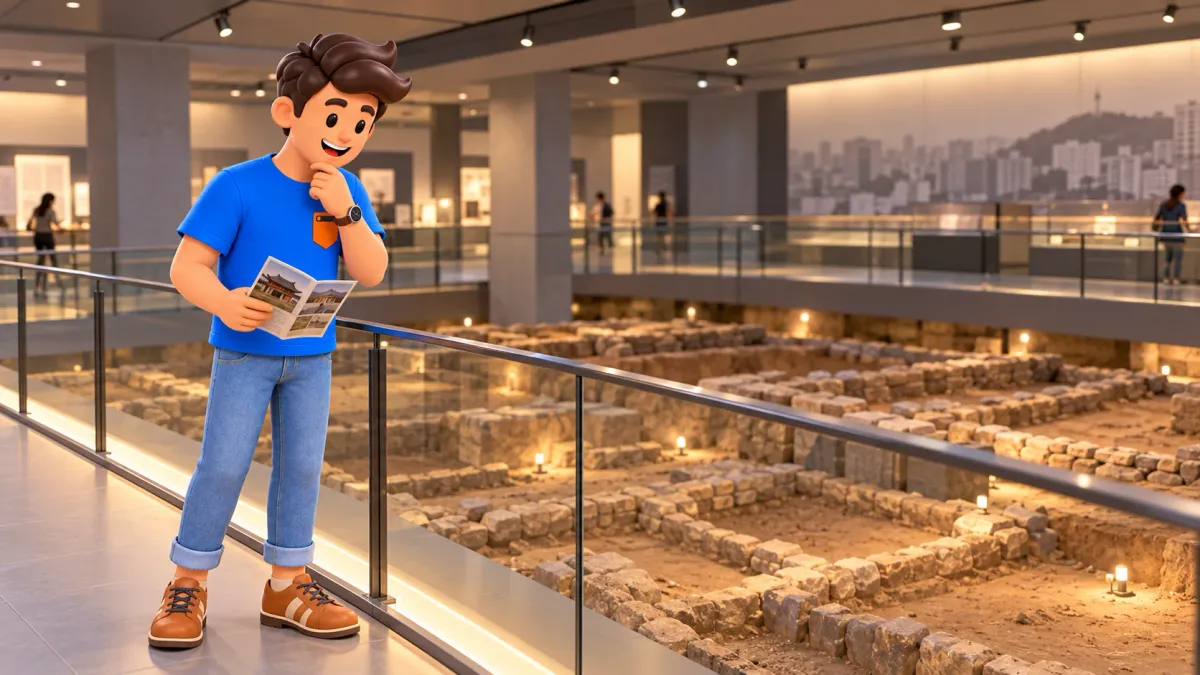
To see older Seoul beneath modern development, begin with Gongpyeong Historic Site Museum below Centropolis and add Gungisi beneath the new City Hall if you want to continue. The first concerns houses and alleys, the second traces of a state weapons office. They are separate indoor museums on basement levels, linked by an ordinary walk at street level. Allow three to four hours for selected viewing, the connection and a pause. There is no promised underground tunnel or continuously covered route between them.
The interest lies in what fragments reveal, rather than a complete secret ancient capital. A low stone line can identify a house foundation, a gap between structures an alley, and overlapping remains different building phases. Modern buildings continue above these traces. That changes an impression of the centre: history belongs beneath everyday places of work, meetings and government as well as inside recognisable palaces. For a first visit, learning to read several relationships is enough.
Two descents into two different urban worlds
Gongpyeong helps imagine neighbouring houses, plots and passages. Gungisi turns attention towards state production and the administrative capital. Both concern where things were found as well as the objects themselves. Choose one hall for a short window or connect both in a half-day. Tuesday to Saturday, roughly 10:00–16:00, is a useful common daytime window under ordinary calendars. Travel between the buildings and a break form a distinct street-level part of the programme, rather than another continuous indoor exhibition corridor.
Connect these historical layers into a trip more conveniently with RoadMe: the app fully develops a personal route around your interests, dates and pace. Archaeology, architecture, walks and rest form a coherent plan that is easier and more effective to use in Seoul.
| Place | Main subject | What to observe |
|---|---|---|
| Gongpyeong, Centropolis B1 | Residential Hanyang | House foundations and alley lines |
| Gungisi, new City Hall B1 | State workshops | Building traces and changes to the site |
| Connecting streets | The contemporary centre | Building scale and present passages |
With less time, give Gongpyeong around sixty to ninety minutes or Gungisi forty-five to sixty minutes for selected viewing. These are editorial allowances, not compulsory tour durations or promises to study every cabinet. General admission is free, while programmes and commentary language need separate checking. Public visitor routes provide enough for an introduction: overall plan, one interesting fragment and a return to the whole.
Gongpyeong: house traces below a business complex
Gongpyeong Historic Site Museum, 공평도시유적전시관, occupies Centropolis’s B1 level. Its subject is the everyday city rather than ceremonial palace architecture. Where did a house stand, how did it meet another plot, and where did a small passage lead? Such questions turn foundations into a history of living. Follow a room boundary and see what joins it, rather than searching for the single most attractive stone. A fragment becomes more understandable when neighbouring structures and the movement between them enter the picture.
Excavations in 2014–2015 revealed 108 building sites, roads, alleys and more than a thousand everyday objects. Those figures describe discoveries, not the number guaranteed in today’s display. A sixteenth-to-seventeenth-century layer was particularly well preserved. The museum opened in September 2018, integrating archaeology into new development. A business address became a place to examine the layout of earlier Hanyang. The new city did more than replace the old: its design had to account for what investigation found beneath the planned construction.
How remains were preserved matters. The museum lies within the excavation site, but preparation included relocating and restoring some traces. Saying everything lies untouched exactly where it originally stood oversimplifies archaeological and conservation work. Preserved material, treatment, modern supports and reconstruction explain the place through different means. Distinguish these layers instead of treating every visible surface as equally ancient. Conservation itself becomes part of the city’s story and the development decision, making museum presentation something to understand rather than an invisible process behind the finished display.
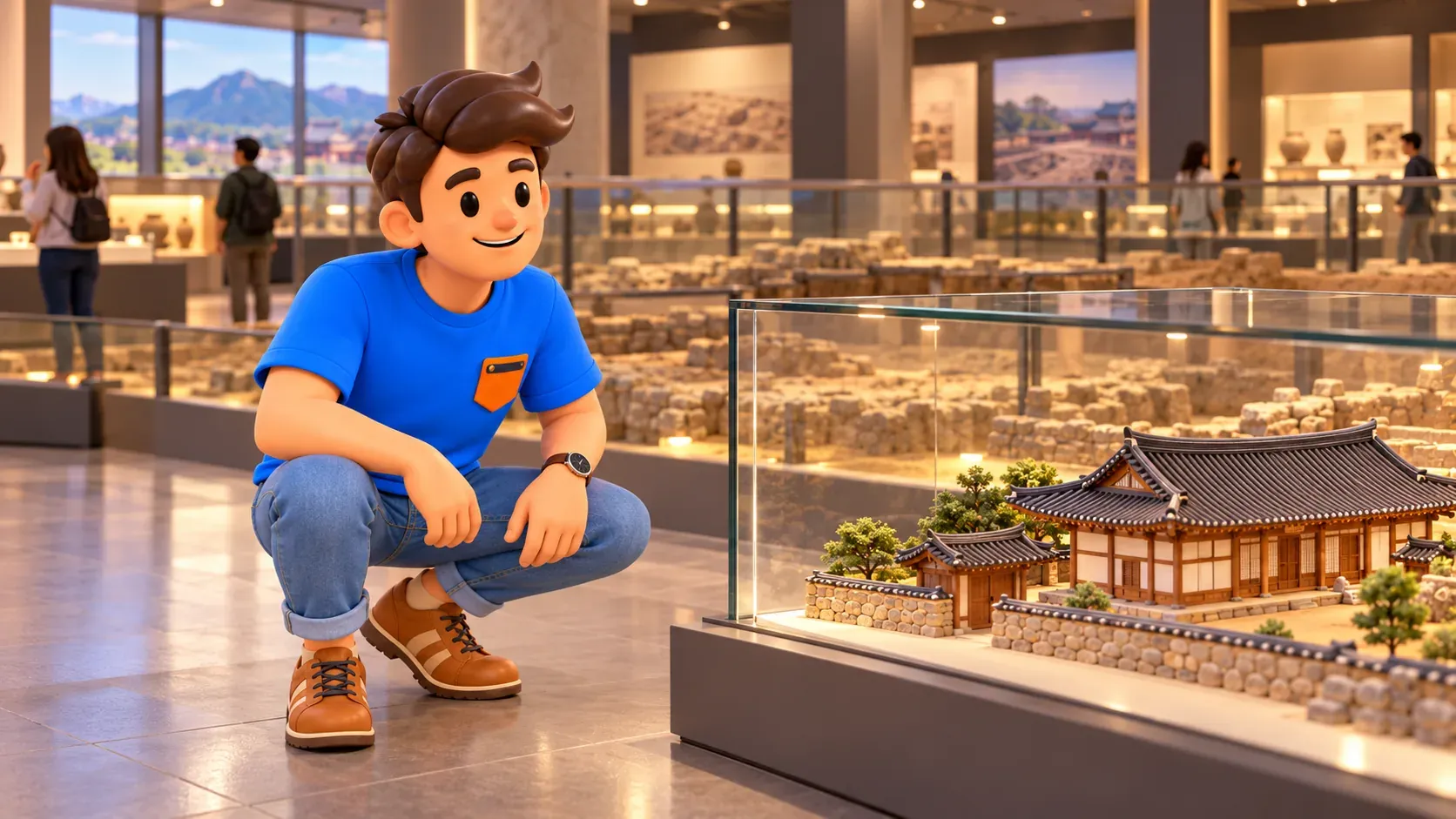
Compare a low foundation with a three-dimensional house model. The former shows an excavated trace; the latter helps imagine walls, timber structure and roof. Reduced and full-scale reconstructions do not make every rebuilt wall an authentic house surviving across centuries. The distinction enriches looking: evidence and its explanation appear together. Ask which understanding rests on stones and which becomes clearer through interpretation. A small model can therefore have considerable value without claiming the same material status as the remains that gave rise to it.
What an alley tells you
A passage line is one of Gongpyeong’s most useful subjects. It connects plots and shows a city made of relationships between houses. Imagine movement from a wider street to a narrow passage and then a courtyard. We do not know every actual walk made by a former resident, but layout supports a meaningful question about daily routes. Archaeology approaches ordinary observation of a current neighbourhood, where entrances, building corners and pavement width also direct movement, even when the architecture and available space differ substantially.
Choose two layouts and compare one feature: courtyard openness, room size or exit position. There is no need to infer a whole family’s wealth from a first impression. Interpretation helps when a stone outline is ambiguous. Slow comparison is more useful than inventing detailed biographies for unknown residents. A fragment’s value does not diminish because some questions remain unanswered. Instead, the difference between found material and a modern effort to imagine the life around it becomes visible, allowing curiosity to remain specific without pretending to certainty.
Getting to Gongpyeong
Use Jonggak on Line 1, Exit 3-1, then the museum entrance at Centropolis B1, 26 Ujeongguk-ro. A basement level does not imply an expedition into closed infrastructure: this is a public exhibition with designated visitor movement. Regular hours are Tuesday to Sunday, 09:00–18:00, last admission 17:30; Mondays and 1 January are closed. Admission is free. Check a particular commentary language or activity separately, without assuming every form of interpretation accompanies any unplanned arrival at the desk or the same time on every date.
After viewing, return to the current street and change scale for a few minutes. Glass facade, broad junction and people show another way of organising central ground. The return to the surface is a meaningful part of the outing. Exact alignment between every old alley and present pavement is not required; the city was rebuilt. Compare broader relationships between passage and building, private plot and public street, which continue to shape movement despite different architecture. The contrast can be observed without reconstructing a speculative street map.
Gungisi: the working layer of an administrative centre
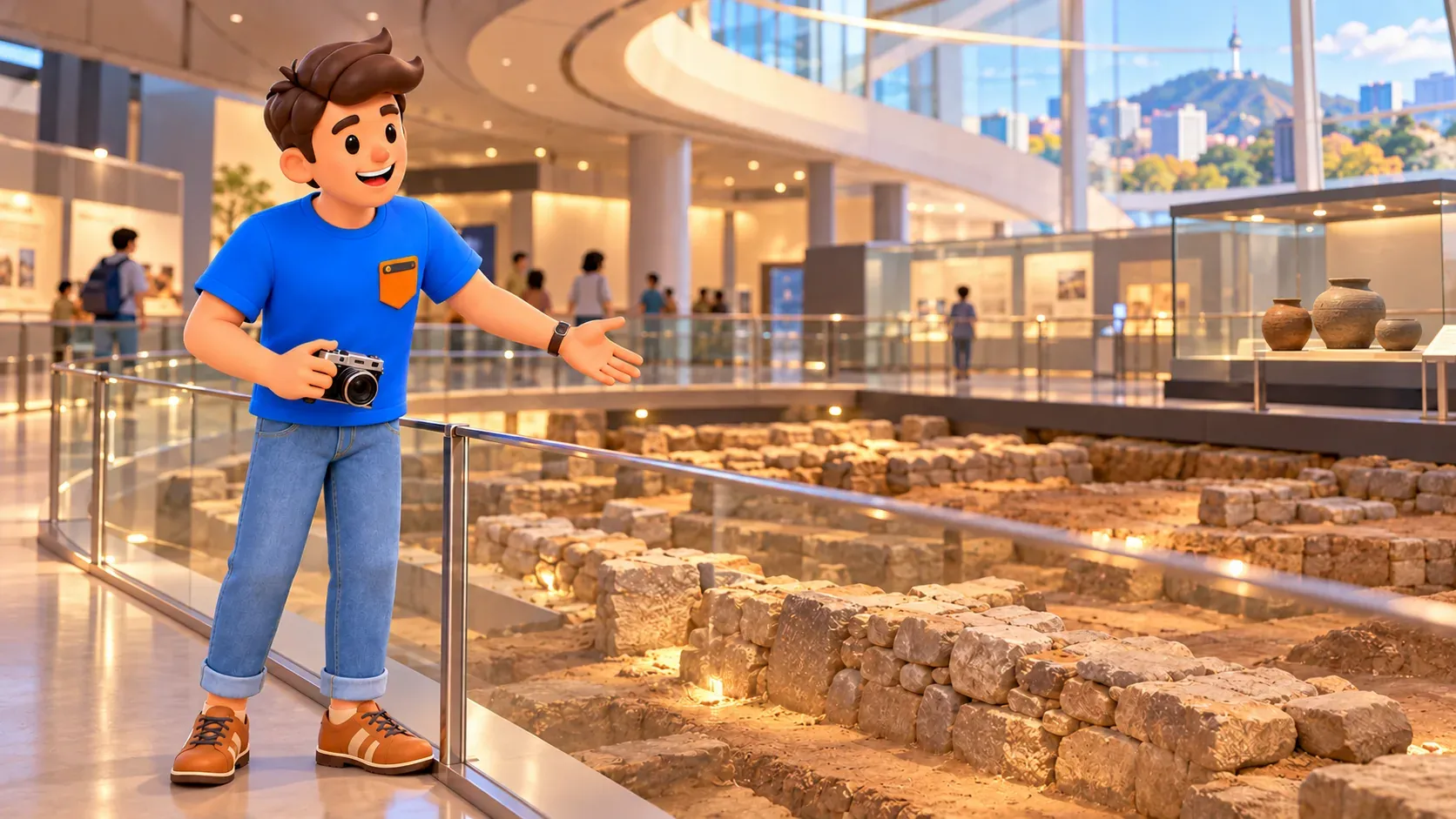
Gungisi Relics Exhibition Hall, 군기시유적전시실, is on B1 of the new Seoul City Hall. Construction revealed building remains and stone-reinforced areas associated in part with Joseon’s office for manufacturing and storing weapons. This differs from Gongpyeong’s residential alleys. State production required land, buildings and organised work. An object matters beside material traces of the institution rather than as an isolated curiosity. The compact hall provides a view of the administrative capital through a working environment, a different subject from grand ceremonial architecture.
The official excavation description records 45 remains and 590 objects from cultural layers spanning early Joseon to modern times. These totals concern investigation rather than every item currently available to visitors. Do not combine all traces into one historical moment: the site changed through rebuilding. Compare line heights, masonry directions and how structures meet. Labels help explain a sequence when the eye initially sees only several low stone rectangles at different levels. Small differences can reveal more about change than a single impressive object viewed without its context.
Weapons connect the site with its function, but the hall offers more than spectacular old equipment. Everyday finds and building decisions matter alongside them. Ask what a state institution needed to operate here: space, access and stable foundations become part of an answer. The City Hall above adds another relationship: today’s administrative centre preserves earlier traces of government tasks. This is spatial proximity, not a claim that exactly the same organisation operated continuously within an unchanged building. Distinguishing those ideas makes the connection more interesting and historically meaningful.
City Hall’s calendar and the exhibition’s calendar
City Hall on Lines 1 and 2 is the arrival reference. The hall itself is in the new building at 110 Sejong-daero, B1, with free general admission. A March 2026 reopening notice lists Monday-to-Saturday operation and closure on Sundays, 1 January, Seollal day and Chuseok day. Different institutional pages give conflicting evening hours. Our outing uses a straightforward 10:00–16:00 daytime window; a late visit needs the latest operator notice checked separately rather than borrowing hours from a neighbouring City Hall gallery.
Choose Tuesday to Saturday for both halls: Monday closes Gongpyeong, Sunday closes Gungisi. The connection uses ordinary public streets and surface crossings, depending on the chosen approach. Weather remains part of the day despite indoor exhibitions. Three to four hours with a pause is a comfortable idea, not a promise of a completely rain-protected route. If a short indoor visit without the connection fits better, either museum provides a subject of its own. The second can remain another day’s continuation instead of a requirement.
Distinguish trace, reconstruction and explanation
Ask three questions in either place. What was actually found? How was the material preserved and prepared for display? What helps imagine the lost three-dimensional form? Answers differ. Low masonry, a modern walkway and a house model perform separate tasks. Clear distinctions respect historical material and researchers’ work alike. A model is not useless because it is new; an ancient fragment need not look like an entire building to communicate valuable information. Seeing those differences helps you follow the exhibition’s reasoning rather than only its appearance.
Afterwards, sketch a simple outline in your own notebook: a foundation beside a possible upper structure. The exercise retains the difference between evidence and reconstructed image without replacing museum documentation. A verbal comparison works equally well. In a group, each person can choose one fragment and explain what it helped them understand. The outing stays shared and meaningful without competition over labels read or an attempt to memorise every construction phase.

What to notice back at street level
On returning outside, find an ordinary passage between buildings and consider it as a material decision. Width, plot boundary and entrance position describe present use. This is a change of attention rather than a prediction of future excavations. Gongpyeong and Gungisi show history as more than major events: repeated arrangements of housing, work, access and boundaries also shape a capital. The familiar city becomes worth looking at again because you have seen how small traces of earlier decisions remain meaningful below it.
Continue that perspective within a convenient trip more easily with RoadMe: the app develops a complete personal plan around your interests and preferred rhythm. Archaeological stops, architecture, city walks and rest receive suitable places in the programme, helping you use time more effectively.
Keep one idea from a first outing: a city exists in height and through depth of time. Beneath a modern building, a modest fragment can change understanding of a whole neighbourhood without preserving a complete secret street. Begin with Gongpyeong’s residential setting or Gungisi’s working environment, adding the other according to time and interest. Descending one basement level then becomes a way to see present Seoul more carefully after returning above, rather than a search for an underground sensation.