
Who guards Seoul’s royal tombs? Reading the stone figures

The figures around Seoul’s royal tombs are more than generic stone guards. Civil officials, military officials and animals form a symbolic setting for the ruler. Clothing, position and direction help explain the space. For an introduction, choose Seolleung in Gangnam and allow one and a half to two hours for selected observations from public paths. There is no need to tour several complexes or approach every statue. Begin with the relationship between grassy mound, rows of figures and ceremonial approach, then examine a few visible differences.
Look at the whole scene before faces. Where is the mound? Which forms are human and which animal? Who faces an approach, and who looks outward from the burial area? This sequence helps a figure’s role emerge. A tightly cropped photograph may turn a statue into an amusing character. In its setting, the same sculpture belongs to royal memory and an ordered world around the deceased. The subject is the representation of authority, service and care through stone, rather than a collection of unrelated ornaments beside a patch of grass.
Start with one tomb and four questions
Choose an accessible part of Seolleung rather than attempting a sculpture census. Consider human figures, animals, a tall pillar and an object resembling a stone lantern. What connects them, and how do their roles differ? If a detail is distant, an overall view or history-centre explanation can help. Seolleung has a permitted path beside its burial mound, a particular viewing opportunity rather than unrestricted access around every mound in the complex. The scene can be understood from designated positions without entering protected ground among the sculptures.
Build this historical walk into a convenient trip with RoadMe: the app fully develops a personal itinerary around your interests, dates and pace. Tombs, museums, city walks and rest form a coherent programme that is easier and more effective to use in Seoul.
| Figure | First visible clue | What it suggests |
|---|---|---|
| Civil official | Long robe and ceremonial tablet | Courtly service |
| Military official | Armour, helmet and sword | Military protection and attendance |
| Tiger and sheep | Different silhouettes and postures | Symbolic setting around the mound |
| Pillar and lantern | Vertical stone forms | Organisation of burial space |
Learning every Korean term is unnecessary. First distinguish a courtly robe from armour, then an animal from an architectural object. That creates a small grammar of the place. Facial details stop appearing random because they belong to a particular figure type. You can ask the same questions at another tomb later, while expecting differences. Royal tradition developed over time, and individual monuments served different rulers and circumstances. A focused visit gains value from recognising those relationships rather than proving you have located every possible category.
An official with a tablet is not another soldier
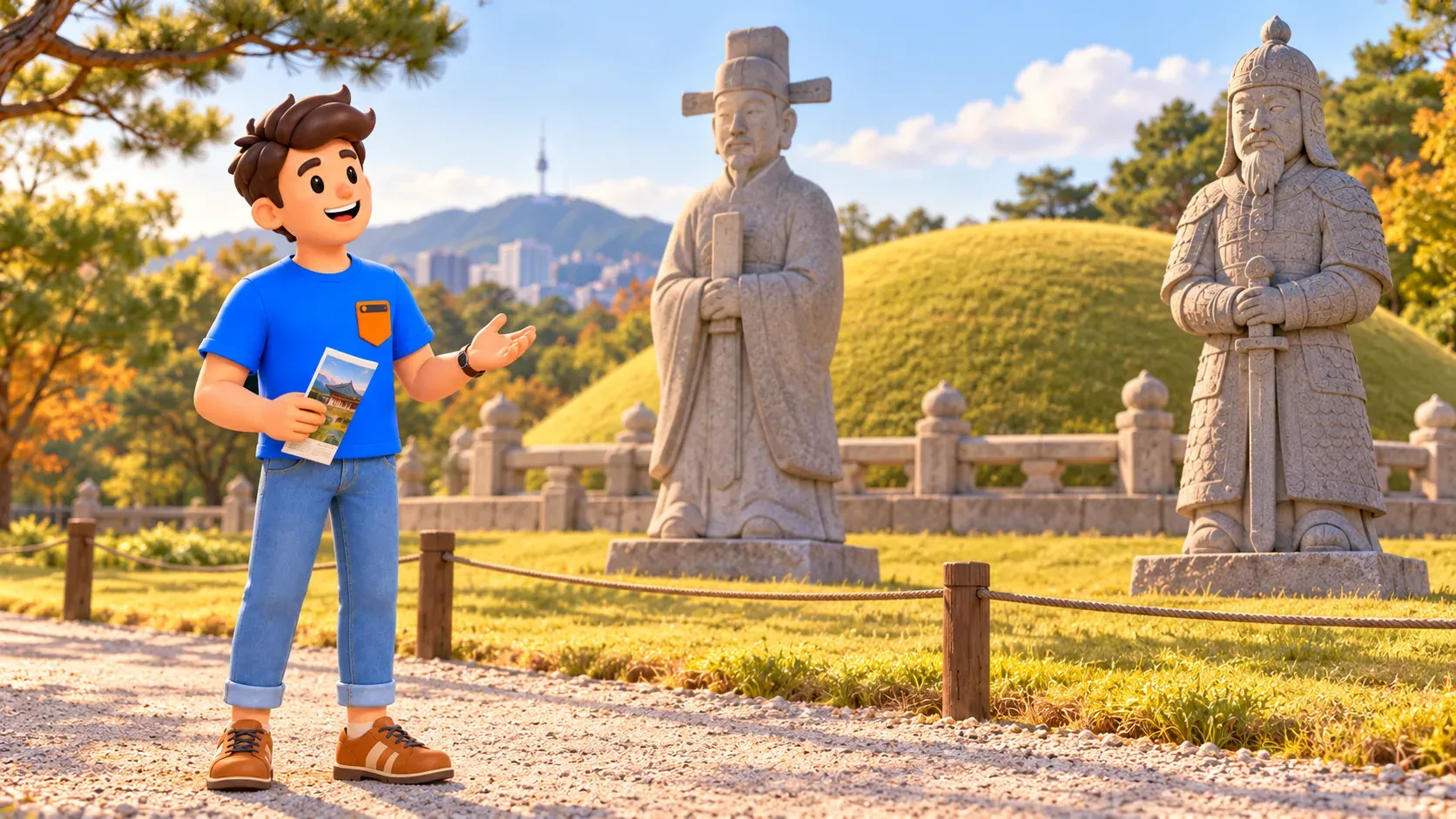
The civil figure, munseogin, represents an official in court dress. Look for headgear, long robe, belt and the narrow ceremonial tablet held before the body. The object belongs to the official’s appearance, rather than being an arbitrary board. The figure communicates attendance and order instead of an attack. Calling all the surrounding humans stone warriors therefore loses an important distinction. Different aspects of a ruler’s world are represented here, and civil service has a role of its own within the arrangement around the burial place.
The posture is usually restrained. Hands gather before the body, clothing establishes vertical lines and the head stands out within the whole volume. Notice how recognition works without movement. This need not be a portrait of a particular named official. Type, status and function may matter more than individual biography. Faces are not necessarily identical, however: proportions, expression, folds and treatment of edges changed. Small differences make the sculptures rewarding even for a visitor who has no intention of studying the detailed history of every royal reign.
The military official: clothing changes the presence
The military figure, museogin, is recognisable through helmet, armour and sword. A more substantial appearance emphasises the military role. Compare shoulders and body outline with the civil official’s long robe. The main distinction appears before small surface patterns. A sword belongs to the image of military attendance on the ruler; it does not establish that a battle happened at the tomb. The sculpture conveys strength without an action pose or a scene of fighting. Its stillness participates in the ordered setting rather than making it a battlefield illustration.
Compare types in a consistent sequence: overall outline, headgear, hands and object. Do not begin by guessing an emotion from the face alone. Clothing and attributes often explain the role more clearly. Different periods brought changes in proportions, helmet details and expression. Some features also persisted for a long time, so a nose or bent arm does not confidently date any statue. Observation becomes more useful when a visible difference remains a question to investigate rather than immediately turning into an overly certain historical conclusion.
Tigers and sheep do not merely face visitors
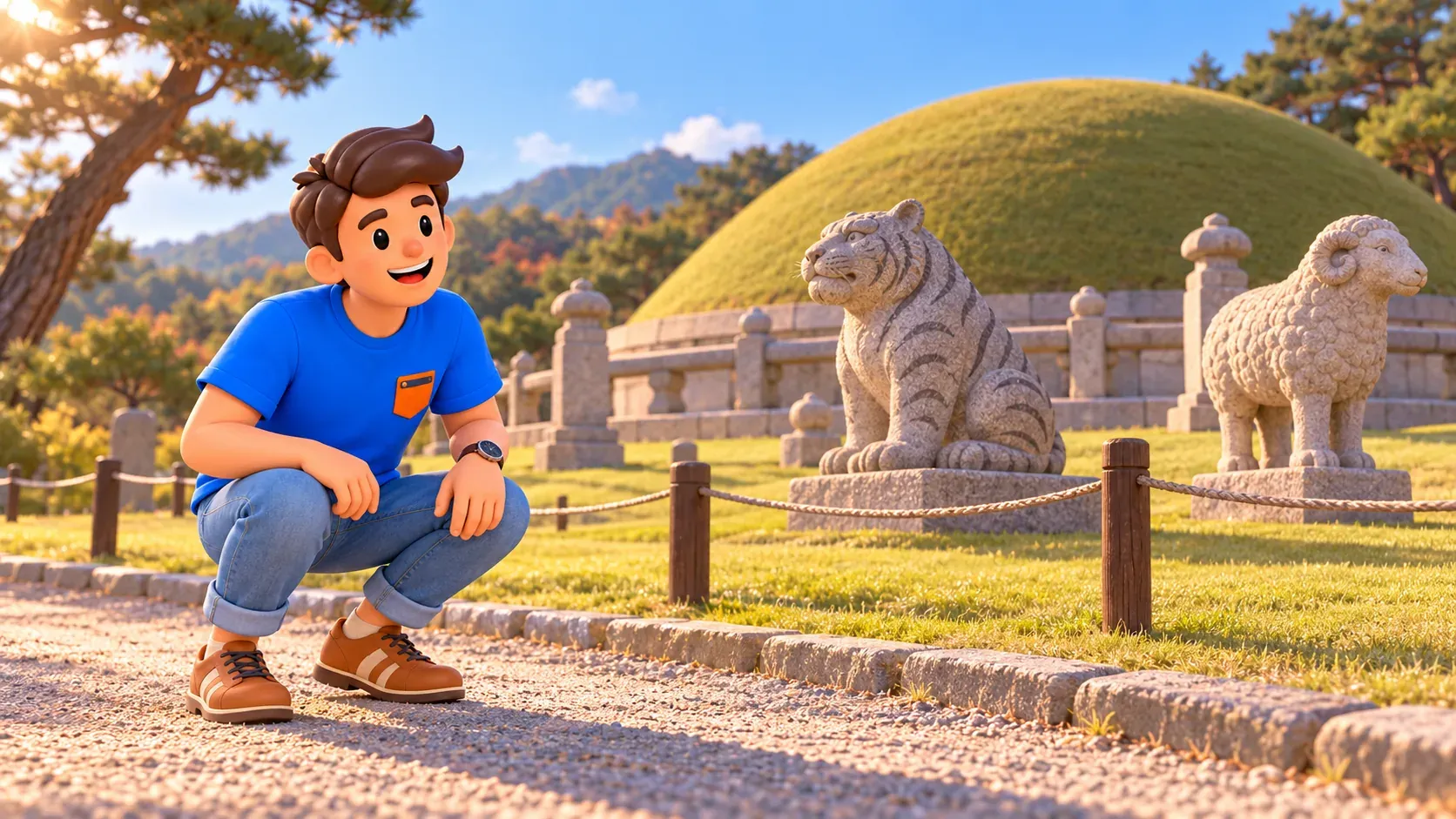
Stone tigers and sheep usually stand around the burial mound facing outward. They contribute to symbolic protection and a balanced surrounding order. Their presence is not evidence of live wild animals kept at the grave. Nor should you expect a naturalistic zoo: sculpture uses recognisable conventions. A tiger is often seated and a sheep standing, with different outlines visible before fine details. Identify posture through body and legs, then look for head and direction. The image can remain legible from some distance, which makes close contact unnecessary for this comparison.
A tiger need not appear frightening in a modern sense. A large head, compact body and stylised expression can suggest quite different associations to a visitor. Allow the historical role to come before a personal impression. The sheep is not an accidental decorative contrast beside it. Different animals participate in one symbolic system. Avoid treating every form as a puzzle with a single easy everyday answer, however. Position and the particular tomb arrangement matter more than a witty caption attached to an isolated photograph with its surroundings removed.
Stone horses appear with human figures and extend the idea of attendance. Do not turn the outing into a hunt for an obligatory complete animal set. Relationships are more useful: what belongs near the mound, what accompanies an official, where pairing recurs. If some sculptures are not visible from the permitted route, the composition can still be understood. Missing a close sheep portrait does not make the visit incomplete. The purpose is to read a place, rather than collect photographic proof that every detail has been inspected at maximum proximity.
Why a pillar and lantern matter too
Mangjuseok stone pillars help mark and organise the burial area. Their verticals contrast with the low rounded mound. Some include small carved animals, but their precise meaning is not sufficiently settled to present every popular story as established fact. Notice the distinction between what is visible and what remains interpretation. An intriguing detail does not require an immediate dramatic legend to deserve attention. Seeing its position relative to mound and neighbouring objects already adds something useful to your understanding, even when a fuller explanation remains open.
The jangmyeongdeung resembles a stone lantern and has a symbolic role within the ensemble. A historical description allows a possible lighting function in an early phase, yet most examples show no evidence of burning. Saying that these lanterns always illuminated the tomb every night would therefore be more certain than the evidence permits. Modern lighting is a separate issue. Look instead at support, stone cap and middle section. The object remains interesting without a promise of flames during a present-day visit or a fictional account of continuous ancient use.
Stone also records the work of craftspeople
These figures required substantial labour as well as an idea. Granite had to be quarried, carved, transported and set in a chosen location. Uigwe records of ceremonies and associated work help researchers examine that organisation. In front of a finished sculpture, it is easy to overlook the practical history. Notice the block’s volume, transitions between head and body and depth of clothing folds. Material and technique matter when a heavy mass becomes a recognisable human or animal presence. The sculpture is also an outcome of coordinated making.
Surface changes perception. Light picks out some lines and softens others, while distance gathers details into a simple outline. Do not infer an exact workshop without supporting interpretation. Compare two visible elements using one criterion, perhaps sleeves or treatment of the head. This needs no touching and offers more than a quick glance at a row. A sculpture becomes a sequence of choices, rather than an anonymous stone accessory to any old burial.
Why the figures are not identical everywhere
Royal tombs followed traditions for arranging stone objects, but these were not an unchanging diagram for all centuries. Scale, details and organisation developed. The transition to imperial status in the late nineteenth century introduced further changes: Hongneung and Yureung in Namyangju differ in animal selection and sculpture placement. These are separate places, not stops within today’s Gangnam walk. The comparison demonstrates historical development rather than an instruction to visit two more complexes immediately. A small set of differences is enough to challenge the idea of one universal sculptural arrangement.
Even within one larger complex, distinguish the person associated with a particular mound. Seolleung concerns King Seongjong and Queen Jeonghyeon; the neighbouring Gangnam Jeongneung belongs to King Jungjong, Seongjong’s son. Do not confuse it with Queen Sindeok’s Jeongneung in another Seoul district. Names, family relationship and location provide a useful foundation for further interest. For an initial walk, choose one ensemble instead of making similar statues evidence of an identical history. The setting becomes more memorable when a specific royal story and a specific place remain connected.
Plan a calm visit
Use Seolleung station on Line 2 and Suin–Bundang, Exit 10, then public streets to the entrance at 1 Seolleung-ro 100-gil. Grounds admission follows the complex’s rules. Monday is normally closed; if it coincides with a public or substitute holiday, opening is possible and closure moves to the first following non-holiday. Hours vary by season. A daytime window around 10:00–16:00 provides a useful basis for selected observations and leaves a margin before winter last admission. Check the relevant date and accessible areas when arranging the outing.
One and a half to two hours is an editorial allowance with walking and a pause, rather than every burial and every history-centre display. Begin with ceremonial approach and overall view, then use permitted positions at Seolleung. If the history centre is open, add one explanation of a figure you noticed. On the return, consider the whole ensemble again: details change how it reads. A close detail and a wide view together can explain both a character’s appearance and its place within the wider ordered landscape.

Continue exploring royal history more conveniently with RoadMe: the app develops a complete personal route or trip plan around your interests and preferred rhythm. Historical sites, modern districts and rest become a coherent programme that helps you use time more effectively.
Afterwards, the word guards has a wider meaning. Warriors are only part of the setting: officials, animals and stone forms create an order of remembrance around the mound. Distinguish a few roles and see them together. The next royal tomb can then become a new historical ensemble rather than another grassy rise with apparently identical stone characters.


