
Seongbuk-dong in Half a Day: Houses, Literature and Gilsangsa

Give Seongbuk-dong a relaxed four to five hours: visit art historian Choi Sunu's house, climb to the literary home Simujang and finish at Gilsangsa Temple. These three places connect architecture with personal choices about living, preserving and paying attention. They make a meaningful outing without collecting a large number of museums.
Hansung University station on subway Line 4 is the starting and returning transport anchor. Slopes and separate climbs lie between the stops, so this is not a flat city circuit. The full version with Choi Sunu House normally suits Tuesday to Saturday from April to November, subject to a current notice check. Winter, Sundays and Mondays call for a shorter version.
Three places rather than the whole district
Seongbuk-dong combines houses, greenery, literary memory and small cultural venues. There are many possibilities, but proximity on a map does not establish matching access or brief connections. Choose three anchors for a first visit and leave time to understand each. Exhibitions, private villas and separately reserved museums can have another day when they become the principal interest.
Preparing this walk is much more convenient with RoadMe: the app develops a complete personal plan around your interests, dates and pace. Hanok, literature, temple visits and rest receive suitable places in a trip programme that is easier and more effective to use on the ground.
| Part | Approximate allowance | Focus |
|---|---|---|
| Choi Sunu House | 35–45 minutes | Courtyard and preservation |
| Simujang | 30–45 minutes | Literature and a modest home |
| Gilsangsa | 45–60 minutes | A donation and quiet observation |
| Connections and orientation | 60–90 minutes overall | Hillsides and public approaches |
| Pause | 30–45 minutes | Cafe or rest |
These are editorial estimates, not on-site measurements. Accommodation travel and a full lunch are additional. If hillside movement is tiring, a short taxi connection towards the temple can preserve energy for the visit itself. It is an option rather than a compulsory part: weather, stamina and a practical pickup place determine the choice.
Choi Sunu House: taste on an everyday scale
From the station, follow a public urban approach to the house, saving its Korean name 최순우 옛집. A small turn can be missed if you only watch the broad street scene. Begin after a confirmed opening rather than arriving too early merely to satisfy the first item on a list. A small cultural property has its own working day.
Choi Sunu was an art historian and director of the National Museum of Korea. He lived in this hanok from 1976 to 1984. The house dates to the 1930s, so the experience concerns more than a generalised ancient Korea: traditional form remained a personal domestic setting in later times. A modest courtyard brings everyday living and reflection on art into the same close scale.
Relationships between elements are more interesting here than luxury. How does a timber room edge meet the court? Where does the eave create shade? What appears through a doorway? Choose one permitted position and spend a few minutes observing proportions. Such attention suits the story of a man who helped other people recognise the qualities of Korean artistic culture.
The house survived through civic initiative and donations. Its story therefore concerns both a resident and a public decision to protect a small place of memory while the city changed. A preserved home does not need palace dimensions to matter. Its domestic scale helps explain why an individual's surroundings can become shared heritage, with meaning beyond the biography alone.

The seasonal calendar shapes the beginning
The house has a winter closure and usual Sunday and Monday closing days. Reference listings disagree on the end of the visiting day, so consult the latest notice before going. For this route, a morning after opening is more sensible than relying on the final minutes. Special activities may have their own arrangements and cannot be assumed to follow ordinary access.
If it is closed, do not present a glance through a fence as the promised visit. Remove this block, retain Simujang and Gilsangsa, and begin later or allow more rest. One closed house does not make the entire neighbourhood unavailable. Accept the seasonal adjustment in advance so that the outing remains pleasant rather than organised around disappointment at a gate.
Inside, observe marked boundaries. An open courtyard does not mean entry to every room, and an attractive tree or object is not there to be touched. If a platform is open, follow the local footwear rule. Access can differ between neighbouring houses despite similar traditional construction. Look for the instructions belonging to the place you are actually visiting.
To Simujang: a literary story with a climb
The next destination is 심우장. Return to a public urban route and use a current walking map for its signed approach. A straight line between map pins ignores fences, residential plots and steps. Expect an ascent on the final section. A short pause is more useful than rushing to match a table's estimate. The geography is part of the outing rather than empty time between attractions.
Han Yong-un, known as Manhae, lived at Simujang from 1933 until his death in 1944. He combined the roles of Buddhist monk, poet and independence activist. The home gives that history a personal scale: a small dwelling with a limited set of rooms rather than a large ceremonial ensemble. You do not need an extensive literary background to understand the difference.
Its name refers to the Buddhist image of searching for a lost ox, used to explain a path towards enlightenment. This offers a simple interpretive anchor: searching and inner work rather than a display of status. A visitor can notice how the restrained home differs from expectations of a grand memorial without first mastering the resident's complete biography or every aspect of his thought.
The hanok faces north. A central timber hall sits between a living room and kitchen. From an accessible place, consider how several functions fitted beside one another. Do not treat every present-day detail as an untouched personal possession. The historic house now serves as a place of memory and heritage care as well as evidence of former domestic life.
Spend a few minutes with the available interpretation. If Korean text is difficult, retaining the name, years of residence and meaning of the house name is enough to begin. Room size, court and tree shade then connect to a particular story. The visit needs neither a long lecture nor identical literary preparation from every member of the party.
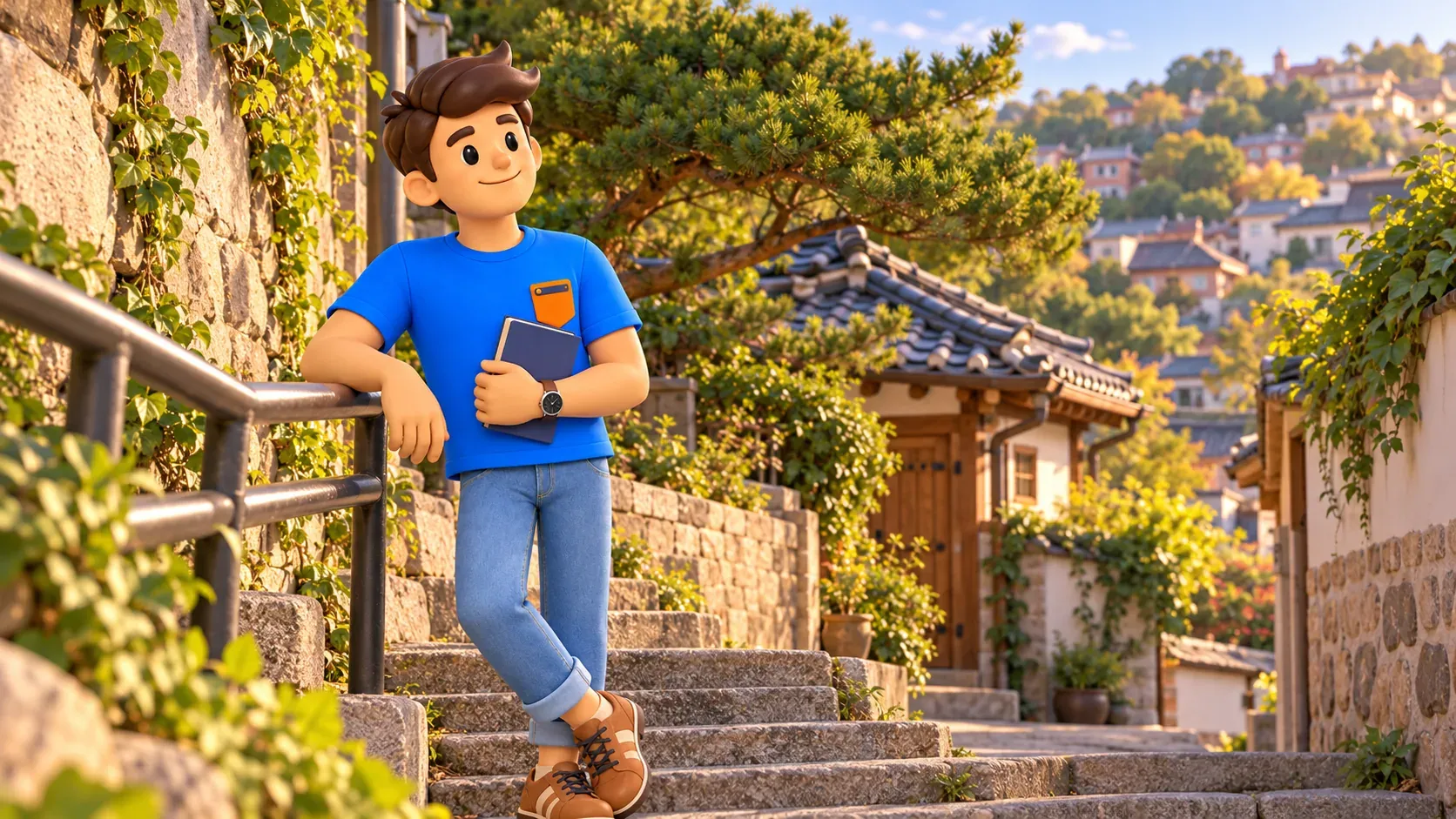
Residential streets between cultural stops
Seongbuk-dong remains a residential district. A small house behind attractive gates does not become public property because it has an old roof. Stay on public streets, avoid looking through windows and leave residents room to pass. On narrow sections, keep the group compact and move conversations or photographs to a place where they do not obstruct ordinary movement.
Do not automatically add the city wall climb and every upper lane. They change both effort and duration. Simujang and Gilsangsa have a separate urban connection, not a flat path inside one museum park. If a map suggests a short staircase route, consider whether it suits the party before accepting it. A line that saves distance can still increase difficulty.
A cafe can fit between house and temple or follow the temple visit. Choose a suitable open place with seats rather than making a famous teahouse compulsory without checking its arrangements. A drink and snack are one pause; a full meal needs more time. Carry water for the climbs instead of assuming every desired stop will immediately provide a comfortable break.
Gilsangsa: a temple created through a gift
Gilsangsa opened in 1997 on the site of Daewongak, a well-known establishment with traditional buildings and a garden setting. Kim Yeong-han donated the property for its transformation into a Buddhist temple. The story connects to monk Beopjeong and his teaching on non-possession. This particular decision explains the ensemble more usefully than imagining an ancient monastery unchanged through centuries.
Observe how a former estate-like environment became a religious one. Smaller buildings, trees and paths need not repeat the composition of a large temple conceived as a single monumental project. Choose a permitted quiet route and notice the greenery linking individual spaces. The relationship between setting and changed purpose is one of the distinctive rewards of a visit.
The temple nevertheless functions primarily as a religious place. Speak quietly, give worshippers space and stay out of closed halls. Interior photography, footwear and room access follow local instructions. A quiet visit to an open area does not automatically entitle you to join a practice or attend every ceremony. Respecting that distinction makes room for the temple's actual daily life.
Meditation programmes, temple activities and special events require separate checks and time. Do not assume spontaneous participation, complimentary food or a conversation with a monk because someone else described such an experience. An ordinary visit is sufficient: the donation story, buildings among trees and calm observation already provide a clear and meaningful conclusion to the route.

Keep the hillside pace comfortable
Wear shoes suited to urban slopes and watch the condition of steps. After rain, in snow or on ice, the shortest route may be a poor choice. For reduced mobility, ask about particular entrances and available areas at each property. A taxi reduces part of the urban effort but does not remove every internal change of level or historic threshold.
Connecting these conditions with the whole journey is easier with RoadMe: the app prepares a personal programme around your interests and a comfortable pace. Cultural stops, other districts and rest work as one trip plan rather than a set of obligations on an overloaded day.
At the temple exit, confirm the current stop and direction for local bus Seongbuk 02 towards Hansung University, or choose another verified return. The route number alone is insufficient: the correct side of the road and direction matter. If tired, finish calmly instead of adding another museum merely because its marker looks close. A manageable return belongs to the day's planning.
What the walk leaves with you
Choi Sunu House reveals attention to beauty and civic preservation; Simujang joins literature to a personal living space; Gilsangsa shows property given a different purpose. The stories differ, yet human decisions connect them within one neighbourhood. Three focused visits can reveal more meaning than a hurried sequence of exterior facades, while leaving room for your own observations.
For another encounter with traditional homes, choose Namsangol in two hours. For a different mood, consider Seoul Forest and Seongsu. Give each programme its own time. Quiet Seongbuk-dong is easier to remember when the final stop is not followed by an immediate rush towards another obligation.


