
Sant Andreu in half a day: a park, a factory and Casa Bloc

Spend a morning in Sant Andreu following three connected ideas: a truck factory turned into a park, a textile complex now telling the history of work, and an experiment in better everyday housing. Allow approximately four hours, from 10am to 2pm, on an ordinary Tuesday to Sunday. The main stops are Parc de la Pegaso, MUHBA Fabra i Coats and an exterior look at Casa Bloc.
Begin at the historic park entrance on Carrer de la Sagrera, 179. Finish on the public pavement beside Casa Bloc, around Passeig de Torras i Bages and Carrer de l’Almirall Pròixida. This is a one-way walk, with no return to the start included. The schedule is a planning estimate, excluding travel from your accommodation, a full lunch and the Casa Bloc apartment tour. Visiting conditions were checked on 17 October 2026.
A half-day with a clear thread
Give the park about 45 minutes, then allow 30 minutes to reach Fabra i Coats. From approximately 11.15am to 12.45pm, explore the accessible factory setting and spend around an hour on a selected museum theme. Another 30-minute street connection brings you to Casa Bloc. Divide the remaining 45 minutes between the building’s exterior and a short rest before finishing.
The connection is more interesting than a checklist: Barcelona makes things, changes the use of industrial land and experiments with how people live. Three stops are enough to follow that story. Trying to cover every landmark in the district would dilute it and remove the unhurried street time that gives this morning its character.
If industrial heritage and everyday architecture appeal to you, give those interests to RoadMe: the app creates a personal trip plan around your dates, pace and budget. A day-by-day plan is easier to arrange and use on holiday than separate lists of walks, museums and neighbourhood ideas.
Here, Sant Andreu means the wider city district, not just the historic neighbourhood of Sant Andreu de Palomar. Parc de la Pegaso is in La Sagrera; the walk then continues towards Sant Andreu’s older core. Remember that distinction when choosing where to arrive: Casa Bloc is the finish, not the intended starting point.
Choose a museum day and start at ten
Under its ordinary timetable, MUHBA Fabra i Coats opens Tuesday, Wednesday, Thursday and Sunday from 10am to 2pm; Friday and Saturday hours are 10am–7pm. Last admission is 30 minutes before closing. A 10am park start leaves room to reach the museum well before its shorter days end. Monday does not suit the full version of this itinerary.
The museum closes on 1 January, 1 May, 24 June and 25 December. Check the chosen date and the institution’s notices before leaving. Public holidays and special events can change an otherwise sensible plan. Friday and Saturday offer more afternoon flexibility if you discover that the museum deserves longer than the suggested hour.
Do not apply one institution’s hours to the entire factory site. Several organisations use Fabra i Coats, and an open gate does not establish admission to every interior. This route includes one MUHBA visit, rather than a promise that the whole cultural complex can be explored whenever its outdoor areas are accessible.
Parc de la Pegaso: where the trucks were made
The park’s name recalls the Pegaso trucks produced by ENASA. Its former factory site retains the historic gateway and an office building, useful reminders that the greenery occupies land once organised for production. Look for the relationship between those surviving elements and the park rather than expecting an outdoor display of historic vehicles.
Opened in 1986, the park was designed by Enric Batlle and Joan Roig. Planting, a water channel, small bridges and changing pockets of enclosure give it a different rhythm from the surrounding streets. Choose an open path through the greenery and pause at a bridge without blocking the crossing. The first stop should ease you into the morning.
You need not identify every tree to appreciate the transformation. Notice where paths curve around planted areas, where surrounding homes come back into view and how the water shapes movement. A former industrial site now accommodates walking and resting. That change in ordinary use is the historical point, even without a long catalogue of factory facts.
The municipal timetable lists 7.30am to approximately 9pm from April to October, and until 7pm from November to March, with closing related to dusk. The suggested morning comfortably avoids the evening limit. Photographs of jets or full water features do not guarantee their operation on your date. Decorative water is not a swimming area.

Follow the streets to Fabra i Coats
Leave the park by an available public exit and follow the street connection towards Gran de la Sagrera, Gran de Sant Andreu and Carrer de Sant Adrià. The factory complex’s address is Sant Adrià, 20. Allow around 30 minutes, including crossings and locating the signed visitor entrance. That is an allowance, not a measured walking time.
Use pavements and marked crossings rather than looking for a straight line through private courtyards, railway land or construction areas. There is no need for a secret shortcut. The public streets are part of the experience, showing how former production sites sit among housing and neighbourhood businesses rather than in an isolated heritage enclosure.
A quick water stop can fit the connection; a substantial breakfast needs extra time. If you linger in the park, reduce optional pauses instead of banking on admission just before the museum closes. Finding the entrance, understanding what is on display and waiting if necessary all take part of the visit allowance.
Read the factory before going inside
Brick walls, repeated windows and long building fronts make the factory’s scale immediately legible. Take in the whole composition from an accessible public area, then choose a detail: a window rhythm, a tower or the meeting of two volumes. The architecture rewards that change of scale without requiring a circuit of every building.
The Fabra i Coats name recalls the 1903 merger involving Fabra and the Scottish Coats company. The museum follows the factory’s history from 1903 to 2005. Those dates describe its historical narrative; they do not mean every surviving structure was built in 1903 or that today’s cultural uses occupy rooms exactly as the textile business did.
Allow roughly half an hour of this 90-minute stop for the exterior setting and the museum approach. Stay within areas open to visitors. An attractive industrial building may still contain working or service spaces. Its heritage appearance is not an invitation to open an unmarked door or enter a private workspace.
An hour in MUHBA: work beyond machinery
The museum occupies Nau F, also known as Fàbrica 10, the former thread-dyeing building. Its subjects include the factory, the exhibition Barcelona, City and Work, and a collection reserve. With an hour, choose a main line of interest and examine a few objects closely. A large collection does not mean every item is displayed or can be absorbed in one visit.
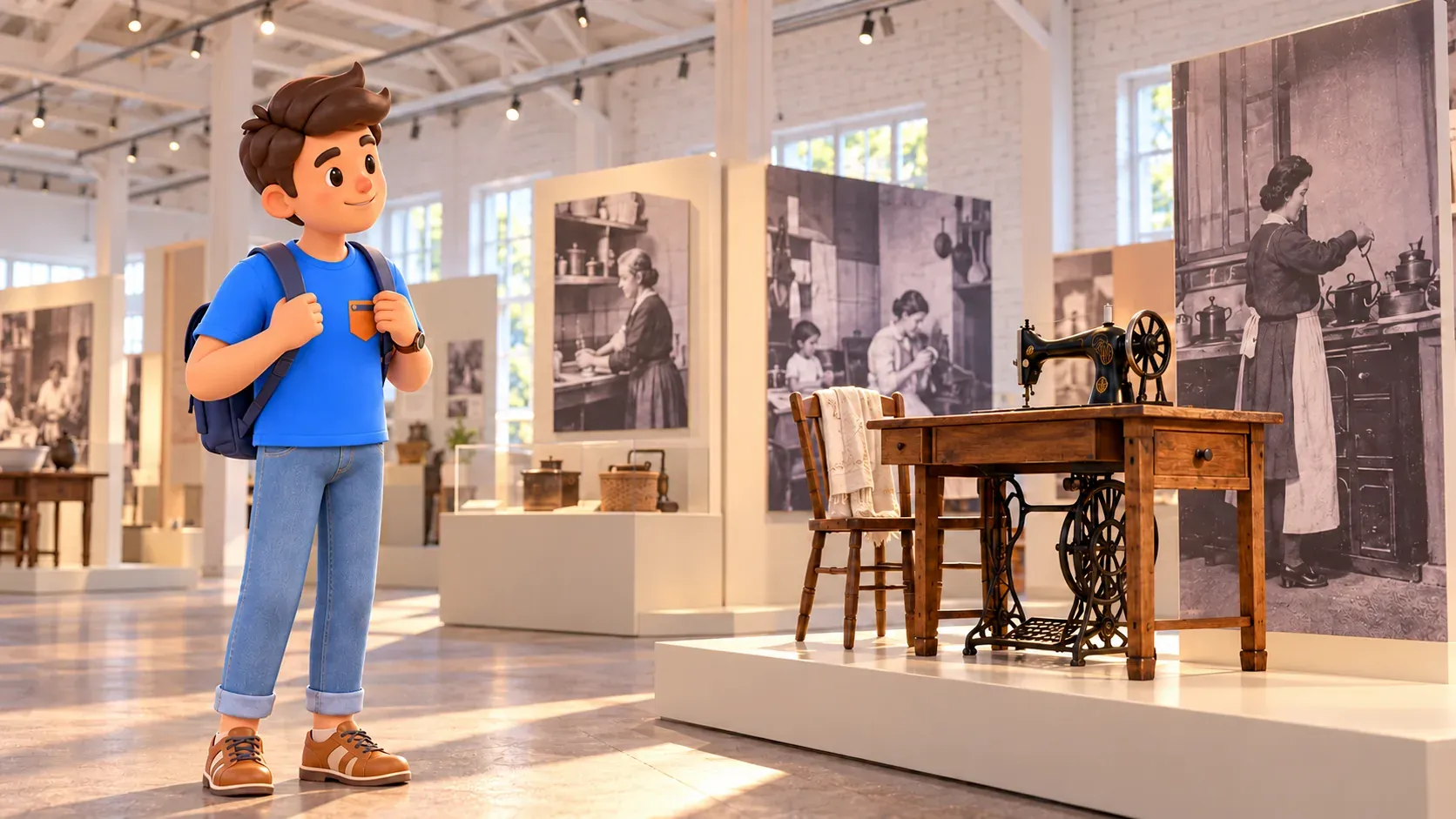
The most useful shift is to consider work beyond large machines. Domestic labour, care and services also belong to the story of how a city functions. Everyday objects can reveal time, skill and effort that a monumental factory façade cannot convey by itself. This makes the museum relevant even if textile technology is not your main interest.
At the check date, MUHBA’s main page lists independent admission as free. Organised visits and special activities have their own conditions; free entry does not promise an on-demand guided tour. Older pages may retain a temporary-closure notice or a previous tariff. Use the museum’s current information when making the final decision for your date.
One important limit remains: the Sala de Calderes, or boiler room, is currently unavailable to visitors. Do not include it in this morning or treat an image of restored equipment as proof of access. Inside the museum, respect display boundaries too: an old sewing machine or worktable may be a collection object, rather than something intended for hands-on use.
The art centre is a separate visit
La Fabra contemporary art centre also occupies the complex, but it is a different institution from MUHBA. Its ordinary September–July hours are Tuesday–Saturday, noon–8pm, and Sundays and public holidays, 11am–3pm; it closes in August. Its changing exhibition programme should be checked separately rather than inferred from the museum visit.
A second interior is not included in these four hours. If contemporary art matters more to you, reshape the morning around the centre and its current exhibition. If you want both institutions, extend the factory stop and reconsider the Casa Bloc finish. Being on the same site saves some movement, but not the time needed to engage with another exhibition.
For a trip that balances museums with neighbourhood walks, try planning in RoadMe. It develops a personal itinerary around your interests and pace, making the sequence of days more convenient to organise and follow during your stay.
Casa Bloc: a different idea of home
Continue along public streets through Carrer del Segre and the Plaça d’Orfila area towards Passeig de Torras i Bages. Allow another 30 minutes. Casa Bloc is the final architectural stop, viewed from the public pavement. Residential galleries, stairs and restricted spaces are not visitor shortcuts or places to enter for a better photograph.
Designed in the 1930s by Josep Lluís Sert, Josep Torres Clavé and Joan Baptista Subirana, associated with GATCPAC, the complex addressed functional workers’ housing, light, ventilation and shared space. After Barcelona’s richly decorated central landmarks, it suggests another way of looking: ask how a building supports everyday life, rather than how much ornament it displays.
Notice the long horizontal lines, open galleries and portions raised on supports. These help explain its spatial ideas without making the entire residential complex a public museum. People still live here. Keep photographs focused on architecture rather than windows and domestic details. About 25 minutes provides a useful first exterior introduction.
The restored apartment 1/11 requires a separately booked guided visit. The ordinary individual tour is on Saturdays at 11am, lasts approximately 90 minutes and does not run in August. It overlaps with this route’s factory visit, so it cannot simply be added at the end. Choose a different order or another day if the interior is a priority.

Finish without turning the morning into a marathon
Use the final 20 minutes for a pause in a suitable nearby public place, then finish beside Casa Bloc. Lunch and the journey back come afterwards. In heat, shorten exposed sections and rest; in rain, reduce the park portion. Greenery does not guarantee continuous shade, and this overview does not establish a step-free route throughout.
For another day with an industrial past, consider the Sants and Hostafrancs walk with a park and metal dragon, in a different part of Barcelona. Today’s three changes already make a satisfying thread: manufacturing land becomes a park, a textile factory opens a conversation about work, and housing asks how architecture can improve ordinary life.


