Rome’s Talking Statues: Pasquino and Madama Lucrezia
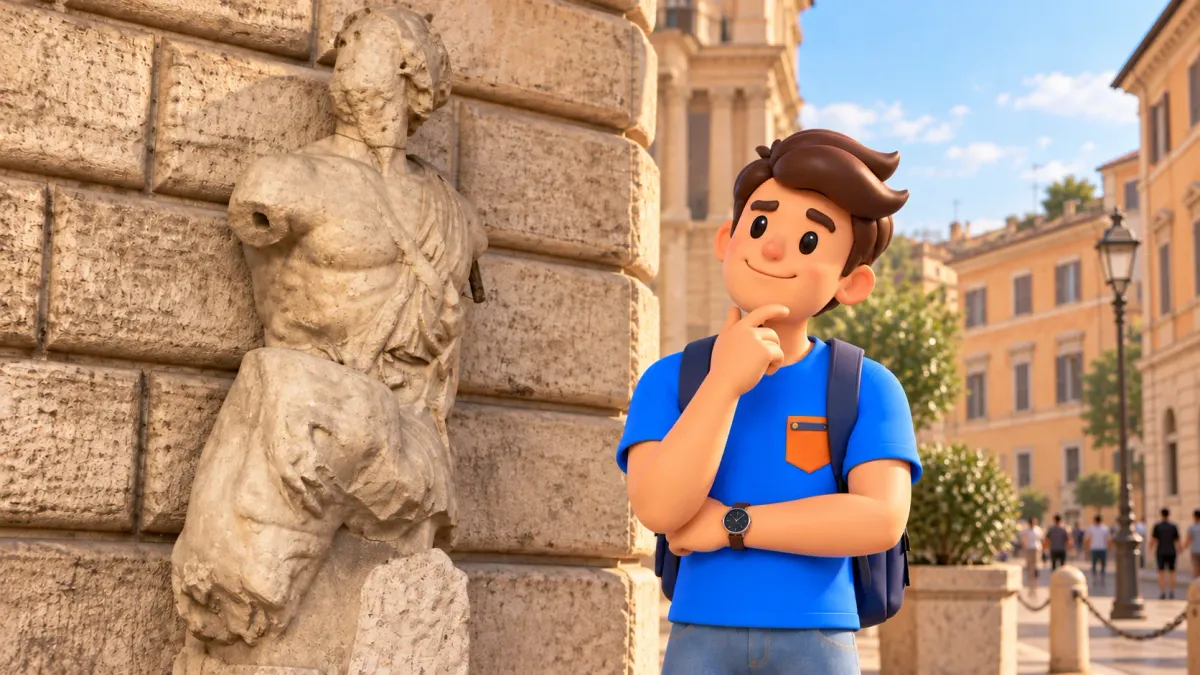
Rome’s talking statues were not mechanical curiosities. People supplied their voices by leaving anonymous satirical messages, often in verse, on or beside familiar stone figures. An imagined speaker could comment on city life, mock influential people or answer another joke. Ancient sculpture acquired a new role in the living city of the Renaissance.
You do not need to collect every figure to understand the tradition. Pasquino near Piazza Navona and Madama Lucrezia by Piazza San Marco offer two distinct examples of old marble receiving a new biography. Choose one short stop within a walk you already intend to make. The second can belong to another day, rather than turn a small historical discovery into an obligation.
How stone acquired a public voice
In sixteenth-century Rome, satirical sheets placed around recognisable statues could be read by passers-by. The writer might remain unnamed while the message seemed to come from the figure itself. A fixed address met changing words: people knew where to look, without necessarily knowing which sharp observation would appear there next.
RoadMe makes it much more convenient to develop a personal plan for the whole trip around your interests, dates, pace and budget. Let the app fit small historical discoveries between major visits and rest, so the day reflects what interests you rather than simply adding more compulsory stops.
This form of communication had its own urban geography. Different figures could participate in an imagined exchange, with a question at one address and an answer at another. The stone remained still while people wrote, read, repeated or copied the words. Talking describes the statue’s social role, rather than any device concealed inside it.
It does not follow that every message expressed a unanimous popular opinion. Anonymity does not establish truth or identify an author’s background. The revealing device is the borrowed voice: criticism acquires a recognisable character to speak through. That idea is enough to change how you look at an otherwise easily overlooked fragment beside a busy square.
Pasquino: begin with a damaged sculptural group
Find Pasquino on Piazza di Pasquino at the corner of Palazzo Braschi, close to Piazza Navona. Do not expect a perfectly preserved statue of a public speaker. The damaged marble fragment is associated with a group of Menelaus supporting the body of Patroclus. Its ancient subject and later reputation as a satirist belong to different chapters.
Cardinal Oliviero Carafa placed the sculpture in the square in 1501. For the feast of St Mark, it was dressed and surrounded with epigrams. A particular literary life became attached to this urban address. Pasquino’s name gave rise to pasquinate, the Italian term for these satirical compositions, while the original identity of the damaged heroic figure became less immediately apparent.
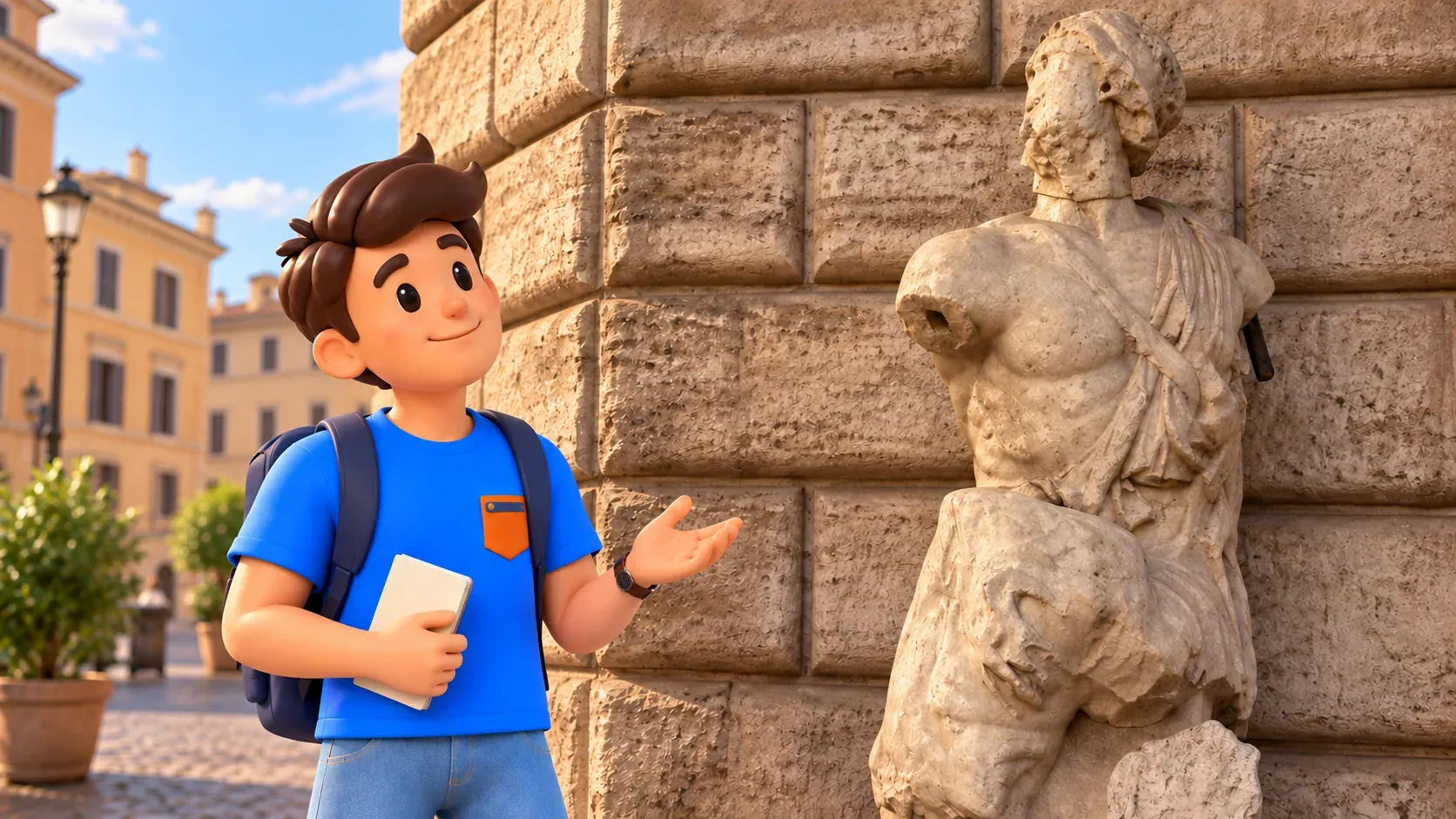
First examine what survives without mentally completing every missing part: the turn of the torso, drapery, relationship between fragments and areas of loss. Then look at the wall and space around it. The street setting helps explain how this became an address for public words. Its new function did not require a grand monument standing alone in an enormous open space.
Avoid explaining every damaged feature as punishment for satire. The condition of an ancient fragment and stories about attempts to silence Pasquino are separate questions. If you hear a striking account of how a particular body part was lost, check its source before treating it as fact. A legend can reveal a character’s reputation without accurately describing the marble’s physical history.
The name belongs to stories, not a settled biography
Several explanations exist for the name Pasquino. Some feature a sharp-tongued local craftsman or tailor; others mention an innkeeper or teacher. These are traditions rather than a securely established biography. Choosing the most entertaining and presenting it as certain would lose something interesting: the competing explanations show how the identity of an urban speaker grew.
Separate three layers. There is an ancient sculptural group, its later placement and reuse on a city square, and stories explaining a familiar name. Combining them can accidentally suggest that the marble originally portrayed a Roman tailor and was made in antiquity to criticise rulers. Keeping the layers apart makes both the surviving object and its later role easier to understand.
For a short visit, ask what made this fragment recognisable: its face, its address or the personality people attributed to it. There need not be a single answer. Form and public use complement each other. A small object beside an important piazza becomes more than a passing photograph once you notice that relationship.
Madama Lucrezia: a large face beside an everyday passage
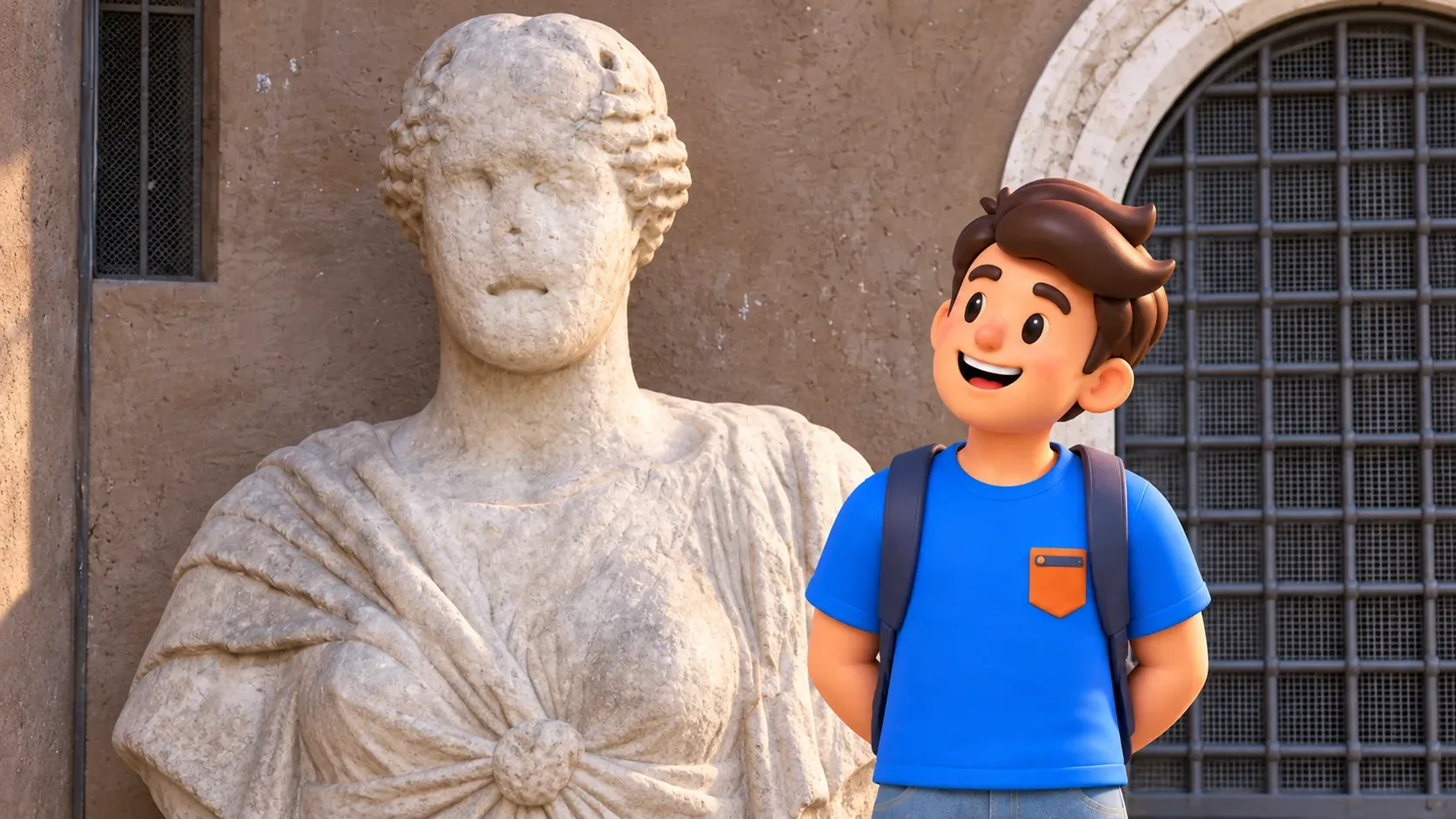
The second example stands on Piazza San Marco between Palazzo Venezia and the Basilica of San Marco. This is a square in Rome, rather than Venice’s St Mark’s Square. Madama Lucrezia is a large female marble bust with heavily worn facial features. The head survives: it is not a headless statue or a full standing figure hidden by a pedestal.
Look at the relationship between head and shoulders, the waves of hair, the folds and the drapery knot on the chest. That is a more useful beginning than immediately insisting on the woman’s identity. Interpretations have connected the figure with Isis and her cult, while a portrait of Faustina has also been proposed. The damaged face does not justify a confident identification.
The familiar name is not evidence of the original ancient subject either. One tradition links it to Lucrezia d’Alagno, associated with Alfonso V of Aragon, king of Naples. This explains a proposed nickname; it does not make the ancient bust a portrait of a fifteenth-century woman. Name, original image and subsequent urban role once again belong to different historical layers.
The bust was known near San Marco in the fifteenth century, but its position changed. Its present placement is connected with early twentieth-century alterations during construction of the Victor Emmanuel monument. Saying it has stood on precisely the same spot since the Renaissance would therefore be too exact. The enduring relationship with this part of Rome is more useful than an invented history of complete immobility.
Two characters can explain the tradition without a full circuit
Pasquino invites attention through fragments and movement; Lucrezia through the scale of a bust and a frontal presence. That difference helps suggest why people could give stone figures distinct literary characters. We are still looking at voices supplied by writers. Avoid assigning each statue a permanent political programme or a rigid set of subjects without evidence.
Seeing both can be rewarding, but they need not share one outing. Notice Pasquino when your day already involves Navona, and Lucrezia when you are near Palazzo Venezia. A city walk with crossings and other possible stops lies between them. Two twenty-minute observations do not automatically create a forty-minute itinerary connecting the addresses.
With children, try the idea of lending a voice to an unmoving object in a story. Invent a neutral remark about your own walk and put it in your own notebook. This explores a literary device without inviting anybody to attach something to a monument. A historical custom is different from present-day permission to alter a cultural object.
How a message could outlive its paper
Many messages were handwritten on small sheets or scraps. They belonged to a passing moment, so the physical material could disappear quickly. Some texts were copied, collected and printed. What survives is consequently not a complete transcript of the city’s conversation. Preservation and selection also shape what later readers consider characteristic of an era.
Johns Hopkins University’s library collection studies a print of Pasquino from around 1550. Such an image shows how the street figure itself became a printed object to examine. There is another transition here: ancient marble, a Renaissance message placed around it, then an image of that situation. These layers do not all belong to one date or a single maker.

A modern comment feed can offer a useful analogy for a recognisable address with changing contributions. It remains an analogy. Transmission speed, readership, circulation and possible consequences were different. You do not need to make Pasquino the literal inventor of social media or the first newspaper to appreciate a city using old stone for new public conversations.
Add one observation stop to a day you already want
Choose the statue closest to your existing walk. For an illustrative twenty minutes, allow five to find a suitable public viewing position, ten to examine the figure and reflect on the story, and five to make a note and decide what follows. This example starts and finishes at one sculpture. Approach, onward walking, food and other visits are extra.
Daylight helps with surface and detail. Current barriers, conservation work or restrictions on a passage may change where you can stand, so respect the available public position. Neither of these two outside stops requires entering a palace or church. That does not mean every member of the wider talking-statue tradition is outdoors under identical access conditions.
Try RoadMe to work out a personal itinerary for the whole trip with your mix of familiar landmarks, unusual history and pauses. The app makes it easier to distribute small discoveries across days while preserving time to look properly at the place you have chosen.
If contemporary notes happen to be present, do not automatically treat them as old texts or an official account of the sculpture. A particular message cannot be promised in advance: it may be absent, replaced or difficult to read. The visit still works without fresh wit on display. Understanding why this figure became a familiar urban speaker is enough.
Photograph the sculpture with a little of its setting as well as a detail of the material. One scale shows the object; the other explains its street role. Keep the passage clear and leave the marble untouched. Then return to your ordinary walk with a new question: which other familiar city objects acquired meanings their original makers could never have anticipated?