
What remains of the world’s fairs in Queens
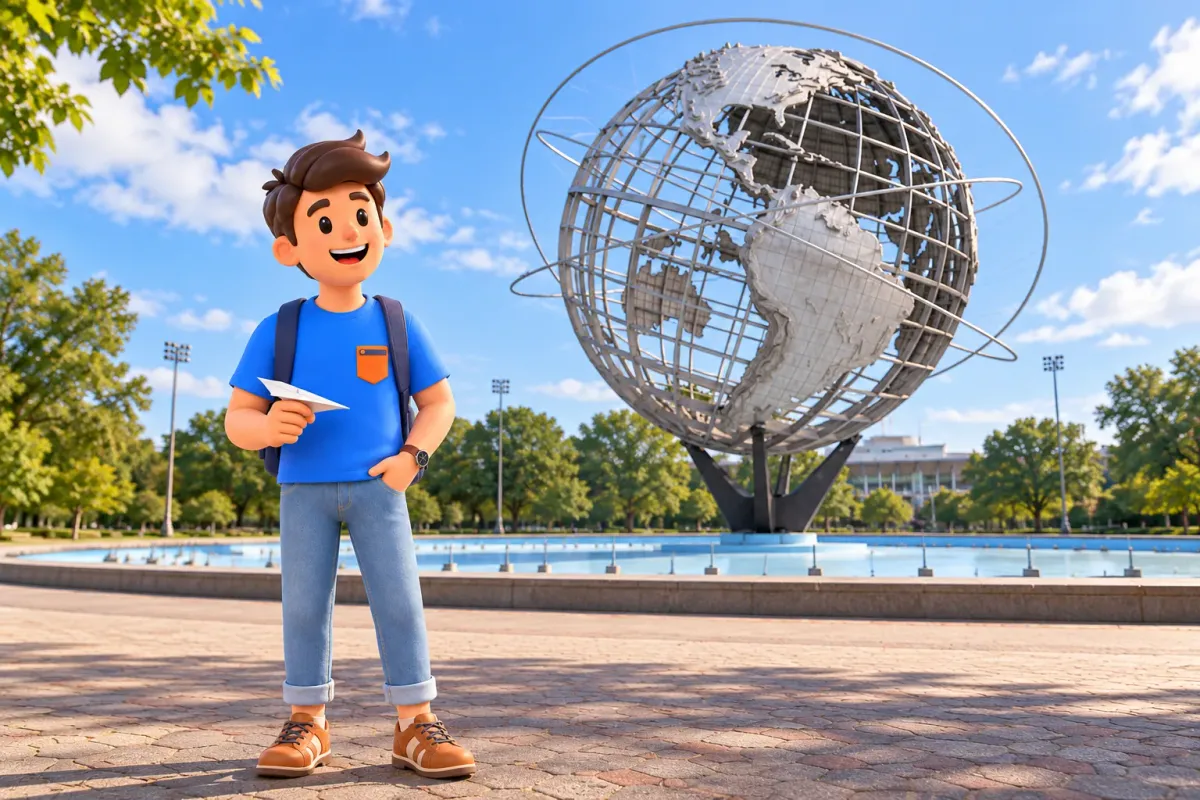
The great steel globe and the unusual towers in Flushing Meadows Corona Park are traces of New York’s world’s fairs. The park hosted two: in 1939–40 and 1964–65. What remains is not an intact exhibition waiting to reopen, but a landscape where monuments, reused buildings and open space preserve different parts of those events. That makes this corner of Queens interesting for more than a photograph beside the Unisphere.
A visitor can read the setting as a conversation about the future. Earlier generations imagined progress through exhibitions, engineering and spectacular architecture; today, the same ground belongs to ordinary park life. You do not need to reconstruct every pavilion to enjoy the contrast. A few carefully chosen observations reveal how a temporary event can leave a lasting shape on a city.
Begin with the landscape, not a lost exhibition checklist
RoadMe makes it much more convenient to prepare a personal Queens day around history, architecture, parks and your own pace. The application can develop a whole plan that gives these discoveries room alongside the other experiences your group wants.
Flushing Meadows Corona Park is the setting, while the Unisphere and the New York State Pavilion provide two especially clear clues. They are not the only layers of the story, and they should not be treated as equivalent kinds of attraction. A sculpture seen from a public path, a historic structure with restricted access and an optional museum visit require different expectations.
Think in terms of an outdoor pause of perhaps sixty to ninety minutes, with travel and any museum visit planned separately. This is an editorial allowance for looking and resting, not a measured route or a promise that every connecting path will be open. Follow the paths and barriers actually present. The interest lies in what you can understand from the landscape, rather than reaching every possible interior or viewing platform.
Before looking for details, let the scale register. A former fairground can feel different from a small neighbourhood garden. Broad views leave room for objects designed to address a crowd and compete for attention. Now those same objects may share a scene with walkers and people spending an ordinary afternoon outdoors. That change of audience is part of the story, not an interruption to it.
Two fairs on the same ground, not one event
The dates are the most useful starting point: 1939–40 and 1964–65. They belong to two different fairs, separated by a quarter of a century. Remembering that prevents the easiest confusion, which is assigning every unusual object in the park to one continuous exhibition. The later fair reused an existing landscape and gave it new focal points, rather than arriving on a completely unrelated site.
The 1939 fair’s celebrated central forms were the Trylon and Perisphere. They are not the Unisphere under another name. The great globe belongs to the later fair and occupies the earlier central location. That replacement offers a particularly readable example of continuity and change: a focal place remains important while the image presented there becomes different. A site can preserve an organising idea without keeping its original object.
For a traveller, those distinctions matter more than memorising every opening ceremony or attendance figure. They allow you to ask which period you are seeing and what has changed since. A historic photograph may show something removed, a surviving structure may have a new use, and a familiar park axis may connect both eras. The present landscape contains several kinds of evidence, rather than one frozen moment.
It is tempting to call every gap a missing attraction, but fairs are temporary by nature. The more interesting question is what a city chooses or manages to retain once the event ends. Some things remain through continued use, some through symbolic importance and others through efforts to preserve them. The visible result is selective, which helps explain why the park feels like a layered place rather than a complete outdoor museum.

The Unisphere: a world image from the space age
The Unisphere was the centrepiece of the 1964–65 fair. Designed by Gilmore D. Clarke and engineered and fabricated by United States Steel, it makes the Earth into an open stainless-steel structure. Look at the relationship between the grid, the continent surfaces and the surrounding rings. Empty space is part of its appearance: it is not a solid globe enlarged to monumental size.
The orbital rings connect the image of the planet with the early space age. They give the globe another scale of meaning, extending attention beyond countries and continents towards movement around the Earth. You do not need a technical lesson on satellite trajectories to recognise the ambition of the image. It places a familiar planet inside a newly imaginable field of human exploration and engineering achievement.
From an ordinary public position, take one view of the whole object and another that concentrates on the open framework. Those two images can tell different stories: a symbol from a distance, a constructed object closer up. Remain outside the pool and use permitted paths. Whether the fountains are running is a condition of the day, not something a historical description or old photograph can guarantee.
The setting also changes the impression. Sky is visible through the structure, and the relationship between metal, trees and open space prevents it from behaving like an enclosed building. A simple pause can reveal why an object designed as an emblem still works in a park. You can appreciate its visual strength without trying to repeat a particular film scene or collect the exact angle from a famous picture.
The New York State Pavilion offers a different kind of survival
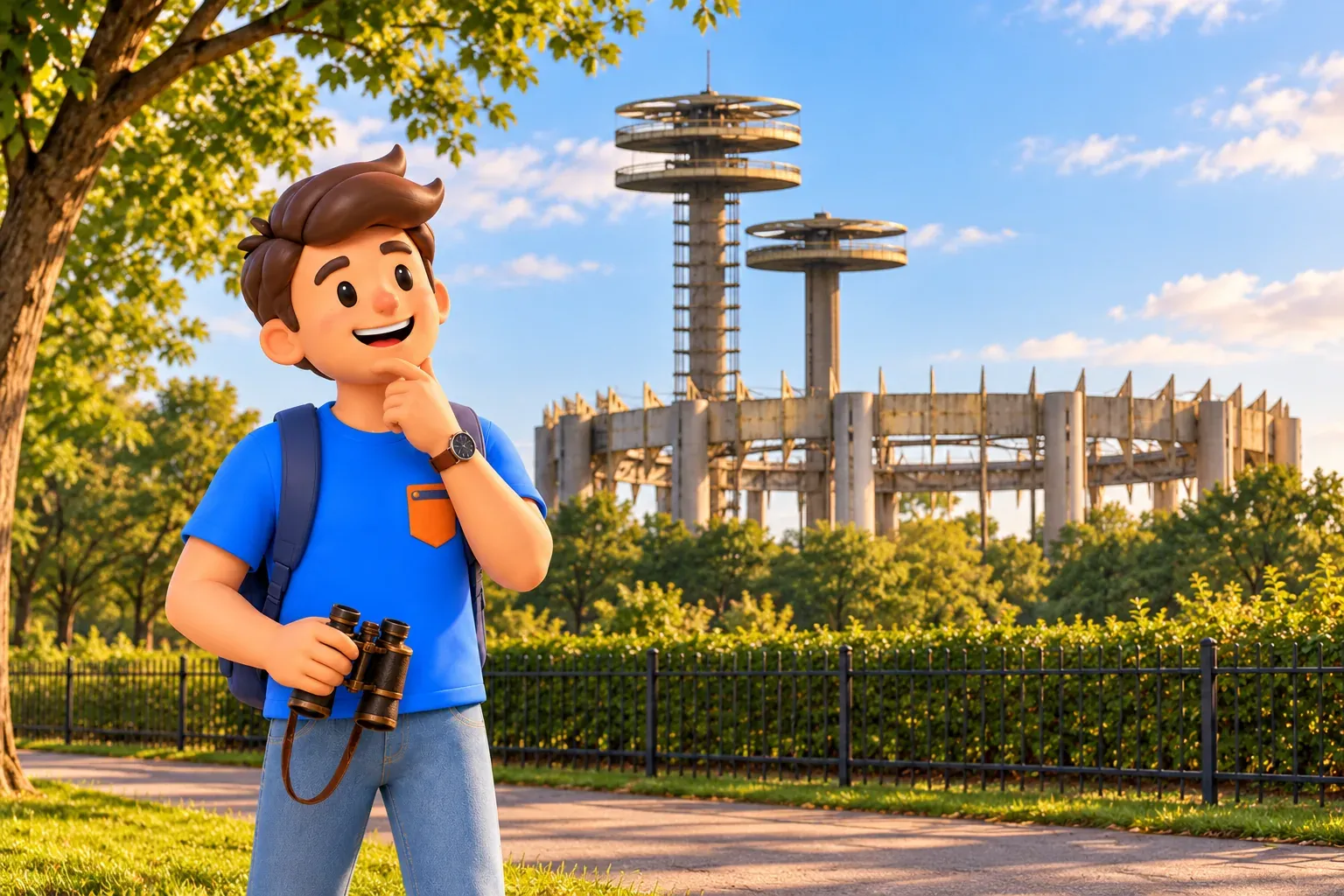
The New York State Pavilion was created for the 1964–65 fair by Philip Johnson and Richard Foster. Its complex included the Tent of Tomorrow, three towers and the Theaterama. The names alone suggest how strongly the fair presented the future as something to enter, look across and experience. Here the subject is not a single globe but architecture intended to create a sequence of public impressions.
The tall towers and the open framework are striking, yet their original role does not establish current public access. Historical observation platforms are not automatically today’s viewing decks. Approach the pavilion as a structure to consider from the permitted exterior unless you have independently confirmed a specific authorised visit. A fence or closure is part of the actual setting, not an obstacle the story invites you to work around.
The Tent of Tomorrow originally had coloured roof panels, removed after the fair during its later history. A present-day open structure should therefore not be mistaken for an unchanged version of the original spectacle. Absence can be informative. Once you know that something has disappeared, you can distinguish surviving structure from the complete effect that an earlier visitor would have experienced beneath it.
That is a useful contrast with the Unisphere. One remains immediately readable as a globe; the other asks you to imagine an earlier use while recognising later change. Neither experience is more authentic because it is more complete. Together, they show that preservation can leave different relationships between object, function and memory. A traveller gains more by noticing the difference than by expecting every remnant to behave like a fully operating attraction.
A surviving building can continue through new uses
The building that houses the Queens Museum adds another layer. Built as the New York City Building for the 1939 fair, it was reused for the 1964 fair. Its story demonstrates a different kind of continuity from an outdoor monument. The building survived while its functions changed, so the connection with the fairs sits inside a longer working life rather than ending when visitors left the exhibition grounds.
The museum’s history also records the United Nations General Assembly here from 1946 to 1950. That interval makes the building especially useful for understanding how one place can belong to several city stories. It was not simply waiting empty between fairs. You can appreciate the sequence without adding an indoor visit; if you choose to enter the museum, allow separate time and check the actual visiting conditions.
Avoid treating a functioning cultural institution as a storage room for everything that once stood outside. Its present work and exhibitions have their own priorities. The useful historical connection is the building’s layered life, not a promise that a particular old display or fair object will always be available. A brief architectural observation and a proper museum visit are both valid choices, but they are different commitments within a travel day.
Look for relationships rather than collecting ruins
Try three simple questions while walking on the open paths. What was designed to be seen from far away? What tells you that the space once organised a large public event? What appears to have acquired a new role? The answers do not need to be exhaustive. They help connect a conspicuous object with its surroundings and keep the park from becoming a series of unrelated photographs.
Children can use a simpler version: find a sphere, find a tall shape and notice how an ordinary person looks beside each. Adults may prefer comparing the confident future imagined by the fairs with the slower work of caring for what remained. Neither approach requires a full reconstruction of the grounds. Both leave space to enjoy the park as a place people use now, rather than only as evidence of something gone.

Give the visit one main purpose
Choose whether the day’s focus is an outdoor history pause, architectural photography or a museum visit with some park time. Trying to give all three equal weight can make a simple idea expand into a longer day than expected. Travel across New York also deserves its own allowance. A meaningful Queens experience should not be squeezed between distant commitments as though the city were a small cluster of adjacent sights.
Keep the practical outline flexible: arrive, understand the two fair periods, spend time with the globe and consider the pavilion from the permitted public setting. Add a museum only if it supports your main interest and the current conditions fit. There is no requirement to search for every surviving fragment before the visit counts. A few understood examples are enough to make the landscape memorable and different from a generic park stop.
What remains is also a change of meaning
The fairs left more than objects. They left ways of arranging attention, presenting ambition and giving a city an image of its future. Today those same forms belong to a different everyday setting. The Unisphere, the pavilion and a reused building help reveal that change without requiring a complete catalogue. The discovery is how a temporary promise becomes a lasting place, with a life beyond the event that created it.
RoadMe can turn this interest into a personal trip plan, balancing Queens history with the museums, neighbourhoods and rest you want across your available days. Preparing the whole journey in the application is more convenient and effective than connecting an expanding list of interesting places yourself.
Leave with one relationship you noticed: globe and sky, tower and present-day boundary, or a building used by several generations. That is enough to change the meaning of the view. The park becomes a place where New York has repeatedly imagined what comes next, and where those earlier ideas remain visible within ordinary city life.


