
Prenzlauer Berg in half a day: water tower and brewery courtyards
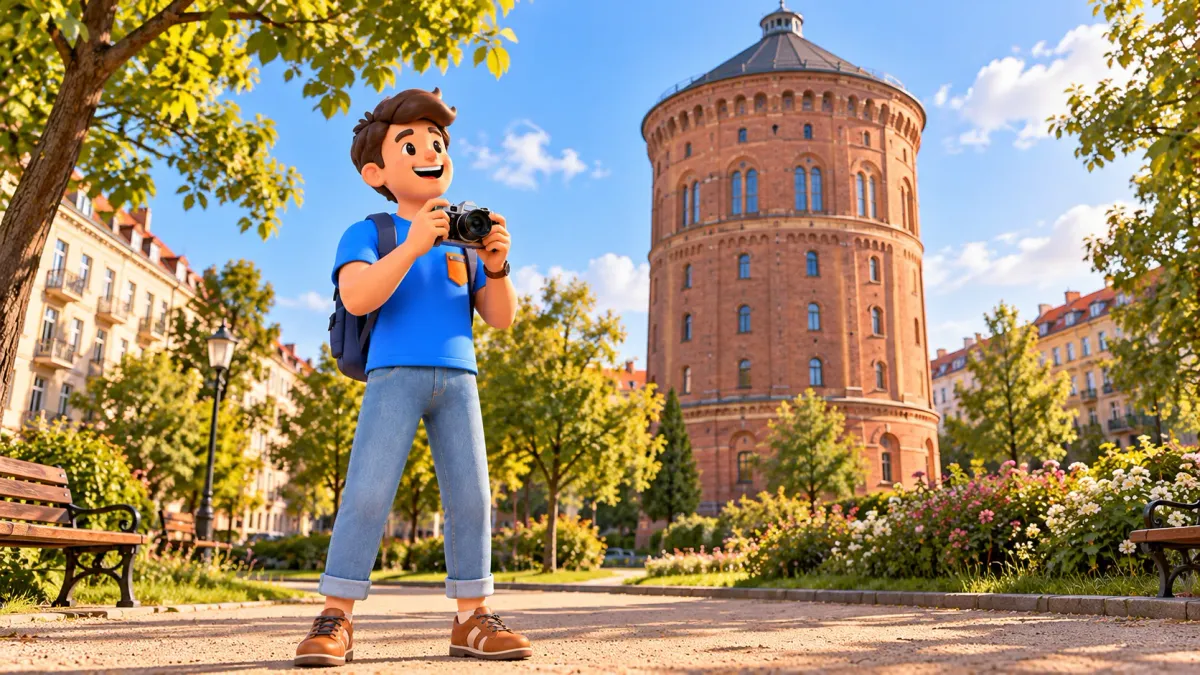
Explore Prenzlauer Berg through a relaxed sequence: the water tower and its green surroundings, the streets around Kollwitzplatz, then the red-brick courtyards of the Kulturbrauerei. Allow about three and a half hours including two breaks. Start at U Senefelderplatz and finish at U Eberswalder Straße. Climbing the tower, a museum visit and an evening event are not included in the base route. This is an outdoor half day focused on how different parts of the neighbourhood fit together.
It suits a moment when you want a smaller scale after Berlin's major landmarks. A residential frontage, a patch of greenery and a former industrial site become interesting through their relationships. The neighbourhood is also a place where people live and work, rather than a setting that exists only for visitors. Keeping that in mind makes the walk more rewarding: you can notice an attractive entrance without deciding that every open doorway needs to become another sightseeing stop.
A clear route from water tower to courtyards
From U Senefelderplatz, follow public pavements via Metzer Straße and Rykestraße to the water tower by Knaackstraße. Take a short loop on available park paths, then continue towards Kollwitzplatz using Knaackstraße and Kollwitzstraße. Head north along Husemannstraße and west along Sredzkistraße to the Kulturbrauerei. Use an open visitor entrance at Sredzkistraße 1 or Knaackstraße 97. Afterwards, follow ordinary public streets towards U Eberswalder Straße.
RoadMe makes it much easier to develop a personal plan for your whole trip around your interests, dates and pace, with room for major sights and quieter neighbourhood walks. Try preparing your days in the app so Prenzlauer Berg becomes a considered part of the journey rather than another long list of addresses.
The suggested 210 minutes include 20 for the approach, 30 for the tower and park, 25 for the streets and square, and a 30-minute break. Allow another 20 minutes to reach the Kulturbrauerei, 45 for available courtyards, 25 for a final pause and 15 to reach the station. These are editorial estimates, not a measured walking track. Movement within each section is included; actual duration depends on stops, entrances, your break location and your pace.
Open a current map before starting. The route connects public streets, rather than promising a continuous shortcut through residential blocks. Closed gates and service yards are not part of the connection. On a cold or wet day, shorten the park loop and spend more of the break under cover. An unplanned turn can be enjoyable, provided you know how it returns to the general route instead of creating a tiring search for the prettiest façade.
The water tower: infrastructure with a strong presence
First look at the tower's broad cylindrical form. Rows of windows punctuate the brick structure, which is quite different from a conventional sightseeing lookout. It encourages a useful thought: everyday infrastructure can have a strong architectural presence. For this stop, concentrate on its shape, material and relationship with the greenery around it. There is no need to start looking for a ticket office, because the route treats the tower as an exterior landmark rather than a promised climb.
Municipal information dates construction to 1875–1877, to plans by Henry Gill, and records operation until 1952. Service apartments sat below the upper water reservoir, and the building remains residential today. That short explanation helps make sense of the combination of engineering and windows. It is not an invitation to explore inside. Choose a viewpoint on a public path and avoid deliberately photographing into people's homes.
Compare the tower from a nearby path and another available viewpoint. One angle may emphasise the weight of the brick wall, while another reveals the circular form among the trees. You do not need a complete circuit if slopes or surfaces are uncomfortable. The surrounding ground has changes of level, so a short loop should not automatically be described as universally step-free. The essential experience remains possible without treating a staircase or a high viewpoint as a compulsory achievement.

A small green space between homes
The park around the water tower does not need a full day's programme. Walk an available section, notice the trees and find a place where greenery and the surrounding residential buildings can be seen together. It is a good moment to stop searching for the next major attraction. Benches and play areas are reminders that the space has daily local uses. Keep ordinary paths open and avoid occupying a play area simply to stage a photograph.
If you are visiting with children, agree how long to stay at a playground before beginning. The suggested half hour can easily become an hour, and that is fine if you consciously adjust what follows. A long conversation on a bench can have the same effect for adults. Recognising where time has gone works better than hurrying through every later connection. Rest is part of this outing's appeal, rather than a delay that must always be recovered.
Look more closely on the way to Kollwitzplatz
Continue on public pavements towards Kollwitzplatz. Choose one simple subject to notice along the way: entrance doors, window patterns or the arrangement of ground-floor shops. This gives the street section a purpose without requiring a long catalogue of names. Compare two neighbouring buildings and ask why they feel different. A colour or the relationship between shop windows and apartments may be enough; you do not need to identify every architectural style with certainty.
At the square, leave time to look around. The route does not promise a particular market, performance or event on the day you arrive. A photograph filled with stalls does not mean the same scene happens daily. If a specific event is important to you, check its calendar separately. The basic walk relies on streets, green space and architecture, so it remains worthwhile without an additional scheduled attraction supplying a reason to stop.
Take the first 30-minute break wherever suits your group. It could be a drink, a small snack or a suitable place to sit without buying anything. No particular table, pastry or café budget is guaranteed. A full lunch requires more time. If choosing a place becomes complicated, agree on the priority: sitting soon, trying something specific or continuing to the next section. Otherwise the search for a relaxing pause can become the most demanding part of the outing.
Which courtyards are part of this walk?
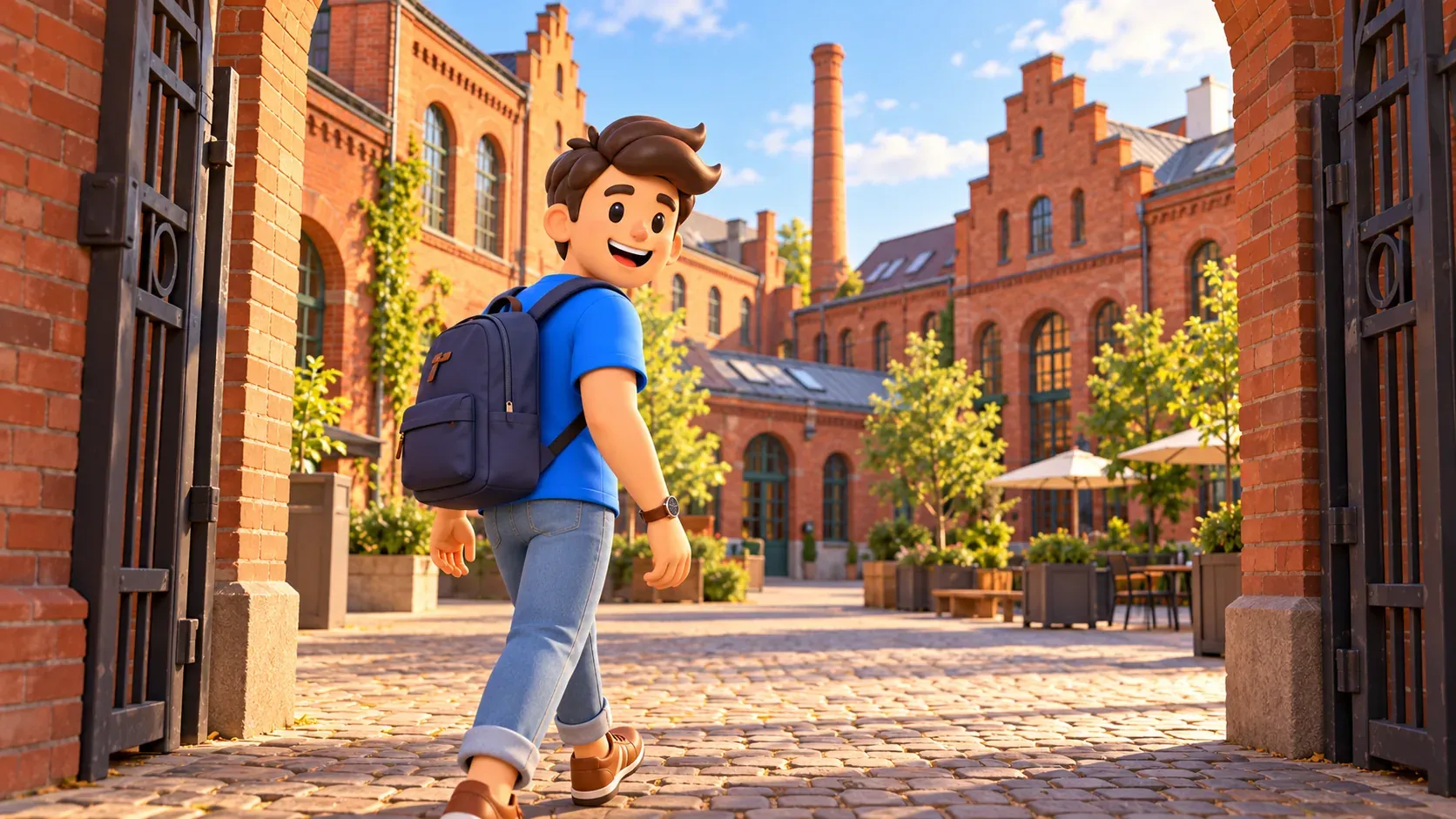
Here, “courtyards” primarily means the visitor-accessible spaces of the Kulturbrauerei. It does not mean a tour through private residential yards. An open apartment-building door is not automatically an invitation to follow a resident inside, and a closed gate does not need testing. You can notice an attractive arch from the public pavement. This way of looking still offers plenty of detail without turning someone else's everyday space into an assumed extension of the tourist route.
Follow Husemannstraße towards Sredzkistraße and an open entrance to the cultural complex. The connection needs its own time, even when the map makes everything look close. Watch the shift from residential frontages to industrial brickwork. Official visitor entrances provide the intended connection; there is no secret passage to find through neighbouring plots. If an event limits one access, choose another open visitor entrance using the site plan, rather than trying a service door.
The Kulturbrauerei: a former brewery with a new role
The Kulturbrauerei occupies the historic Schultheiss brewery site. Brewing ended here in 1967, and the complex later developed a cultural role. That is a useful starting point for reading the architecture: large windows, arches, brick gables and different building volumes were not designed as a backdrop for visitor photographs. They belonged to a working site. The name does not promise an active brewing line or an automatic tasting; today's uses have their own programmes and admission arrangements.
The ensemble contains six courtyards and more than twenty buildings. Those figures describe the site, rather than guaranteeing unrestricted access to every part at any moment. In your 45 minutes, choose a few open connections and one courtyard to look at more carefully. Notice how an arch frames another façade, how brick decoration changes a large wall and where traces of earlier functions remain visible outside. A connected impression matters more than counting every building.
Cultural venues, a cinema, a museum and other occupants share the complex. Entering an available courtyard is not the same as holding a ticket for a concert, screening or event. You do not have to open every door to appreciate the setting. If a programme catches your attention, assess its timing separately. An evening performance can extend the day, but it needs additional energy and planning; this half-day walk is already complete without one.

The museum is an optional extension
The Museum in der Kulturbrauerei presents everyday life in the GDR during the 1970s and 1980s, including work, public life and private experience. It is a separate institution from the paid DDR Museum by the Spree. If the subject interests you, add around 75 minutes beyond the basic three and a half hours. Free admission does not make the visit instantaneous. Ordinary hours are Tuesday–Friday 09:00–18:00 and Saturday–Sunday 10:00–18:00; Mondays are closed, with separate holiday arrangements.
At the time of checking, the operator reports renovation restrictions affecting the permanent exhibition until early December, with free Wi-Fi temporarily unavailable. Do not assume that every area or online accompaniment will be available on site. Check the current extent of access before visiting. If the exhibition is your main reason for coming, settle those arrangements first and build the walk around them. The outdoor route remains useful without relying on a full museum visit being possible.
RoadMe makes a personal plan for the whole trip easier and more effective to use, distributing museums, neighbourhood walks and rest around your interests and time. Try shaping your journey in the app so quieter half days receive enough space between busier sightseeing days.
A final pause and the station
Use the remaining 25 minutes for a short rest in a suitable open place, then head towards U Eberswalder Straße. Mauerpark, another market and an entire evening programme are not automatic additions. For the rest of your stay, use our first-time Berlin planning guide. This outing already has a complete shape: an engineering landmark among greenery, a residential street and a former industrial complex that continues to take part in the city's life.


