
Pok Fu Lam in half a day: Béthanie and the reservoir

Pok Fu Lam makes a rewarding change of pace after Hong Kong's busy waterfronts and shopping streets. Begin with the pale historic architecture of Béthanie, then make your way towards the reservoir for a walk shaped by trees, water and old masonry. The connection between the two is practical as well as visual: this is a small journey through the ways a growing city cared for people and secured its water supply.
Allow roughly three to four hours for a modest version, including approaches and a break. This is a planning estimate, not a timed walking track. Béthanie's free museum and its paid guided tours are separate visitor options; neither should be read as a promise of unrestricted access to every part of an active campus.
Choose the emphasis before you set off
The easiest way to enjoy this half-day is to decide which part matters most. Architecture enthusiasts can make Béthanie the main visit and keep the reservoir section short. Travellers who want greenery can give the building a lighter introduction and save their energy for the wooded paths. Combining both works best when neither becomes an attempt to see everything.
Use RoadMe to turn these ideas into a personal route built around your interests, available time and preferred pace. Planning the whole outing in the app makes it easier to give architecture, history and time outdoors the balance you actually want.
A building and one selected masonry bridge are enough to give the day a clear shape. There are several historic structures around the reservoir, but visiting all of them is a different undertaking. Do not let the length of a heritage list decide how far you walk. Choose a turning point that leaves room for the return journey.
For children, a small observation game can connect the stops: find a pointed arch at the building, then compare it with the rounded arch of a bridge. It gives the walk a theme without turning every pause into a lesson. Adults can use the same approach, concentrating on a few details rather than collecting dates and photographs.
Béthanie: a place of recovery with a new role
Béthanie was completed in 1875 as a sanatorium for the French mission, receiving missionaries who needed to recover from illness. That original purpose makes the complex more interesting than an unexpected Gothic façade on a Hong Kong hillside. The chapel belonged to a larger place of residence and care; it was not the whole story of the site.
Look at the rhythm of the windows, the pointed openings and the relationship between pale walls and surrounding greenery. You do not need specialist architectural vocabulary to enjoy these features. Choose one element, see how it repeats, then step back within the permitted visitor area to understand how it belongs to the building as a whole.
Restoration completed in 2006 brought a new chapter as a campus of the Hong Kong Academy for Performing Arts. That reuse is part of the attraction. The building continues to have a purpose, with education and other activities taking place alongside heritage visiting. It is not an abandoned institution waiting to be explored through any available doorway.
A useful question is what the architecture reveals about its earlier function, and what its present organisation reveals about the new one. A visitor entrance, a restored detail or the contrast between old fabric and contemporary use can make the stop meaningful. You need not see every room to understand why keeping a historic place in use matters.

Make the museum or tour choice explicitly
The Academy's visitor information checked in October 2026 lists a free Béthanie museum, closed on Wednesdays and public holidays, and separate paid guided tours for which advance booking is recommended. This distinction matters more than a general opening label. It does not establish that the chapel or all teaching spaces are available for independent sightseeing.
If interiors are your priority, confirm what the particular visit includes before arranging the rest of the day. A building's name on a ticket or itinerary is not a room-by-room access guarantee. A booked tour also gives your outing a fixed appointment, whereas a modest museum visit may allow a more flexible start, within its actual visitor hours.
Check the latest Academy notice for your date rather than relying on an old screenshot. Campus hours, museum hours and box-office hours answer different questions. A campus may be operating when a museum is closed, and a ticket counter's timetable does not describe a sightseeing session. Establish the purpose of your visit first, then use the relevant schedule.
If your date does not work for the museum, decide whether a permitted exterior view is enough. It can still introduce the area's history, provided you accept that it is a shorter architectural stop. If the interior is the main reason you wanted to come, move that visit to another day and treat the reservoir as a separate outing.
The link to the reservoir is a real street journey
Leave Béthanie through the permitted visitor exit and use public streets towards Pok Fu Lam Reservoir Road. The building and reservoir do not form one continuous landscaped attraction. The approach involves ordinary roads, crossings and hillside terrain. Two nearby map pins can look deceptively simple when the spaces between them are not visible.
Check current pedestrian navigation before starting the link. Choose legal crossings and a clear public approach, even if another line looks shorter on the screen. Stop somewhere out of the way when you need to study the map. Keeping the group together through the road section makes the transition much less tiring than repeatedly stopping and catching up.
This is a good combination for travellers who accept some urban walking in return for a greener second half. If you want only a wooded waterside outing, start with the reservoir instead. If you care mostly about architecture, finishing after Béthanie is equally reasonable. A shorter programme can be the better choice in humid weather or when walking ability varies.
Do not automatically add the Peak because it is also on Hong Kong Island. That introduces another objective, different gradients and a larger time commitment. For this outing, deciding where to turn back is more useful than adding another famous destination. Save an ambitious hillside extension for a day when it is the actual plan.
Read the landscape through a masonry bridge
Pok Fu Lam Reservoir began supplying water in 1863. Behind the pleasant greenery lies a basic question of urban life: how a growing settlement could provide fresh water. Thinking about that task changes a bridge from a picturesque object into part of a larger working landscape. Roads, streams, slopes and storage all belong to the same story.
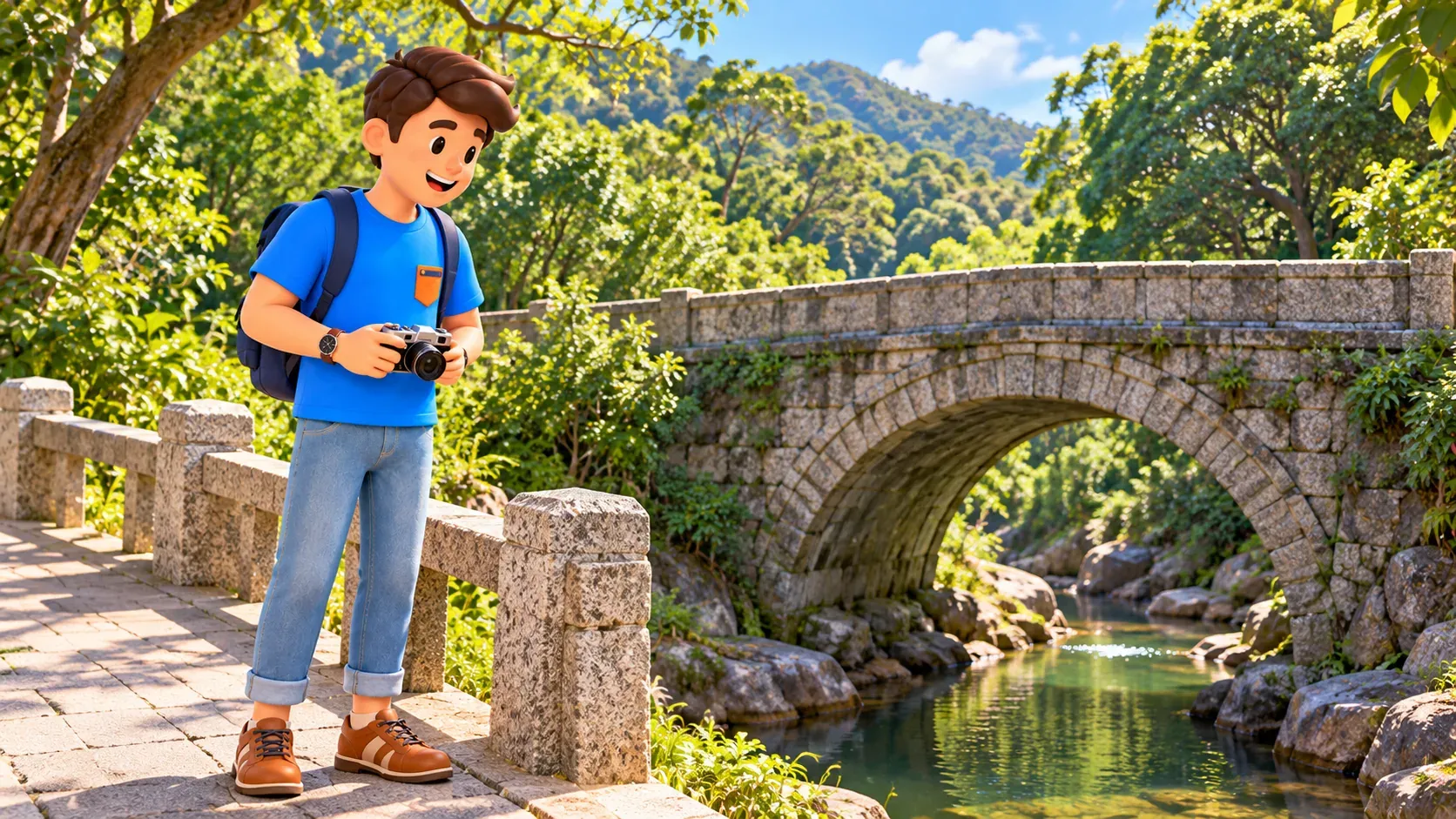
Several historic bridges survive in the reservoir area. They should not be collapsed into a single stop or an assumed complete circuit. Choose one bridge on the public section you intend to walk, and make sure the actual map point matches your plan. A modest, clearly understood route is more useful than a promise to find every arch.
Look at the shape of the opening, the finish of the stone and the way the road passes over the watercourse. An arch carries weight through its blocks towards the supports, a principle you can appreciate without an engineering lesson. The structure also helps explain the terrain: water gathers from the hills while a road maintains a usable crossing.
Observe from the public path. There is no need to descend into the streambed or climb beyond a barrier for a more dramatic view. Water levels, vegetation and sightlines vary, so a particular photograph should not become a condition of enjoying the visit. Close attention to the granite and parapet may be more revealing than chasing a view you saw online.
Give the green section a comfortable limit
After the bridge, continue only as far as your energy and return plan allow. A short out-and-back walk on an authorised path can be easier to manage than following unfamiliar branches in search of a complete loop. The reservoir does not need to be circled for the outing to feel complete. A quiet pause is part of its value.
Divide the half-day between the building visit, the street connection and the green walk, then leave a separate margin for rest and reaching transport. If a guided visit takes longer than expected, shorten the final section rather than walking faster to recover time. On a hillside, especially in humidity, that is rarely a satisfying exchange.
For a wider Hong Kong trip, RoadMe can develop a personal plan around your interests and available days. It is a convenient way to fit a quieter outing like Pok Fu Lam into a trip that also includes museums, neighbourhoods and time to rest.
Bring drinking water and do not assume a café will appear beside your chosen bridge. Comfortable shoes matter more than an outfit chosen for a chapel photograph. Keep the bag light enough that you still want to walk after the first stop. A bottle, suitable sun or rain protection and your own essentials are more useful than carrying every possible extra.

Weather, accessibility and the rest of the day
Rain changes the balance of this outing. An indoor museum visit may remain appealing while the wooded section becomes a separate decision. During thunderstorms, heavy rain or relevant warnings, choose an indoor alternative and postpone the reservoir walk. After a shower, the first dry patch of pavement is not evidence that the whole route has dried.
For a wheelchair or pushchair, confirm the particular entrance and approach with the venue, then consider the reservoir link separately. An accessible room does not establish that every street, gradient and path between the two stops is suitable. One well-chosen visit with transport between sections can work better than an assumed continuous route for everyone.
Leave room afterwards for lunch and an unhurried return to the city. Adding another major museum or a distant island creates a different kind of day. If the western side of the island interests you, keep the HKU to Sai Ying Pun walk for another outing, when university architecture, a museum and a surviving urban façade can receive their own attention.
Pok Fu Lam works with two strong impressions: a historic building that found a new use, and a landscape made legible by the relationship between stone, roads and water. Give those ideas enough space, choose a comfortable turning point and let the walk reveal a quieter part of Hong Kong.


