
Pisa in two hours: a walk from the cathedral square to the Arno
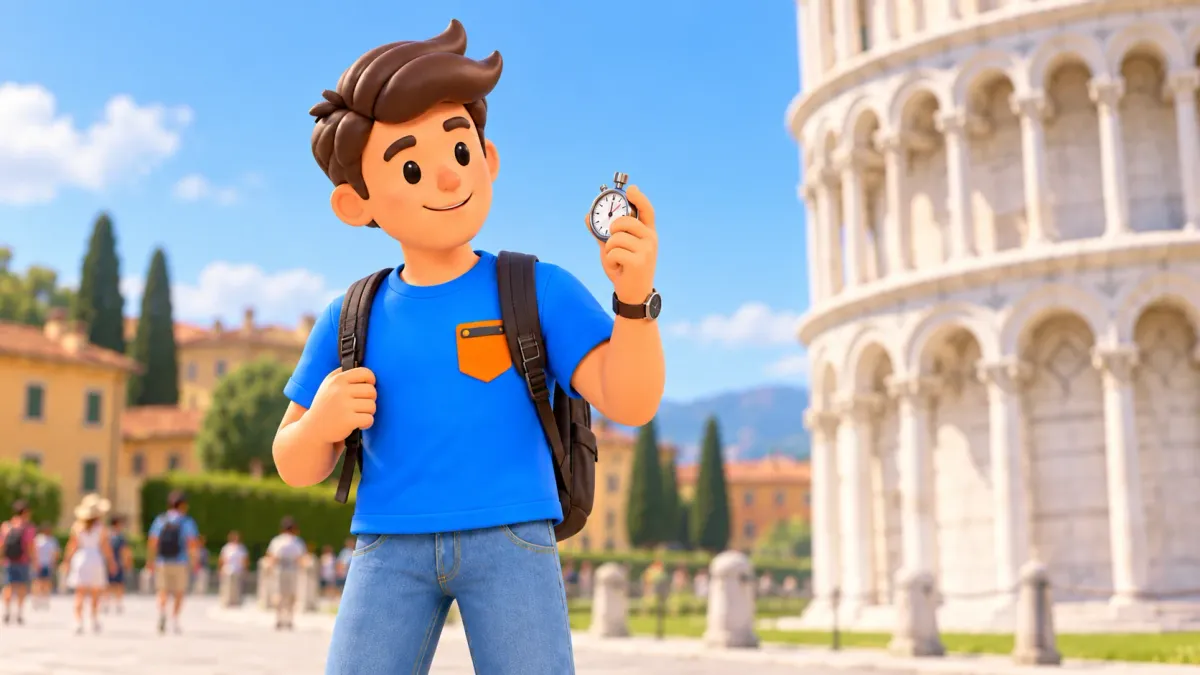
If you are already beside the Leaning Tower and have around two hours, you can see the famous ensemble and a small slice of everyday Pisa. This walk leads from the cathedral square through Piazza dei Cavalieri and Borgo Stretto to the Arno. It finishes at Piazza Garibaldi beside Ponte di Mezzo, where you can pause before deciding whether to continue.
The plan is based on exterior views. A tower climb, cathedral admission and museums are outside these two hours. All timings are planning estimates, not measured walking records: pace, photography and street conditions can change the duration. Travel from the station to the starting point, and onward travel after the finish, also need separate time.
Give the two hours a simple shape
Think in a few clear stages: roughly half an hour around the ensemble, a walk to Piazza dei Cavalieri, twenty minutes on that square, then the central streets and the river. A short pause can fit near Piazza delle Vettovaglie. Keep the final minutes for the Arno and a small margin rather than another compulsory admission.
If you have already explored the cathedral square, there is no need to repeat it to complete a schedule. Start with the walk towards Piazza dei Cavalieri and use the extra time for a slower passage through the centre. The important thing is the sequence of different experiences, not keeping precisely to a stopwatch.
To make a short visit easier to organise, try RoadMe: the app develops a personal walking plan around your interests and available time. It connects the main places with what you actually enjoy, so you can spend less attention on arranging the next stop while you are in Pisa.
The main sequence is straightforward: cathedral square, Via Santa Maria, the direction of Via dei Mille and San Sisto, Piazza dei Cavalieri, Via Ulisse Dini, Borgo Stretto, Piazza Garibaldi and the Arno. Vettovaglie is a small optional detour from Borgo Stretto. No paid admission is required for the basic outdoor walk; cafés and interiors are separate choices.
Suggested time from the start, for exterior views. The Vettovaglie pause is optional; these are planning estimates.
| Minutes | Stage |
|---|---|
| 0–30 | Cathedral-square ensemble |
| 30–45 | Walk to Piazza dei Cavalieri |
| 45–65 | Piazza dei Cavalieri outdoors |
| 65–85 | Via Ulisse Dini and Borgo Stretto |
| 85–100 | Vettovaglie or a short break |
| 100–120 | Garibaldi, Arno and a small margin |
The first half hour: see an ensemble, not only a tower
Begin in an accessible part of Piazza dei Miracoli where you can see the cathedral and tower together. Look first at their relationship with the baptistery and Camposanto. The lean immediately draws attention, but the arrangement of several buildings gives the square its distinctive character. For a short introduction, this composition matters more than reading a complete history of every monument.
The tower is the cathedral's bell tower, despite standing separately. The baptistery has a circular form, while the Camposanto creates a long architectural edge. These simple reference points turn separate photographs into an understanding of the place. Choose one wider view and one smaller detail that makes you want to look more closely.
On the cathedral, notice the repetition of arches and pale stone. You do not need a vocabulary of architectural terms to enjoy the façade. Follow its rhythm and compare it with the rounded form of the baptistery. This small habit of observation remains useful throughout the walk, even if art history is a new interest.
Avoid spending the whole visit searching for one perfect tower photograph. If the area is busy, find a clear place to stop, take a few pictures and move on. Follow the marked paths and respect fenced areas. Access to the square should never be confused with permission to enter every building around it.
From the open square into the street network
Leave towards Via Santa Maria and the historic centre. For Piazza dei Cavalieri, orient yourself towards Via dei Mille and the small street junctions around San Sisto. Keep this stage moving: a long stop at every façade quickly uses the time intended for the later part of the route.
The change of scale is immediate. Open space gives way to house walls, doorways, shop windows and details close to eye level. Let your attention adjust. This transition from a monumental ensemble to ordinary urban fabric is part of the interest of the walk. You do not need to find another internationally famous landmark on every street.
San Sisto can be a short exterior reference point before the next square. Its history is connected with the civic memory of medieval maritime Pisa. For this route, a comparison between its restrained appearance and the more ceremonial façades ahead is enough. Going inside is not part of the estimated timetable.
If a turn is unclear, stop at the side of the passage and check your map. Following the name of the next square is more reliable than following other visitors, whose destination may differ. If a temporary closure affects the way, use an available public route to the same next point. Do not assume a courtyard is a public shortcut.
Twenty minutes in Piazza dei Cavalieri
Piazza dei Cavalieri presents Pisa through the history of power and learning. Its appearance is associated with Giorgio Vasari's transformation for the Order of Saint Stephen. A short walk does not need a complete political history. Notice instead how differently the space is organised compared with the cathedral square you have just left.
Palazzo della Carovana is the main visual reference. Its expressive façade benefits from being seen together with neighbouring buildings rather than only in close-up. The palace is now associated with the Scuola Normale Superiore. That makes the square interesting as a setting where historic architecture continues to participate in the academic life of the city.
Find Palazzo dell'Orologio and the church of Santo Stefano dei Cavalieri. They help define the edges of the square and show how separate structures make a shared composition. The story of Count Ugolino, connected with a tower incorporated into the clock palace, deserves its own occasion. For now, let the setting remain the focus.
Walk a small circuit through the accessible parts of the square and choose one detail: palace ornament, the clock or a contrast between stone and plaster. An open square does not establish access to teaching buildings. After this stop, continue along Via Ulisse Dini in the direction of Borgo Stretto.
Borgo Stretto: a street worth noticing
Via Ulisse Dini connects the square with the central streets. Borgo Stretto then provides the direction towards Piazza Garibaldi. Here the experience becomes more everyday: arcades, commercial façades and people moving through the centre create a continuous street scene. You can appreciate this change without entering a shop or planning a shopping stop.
Pause near San Michele in Borgo to look at its multi-level façade. The church offers a useful comparison between the architecture of the large ensemble and a building set within a much tighter urban setting. The viewing distance matters. Sometimes a few steps backwards reveal more than approaching the wall as closely as possible.
This is an easy place to lose track of time. For a short route, choose one or two pauses instead of responding to every window. A coffee can occupy the break already allowed for. A long seated order is better saved for after the finish if your two-hour limit is firm.
In narrow passages, step out of the main flow before taking a photograph or reading a map. Keep entrances clear and remain attentive to bicycles and service vehicles where they appear. These ordinary courtesies also make walking more comfortable. You arrive at the last open view beside the river with some attention and energy left.
Vettovaglie: a small optional detour
If time allows, turn briefly towards Piazza delle Vettovaglie. Its historical role as a market square and its porticoes add another type of urban space. Comparing a place of everyday trade with the more representative square you have just visited gives the walk an extra thread without requiring a long explanation at each stop.
This detour does not depend on finding a market in operation. The atmosphere can differ at the time of your visit, and the route does not promise particular trading hours. Look at the layout, decide whether you would like a short pause and then return towards Borgo Stretto and Piazza Garibaldi.
If you are running short of your own time, omit the detour altogether. The main walk keeps its clear structure: cathedral ensemble, Piazza dei Cavalieri, a central street and the river. Removing an optional branch is better than hurrying every remaining stop. Vettovaglie can belong to another centre walk later.
Finish beside the Arno at Piazza Garibaldi
Borgo Stretto brings you to Piazza Garibaldi on the northern side of Ponte di Mezzo. The close perspective of the street opens into space above the water. Pause before automatically crossing the bridge. For this route, you have already reached the finish, so there is time simply to look along the river.
Look both ways along the embankments and towards the façades opposite. After the cathedral ensemble and Piazza dei Cavalieri, this is a third distinctive scale of Pisa: the city stretches along the Arno. A short distance between stops does not mean the experiences are the same when you notice how the spaces change.
Crossing Ponte di Mezzo can be an extension if you have time and inclination. Walking to the station, continuing far along the southern bank or entering Palazzo Blu is not included in the two-hour plan. Before adding anything, check the remaining time and the journey to your next destination.
Adjust the walk to the day you want
If architecture is the priority, keep more attention for Piazza dei Cavalieri and San Michele's façade, with only a brief Vettovaglie detour. If everyday street atmosphere matters more, slow down on Borgo Stretto and finish with time by the water. If you feel tired, leave out branches and keep one clear endpoint.
Instead of arranging every stop manually, you can use RoadMe to prepare a personal walking itinerary based on your interests and pace. It is a convenient way to turn this general route idea into a plan for your own day in Pisa, with the time and experiences that suit you.
In rain or strong heat, shorten the walk according to comfort and choose an appropriate break. Do not assume continuous shelter along the whole route. This is not a verified step-free itinerary: particular surfaces, steps and access requirements need their own consideration. Exterior views reduce dependence on museum opening hours but do not remove temporary restrictions in public streets.
The two hours end beside the river, rather than with an obligation to finish seeing an entire city. You have connected a famous ensemble, a historic square and an everyday street in one coherent walk. Continue with another route if you wish, or keep this as a complete first impression of Pisa.
For a choice between a short visit and a full day, see How long to spend in Pisa.


