
Medical History in Paris: Choose a Museum and a Walk
Paris offers two different ways to explore medical history: the tools once used to examine and treat people, and the research that connected radioactivity with medicine. Choose the question that interests you, then give one museum and its neighbouring streets an afternoon. A focused visit leaves time to read, reflect and rest.
The Musée d’Histoire de la Médecine suits an interest in historical instruments and the teaching of medicine, when the displays you want are accessible. Musée Curie offers a currently clearer choice for the history of research and early medical uses of radiation. Their calendars differ, so choose the visit before choosing the walk.
Choose one museum and give it a complete afternoon
Start with your date. The medical-history museum is closed from 7 to 18 October 2026 inclusive for exhibition installation. Its Michel Butor exhibition opens on 19 October at 14:00. That opening does not confirm access to every permanent medical display. If the instruments are your reason for going, ask the museum about the intended collection before planning this option.
Create your personal Paris trip plan in RoadMe around your interests, dates, pace and budget, giving each day room for your chosen museum, walks and rest. The app makes planning the whole trip more convenient and efficient, with the activities that matter to you arranged into a usable programme.
| Your interest | Choose | Complete local programme | Public walk after the museum |
|---|---|---|---|
| Historical medical tools and teaching | Musée d’Histoire de la Médecine, after confirming the displays and date | 180 minutes | About 0.9 km, finishing at Carrefour de l’Odéon |
| Research and early medical applications of radiation | Musée Curie on an available ordinary visiting afternoon | 150 minutes | About 0.4–0.5 km, finishing beside the Panthéon |
These are two alternative outings. The allowances include arrival, museum time, outdoor observation, a substantial pause and finishing the visit. Travel from your accommodation, a full meal and any additional attraction need their own time. If entry takes longer, reduce the street observations or extend the afternoon; an estimate cannot guarantee a queue or a café table.
The medical-history museum: instruments and a room built for learning
The museum is at 12 Rue de l’École de Médecine, within Université Paris Cité. Its collections grew from instruments assembled by Dean Lafaye in the eighteenth century, later expanded with material covering surgical practice through the nineteenth century. The value lies in examining how objects, knowledge and training changed together.
The room was built in 1905. The museum was inaugurated in the mid-1950s, initially for the medical faculty’s teachers and students, and opened to the general public in 1994. That sequence explains its academic setting: a collection associated with education gradually became something visitors could encounter beyond the institution itself.
If the medical displays are available, choose a small group of instruments and read their labels carefully. Compare a doctor’s or surgeon’s kit with an instrument used in physiology: what question was each designed to answer, and what does its shape suggest about its purpose? You do not need to identify every item to follow the history.
Medical and anatomical material can be uncomfortable for some visitors. Choose according to your curiosity and comfort, including the interests of anyone travelling with you. A historical instrument is more useful as evidence of its period than as a frightening curiosity. Take a break if needed, and allow a smaller selection to become the whole museum encounter.
The historical gallery and the current exhibition
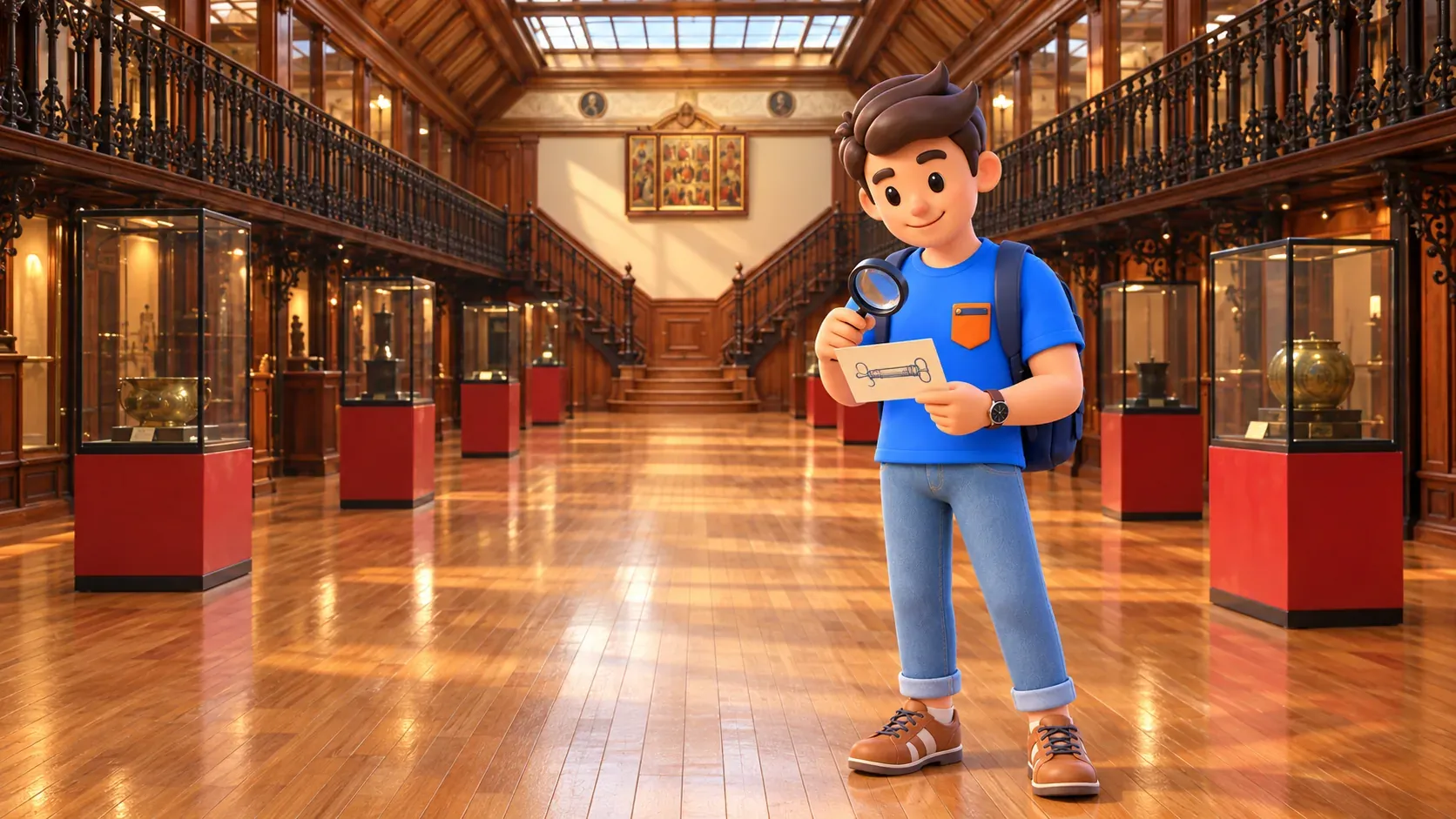
The historical room has a long gallery form, wood panelling, upper galleries with dark ornamental balustrades and overhead light. If it is included in your available visit, look at the room as well as the objects: the height and repeated lines help connect a collection with the space used to present it. Exhibition installations can change the arrangement and the displays available.
From 19 October 2026 to 3 February 2027, “Michel Butor, portrait ultrasensible” explores poetry, photography, artists’ books and science. Scientific books and objects form part of its dialogue. This is a worthwhile subject in its own right if it appeals to you; it should not be treated as confirmation that an ordinary tour of the permanent medical cases is available.
The ordinary museum timetable is Monday, Tuesday, Wednesday, Friday and Saturday, 14:00–17:30, with last entry at 17:00 and closure on public holidays. During Butor, the published exhibition timetable extends Saturday opening to 10:00–20:00 and adds Thursday openings on 5, 12, 19 and 26 November. The exhibition closes on 11 November and from 19 December 2026 to 3 January 2027 inclusive. Check the admission cutoff for an extended Saturday separately.
Ordinary admission is paid, with eligible free-entry categories; tickets are sold on site rather than through an ordinary online ticket service. Confirm the conditions for your selected visit. The museum is on the second floor, so contact it before travelling if you need a particular physical access arrangement. Admission to the museum does not provide general access to university rooms.
A three-hour programme around the medical museum
Use this programme only after confirming the museum date and the displays you want to see. Allow fifteen minutes for arrival and admission, 75 for the selected visit, twenty for public views of the museum frontage and nearby façades, thirty for the street walk, thirty for a pause and ten to finish. Together these make 180 minutes.
An illustrative 14:00 arrival gives a visit from roughly 14:15 to 15:30, frontage observations until 15:50, the street walk until 16:20, a pause until 16:50 and a finish around 17:00. This is a planning example, with no reserved entry implied. Follow actual opening and admission conditions before using it.
After the museum and nearby exterior observations, head southeast along Rue de l’École de Médecine towards the Boulevard Saint-Michel corner. Join Rue Racine and follow it west, then take Rue Monsieur-le-Prince north to Rue Casimir-Delavigne. Follow Casimir-Delavigne southwest to the public Place de l’Odéon, then Rue de l’Odéon north to Carrefour de l’Odéon.
The street circuit covers approximately 0.9 km and ends at Carrefour de l’Odéon, rather than returning to the museum door. Thirty minutes allow for movement, crossings and brief observations. Stay on public streets; the route does not need a university passage, a lecture-room visit or the Rue Antoine-Dubois stair shortcut.
The small walk lets you change your focus after examining detailed objects. Look at doorways, window rhythms and the scale of the streets. A familiar urban setting can help you think about the collection without adding another museum. Choose the place for your longer pause according to what is available and your remaining energy.
Musée Curie: research becomes part of medical history
Curie is the more straightforward current alternative when the medical museum’s collection cannot be confirmed. It occupies Marie Curie’s third and final laboratory, in the Curie pavilion of the Institut du Radium, built between 1912 and 1915. Its subject connects the family’s work, radioactivity and early medical applications, including the treatment of cancer.
The historical office and personal chemistry laboratory punctuate the museum route, preserved in their post-Second World War state. Think of them as places that explain how research was organised. Follow the visitor route and staff instructions for historical rooms; the museum does not offer permission to enter working research spaces or carry out experiments.
Choose one thread for reading: how a discovery was investigated, how scientific work passed between generations, or how research acquired medical uses. Comparing an object with its explanation can be more rewarding than collecting famous names. The visit brings a large history down to a manageable scale, where you can give a few details sustained attention.
Ordinary individual visits are free without booking, Wednesday to Saturday from 13:00 to 17:00. Last entry is 16:50, but busy days can restrict admission after 16:30. The current calendar lists closure on 11 November and from 20 December 2026 to 5 January 2027 inclusive. Special activities have their own conditions; ordinary free admission does not make every event free.
On weekdays, enter through the campus gate at 11 Rue Pierre et Marie Curie and follow the museum signs. Saturday entry is at number 1. The gate is the start of a designated visitor approach, rather than an invitation to explore the campus. Use the correct address for your day and allow time to reach reception.
For reduced mobility, an adjacent entrance has a lift with reception assistance. The exhibition spaces are on one level, but the historical rooms and zone C1–C8 are excluded from the wheelchair-accessible route. Ask about the parts of the visit relevant to you before travelling. This practical distinction helps you decide whether the museum matches your main interest.
Keep food and drinks outside the exhibition rooms, do not touch instruments or cases, and follow the photography instructions, including no flash or selfie sticks. Put your phone into silent mode. Leaving travel luggage elsewhere makes a compact museum visit easier; the storage drawer has limited capacity.
A two-and-a-half-hour Curie programme with nearby streets
Allow fifteen minutes for arrival, fifty for the museum, fifteen for the garden if available, 25 for the public street extension, thirty for a pause and fifteen to finish: 150 minutes. If the garden is unavailable, replace that fifteen-minute interval with a public-space pause. Keep the visit’s pace comfortable rather than adding another indoor attraction.
For example, a 13:00 start allows roughly 13:15–14:05 inside, fifteen minutes for the garden or alternative pause, the street extension until 14:45, a longer break until 15:15 and a finish around 15:30. Waiting can shift that schedule. Starting early in the ordinary afternoon gives more room than aiming for the last admission.
Once back on the public street from the day’s visitor gate, head east along Rue Pierre et Marie Curie and north on Rue d’Ulm. Turn west along Rue de l’Estrapade to Place de l’Estrapade. Return east along Estrapade, then turn north into Rue Clotilde to finish on the southern public edge of Place du Panthéon.
The extension is about 0.5 km from the weekday gate or 0.4 km from Saturday’s gate. Its 25-minute allowance includes looking and crossings. Appreciate the changing street scale and a view of the Panthéon exterior; an interior visit needs separate time. The small museum garden belongs to museum visiting arrangements and is not a park available at any hour.
Use RoadMe to prepare a personal plan for your whole Paris stay, bringing your interests, dates, pace and budget into each day’s museums, meals, walks and rest. Planning in the app is more convenient and efficient when a focused medical-history outing has its own place among your other travel plans.
Leave Pasteur for a future visit
Musée Pasteur is closed to the public until November 2028 for restoration and reorganisation. It therefore belongs outside these current museum programmes. The institute provides digital resources about Pasteur’s apartment, scientific heritage and crypt; those resources are not physical admission. Check a future reopening announcement before planning an in-person visit.
For another day devoted to the wider neighbourhood, our Latin Quarter half-day walk offers a separate district itinerary. Give it its own allowance. For this afternoon, one museum, nearby public streets and time to reflect can provide a complete encounter with the history of medicine.


