
Historic Paris Department Stores: A Walk for the Architecture
Paris’s historic department stores offer a different way to look at the city: through coloured glass, metal balconies, generous staircases and façades designed to catch attention. You can come for the architecture, spend time noticing how a large commercial building works, then leave without a shopping bag.
Choose one compact outing. Galeries Lafayette and Printemps form a close pair on Boulevard Haussmann; Samaritaine gives you a central visit ending by the Seine; Le Bon Marché offers a Left Bank exploration of light and structure. Each has its own character and a realistic programme, with ordinary public spaces separated from booked tours and private areas.
Choose one district and leave time to look
Try RoadMe to build a complete personal Paris trip around your interests, dates, pace and budget. Having the whole plan in the app makes it much more convenient and efficient to connect architectural discoveries, other visits and time to rest.
Choose Haussmann for the contrast between a dramatic interior dome and an elaborate street silhouette. Choose Samaritaine if you like comparing historical decoration with contemporary architecture. Choose Le Bon Marché for light, structure and the gradual growth of a nineteenth-century store.
These are estimates from arrival in the chosen district to finishing locally. Travel from your accommodation and your next journey are additional. Interior navigation and crowds can change the pace; shorter versions reduce observation and pauses.
| Choose one outing | Main programme | Short version |
|---|---|---|
| Lafayette and Printemps | 15 min arrival + 40 dome/interior + 30 optional roof + 10 street link + 40 Printemps + 30 rest + 15 finish = 180 min | 120 min, omitting the roof and shortening the visits and pause |
| Samaritaine and Pont Neuf | 15 min arrival + 20 façades + 40 interior + 15 street connection + 20 river pause + 10 finish = 120 min | 90 min, with a shorter exterior look, interior and pause |
| Le Bon Marché and its block | 10 min arrival + 20 façade + 45 interior + 15 block walk + 20 rest + 10 finish = 120 min | 90 min, concentrating on one interior space and a few exterior details |
A daylit visit makes the exterior comparisons easier and avoids relying on late terrace opening. All three programmes leave room for an ordinary architectural visit without a purchase. A restaurant table, reserved activity or behind-the-scenes space follows its own conditions.
Galeries Lafayette: coloured glass and a theatrical interior
Start at the Coupole store, 40 Boulevard Haussmann. The Men’s store at number 48 and Gourmet at number 35 are separate buildings: entering whichever address appears first can send you towards a different experience. Once inside the main store, find a permitted public viewpoint from which the dome and balconies make sense together.
The dome was erected during the 1909–1912 expansion led by architect Ferdinand Chanut. Jacques Gruber created the stained glass, while Louis Majorelle supplied the balcony ironwork. Their Art Nouveau decoration gave the sales hall a richness that rewarded looking upward, turning everyday browsing into a staged encounter with light and ornament.
Notice the relationship between the radial glass overhead and the repeated balcony curves below. Choose one colour or metal pattern, then look at how it returns across the space.
Keep entrances and circulation clear, and use only floors and viewpoints open to visitors. The old monumental staircase associated with Majorelle was removed in 1974; it is part of the building’s history, rather than something to seek today. Access between the dome structures requires a confirmed special offer.
At the 14 October 2026 check, the dated 12–18 October schedule gives the Coupole store Monday–Saturday, 10am–8.30pm, and Sunday, 11am–8pm. Use the corresponding calendar for your own date. Those store hours do not establish the terrace’s closing time.
The roof and Glasswalk are separate choices
The public terrace is on the eighth floor, with free ordinary access and no reservation, subject to weather and current access. Allow thirty minutes for going up, looking and returning. If it is closed, use that allocation for permitted interiors or a longer rest; the three-hour programme still has a useful shape.
Follow the terrace signs and confirm the route with staff if mobility matters. The English owner page describes lifts reaching the seventh floor followed by a final staircase, so a completely step-free ascent is not established. Check the actual roof hours before going up, especially if you are considering a late visit.
Glasswalk is a different experience: a reserved five-minute slot on the third floor, with arrival ten minutes early. Finding it and waiting can occupy twenty to thirty minutes. Fit that time inside the Lafayette block or extend the outing, and check the real booking calendar. Looking at the dome from permitted retail space does not depend on taking the Glasswalk.
Printemps: read the building from the street first
Leave Lafayette and walk west along Boulevard Haussmann towards Printemps, whose ordinary address is 64 Boulevard Haussmann. The inspected street link is about 300 metres; ten minutes allows for crossings and orientation. The Caumartin–Haussmann corner gives the façade a strong presence in the street, with rounded pavilions and an elaborate roof silhouette.
Look first at the building’s overall shape, then compare the small circular windows, sculpted figures and the rhythm of the larger openings. The corner invites attention from several directions. Observe from a public pavement without obstructing traffic or an entrance.
Jules and Augustine Jaluzot founded Printemps in 1865. The architecture developed over time: René Binet designed the historic stained glass in 1910, and Georges Wybo’s work on the Femme building’s staircase and roofs dates to 1921–1924. Historical features are not all visible during ordinary entry.
For the public interior portion, follow the current store directory and staff guidance. Femme’s seventh-floor 7ème Ciel is a retail space; restaurants and rooftop businesses have their own arrangements. You can look at permitted architecture without assuming a free table or unrestricted entry to every dome and terrace.
Current ordinary hours are Monday–Saturday, 10am–8pm, and Sunday, 11am–8pm. If the backstage story is your priority, book the separate paid ninety-minute Manatour tour online. It meets at the Homme reception, 70 Boulevard Haussmann, with mandatory arrival fifteen minutes early; there is no cloakroom, and stairs and escalators make this tour unsuitable for wheelchairs and strollers.
Replacing the ordinary forty-minute Printemps block with that tour and early arrival changes the main outing to 245 minutes: four hours and five minutes. A confirmed slot controls the timetable. Leaving both the ordinary visit and the whole tour in the plan would need more time.
Samaritaine: an architectural conversation near the Seine
For the central option, begin around the store’s public address, 9 Rue de la Monnaie. Use the public streets around the building to compare the historic frontages with the contemporary Rivoli side, then enter through an open visitor entrance. A useful street sequence is Monnaie, Baillet, Arbre Sec and Rivoli before returning towards Monnaie and Pont Neuf.
The business began in 1870. Frantz Jourdain’s 1890–1910 development combined riveted steel, a large glass roof and Art Nouveau ornament, including colourful enamelled façade panels. Henri Sauvage’s stepped Seine-side Art Deco building followed in 1926–1928. Look for differences in decorative rhythm and mass rather than treating the whole ensemble as one construction campaign.
After the safety closure in 2005, a major renewal introduced SANAA’s new Rivoli building; Samaritaine reopened in 2021. The different architectural languages are part of the interest. A contemporary glass frontage and a richly ornamented historical one can address the same busy neighbourhood in markedly different ways.
Inside permitted retail areas, notice how pale metal beams, connections and railings organise the open volumes. Compare a close structural detail with the view across several levels. Merchandise and seasonal decoration change, so let the enduring relationship between structure and light carry the visit.
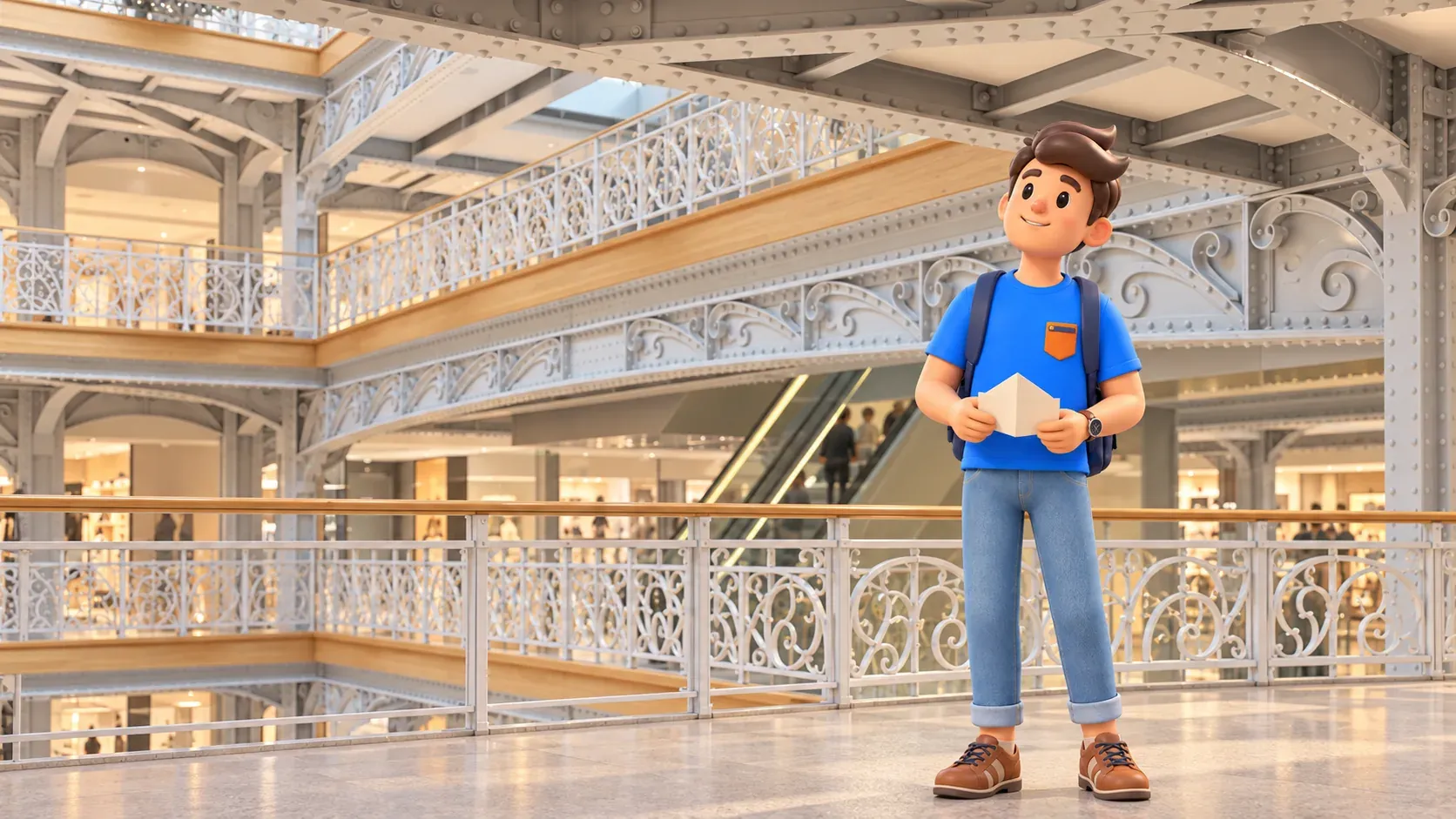
The store opens daily, 10am–8pm. Its customer route includes lifts and ramps, though particular rooms and activities need their own access check. Ordinary admission does not provide entry to hotel premises. Restaurant seating and events also have separate conditions; the architectural programme works without them.
Continue to the public pavement at the northern end of Pont Neuf for the twenty-minute river pause. The exterior circuit is roughly 500–650 metres, before walking inside the store. You can enjoy the river from this level; a descent to lower spaces is an optional different route. Give meals and any lengthy queue additional time.
If you prefer a guided visit, the checked individual offer is a paid ninety-minute French tour on Saturday at 4pm. Custom groups with multilingual options are a separate product. Replacing the forty-minute independent interior with the tour and a fifteen-minute planning arrival buffer gives 185 minutes, or three hours and five minutes; this buffer is our estimate.
Confirm the booking before arranging the afternoon, and put exterior observation in the available seasonal daylight. The store can cancel the tour up to seventy-two hours beforehand if fewer than five people enrol. It provides no luggage storage, and an English-language individual session should not be assumed.
Le Bon Marché: metal, light and a Left Bank block
Begin at 24 Rue de Sèvres. Give the façade twenty minutes, comparing a corner pavilion with the longer runs of windows and the roofline. Then use forty-five minutes inside for one or two permitted spaces where the relationship between structural members, galleries and daylight is clear.
Aristide and Marguerite Boucicaut transformed the commercial business from 1852. The present building developed in later stages. Architect Louis-Charles Boileau and engineer Armand Moisant helped shape its architecture and metal structure; Gustave Eiffel brought technical expertise to expansion works in 1879. The result belongs to several contributors and successive building campaigns.
Large glass roofs helped bring light into substantial interiors. Notice how an opening relates to the surrounding floors, then compare that experience with the more solid street frontage. Current displays and accessible areas can change. A historical photograph is useful for understanding structure, but does not tell you what installation you will find on your visit.
Ordinary hours are Monday–Saturday, 10am–7.45pm, and Sunday, 11am–7.45pm. Cultural tours and archives have separate arrangements; a short public visit does not include them. Finish with the block loop: west along Sèvres, north along Bac, east along Babylone and south along Velpeau, returning to Sèvres. About 500–600 metres fits the fifteen-minute walking allocation at a steady pace.
Give architecture a comfortable place in the trip
RoadMe can develop a complete personal day-by-day trip around the architecture, culture and other interests you enjoy, with your dates, pace and budget in mind. Using that coherent plan in the app makes organising the journey easier and following it more convenient.
Take the allocated pause somewhere suitable and permitted; a particular empty seat is not guaranteed. For a separate Left Bank outing with a longer green break, our Le Bon Marché to Jardin Catherine-Labouré walk has its own ninety-minute programme and garden calendar. Choose it instead, or recalculate the combined day rather than adding it unnoticed to these two hours.
Before setting out, confirm store hours, any booked activity and the access conditions that matter to you. One dome, one façade or one carefully observed structural detail can be enough to change how you look at Paris. Leave with time and energy for the next part of your day.


