
Neukölln in half a day: KINDL, Körnerpark and Comenius Garden

Spend half a day in Neukölln between contemporary art and two very different gardens. Start at KINDL in a former brewery, continue to Körnerpark and finish at the Comenius Garden on Richardstraße. Allow around four and a half hours from U Boddinstraße to U Karl-Marx-Straße, including a break. This is a route with one main exhibition visit, rather than an attempt to cover the whole district. Wednesday to Sunday is the practical choice for the complete sequence, when KINDL normally opens.
The connection between the stops is more interesting than a simple list of attractions. Former production space becomes a place for art; an old gravel pit becomes an ordered garden; a smaller garden uses plants to explore learning and the human life course. You can enjoy those changes without arriving as an art specialist or garden historian. Notice how each place arranges your attention, and let that become the common thread through a varied afternoon.
How to organise the half-day route
From U Boddinstraße, use public streets via Boddinstraße and Morusstraße towards KINDL at Am Sudhaus 3. After the exhibition, return towards Morusstraße and follow the connection via Kienitzer Straße and Rübelandstraße to Jonasstraße and Körnerpark. Then use a current map and public pavements to reach the Comenius Garden entrance at Richardstraße 35. Finish at U Karl-Marx-Straße. The two gardens occupy separate neighbourhood spaces, so their connection needs time of its own.
RoadMe makes it much easier to develop a personal plan for your whole trip around your interests, dates and pace, balancing art, green walks and rest. Try preparing your journey in the app so this Neukölln afternoon fits naturally among your other Berlin experiences.
The suggested 270 minutes comprise 20 for the approach, 70 for entry and a KINDL visit, 30 to reach Körnerpark, 40 in the park and 25 for a break. Add 25 minutes to reach the Comenius Garden, 40 inside and 20 to reach the final station. These are editorial estimates, not a measured walking track. Starting around 11:40 would bring you towards KINDL for its noon opening and towards the finish around 16:10 at an ordinary pace.
That timing explains the rhythm rather than guaranteeing immediate admission. Check exhibition dates, garden access and your own requirements before choosing a day. Monday or Tuesday needs a different, mainly outdoor version because the standard KINDL visit will be missing. In winter, keep the gardens within daylight. A long lunch or several detailed exhibition visits extends the programme; it cannot be added invisibly to the four and a half hours already allocated.
KINDL: begin with one artistic encounter
KINDL is a centre for contemporary art in a former brewery building. Before entering, look at the scale of the structure and its windows. The architecture keeps a connection to production even though the activity inside has changed. The name does not automatically mean a brewery tour. Its current exhibition programme is the reason to go indoors, and the subjects that appeal to you should determine the attention you give this first section.
Choose one theme or a few works that particularly interest you. Seventy minutes including entry is a reasonable introduction, not a promise of seeing every space and video programme completely. If a work needs more time, stay deliberately and adjust another section. Contemporary art can reward a straightforward first question: what changes when you move closer, step back or look from another available position? You do not need to produce a final interpretation immediately.
Distinguish the building, the exhibition and an individual work. A spacious industrial hall does not guarantee that an installation photographed in an earlier season will still be there. The centre has an active programme at the October 2026 check; the earlier summer exhibition break no longer describes the current visit. For a later trip, choose from the programme then available. This route therefore avoids turning a changing set of works into a supposedly permanent checklist.

Admission and the approach to KINDL
Ordinary hours are Wednesday 12:00–20:00 and Thursday to Sunday 12:00–18:00. Monday and Tuesday do not work for the standard exhibition visit, while public holidays have separate arrangements. Admission is normally paid; choose the current ticket that fits your circumstances and programme. Special free dates or concessions should not be extended to an arbitrary day. For this half-day plan, the essential point is that the first stop includes a considered indoor visit rather than only a façade photograph.
There is a specific access detail: the operator's German page reports that the lift at the stairs towards Neckarstraße is temporarily out of service because of construction. The exhibition building itself is described as wheelchair-accessible. Those are different parts of the visit. If you need a route without steps, confirm the currently available approach with the venue before setting out. A general statement about the building should not become a promise that the whole walk through both gardens is universally step-free.
Walk towards Körnerpark
After the exhibition, use public streets via Morusstraße, Kienitzer Straße and Rübelandstraße towards Jonasstraße and Körnerpark. Follow the available connection on a current map: this is a neighbourhood walk between separate places, rather than an internal corridor through one cultural complex. The half-hour allowance leaves some flexibility for orientation. It also gives you time to discuss what stayed with you at KINDL and let your attention return from exhibition scale to ordinary street life.
If you already need a seat, move part of the planned break to a suitable place along the way. That is a clear adjustment to the schedule. A full lunch is more likely to require additional time beyond the allocated 25 minutes. Avoid treating rest as something that can always be postponed until the end. The next park has a different pace, and it is more enjoyable to arrive curious than to spend its entire visit recovering from an overly hurried start.
Körnerpark: a garden below street level
Körnerpark was created in 1912–1916 on the site of a former gravel pit. It lies below the surrounding streets, and that change of level is central to the first impression. The city stays above while a more ordered garden appears beneath it. Look from an available upper position before taking a suitable route down. You can then notice both the overall arrangement and the change in feeling as residential streets give way to the enclosed garden setting.
Follow the main axis, the relationship between lawn and paths, the balustrades and the long orangery building. This is an independent urban green space, rather than a miniature palace with royal rooms waiting behind it. Water features and planting change the impression with the seasons, so flowing jets or particular flowers are not guaranteed on every date. The geometry remains legible without them. Find somewhere that brings several elements together rather than pursuing only one popular photographic angle.
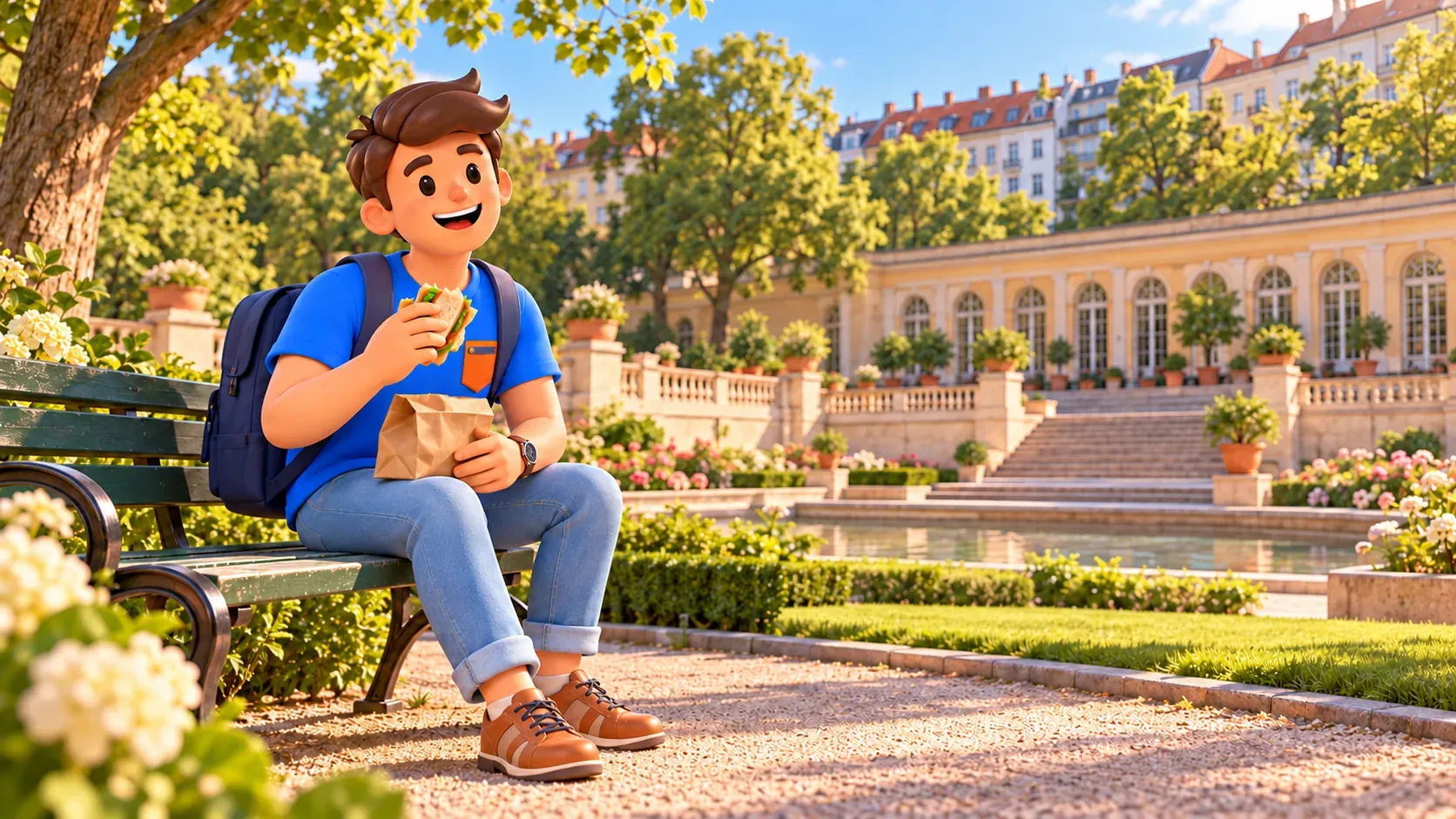
With forty minutes, choose a small circuit and one unhurried stop. Every staircase need not become compulsory if another level suits you better. The gallery's official information specifies ramp access from Wittmannsdorfer Straße, a useful detail that should not be applied automatically to every park entrance. Choose connections that are actually available for your needs. The visit gains more from enjoying the space than from reproducing someone else's exact path through it at any cost.
The gallery and a pause: make a deliberate choice
The gallery in the orangery presents contemporary art. Ordinary opening hours are daily, 10:00–20:00, with free admission; 24 and 25 December, 31 December and 1 January are listed closing days. For this route, an indoor look can replace part of your park time if you want to continue the art theme. A second full exhibition visit is not automatically included within forty minutes. If it draws you in, lengthen the day or consciously reduce another stop.
After the park, allow 25 minutes to rest. Use an available seat or a café with room; a particular venue, menu or service is not guaranteed. Water and a small snack may be enough. The break separates the formal geometry of Körnerpark from the different attention invited by the next garden. If you are in a group, agree what everyone still wants to see before beginning another street connection towards Richardstraße.
The Comenius Garden: plants as a way of thinking
Reach Richardstraße 35 using a current map, public streets and normal crossings. The Comenius Garden is a modern project inspired by the ideas of the seventeenth-century educator and thinker Jan Amos Comenius. It should not be imagined as a surviving garden from his lifetime. Its concept connects plants with stages of life, learning and experience. After an exhibition hall and a formal park, it offers a third way to pay attention: nature becomes a prompt for questions as well as a pleasant setting.
Do not try to decode every symbol immediately. Follow an available short path, notice a change in planting, an open area or water, and consider how the space encourages you to slow down. This is not an exercise with one correct answer. With children, you might ask what can be learned from an ordinary leaf or tree; adults can use the same question without organising a formal lesson. Leave plants in place and remember the garden's educational and neighbourhood roles.

The tourism listing gives ordinary hours as daily, 12:30–19:30. Confirm access for your visit and choose daylight rather than relying on a late winter arrival. The operator explains that visitors can normally use a buzzer button to open the gate. Here that is an intended means of public entry, different from trying a random residential gate. If restrictions apply, do not assume entry is guaranteed. The forty-minute allowance does not include a prearranged private guided visit.
RoadMe makes a personal plan for the whole trip easier and more effective to use, matching art, walks and rest to your interests and available time. Try distributing different kinds of day in the app so the journey stays varied without becoming overloaded.
Finish towards Karl-Marx-Straße
After the garden, head to U Karl-Marx-Straße on public streets, retaining the allotted time for the connection. Britz Palace and Tempelhofer Feld need separate outings rather than automatic additions. For the wider trip, use our first-time Berlin planning guide. This half day already brings together three clear themes: new art within former production space, the garden geometry of an old quarry and an intimate setting where walking becomes a way to think.


