
Moscow’s Northern River Terminal: Park, Architecture and Water

Moscow’s Northern River Terminal suits a day when you want open space and broad water rather than another central street. One expressive building, a park, a public promenade and the sense of a possible departure provide the main story. There is no need to buy a boat ticket to enjoy it: the shore-based version is already a worthwhile outing with architecture and unhurried pauses.
Allow roughly two to three hours for the exterior, a short waterfront section and rest, including the approach from transport. A museum programme or sailing needs separate time. These are editorial planning estimates, not measured walking times. Begin with the geography: the water here is Khimki Reservoir, not the central Moskva River with the same piers and sightseeing departures.
Choose a shore day, with a boat as a deliberate addition
For an introduction, three things are enough: an overall terminal view, one architectural detail close up and an open public section beside the water. The park connects them without a search for the next attraction. This works for a break from dense central streets, a family outing or a different chapter of Moscow’s transport history. Length can respond to weather and mood, rather than the number of nearby activities advertised in a guide.
RoadMe makes this idea easier to use as a fully personal plan. The app works out a walk or trip around your interests, dates and pace, giving architecture, a museum, quiet park time or a water journey the place that suits you.
If sailing is the main aim, choose the actual departure and check the carrier’s terms first. The shore then becomes a walk before boarding or after returning. If the building and water are the priority, do not organise the whole day around finding a boat with spare seats. The formats have different logic. An unplanned ticket does not necessarily improve an already pleasant half day on land.
Parkland, indoor rooms, outdoor terraces and boarding areas are not interchangeable. One accessible section does not establish access to everything else. Build the core on open public areas and add ticketed or indoor elements only after checking them. A passage beside a historic building is not automatically a route onto its roof, onto a pier or aboard a moored vessel. Understanding those boundaries keeps the visit straightforward.
Approach from the metro: cross the highway correctly
The Northern River Terminal is at 51 Leningradskoye Highway. Rechnoy Vokzal metro is the natural transport reference, but its matching name does not mean you emerge directly beside the water. The connection involves parkland and a major road. Include that approach in the outing’s overall time rather than treating it as an invisible preliminary stage. The walk begins with the journey to the actual building, not simply the metro station’s name.
The Moscow Transport Museum’s official directions point to Exit 2, a walk through parkland and the underpass beneath Leningradskoye Highway, then the terminal. Check the current route for your visit. Do not cross a large highway along a line that looks convenient on a map instead of using the designated crossing. Understanding which side holds the destination explains the real approach better than a straight-line distance. With a stroller or limited mobility, assess that particular connection separately.
Friendship Park on the approach and the terminal’s own park are different spaces. The first can remain part of the arrival, while the second is the outing’s main setting; neither needs a complete circuit. Otherwise, the plan quietly expands before you reach its principal subject. If arriving by car, check current parking arrangements: access to the district does not imply driving freely to the promenade. Start the main walk on foot with a clear return to your chosen transport.
A building like a ship: read the idea in its proportions
The terminal opened in 1937 alongside Moscow’s developing water connections. Its character combines transport and ceremonial architecture: a long body with galleries, a central vertical, a spire and an orientation towards the broad water. The ship association comes from proportions and deck-like levels, not a single decorative symbol. Begin by seeing how those elements belong together. It is a larger architectural idea than one photogenic star or tower.
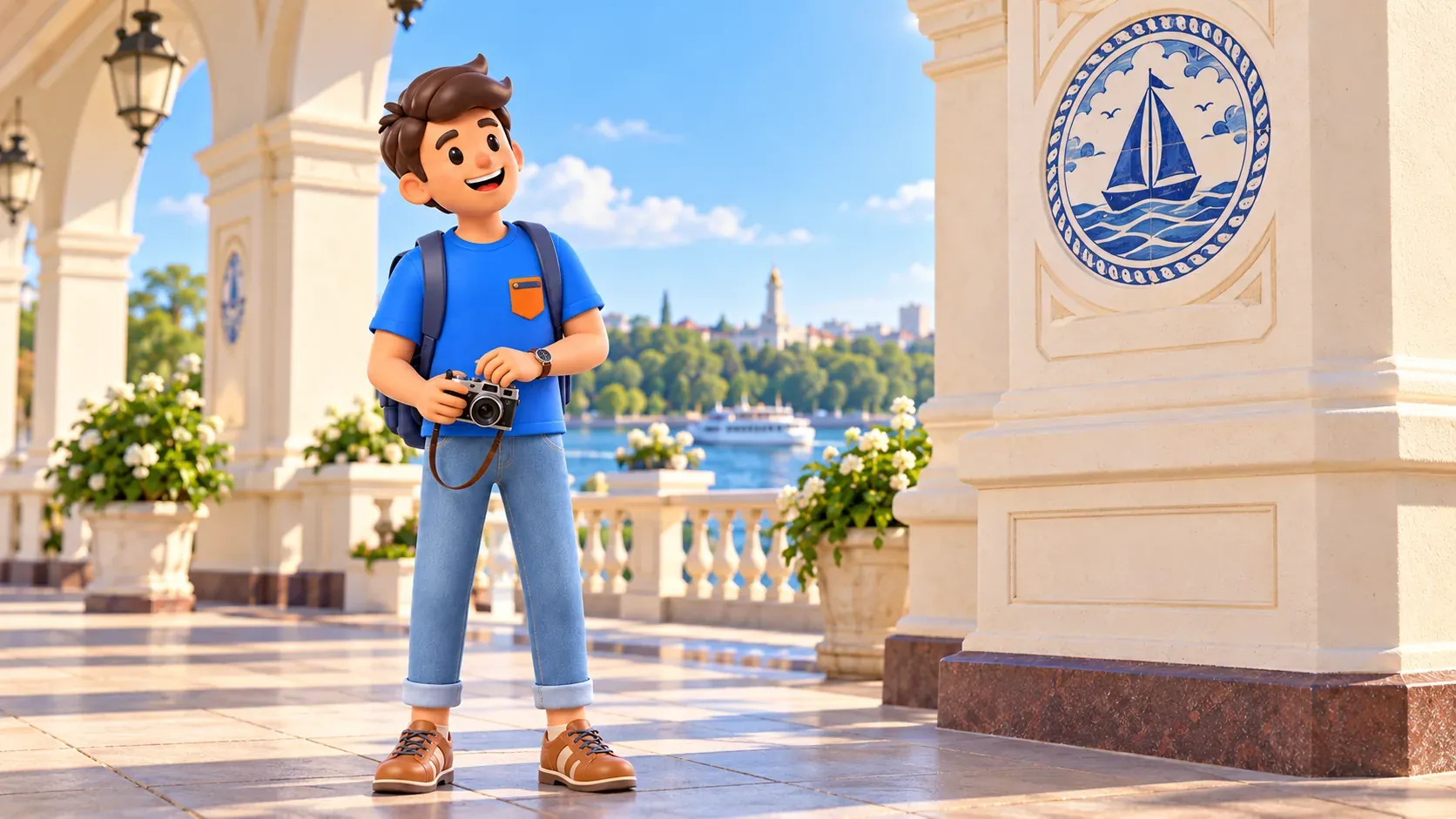
Start from a comfortable public distance. Notice how the horizontal body meets the tall centre, where arches repeat and how the structure relates to park and reservoir. Then choose one detail: a ceramic medallion, a railing pattern or the transition between gallery levels. Trying to collect every ornament immediately can make the overall idea harder to see. One close observation and one broad view often create a clearer understanding than a large number of similar pictures.
The phrase “port of five seas” concerns the history of waterways and the canal; it is not a promise of a short direct service to any sea today. Separate the image of a grand journey from current transport programmes. After restoration, the terminal reopened in 2020 with both transport and public uses. Passengers with luggage and visitors who have no intention of sailing can share the setting. Respecting both uses matters more than deciding whether it is principally a station or a leisure backdrop.
Interiors and museum: one chosen block without a roof promise
For more context, look at the Moscow Transport Museum’s current programme at the terminal. Its exhibition space is inside the building, and a tour can link architectural details with Moscow’s water-route history. Choose according to interest rather than a list of rooms in an old review. The actual content of the visit matters more than the historic building’s general name. A former photograph of an open doorway does not establish the conditions in force today.
As checked on 23 October 2026, the museum’s published information carries a notice that access to the roof is temporarily unavailable. Do not build this outing around a compulsory rooftop viewpoint. Older announcements of seasonal opening are not a guarantee of present access. If a view from above is essential, clarify the latest position with the museum first. The shore-based walk does not require that experience, and its main architectural subject remains visible from ordinary public areas.
An extra hour to an hour and a half is a useful initial block for one substantial museum visit, adjusted to the chosen programme. Include admission arrangements and time afterwards, not only movement through rooms. If it proves absorbing, shorten the outdoor circuit rather than adding a long promenade, sailing and restaurant visit to the same small window. Follow venue and photography rules, and do not treat stairs or an open door as an invitation into working areas. One expressive interior or connected story can be enough.
Park and reservoir: choose a comfortable length
After architecture, take a short open promenade section and return into the park. Khimki Reservoir’s breadth supplies the experience: light, moving air and the relationship between a broad water surface and the long building. The entire shoreline need not be covered. Choose a stretch with a clear return and an ordinary place to rest, rather than a distance that has to be completed. A smaller waterside outing still delivers a marked change from central Moscow.
Pier activity and vessel movements change by season and timetable. One day may be busy, another quieter. These are different impressions, not successful and failed versions of a compulsory show. Watch from public areas rather than entering boarding spaces or vessels without permission. Interest in a ship is not a pass to approach it for photographs. A working transport setting remains one even when visitors are mainly there for views and a stroll.
Alternate exposed water and more sheltered paths. In heat, look for shade; in a cool wind, shorten the waterfront section. Do not expect operating fountains, seasonal activities or an ideal sunset because an old photograph showed them. With children, plan water and food before tiredness appears and carry an ordinary small supply. Do not make the day depend on one cafe. Stay on open paths and off ice, and avoid improvised descents along the bank. A fine panorama does not change the purpose of the promenade.

A boat trip: check more than departure time
For a continuation on the water, select an actual service with a current carrier. Check date, pier, duration, boarding terms, relevant age arrangements and the return location. A short excursion and a multi-day cruise serve different purposes. A large moored vessel does not mean available seats on the next short sailing. Nor does the word “river” make every Moscow departure interchangeable. Verify the service that fits your day rather than the most attractive boat in a photograph.
The finishing point is particularly important. If disembarkation is elsewhere, it changes transport back, food plans and the rest of the day. Leave a boarding buffer and avoid a museum booking immediately after an estimated arrival. Time afloat belongs together with check-in, approach and waiting, rather than as an isolated appealing number. Consider comfort too: seating time, an enclosed saloon and companions’ willingness to spend time in wind or on a longer return journey all matter.
Do not assume year-round navigation from here by analogy with other central Moscow services. Season, weather and the carrier’s programme affect availability. For a cold-weather visit, check actual departures on your date. If none suits, the shore walk remains complete; there is no need to travel to a random alternative pier to fulfil a requirement to end aboard a boat. A water journey should extend your interests, not become an obligation after an already satisfying visit. Another day may offer a better setting for it.
Finish the outing and place it within your Moscow trip
Choose a short return through the park to suitable transport. There is no need to append distant embankments, another bank or several other major districts. This spacious place works particularly well as a pause between denser Moscow days. You can finish after architecture and rest, keeping the museum or sailing for another occasion with its own subject and sufficient time. An outing does not need every possible activity to be complete.
RoadMe can work out a fully personal trip plan around your interests, dates and comfortable pace. In the app, it is easier to coordinate the Northern River Terminal, other Moscow neighbourhoods, museums and rest into a journey shaped for you.
Before leaving, check what really determines the format: open approaches, the museum programme if wanted, weather and a confirmed sailing if selected. Do not script every minute beside the water. An unallocated pause matters as much as the organisational details. The day can then be shortened in wind or extended in the park without losing its purpose. Leave enough energy for the return rather than using the final open section as an automatic invitation to keep going.
On the way back, retain one image: long galleries above water, the fine spire, a ceramic detail or open space between shore and horizon. A personal impression is more valuable than a formal list of every available activity. It explains why the terminal is worth visiting without luggage or a sailing ticket: here Moscow feels like a city of broad water connections and open space. The next visit can begin with the subject that interested you most today.


