
Montjuïc gardens in half a day: Laribal to the Alcalde viewpoint
For a green half-day on Montjuïc, choose three gardens and a viewpoint: Laribal, Mossèn Cinto Verdaguer, Joan Brossa and Mirador de l’Alcalde. Start at Laribal’s upper entrance beside the Fundació Joan Miró, return to that entrance after a limited terrace visit, and head east along Avinguda de Miramar. Visit Verdaguer’s gardens through the entrance by Carrer dels Tarongers, then cross into neighbouring Joan Brossa and continue towards Plaça de la Sardana and the Alcalde viewpoint.
Allow around four hours for the connecting walks, selected garden paths, observations and a proper rest. This is a planning estimate, excluding travel to the start and the return from the hill. The castle, museums, Botanical Garden and cable cars belong to other outings. The theme here is how different green spaces occupy one hillside, rather than how many major attractions can fit into a morning.
A garden half-day that respects the slope
The route offers four successive experiences. Laribal makes terraces and small spaces the main attraction. At Verdaguer, attention shifts towards planting and water. Joan Brossa introduces a more wooded character, before Alcalde opens the view towards Barcelona and the coast. Remembering that simple sequence is more useful than treating every path as compulsory and repeatedly consulting a long list of sights.
For a more convenient way to work this into the whole trip, try RoadMe: the app develops a personal itinerary around your interests, dates, pace and budget. You can distribute gardens, substantial visits and rest across your days so that the programme stays varied without constant manual planning.
Montjuïc is a hill. Comfortable paths in some sections do not remove the ascents, descents and stairs between terraces. This version should not be treated as a continuously level or fully step-free walk. If mobility is a concern, choosing one suitable garden and checking its specific accessible entrances is more useful than relying on a general promise about the whole hillside.
Start with plenty of daylight remaining. The city listings for Laribal, Verdaguer and Brossa give ordinary daily opening from 08:00, but qualify closing by dusk; seasonal clock times should not become a promise of walking after dark. Check temporary restrictions for your date. A gated garden and an open public street are different spaces: being able to continue along the road does not mean the next park remains open.
Laribal: a garden that uses its hillside
Enter from the upper side beside the Miró foundation and choose a limited exploration of open terraces, returning to the same exit. This start keeps the onward direction clear. You do not need to descend to the lowest boundary if you do not want the climb back. The first section should introduce the garden’s design, rather than test your willingness to take every staircase.
Laribal is associated with Jean-Claude Nicolas Forestier and Nicolau Rubió i Tudurí. Completed in 1922, it belongs to Montjuïc’s landscaping history connected with preparations for the 1929 International Exhibition. Instead of one large level lawn, it offers a sequence of small places, paths, pergolas and terraces. The slope becomes part of the composition rather than merely an obstacle to be removed.
Notice how the atmosphere changes between levels. Plants sometimes close off the distance and create an intimate garden room; elsewhere, a path restores perspective. Stone, ceramics and greenery work together. Even without identifying species, you can recognise a carefully designed landscape whose mood nevertheless feels relaxed. A few chosen observations reveal more than rushing through every corner in search of the next named feature.
One familiar detail is the Font del Gat, the Cat Fountain, with its feline head. Include it in the short garden section if your chosen open path and energy allow. Do not make running water essential to the experience, and do not refill a bottle from an ornamental fountain without clear drinking-water identification. This walk is about the garden’s arrangement, which remains interesting without a water display.
Return to the upper gate before continuing east
After the selected Laribal section, return to the upper entrance and follow Avinguda de Miramar east towards Carrer dels Tarongers. This is an ordinary connection between gardens, not one continuous path inside a single park. Use marked crossings and follow signals. If you stop to check a sign or a photograph, move out of the way: the hill accommodates sightseeing alongside other everyday journeys.
The nearby Miró foundation may tempt you to add a museum immediately. Make that decision separately. A proper collection visit changes both the length and character of the day, whereas the next garden offers a different way of looking. The green half-day has enough substance of its own. Returning for art later gives it more space than squeezing a museum between two garden stops.
Mossèn Cinto Verdaguer: water, leaves and seasons
Enter near the junction of Avinguda de Miramar and Carrer dels Tarongers. Dedicated to the poet Jacint Verdaguer, the gardens opened in 1970 on former quarry land. Lawns, paths and small pools create a more open pattern than Laribal’s intimate terraces. Choose an exploration towards the small aquatic-plant basins, then return towards the Tarongers entrance to continue to Brossa.
The garden’s distinctive planting combines bulbs, rhizomatous plants and aquatic species. Keep seasonality in mind before arriving: photographs filled with colour do not guarantee the same display throughout the year. Spring and summer plantings succeed one another, while other colours, leaves and the overall composition become more prominent in autumn. Expecting a complete carpet of tulips on an arbitrary date can obscure what is appealing now.
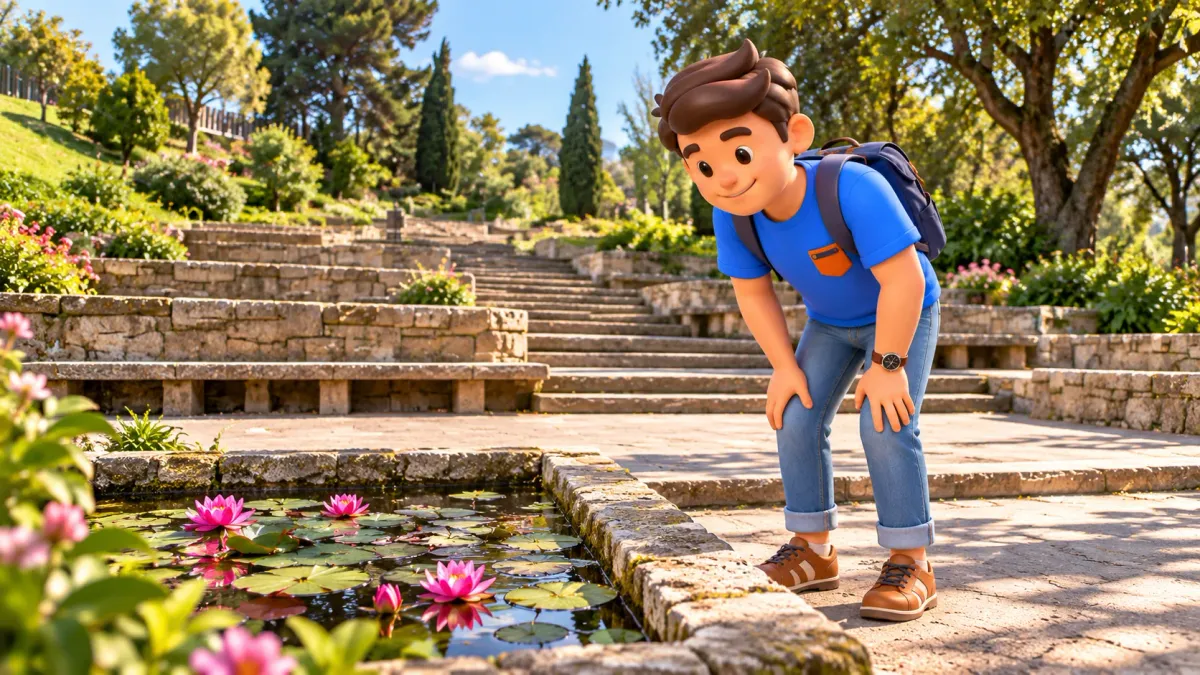
At the small basins, study the transition between environments. Notice how leaves sit above the water, how reflections alter a plant’s shape, and how the stone edge separates planting from path. There is no need to identify every species. Choose one section and observe for a while without touching plants or stepping onto the edges. A living garden rewards attention more than speed.
This can be a good place for a longer pause wherever resting is permitted. Treat water and greenery as a reason to slow down, rather than a promise of a particular sound, flower or animal encounter. Planting and water features change. If maintenance closes part of a path, shorten the garden section and return by an open route; the onward walk does not require crossing a working area.
Joan Brossa: a new landscape after the fairground
Return to Carrer dels Tarongers and cross to the neighbouring Joan Brossa gardens. To continue, choose open paths towards the exit for Carretera de Montjuïc and Plaça de la Sardana. This gradually brings you towards Mirador de l’Alcalde. Different levels shape the gardens, so follow local exit signs instead of trying to maintain a straight line across the slope.
The gardens opened in 2003 on the site of the former amusement park, which closed in 1998. They are named after poet and artist Joan Brossa. That history helps explain the mix of leisure, play and greenery: the space was not always a quiet garden, and traces of its earlier use remain. Compare its more wooded character with Laribal’s precise composition and Verdaguer’s aquatic planting.
You do not have to find every sculpture and play area. With children, allow time for a suitable open space, assess equipment locally and remain aware of changes in level. For a quieter outing, choose a few pauses beneath trees. The same garden can provide play, rest or an opportunity to consider how a city gives former leisure land a different public role.

A rest and some simple hillside preparation
A proper pause is already included in the four-hour allowance. Bring water and a small snack to enjoy where permitted, and make a full lunch a separate decision. Do not assume a café or toilet operates at every entrance. When checked on 17 October 2026, the city listings marked the toilets at Laribal and Brossa temporarily out of service, so plan facilities before beginning.
Wear shoes with reliable grip for stairs and damp stone. After rain, in strong heat or wind, shortening the garden section is easier than preserving the whole plan regardless of conditions. For a shorter version, begin at Verdaguer and finish after Brossa, or continue to the viewpoint if you feel comfortable. That is a different, reduced outing; reaching the new start and returning still require their own allowance.
If nature interests you more than museums, RoadMe can develop a personal trip plan around that preference and your pace. The app makes it easier to distribute activity and experiences across the days while preserving time for other neighbourhoods, food and rest.
Alcalde: lift your eyes from plants to the city
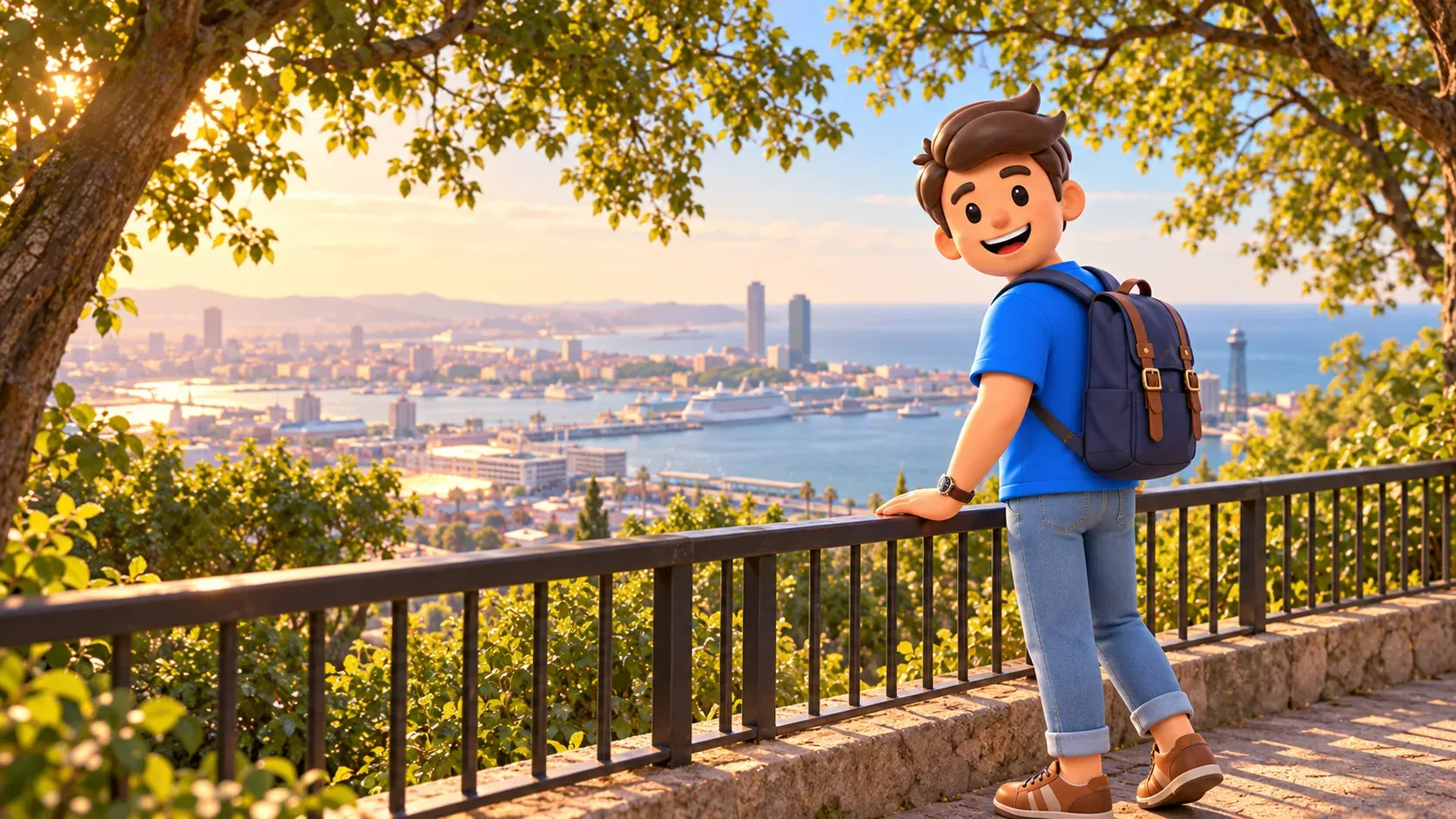
Leave towards Plaça de la Sardana, cross to Mirador de l’Alcalde and finish on an available viewing terrace. The scale changes again: after leaves, paths and small basins, the city and Mediterranean coast become the subject. Weather and visibility shape the view. You do not need an exact match with someone else’s photograph to understand why this panorama makes a natural conclusion.
The viewpoint garden opened in 1969. Look down as well as out: Joan Josep Tharrats designed its unusual paving with mixed materials, including stone, brick, glass and metal pieces. Beside the broad view, that work returns attention to a small fragment. It is an apt ending to the walk: a landscape can be read from a distance and almost within arm’s reach.
The half-day programme ends at Alcalde. Plan the connection to transport, descent or next visit separately, with some allowance for remaining energy. On another day, the Arc de Triomf to Ciutadella walk offers a more compact green outing in the city. It combines history, gardens and architecture differently, while today’s four hours retain their focus on Montjuïc’s changing character.


